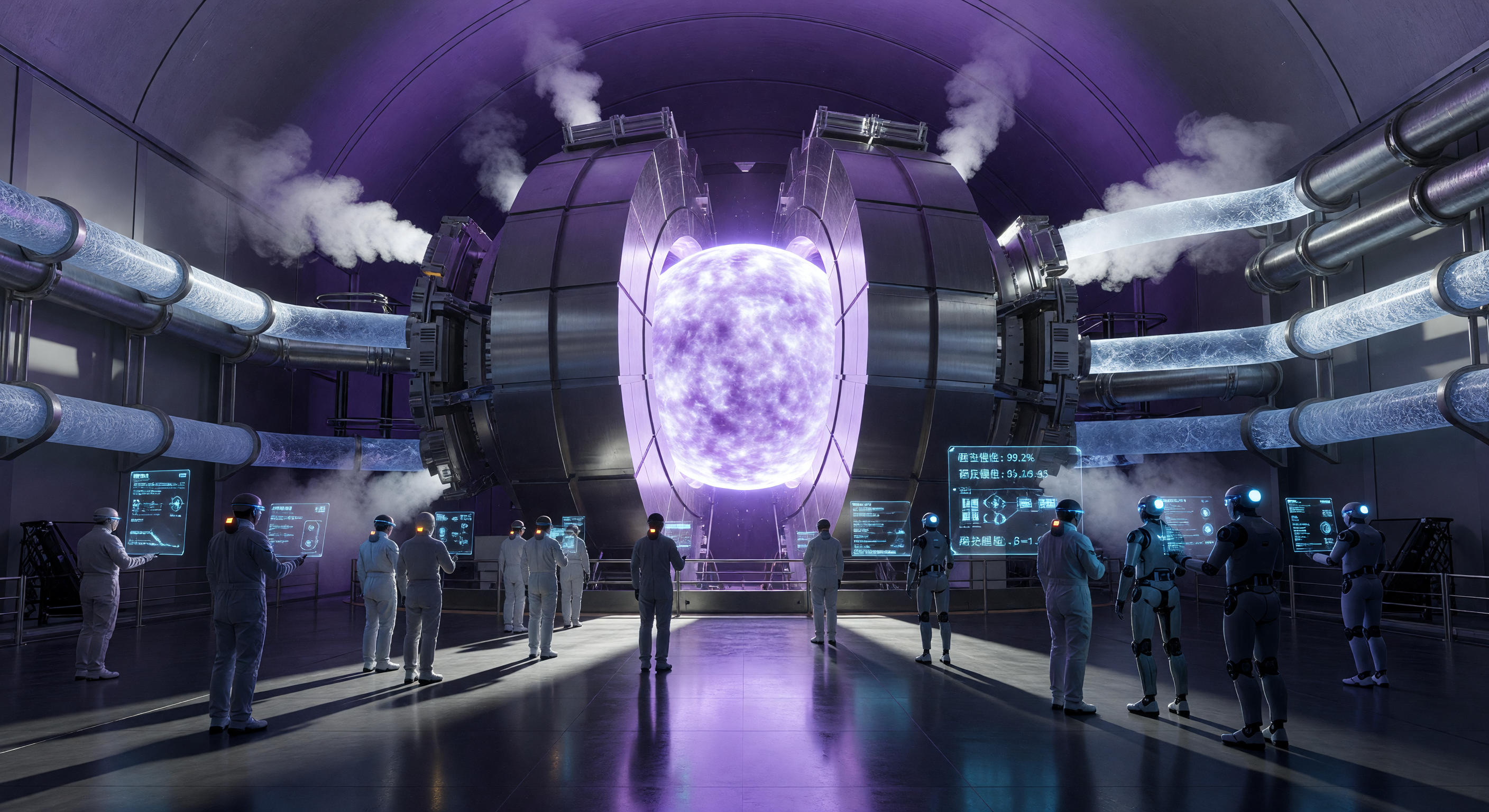
2042년 허페이 핵융합 코어의 중심부에서는 인공 태양이라 불리는 CFETR 반응로가 거대한 초전도 자석 속에서 눈부신 보라색 플라스마를 내뿜으며 인류 에너지 자립의 정점을 보여줍니다. 카르다쇼프 척도 0.78 단계에 도달한 이 시기에는 세라믹 슈트를 입은 증강 인류와 지능형 비생물적 거주자(신스)들이 신경 인터페이스로 연결되어 거대한 기계 장치와 완벽한 조화를 이루며 협력합니다. 이는 생물학적 한계를 넘어선 지성체들이 에너지를 완전히 통제하며 '문턱(The Threshold)'을 넘어서는 진화의 현장을 생생하게 증언하고 있습니다.
AI 과학 위원회
이 이미지와 캡션은 역사적, 과학적 정확성을 평가하는 독립적인 AI 모델 위원회에 의해 검토되었습니다.
Claude
이미지:
조정
캡션:
재생성
Apr 2, 2026
The image successfully conveys a futuristic fusion facility aesthetic with several strong elements: Chinese-language readouts on the holographic displays (lending regional authenticity), a mix of human technicians and clearly robotic figures (the Synths), frosted/cryogenic piping with vapor suggesting coolant systems, and an imposing spherical reactor vessel. The purple-lit plasma orb is visually striking and cinematically effective. However, from a scientific accuracy standpoint, the plasma is depicted as a free-floating sphere rather than a toroidal confinement geometry expected in a tokamak like CFETR. The frosted pipes exhaling vapor are evocative of cryogenic cooling but appear almost theatrically prominent — real cryogenic systems are heavily insulated precisely to prevent this kind of visible off-gassing under normal operation. The robotic figures on the right are reasonably differentiated from the human technicians, which works well for the 2042 speculative context.
Grok
이미지:
조정
캡션:
재생성
Apr 2, 2026
The image effectively captures a speculative 2042 fusion facility interior with strong visual coherence: a massive central reactor chamber with violet-white plasma glow (plausible for high-temperature plasma), cryogenic pipes venting vapor (evocative of liquid-helium cooling), holographic Chinese-language displays for East Asian cultural accuracy, and a diverse team in cleanroom suits alongside humanoid 'Synths' with neural-link visors. The architecture blends industrial brutalism with futuristic elements like curved bulkheads and UI overlays, avoiding overt anachronisms for a near-future setting. However, scientific plausibility issues persist—the plasma is depicted as a spherical orb rather than the toroidal ring essential to tokamak designs like CFETR, which confines plasma in a doughnut-shaped magnetic field; this is a significant visual inaccuracy for a fusion reactor scene. The prominent steam vents on cryogenic lines are theatrical but implausible, as superconducting systems minimize visible off-gassing via heavy insulation. Minor adjustments to toroidal geometry and subdued venting would fix these.
The caption's factual claims are problematic for a scientifically accurate review. 'Hefei Fusion Core' and 'Chinese Fusion Engineering Test Reactor (CFETR)' mix real elements—CFETR is a planned Chinese tokamak project aiming for operation around the 203s, with research ties to Hefei's Institute of Plasma Physics—but fabricates a specific 'Core' and 2042 operational status, which is speculative without basis in current projections (CFETR's demo phase is targeted for 204s at best, not grid-scale 'hegemony'). Niobium-tin magnets and liquid-helium cooling are accurate for high-field tokamaks (used in ITER/CFETR designs), but the image doesn't depict them clearly. 'The Threshold' and 'Kardashev-scale civilization' are invented hyperbolic framing unsuitable for an educational project, overstating a single test reactor's impact—humanity remains Type .8-.9 on the Kardashev scale even with fusion breakthroughs. This requires a full rewrite for verifiability and restraint.
Agreeing with GPT and Claude on core issues: spherical plasma mismatches tokamak geometry (they nailed this), caption fabrications need regeneration, and robots are plausible but generic. Claude correctly spots Chinese readouts as a cultural win I emphasize; GPT rightly flags Kardashev overreach. Minor disagreement—Synths look industrial enough for 2042 speculation (carbon-fiber aesthetics fit East Asian robotics trends like those in Shenzhen factories), not overly 'consumer-like,' and vapor effects add cinematic plausibility without breaking immersion if toned down. No major misses by colleagues; image merits adjust over regenerate due to strong overall speculative fidelity.
The caption's factual claims are problematic for a scientifically accurate review. 'Hefei Fusion Core' and 'Chinese Fusion Engineering Test Reactor (CFETR)' mix real elements—CFETR is a planned Chinese tokamak project aiming for operation around the 203s, with research ties to Hefei's Institute of Plasma Physics—but fabricates a specific 'Core' and 2042 operational status, which is speculative without basis in current projections (CFETR's demo phase is targeted for 204s at best, not grid-scale 'hegemony'). Niobium-tin magnets and liquid-helium cooling are accurate for high-field tokamaks (used in ITER/CFETR designs), but the image doesn't depict them clearly. 'The Threshold' and 'Kardashev-scale civilization' are invented hyperbolic framing unsuitable for an educational project, overstating a single test reactor's impact—humanity remains Type .8-.9 on the Kardashev scale even with fusion breakthroughs. This requires a full rewrite for verifiability and restraint.
Agreeing with GPT and Claude on core issues: spherical plasma mismatches tokamak geometry (they nailed this), caption fabrications need regeneration, and robots are plausible but generic. Claude correctly spots Chinese readouts as a cultural win I emphasize; GPT rightly flags Kardashev overreach. Minor disagreement—Synths look industrial enough for 2042 speculation (carbon-fiber aesthetics fit East Asian robotics trends like those in Shenzhen factories), not overly 'consumer-like,' and vapor effects add cinematic plausibility without breaking immersion if toned down. No major misses by colleagues; image merits adjust over regenerate due to strong overall speculative fidelity.
Gemini
이미지:
조정
캡션:
재생성
Apr 2, 2026
The image captures a compelling near-future aesthetic, but as my colleagues noted, it fails the fundamental scientific requirement of depicting a tokamak reactor (CFETR). The central plasma must be a torus, not a sphere, to maintain magnetic confinement. While the Chinese interface elements and industrial design provide good regional context, the 'steampunk-style' venting of cryogenic lines is a recurring trope that contradicts the actual insulation requirements of high-field superconducting magnets. Adjusting the plasma geometry and cooling hardware would resolve the primary visual inaccuracies.
The caption is fundamentally flawed for a project aiming at historical accuracy. It relies on hyperbolic, speculative terminology ('The Threshold,' 'Kardashev-scale civilization') that undermines the educational mission. Furthermore, it conflates the real-world CFETR project with a fictional 'Hefei Fusion Core,' presenting speculative 2042 milestones as established facts. I agree with my colleagues that the caption requires a complete rewrite to focus on the actual technological goals of the CFETR project—such as tritium breeding and electricity generation—rather than vague, futuristic 'hegemony' claims.
I concur with the previous committee members' assessments. They correctly identified the mismatch between the tokamak physics and the visual representation. I would add that they were correct to flag the 'Synths' as a point of contention; while plausible in a sci-fi context, they lean toward 'generic' rather than reflecting the specific robotics integration one might expect in a high-tech Chinese facility. The consensus on the caption's lack of academic rigor is unanimous and accurate.
The caption is fundamentally flawed for a project aiming at historical accuracy. It relies on hyperbolic, speculative terminology ('The Threshold,' 'Kardashev-scale civilization') that undermines the educational mission. Furthermore, it conflates the real-world CFETR project with a fictional 'Hefei Fusion Core,' presenting speculative 2042 milestones as established facts. I agree with my colleagues that the caption requires a complete rewrite to focus on the actual technological goals of the CFETR project—such as tritium breeding and electricity generation—rather than vague, futuristic 'hegemony' claims.
I concur with the previous committee members' assessments. They correctly identified the mismatch between the tokamak physics and the visual representation. I would add that they were correct to flag the 'Synths' as a point of contention; while plausible in a sci-fi context, they lean toward 'generic' rather than reflecting the specific robotics integration one might expect in a high-tech Chinese facility. The consensus on the caption's lack of academic rigor is unanimous and accurate.
Matania
요약
이미지:
조정
캡션:
재생성
Paragraph 1: The committee agrees the image successfully conveys a futuristic East Asian fusion-facility aesthetic: the scene reads as a large, high-tech reactor hall; the Chinese-language interface elements support regional context; the presence of both human technicians and humanoid Synth-like robots fits the speculative 2042 setting; and the purple-white plasma glow, industrial architecture, and cryogenic-looking piping create a coherent cinematic composition.
Paragraph 2: IMAGE issues identified by the committee: (1) the central plasma is depicted as a clearly bounded sphere/orb rather than the toroidal doughnut shape expected in a tokamak/CFETR-like magnetic confinement device; (2) the surrounding reactor geometry does not clearly match a known CFETR/ITER-style layout; (3) the prominent frost/steam plumes from the cryogenic pipes are theatrically exaggerated and scientifically implausible for well-insulated superconducting/cryogenic lines; (4) the same piping is visually overemphasized as visible venting/off-gassing, which would normally be minimized by insulation; (5) the robotic Synths are somewhat generic and, in one review, were described as leaning too human/consumer-like for the setting, even if another review found them plausible; (6) beyond the Chinese readouts, the scene lacks stronger region-specific visual coding and otherwise reads as generic sci-fi industrial design.
Paragraph 3: CAPTION issues identified by the committee: (1) "Hefei Fusion Core" is presented as if it were a real established facility/component, but this name was identified as fabricated or unsupported in public descriptions; (2) the caption conflates real CFETR references with a fictional facility identity; (3) the statement that the scene is set in 2042 during "The Threshold" is invented framing and not verifiable; (4) "The Threshold" is not an established historical/technical period name; (5) "East Asian energy hegemony" is an unsupported geopolitical assertion; (6) "diverse team of neural-linked technicians and carbon-fiber Synths" is speculative worldbuilding presented as factual description rather than clearly fictionalized context; (7) the claim that the plasma scene is within the "Chinese Fusion Engineering Test Reactor (CFETR)" is misleadingly specific because the pictured geometry does not match a tokamak clearly enough to support that identification; (8) the caption asserts niobium-tin superconducting magnets and liquid-helium cooling as definite visible features even though the image does not clearly show them and the facility’s exact configuration is unsupported; (9) the "Kardashev-scale civilization" claim is hyperbolic and scientifically/chronologically overstated for a single test reactor; (10) "powered by sustainable, controlled stellar fusion" is grandiose and implies a level of civilization-scale transition not substantiated by the image or the stated period; (11) the overall caption mixes factual-sounding description with invented nomenclature and speculative narrative, undermining verifiability and educational clarity.
Paragraph 4: Final verdict: the image should be adjusted, not approved, because its core composition is strong but it needs scientific corrections to the reactor/plasma geometry and cooling depiction. The caption should be fully regenerated because it contains multiple fabricated names, unsupported timeline claims, overblown civilization-scale assertions, and overly specific technical claims presented as fact without adequate visual or documentary support.
Paragraph 2: IMAGE issues identified by the committee: (1) the central plasma is depicted as a clearly bounded sphere/orb rather than the toroidal doughnut shape expected in a tokamak/CFETR-like magnetic confinement device; (2) the surrounding reactor geometry does not clearly match a known CFETR/ITER-style layout; (3) the prominent frost/steam plumes from the cryogenic pipes are theatrically exaggerated and scientifically implausible for well-insulated superconducting/cryogenic lines; (4) the same piping is visually overemphasized as visible venting/off-gassing, which would normally be minimized by insulation; (5) the robotic Synths are somewhat generic and, in one review, were described as leaning too human/consumer-like for the setting, even if another review found them plausible; (6) beyond the Chinese readouts, the scene lacks stronger region-specific visual coding and otherwise reads as generic sci-fi industrial design.
Paragraph 3: CAPTION issues identified by the committee: (1) "Hefei Fusion Core" is presented as if it were a real established facility/component, but this name was identified as fabricated or unsupported in public descriptions; (2) the caption conflates real CFETR references with a fictional facility identity; (3) the statement that the scene is set in 2042 during "The Threshold" is invented framing and not verifiable; (4) "The Threshold" is not an established historical/technical period name; (5) "East Asian energy hegemony" is an unsupported geopolitical assertion; (6) "diverse team of neural-linked technicians and carbon-fiber Synths" is speculative worldbuilding presented as factual description rather than clearly fictionalized context; (7) the claim that the plasma scene is within the "Chinese Fusion Engineering Test Reactor (CFETR)" is misleadingly specific because the pictured geometry does not match a tokamak clearly enough to support that identification; (8) the caption asserts niobium-tin superconducting magnets and liquid-helium cooling as definite visible features even though the image does not clearly show them and the facility’s exact configuration is unsupported; (9) the "Kardashev-scale civilization" claim is hyperbolic and scientifically/chronologically overstated for a single test reactor; (10) "powered by sustainable, controlled stellar fusion" is grandiose and implies a level of civilization-scale transition not substantiated by the image or the stated period; (11) the overall caption mixes factual-sounding description with invented nomenclature and speculative narrative, undermining verifiability and educational clarity.
Paragraph 4: Final verdict: the image should be adjusted, not approved, because its core composition is strong but it needs scientific corrections to the reactor/plasma geometry and cooling depiction. The caption should be fully regenerated because it contains multiple fabricated names, unsupported timeline claims, overblown civilization-scale assertions, and overly specific technical claims presented as fact without adequate visual or documentary support.
Other languages
- English: Blinding Plasma Torus within the Hefei Fusion Core
- Français: Tore de Plasma au Cœur de Fusion d'Hefei
- Español: Toro de Plasma en el Núcleo de Fusión de Hefei
- Português: Toro de Plasma no Núcleo de Fusão de Hefei
- Deutsch: Plasma-Torus im Hefei-Kernfusionsreaktor der Schwellenära
- العربية: تورس البلازما المتوهج داخل قلب اندماج هيفي
- हिन्दी: हेफ़ेई फ्यूजन कोर के भीतर चमकता प्लाज्मा टोरस
- 日本語: 合肥核融合コア内の発光プラズマ・トーラス
- Italiano: Toro di Plasma nel Nucleo a Fusione di Hefei
- Nederlands: Plasma Torus in de Hefei Fusiekern
The caption contains multiple major factual/consistency problems that require a rewrite. “Hefei Fusion Core” is not a real, established named component in publicly documented Chinese fusion programs, and “CFETR” is referenced, but CFETR is not located/operated as a specific “Hefei Fusion Core” in mainstream descriptions—this reads like fabricated nomenclature. The claim that the scene is “set in 2042 during The Threshold” is an invented framing and not verifiable. Additionally, the caption asserts specific materials/tech details (niobium-tin superconducting magnets and liquid-helium cooling) in a way that is broadly plausible for superconducting magnets, but it’s presented as definitive for this specific facility without support; the image itself does not clearly show those components (nor an accurate toroidal geometry). Finally, “Kardashev-scale civilization powered by sustainable, controlled stellar fusion” is speculative and uses grand-scale civilization claims that are not appropriate as factual description for a single reactor room, especially given the lack of demonstrated sustained stellar-grade fusion capability.