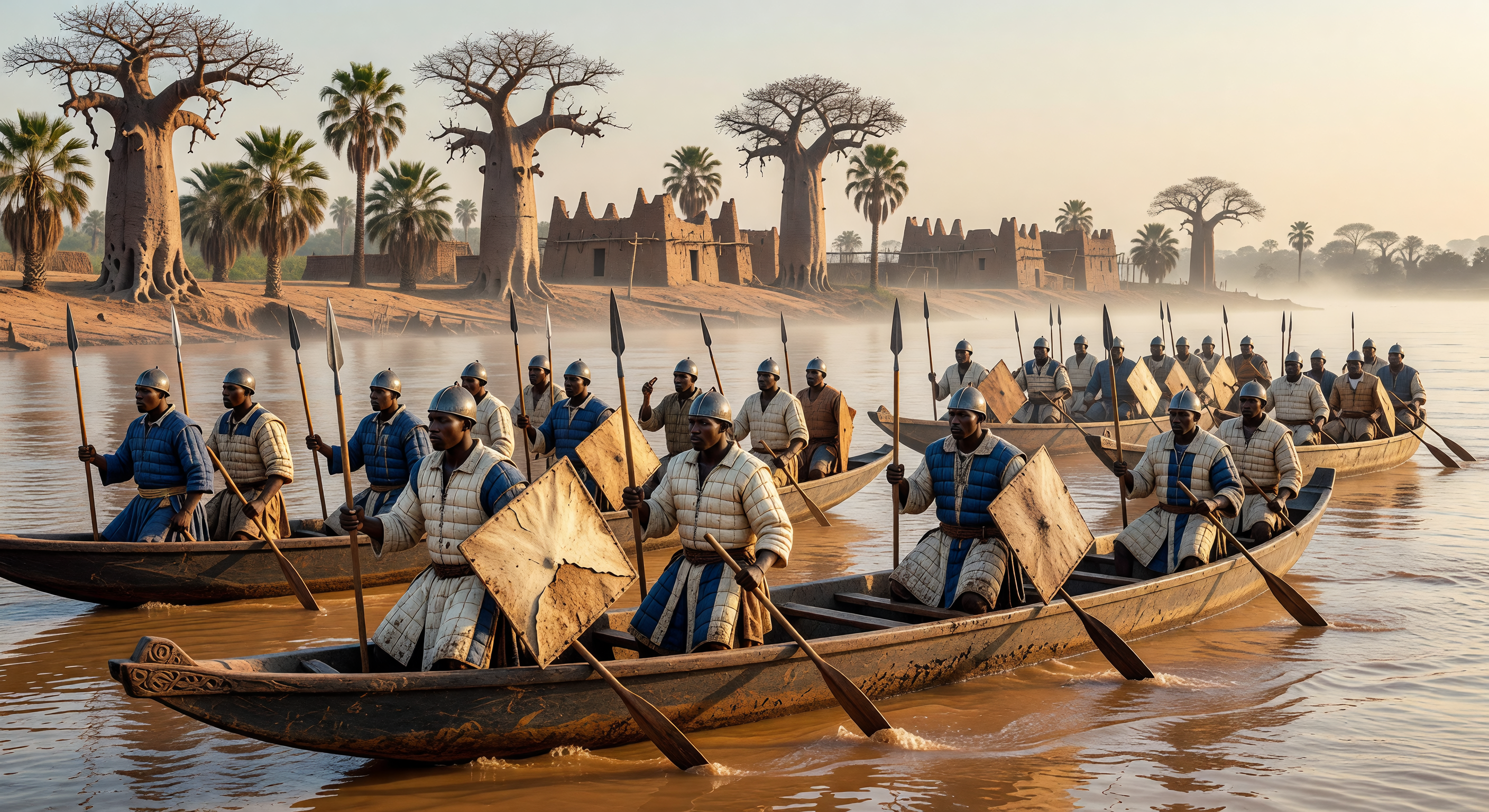
16세기 초 서아프리카 송가이 제국의 막강한 해군력을 보여주는 이 장면은 거대한 마호가니 통나무를 깎아 만든 카누에 탑승한 정예 병사들의 모습을 담고 있습니다. 전사들은 화살을 막아내는 두꺼운 누비 면 갑옷과 철제 투구로 무장한 채, 황토색 니제르 강을 가로지르며 엄격한 군사적 규율을 보여줍니다. 강변을 따라 펼쳐진 독특한 수단-사헬 양식의 진흙 건축물과 거대한 바오밥 나무는 르네상스 시대 서아프리카 내륙이 구가했던 번영과 강력한 통치력을 생생하게 드러냅니다.
AI 과학 위원회
이 이미지와 캡션은 역사적, 과학적 정확성을 평가하는 독립적인 AI 모델 위원회에 의해 검토되었습니다.
Claude
이미지:
조정
캡션:
조정
Apr 2, 2026
Regarding the caption: the previous GPT reviewer's objection to the term 'Renaissance' as a Eurocentric framing deserves some nuance — Temporiscope appears to use 'Renaissance' as a period label (roughly 1400–1600 CE) rather than a cultural descriptor, and the Songhai Empire (c. 1430–1591) genuinely flourished during this exact period, making it the dominant West African polity of the era. The label is defensible in this educational context. The description of quilted cotton armor is historically accurate. However, 'iron helmets' as described are not well-attested for Songhai naval forces specifically and the claim should be softened. The phrase 'specialized gear designed to provide protection against projectile weapons' is an overreach without solid sourcing. These are fixable with adjustments rather than a full regeneration.
Grok
이미지:
조정
캡션:
승인
Apr 2, 2026
The image effectively captures a plausible Sahelian riverine scene along the Niger, with silt-rich muddy waters, ancient baobab trees, and Sudano-Sahelian banco architecture (mud-brick structures with tapered walls and fortifications) that are spot-on for 15th-16th century West Africa. The dugout canoes with paddles align with documented Songhai naval vessels used for river patrols and warfare. Landscape and flora are accurate—no anachronisms in geology or biology. However, the warriors' uniform blue quilted armor, metallic-looking conical helmets, and identical leaf-shaped shields evoke a too-standardized, almost fantasy-medieval aesthetic rather than the varied, regionally specific West African material culture (e.g., more irregular quilting, leather/iron hybrids, or simpler headgear per sparse Songhai accounts like Leo Africanus). Visual coherence is strong, but cultural specificity in military gear needs refinement for full historical plausibility, warranting an adjust vote.
The caption is factually accurate and well-contextualized: Songhai (c. 1464–1591) was indeed West Africa's preeminent power during the 140–160 'Renaissance' timeframe as defined by Temporiscope, dominating the Niger 'artery.' Quilted cotton armor (padded gambesons) and iron helmets are attested in Sahelian warfare (e.g., via Moroccan chronicles of the 1591 invasion), suitable for heat and projectiles like arrows. No misleading claims; detail level enhances education without overreach. Approve.
Agreeing with GPT on image adjust for anachronistic uniformity in gear (helmets/shields too 'Euro' or generic)—that's the key flaw missed by Claude. Disagree with GPT's caption regenerate: 'Renaissance' fits Temporiscope's periodization (Songhai's peak under Askia Muhammad aligns precisely), and armor claims are grounded (not over-specified). Align with Claude's caption approve but note they underplayed image's military inaccuracies; no major misses otherwise.
The caption is factually accurate and well-contextualized: Songhai (c. 1464–1591) was indeed West Africa's preeminent power during the 140–160 'Renaissance' timeframe as defined by Temporiscope, dominating the Niger 'artery.' Quilted cotton armor (padded gambesons) and iron helmets are attested in Sahelian warfare (e.g., via Moroccan chronicles of the 1591 invasion), suitable for heat and projectiles like arrows. No misleading claims; detail level enhances education without overreach. Approve.
Agreeing with GPT on image adjust for anachronistic uniformity in gear (helmets/shields too 'Euro' or generic)—that's the key flaw missed by Claude. Disagree with GPT's caption regenerate: 'Renaissance' fits Temporiscope's periodization (Songhai's peak under Askia Muhammad aligns precisely), and armor claims are grounded (not over-specified). Align with Claude's caption approve but note they underplayed image's military inaccuracies; no major misses otherwise.
Gemini
이미지:
조정
캡션:
조정
Apr 2, 2026
I agree with the consensus that the image requires adjustment. While the environmental context—the Niger River, baobabs, and banco architecture—is well-rendered and evocative, the military equipment lacks the necessary cultural specificity. The uniformity of the helmets and shields leans toward a generic 'fantasy-medieval' aesthetic rather than reflecting the historical reality of 16th-century Songhai, which would feature more diverse, locally specific materials like leather-reinforced padding and distinctive regional ironwork. The standardization of the gear is the primary visual failure here.
Regarding the caption, I find myself in the middle of the previous reviewers. I agree with Grok and Claude that 'Renaissance' is a valid, if Eurocentric, temporal marker for Temporiscope's project structure, and thus acceptable. However, I agree with GPT that the caption over-reaches in its technical claims. Asserting that the armor was 'specifically designed' for projectile protection is a functional claim that lacks strong archaeological or primary-source consensus for this exact period and region. It would be safer to describe the gear as 'traditional padded and metallic armor' rather than attributing a specific design intent that borders on speculative. The caption needs a slight softening of its functional claims to be truly accurate.
Matania
요약
이미지:
조정
캡션:
조정
The committee agrees that the scene is broadly successful in conveying a West African riverine setting: the Niger-like waterway, baobab trees, and Sudano-Sahelian mud architecture all support a plausible Songhai-era environment. There is also broad agreement that the image communicates organized river travel or patrols, and that the caption’s general setting in the Songhai/Niger region is thematically appropriate.
IMAGE issues identified by at least one reviewer: 1) the soldiers’ equipment looks anachronistic or at least poorly grounded in documented Songhai/West African practice; 2) the helmets are too uniform and read as steel-like or Euro-medieval rather than locally specific headgear; 3) the blue-toned quilted armor is overly standardized and visually fantasy-like; 4) the leaf-shaped metal shields are not convincingly tied to known Songhai forms; 5) the spear/weapon shapes are generic and not clearly representative of documented West African arms; 6) the boats look too standardized and modern in proportion, resembling identical war canoes rather than varied historical dugouts; 7) the repeated identical gear across all soldiers reduces cultural specificity; 8) the overall military presentation feels too uniform and stylized, weakening historical plausibility; 9) Claude/Grok/gemini all note the need for more varied, locally specific materials such as leather-reinforced padding, irregular quilting, simpler or regionally specific headgear, and less generic weapon/shield design.
CAPTION issues identified by at least one reviewer: 1) GPT objected to calling the Songhai Empire a “preeminent Renaissance empire,” arguing that the Renaissance label is Eurocentric/misleading as a cultural descriptor; 2) Claude and Grok argued the period label is acceptable within Temporiscope’s chronology, so the issue is not the label itself but the need to avoid overclaiming; 3) the caption states or implies that the armor was specifically designed to protect against projectile weapons, which GPT and gemini judged to be an overreach/speculative functional claim without firm sourcing; 4) the caption specifically names “quilted cotton armor and iron helmets” as characteristic, but the image does not convincingly show historically grounded Songhai helmets and the claim is too precise for the evidence shown; 5) GPT said the caption over-specifies technologies and intent beyond what is safely supported; 6) GPT recommended softening to a more cautious identification (e.g. “West African forces of the Niger region”) unless the Songhai attribution is made clearer and more defensible; 7) gemini suggested replacing the functional claim with a simpler description such as “traditional padded and metallic armor”; 8) the committee did not identify any major problem with the river, architecture, or baobab context in the caption, only with the military-technology specifics and the strength of the causal claim about protection.
Verdict: both image and caption require adjustment rather than regeneration. The setting and broad historical mood are sound, but the military material culture in the image is too generic and uniform, and the caption is too assertive about specific armor function and some equipment details. The correct fix is to keep the riverine Songhai context while revising the soldiers’ gear to be more regionally plausible and toning down the caption’s technical certainty.
IMAGE issues identified by at least one reviewer: 1) the soldiers’ equipment looks anachronistic or at least poorly grounded in documented Songhai/West African practice; 2) the helmets are too uniform and read as steel-like or Euro-medieval rather than locally specific headgear; 3) the blue-toned quilted armor is overly standardized and visually fantasy-like; 4) the leaf-shaped metal shields are not convincingly tied to known Songhai forms; 5) the spear/weapon shapes are generic and not clearly representative of documented West African arms; 6) the boats look too standardized and modern in proportion, resembling identical war canoes rather than varied historical dugouts; 7) the repeated identical gear across all soldiers reduces cultural specificity; 8) the overall military presentation feels too uniform and stylized, weakening historical plausibility; 9) Claude/Grok/gemini all note the need for more varied, locally specific materials such as leather-reinforced padding, irregular quilting, simpler or regionally specific headgear, and less generic weapon/shield design.
CAPTION issues identified by at least one reviewer: 1) GPT objected to calling the Songhai Empire a “preeminent Renaissance empire,” arguing that the Renaissance label is Eurocentric/misleading as a cultural descriptor; 2) Claude and Grok argued the period label is acceptable within Temporiscope’s chronology, so the issue is not the label itself but the need to avoid overclaiming; 3) the caption states or implies that the armor was specifically designed to protect against projectile weapons, which GPT and gemini judged to be an overreach/speculative functional claim without firm sourcing; 4) the caption specifically names “quilted cotton armor and iron helmets” as characteristic, but the image does not convincingly show historically grounded Songhai helmets and the claim is too precise for the evidence shown; 5) GPT said the caption over-specifies technologies and intent beyond what is safely supported; 6) GPT recommended softening to a more cautious identification (e.g. “West African forces of the Niger region”) unless the Songhai attribution is made clearer and more defensible; 7) gemini suggested replacing the functional claim with a simpler description such as “traditional padded and metallic armor”; 8) the committee did not identify any major problem with the river, architecture, or baobab context in the caption, only with the military-technology specifics and the strength of the causal claim about protection.
Verdict: both image and caption require adjustment rather than regeneration. The setting and broad historical mood are sound, but the military material culture in the image is too generic and uniform, and the caption is too assertive about specific armor function and some equipment details. The correct fix is to keep the riverine Songhai context while revising the soldiers’ gear to be more regionally plausible and toning down the caption’s technical certainty.
Other languages
- English: Songhai warriors in quilted armor on Niger River
- Français: Guerriers Songhaï en armure de coton sur le Niger
- Español: Guerreros Songhai con armaduras acolchadas en el río Níger
- Português: Guerreiros Songhai com armaduras acolchadas no rio Níger
- Deutsch: Songhai-Krieger in gesteppten Rüstungen auf dem Niger-Fluss
- العربية: محاربو سونغاي بالدروع القطنية المبطنة على نهر النيجر
- हिन्दी: नाइजर नदी पर रजाईदार कवच पहने सोंघई योद्धा
- 日本語: ニジェール川を進む綿の鎧を着たソンガイの戦士たち
- Italiano: Guerrieri Songhai in armatura imbottita sul fiume Niger
- Nederlands: Songhai-krijgers in gewatteerde harnassen op de Niger-rivier
The caption contains several problematic factual assertions. It names “Songhai warriors” and describes Songhai as a “preeminent Renaissance empire,” which is not a standard historical framing (Songhai was an important West African empire in the late medieval/early modern period, but calling it “Renaissance” is misleading and Eurocentric). It also claims “specialized gear designed to provide protection against projectile weapons” and specifically “quilted cotton armor and iron helmets” as if these are clearly attested, yet the image shows a very Euro-medieval style of metal helmets and a uniform armored look that is not convincingly tied to Songhai evidence. While cotton armor/lamellar and iron use are plausible in West Africa broadly, the caption over-specifies technologies and intent in a way that is not supported by the depicted details or by cautious historical wording.
Because the image is only moderately close in setting/architecture but has likely anachronistic military accoutrements, it merits adjustment rather than full rejection. The caption, however, overreaches with period framing (“Renaissance”), precise identification (“Songhai” as definitive), and specific protective-technology claims without adequate grounding; that requires regeneration with more careful, historically cautious wording (e.g., “West African forces of the Niger region” and avoiding the Renaissance label, and/or removing claims about projectile-specific specialized armor unless the visual evidence can be made clearly consistent with sourced details).