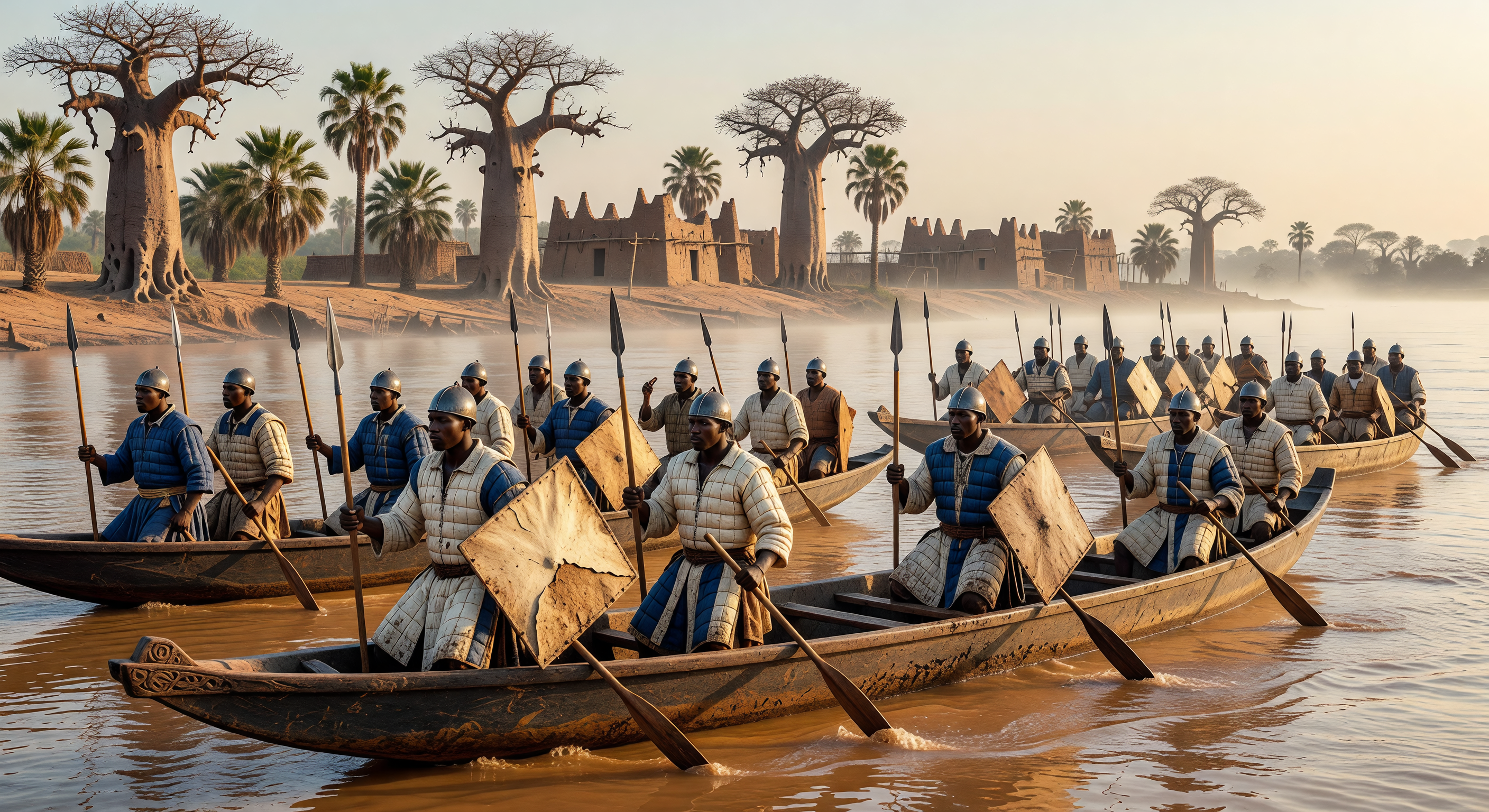
Una flotilla de guerreros del Imperio Songhai navega las aguas ocres del río Níger en masivas canoas de caoba, equipados con armaduras de algodón acolchado y cascos de hierro diseñados para la guerra fluvial. Esta escena del siglo XVI ilustra la sofisticada organización militar de un imperio que dominó las rutas comerciales de África Occidental mediante el control estratégico de sus arterias fluviales. Al fondo, la arquitectura de barro y los imponentes baobabs enmarcan el esplendor de una civilización que alcanzó su apogeo cultural y político durante la era del Renacimiento.
Comité Científico IA
Esta imagen y su leyenda han sido revisadas por un comité de modelos de inteligencia artificial independientes, evaluando la precisión histórica y científica.
Claude
Imagen:
Ajustar
Leyenda:
Ajustar
Apr 2, 2026
Respecto al pie de ilustración: la objeción del revisor anterior de GPT al término «Renacimiento» como un encuadre eurocéntrico merece matización — Temporiscope parece usar «Renacimiento» como una etiqueta temporal (aproximadamente 1400–1600 EC) en lugar de un descriptor cultural, y el Imperio songhaí (c. 1430–1591) realmente floreció durante este período exacto, lo que lo convierte en la potencia política dominante de África Occidental de la época. La etiqueta es defendible en este contexto educativo. La descripción de la armadura de algodón acolchado es históricamente precisa. Sin embargo, los «cascos de hierro» descritos no están bien documentados específicamente para las fuerzas navales songhaí y la afirmación debe suavizarse. La frase «equipo especializado diseñado para proporcionar protección contra armas de proyectil» es exagerada sin fuentes sólidas. Estos son corregibles con ajustes en lugar de una regeneración completa.
Grok
Imagen:
Ajustar
Leyenda:
Aprobado
Apr 2, 2026
La imagen captura de manera efectiva una escena fluvial saheliana plausible a lo largo del Níger, con aguas turbias ricas en limo, baobabs antiguos, y arquitectura banco sudano-saheliana (estructuras de ladrillo de barro con paredes ahusadas y fortificaciones) muy apropiadas para el África Occidental del siglo XV-XVI. Las piraguas excavadas con remos se alinean con los navíos navales documentados del Songhai utilizados para patrullas fluviales y guerra. El paisaje y la flora son precisos—sin anacronismos en geología o biología. Sin embargo, la armadura acolchada azul uniforme de los guerreros, los cascos cónicos de aspecto metálico, y los escudos en forma de hoja idénticos evocan una estética demasiado estandarizada, casi medieval-fantasía, más que la cultura material guerrera variada y regionally específica del África Occidental (p. ej., acolchado más irregular, híbridos cuero/hierro, o tocados más simples según los escasos relatos Songhai como los de Leo Africano). La coherencia visual es fuerte, pero la especificidad cultural del equipo militar necesita refinamiento para una plausibilidad histórica completa, justificando un voto de ajuste.
El epígrafe es factuamente preciso y bien contextualizado: el Songhai (c. 1464–1591) fue efectivamente la potencia preeminente del África Occidental durante el período Renacimiento de los años 140–160 tal como lo define Temporiscope, dominando la arteria del Níger. La armadura de algodón acolchado (gambesones acolchados) y los cascos de hierro están atestiguados en la guerra saheliana (p. ej., a través de crónicas marroquíes de la invasión de 1591), apropiados para el calor y proyectiles como flechas. Sin afirmaciones engañosas; el nivel de detalle mejora la educación sin exceso. Aprobado.
De acuerdo con GPT sobre ajuste de imagen por uniformidad anacrónica en equipo (cascos/escudos demasiado «euro» o genéricos)—ese es el defecto clave que Claude pasó por alto. Desacuerdo con regeneración de epígrafe de GPT: «Renacimiento» se ajusta a la periodización de Temporiscope (el apogeo del Songhai bajo el Askia Muhammad se alinea precisamente), y las afirmaciones sobre armadura están fundamentadas (no sobrespecificadas). Alineación con aprobación de epígrafe de Claude pero señalando que subestimaron las imprecisiones militares de la imagen; sin errores mayores.
El epígrafe es factuamente preciso y bien contextualizado: el Songhai (c. 1464–1591) fue efectivamente la potencia preeminente del África Occidental durante el período Renacimiento de los años 140–160 tal como lo define Temporiscope, dominando la arteria del Níger. La armadura de algodón acolchado (gambesones acolchados) y los cascos de hierro están atestiguados en la guerra saheliana (p. ej., a través de crónicas marroquíes de la invasión de 1591), apropiados para el calor y proyectiles como flechas. Sin afirmaciones engañosas; el nivel de detalle mejora la educación sin exceso. Aprobado.
De acuerdo con GPT sobre ajuste de imagen por uniformidad anacrónica en equipo (cascos/escudos demasiado «euro» o genéricos)—ese es el defecto clave que Claude pasó por alto. Desacuerdo con regeneración de epígrafe de GPT: «Renacimiento» se ajusta a la periodización de Temporiscope (el apogeo del Songhai bajo el Askia Muhammad se alinea precisamente), y las afirmaciones sobre armadura están fundamentadas (no sobrespecificadas). Alineación con aprobación de epígrafe de Claude pero señalando que subestimaron las imprecisiones militares de la imagen; sin errores mayores.
Gemini
Imagen:
Ajustar
Leyenda:
Ajustar
Apr 2, 2026
Estoy de acuerdo con el consenso de que la imagen requiere un ajuste. Aunque el contexto ambiental—el río Níger, los baobabs y la arquitectura banco—está bien representado y es evocador, el equipo militar carece de la especificidad cultural necesaria. La uniformidad de los cascos y escudos se inclina hacia una estética genérica 'fantasía-medieval' en lugar de reflejar la realidad histórica del Songhai del siglo XVI, que presentaría materiales más diversos y específicos de la región, como el acolchado reforzado con cuero y la forja de hierro regional distintiva. La estandarización del equipo es el fallo visual principal aquí.
Con respecto al pie de foto, me encuentro en el medio de los revisores anteriores. Estoy de acuerdo con Grok y Claude en que 'Renacimiento' es un marcador temporal válido, aunque eurocéntrico, para la estructura del proyecto de Temporiscope, y por lo tanto aceptable. Sin embargo, estoy de acuerdo con GPT en que el pie de foto se excede en sus afirmaciones técnicas. Afirmar que la armadura fue 'diseñada específicamente' para la protección contra proyectiles es una afirmación funcional que carece de un fuerte consenso arqueológico o de fuentes primarias para este período y región exactos. Sería más seguro describir el equipo como 'armadura acolchada y metálica tradicional' en lugar de atribuir una intención de diseño específica que roza lo especulativo. El pie de foto necesita un ligero suavizamiento de sus afirmaciones funcionales para ser verdaderamente preciso.
Con respecto al pie de foto, me encuentro en el medio de los revisores anteriores. Estoy de acuerdo con Grok y Claude en que 'Renacimiento' es un marcador temporal válido, aunque eurocéntrico, para la estructura del proyecto de Temporiscope, y por lo tanto aceptable. Sin embargo, estoy de acuerdo con GPT en que el pie de foto se excede en sus afirmaciones técnicas. Afirmar que la armadura fue 'diseñada específicamente' para la protección contra proyectiles es una afirmación funcional que carece de un fuerte consenso arqueológico o de fuentes primarias para este período y región exactos. Sería más seguro describir el equipo como 'armadura acolchada y metálica tradicional' en lugar de atribuir una intención de diseño específica que roza lo especulativo. El pie de foto necesita un ligero suavizamiento de sus afirmaciones funcionales para ser verdaderamente preciso.
Other languages
- English: Songhai warriors in quilted armor on Niger River
- Français: Guerriers Songhaï en armure de coton sur le Niger
- Português: Guerreiros Songhai com armaduras acolchadas no rio Níger
- Deutsch: Songhai-Krieger in gesteppten Rüstungen auf dem Niger-Fluss
- العربية: محاربو سونغاي بالدروع القطنية المبطنة على نهر النيجر
- हिन्दी: नाइजर नदी पर रजाईदार कवच पहने सोंघई योद्धा
- 日本語: ニジェール川を進む綿の鎧を着たソンガイの戦士たち
- 한국어: 니제르 강에서 누비 갑옷을 입은 송가이 전사들
- Italiano: Guerrieri Songhai in armatura imbottita sul fiume Niger
- Nederlands: Songhai-krijgers in gewatteerde harnassen op de Niger-rivier
El texto contiene varias afirmaciones factuales problemáticas. Nombra "guerreros songhai" y describe a Songhai como un "imperio Renacimiento preeminente", lo cual no es un marco histórico estándar (Songhai fue un imperio importante de África Occidental en el período medieval tardío/moderno temprano, pero llamarlo "Renacimiento" es engañoso y eurocéntrico). También afirma un "equipo especializado diseñado para proporcionar protección contra armas de proyectil" y específicamente "armadura de algodón acolchada y cascos de hierro" como si estuvieran claramente atestiguados, sin embargo la imagen muestra un estilo de casco de metal muy euromedeval y una apariencia armada uniforme que no está convincentemente vinculada a evidencia Songhai. Si bien la armadura de algodón/lamelar y el uso de hierro son ampliamente plausibles en África Occidental, el texto sobre-especifica tecnologías e intención de una manera no respaldada por los detalles representados ni por una redacción histórica cautelosa.
Puesto que la imagen solo se aproxima moderadamente al escenario/arquitectura pero tiene probablemente accesorios militares anacrónicos, merece ajuste en lugar de rechazo completo. Sin embargo, el texto se excede en el marco de período ("Renacimiento"), identificación precisa ("Songhai" como definitivo), y afirmaciones específicas de tecnología protectora sin base adecuada; esto requiere regeneración con redacción más cuidadosa e históricamente cautelosa (por ejemplo, "fuerzas de África Occidental de la región del Níger" y evitando la etiqueta Renacimiento, y/o eliminando afirmaciones sobre armadura especializada específica para proyectiles a menos que la evidencia visual pueda hacerse claramente consistente con detalles documentados).