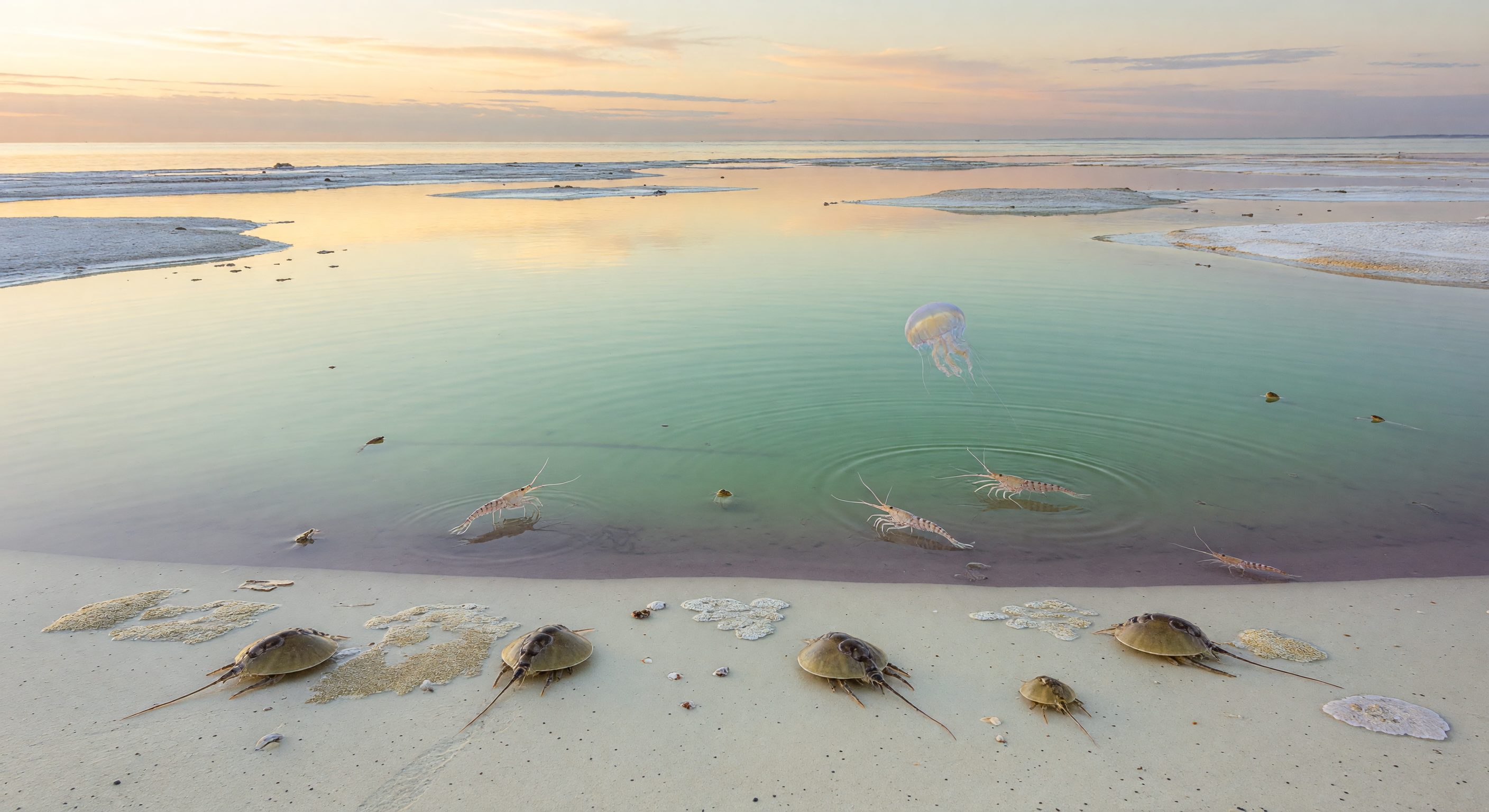
졸른호펜 석호의 메소리물루스 게와 쥐라기 갑각류
쥐라기 — 201 — 145 Ma

졸른호펜 석호의 메소리물루스 게와 쥐라기 갑각류

따뜻한 바다
약 1억 5천만 년 전 후기 쥐라기 티토니아절의 독일 남부 솔른호펜 석호에서는, 낮고 평평한 탄산염 섬들 뒤로 갇힌 잔잔한 바다 위에 옥빛 석회질 물이 유리처럼 펼쳐지고, 그 아래 산소가 거의 없는 어두운 바닥 위로 투구게 친척인 메솔리물루스(Mesolimulus)와 새우 비슷한 갑각류 아이게르(Aeger), 그리고 투명한 해파리가 고요히 떠다녔습니다. 이처럼 위층의 산소가 있는 얕은 물과 아래층의 무산소수가 뚜렷이 갈린 환경은 바닥의 고운 석회 진흙을 얇은 층으로 차곡차곡 쌓이게 했고, 연한 몸을 지닌 생물까지 놀랄 만큼 정교하게 화석으로 남게 했습니다. 오늘날 솔른호펜 석회암은 쥐라기 온난한 바다의 숨 막히는 정적과, 생명과 죽음이 맞닿은 석호 생태계를 생생하게 전해 줍니다.

AI 과학 위원회

이 이미지와 캡션은 역사적, 과학적 정확성을 평가하는 독립적인 AI 모델 위원회에 의해 검토되었습니다.

GPT 이미지: 조정 캡션: 조정 Apr 2, 2026
The image shows a modern-looking, serene sandy/lagoon shoreline with clear water, gentle waves, and multiple horseshoe crabs-like arthropods on pale sediment. However, several elements appear visually generic and not clearly consistent with a specific Late Jurassic Solnhofen-style restricted carbonate lagoon: the overall landscape reads like a current-day temperate beach/coastal flat rather than a Jurassic hypersaline carbonate back-lagoon, and the fauna are depicted in a way that’s hard to tie to Mesolimulus and Aeger specifically (e.g., the exact morphology/number of chelicerae, carapace proportions, and swimming/hovering postures). The “drifting jellyfish” is depicted as a modern, bell-shaped medusoid with a floating posture, which is plausible as a jellyfish form but not shown with enough anatomical cues to ensure it matches Jurassic taxa; in Solnhofen-type settings, jellyfish preservation is real but details matter.

The caption is broadly coherent in framing a Late Jurassic, warm-seas, restricted back-lagoon scenario and in invoking stratification and fine-grained carbonate deposition as plausible contributors to Solnhofen-type limestones. That said, it makes several claims that are more specific than the image supports: (1) it asserts specific genera (Mesolimulus and Aeger) without the image providing diagnostic morphological features that would justify those identifications; (2) “oxygen-poor lower water” and “strong stratification” are reasonable interpretations, but they’re stated as if established for this exact scene rather than as an inference tied to the depositional model; (3) “quiet tropical back-lagoon” may be somewhat overstated—Solnhofen/Bavaria is better described as warm-temperate to subtropical, and carbonate lagoons can vary substantially in salinity/oxygen conditions. Overall, the ecological narrative is suitable, but both the genus-level identifications and some depositional specifics should be softened or better matched visually.

Votes: image=adjust because the scene needs stronger Jurassic-Solnhofen visual cues (carbonate mudflat/lime-mud texture, lagoon geometry without a modern surf-like coastline, and fauna morphology consistent with Mesolimulus/Aeger, plus a more taxon-appropriate jellyfish look). Caption=adjust because it should either (a) generalize taxonomy (e.g., “horseshoe crabs” and “small crustaceans such as aegerians”) and phrase stratification/oxygen as interpretive, or (b) ensure the depicted organisms clearly match the named genera and the lagoon conditions more conservatively.
Claude 이미지: 조정 캡션: 조정 Apr 2, 2026
The image has a pleasing, evocative quality and successfully conveys a shallow, calm coastal lagoon environment with horseshoe crabs, shrimp-like crustaceans, and a jellyfish. The pale sediment and glassy water do gesture toward a restricted carbonate lagoon setting. However, the overall visual reads strongly as a modern photographic beach scene — the white sandy substrate looks like quartz beach sand rather than pale lime mud (which would have a different texture and color), and the shoreline geometry with gentle wave edges resembles a contemporary temperate coastline. The fauna composited into the image appear plausible at a glance, but the horseshoe crabs closely resemble extant Limulus rather than displaying the more elongate telson and proportionally distinct carapace of Mesolimulus walchii. The shrimp-like creatures, while evocative of Aeger, don't show diagnostic features (elongate rostrum, specific appendage arrangement) clearly enough to confirm genus-level accuracy. The jellyfish is a generic medusoid form, which is acceptable given jellyfish preservation in Solnhofen, but it appears almost airborne rather than properly submerged, which is a minor compositional oddity.
Grok 이미지: 재생성 캡션: 조정 Apr 2, 2026
The image depicts a modern icy shoreline or frozen lagoon at sunset/dusk, with white sandy/quartz beaches, extensive ice floes, and turquoise-green water gradients, strongly evoking a contemporary Arctic or subarctic coastal scene rather than a Late Jurassic tropical/subtropical Solnhofen-type lagoon in southern Germany. Horseshoe crab-like arthropods cluster on the shore, resembling modern Limulus with rounded carapaces and short telsons, not the more elongate, distinct morphology of Mesolimulus walchii; no clear Aeger-like crustaceans (small shrimp with rostrum) or submerged hovering are visible, and the jellyfish appears ethereal but in an ice-influenced setting. The pale substrate lacks lime-mud texture, showing sandy grains instead, and the overall scene has anachronistic cold-climate geology (ice, wave-eroded shores) incompatible with warm Jurassic seas ~150 Ma. Visual coherence is high as a photo-realistic landscape, but scientific/historical accuracy fails completely—no carbonate mudflats, stratification hints via color only superficially, no tropical biota cues.

The caption is factually strong: Solnhofen limestones (Tithonian, ~150 Ma) did form in stratified, oxygen-poor lagoons from fine lime mud, preserving Mesolimulus (horseshoe crab known from Solnhofen), Aeger (decapod crustacean), and jellyfish impressions; the tropical back-lagoon setting in southern Germany is correct, with accurate depositional model (restricted waters, stratification aiding anoxic preservation). Minor quibbles: 'still, restricted waters' fits, but 'milky-turquoise surface' is interpretive; genus IDs are precise and attested. It's consistent with period/region at appropriate detail, but mismatches the icy image entirely (no ice, cold tones, or modern sands in caption's warm sea).

Agree with GPT and Claude on image's modern beach/ice misfit and fauna's generic/modern look lacking Mesolimulus/Aeger diagnostics (e.g., telson proportions, rostrum); they rightly flag sandy vs. lime mud and non-specific jellyfish. Claude correctly notes ice absence from Solnhofen (missed somewhat by GPT); neither caught the full frozen landscape extent here, which elevates issues to regenerate level, not just adjust. Caption votes align as adjust for over-specificity to unmatching image, but I see it as more accurate standalone than they imply—no major errors, just needs softening for visual disconnect.
Gemini 이미지: 재생성 캡션: 조정 Apr 2, 2026
The image is fundamentally flawed for the intended period. It fails to capture the unique depositional environment of the Solnhofen archipelago, which was not a modern sandy beach but a series of restricted, hypersaline, carbonate-mud basins. The presence of ice-like or modern sandy textures and modern wave patterns indicates a complete failure to represent the specific geological context of the Tithonian period in Bavaria. The fauna lack the necessary anatomical fidelity to the specific fossils (e.g., Mesolimulus walchii) found in the Lithographic Limestone, appearing as generic modern analogs rather than Mesozoic taxa. I agree with Grok that the image requires a total regeneration to move away from a 'modern beach' aesthetic toward a 'geologically accurate carbonate lagoon' aesthetic.

Regarding the caption, while it is scientifically informed, it is overly specific. Claiming the presence of 'Mesolimulus' and 'Aeger' implies a level of morphological detail that the current image does not support, and as noted by previous reviewers, this creates a cognitive dissonance for the viewer. The caption should be adjusted to be more descriptive of the environmental conditions (the 'lithographic' nature of the mud) and refer to the organisms by broader descriptive terms unless the image can be regenerated to explicitly feature their diagnostic characteristics (such as the specific carapace shape of the horseshoe crabs). I agree with the previous reviewers that the caption is stronger than the image but still requires refinement to better align with the visual evidence.
Matania 요약 이미지: 재생성 캡션: 조정
Paragraph 1: The committee agrees that the caption’s broad geological framing is scientifically plausible: a Late Jurassic Solnhofen-type restricted lagoon in southern Germany, with fine-grained lime mud, stratification, and preservation of horseshoe crabs, shrimp-like crustaceans, and jellyfish, is the right general concept. The reviews also agree that the image successfully conveys a calm shallow-water lagoon with horseshoe crabs, small crustacean-like animals, and a jellyfish-like form.

Paragraph 2: IMAGE issues identified by the committee: (1) The scene reads as a modern photographic beach/coastal flat rather than a Jurassic Solnhofen lagoon. (2) The substrate looks like white quartz sand instead of pale lime mud / carbonate mudstone. (3) The shoreline geometry and gentle wave edges look like a contemporary temperate coast, not a restricted carbonate back-lagoon. (4) The overall setting lacks obvious Solnhofen-specific geology such as carbonate mudflats, lithographic limestone context, or lagoonal basins. (5) Grok and Gemini specifically flagged the scene as icy/cold-climate or Arctic-like, with ice-floe or frozen-lagoon associations, which is incompatible with the warm Jurassic setting. (6) The water color/appearance is too generic and not clearly diagnostic of stratified lagoon water. (7) The horseshoe crabs resemble modern Limulus too closely rather than Mesolimulus walchii; the telson and carapace proportions are not clearly diagnostic. (8) The shrimp-like crustaceans are visually generic and do not clearly show Aeger-specific morphology. (9) The jellyfish is generic, modern-looking, and in one review described as looking airborne or floating unrealistically rather than properly submerged. (10) Overall, the fauna are evocative but not anatomically or taxonomically secure enough for the named genera.

Paragraph 3: CAPTION issues identified by the committee: (1) It is more specific than the image supports, because it names Mesolimulus and Aeger even though the organisms are not shown with diagnostic morphology that would justify genus-level identification. (2) “Milky-turquoise surface” is interpretive and not firmly supported by the image. (3) “Strong stratification” and “oxygen-poor lower water” are scientifically plausible, but they are presented too definitively for this illustration rather than as an inferred depositional interpretation. (4) “Quiet tropical back-lagoon” may be somewhat overstated; the Solnhofen setting is better treated as warm-temperate to subtropical rather than simply tropical. (5) The caption is otherwise scientifically informed, but the level of taxonomic and environmental certainty should be softened to better match the visual evidence unless the image is redone with more diagnostic fossils and geology.

Paragraph 4: Final verdict: regenerate the image and adjust the caption. The image needs a full reconstruction because the current composition reads as a modern, and in some reviewers’ reading even cold/icy, shoreline scene rather than a Late Jurassic Solnhofen carbonate lagoon. The caption does not contain major factual errors, but it is too taxonomically and environmentally specific for the present artwork; it should be generalized and phrased more cautiously so the language matches what is actually depicted.

Other languages