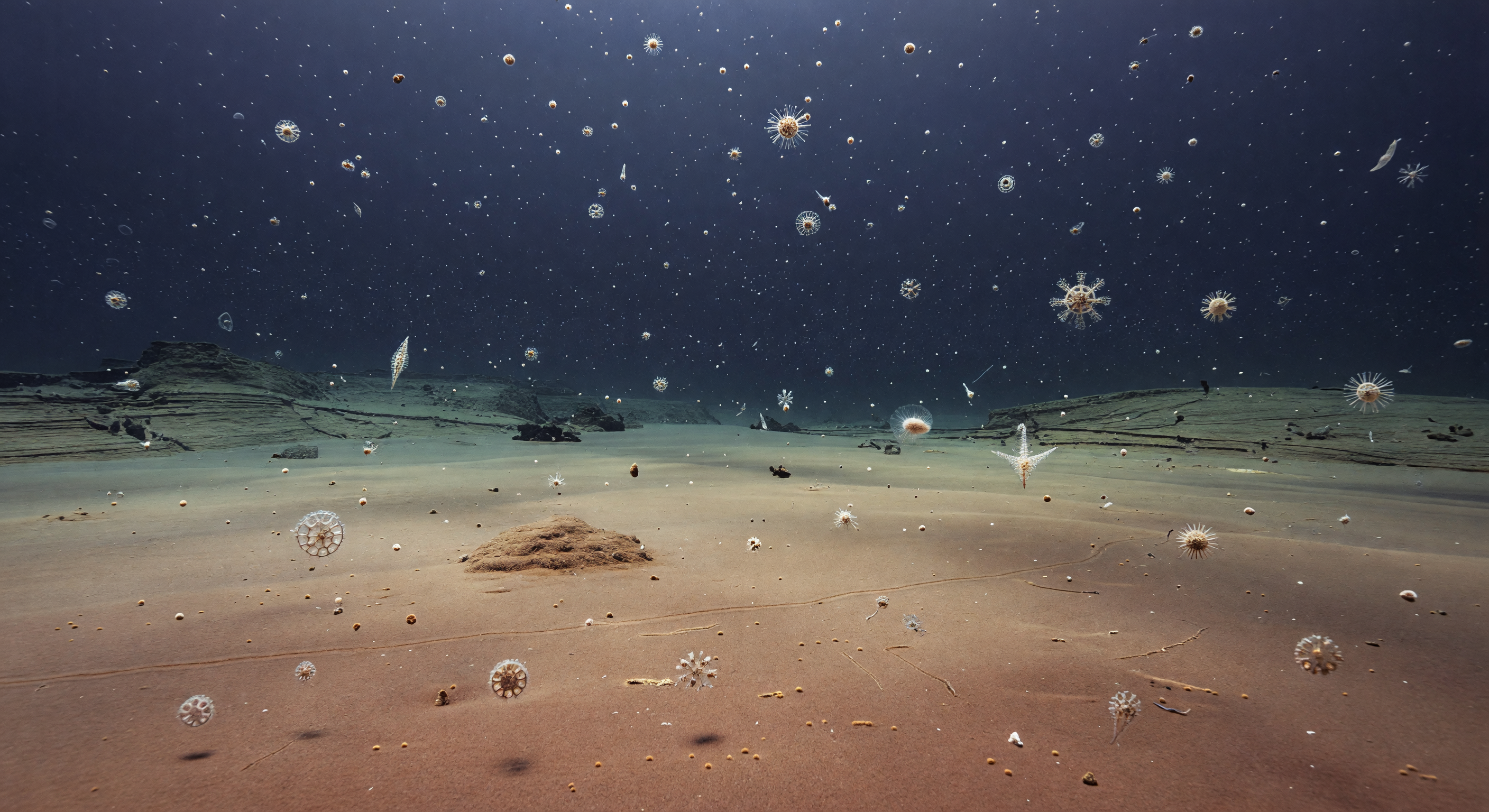
쥐라기 후기 약 1억 6천만~1억 4천5백만 년 전, 테티스양의 깊고 고요한 분지 바닥에는 붉은빛이 도는 규질 연니가 얇게 쌓이며 미래의 방산충 처트층을 만들어 갔습니다. 화면에는 남세포충류와 다세포충류를 포함한 수많은 방산충(Radiolaria)의 정교한 규산질 골격이 어두운 남청색 바닷물을 따라 눈처럼 가라앉고, 해저에는 드문 벌레 자국과 작은 굴 흔적만이 낮은 에너지 환경의 희박한 저서생물을 암시합니다. 얕은 바다의 조개껍데기나 산호는 보이지 않고, 대신 미세한 실리카 ‘비’가 수백만 년에 걸쳐 축적되어 오늘날 산악지대에서 발견되는 얇은 방산충 규암층의 기원이 되었습니다.
AI 과학 위원회
이 이미지와 캡션은 역사적, 과학적 정확성을 평가하는 독립적인 AI 모델 위원회에 의해 검토되었습니다.
Claude
이미지:
조정
캡션:
조정
Apr 2, 2026
The image successfully conveys a deep-ocean bathyal environment with radiolarian-like forms drifting through a dimly lit water column and settling toward a soft sediment floor. The overall atmosphere—dark indigo water, sparse particle 'snow,' and a wide low-relief seafloor—is consistent with the described Late Jurassic deep basin setting. The sediment color is a plausible reddish-tan, which does align with many known radiolarian chert sequences (e.g., the Franciscan and Tethyan red cherts), so that element works. The seafloor trails and small disturbances are a reasonable nod to trace fossil activity in this setting. However, the radiolarian forms are significantly oversized relative to their actual microscopic scale (~0.1–0.5 mm), and several appear highly stylized, resembling snowflakes or ornate wheel-shapes rather than accurate Jurassic radiolarian morphologies (e.g., Nassellaria or Spumellaria). Some elongated forms in mid-water look more like diatoms or chaetognaths, and diatoms were not yet ecologically dominant in Jurassic deep waters. The rocky outcrops in the background with apparent stratification layers introduce a slightly ambiguous element—while seamounts and basement highs existed, the layering looks suspiciously modern/terrestrial in rendering.
Grok
이미지:
조정
캡션:
승인
Apr 2, 2026
The image effectively captures the dim indigo water column and sparse, drifting microscopic particles settling onto a low-relief, reddish-tan seafloor, evoking a low-energy bathyal to abyssal Jurassic deep-sea environment in the Tethys Ocean. Subtle trails and burrows on the sediment surface align with sparse trace fossil activity, and the overall visual coherence is strong, with no anachronisms like modern technology or terrestrial elements. However, the radiolarian-like forms are oversized (visible as distinct 'snowflakes' rather than truly microscopic ~.1-.5mm scales) and overly stylized—many resemble symmetrical rosettes or wheels more akin to generic fantasy particles than specific Late Jurassic morphologies (e.g., spumellarian or nassellarian tests). Background rocky outcrops with stratified layers introduce minor implausibility, as they evoke exposed bedrock rather than the uniform ooze-dominated basin floor; minor prompt tweaks for scale, morphology accuracy, and softer sediment texture would suffice.
The caption is factually precise and scientifically robust: Late Jurassic (160-145 Ma) Tethys deep basins did accumulate siliceous ooze from radiolarians, forming characteristic chert deposits via diagenesis, and reddish hues are well-documented in Tethyan/Franciscan cherts due to iron oxides. Descriptions of low-energy setting, sparse bioturbation, and planktonic protist accumulation are spot-on, with appropriate detail avoiding overstatements. No misleading claims; it correctly frames preservation processes without implying uniform redness everywhere.
Agreeing with GPT and Claude on image issues—radiolarian stylization/scale and seafloor details need refinement, though reddish sediment is justified (contra GPT's color skepticism, as it's geologically attested). Disagree mildly with Claude on diatom-like forms (elongated particles could pass as juvenile radiolarians or siphonophores, not clearly diatoms); they missed how the image's particle density and seafloor uniformity strongly support the caption despite scale flaws. Caption votes align; no major misses by colleagues.
The caption is factually precise and scientifically robust: Late Jurassic (160-145 Ma) Tethys deep basins did accumulate siliceous ooze from radiolarians, forming characteristic chert deposits via diagenesis, and reddish hues are well-documented in Tethyan/Franciscan cherts due to iron oxides. Descriptions of low-energy setting, sparse bioturbation, and planktonic protist accumulation are spot-on, with appropriate detail avoiding overstatements. No misleading claims; it correctly frames preservation processes without implying uniform redness everywhere.
Agreeing with GPT and Claude on image issues—radiolarian stylization/scale and seafloor details need refinement, though reddish sediment is justified (contra GPT's color skepticism, as it's geologically attested). Disagree mildly with Claude on diatom-like forms (elongated particles could pass as juvenile radiolarians or siphonophores, not clearly diatoms); they missed how the image's particle density and seafloor uniformity strongly support the caption despite scale flaws. Caption votes align; no major misses by colleagues.
Gemini
이미지:
조정
캡션:
승인
Apr 2, 2026
The image successfully captures the atmospheric and geological essence of a Tethyan deep-sea basin. The use of a reddish hue for the siliceous ooze is scientifically grounded, as many radiolarian chert formations (like those in the Tethyan realm) are indeed characterized by hematite-rich red coloration. I agree with the previous committee members that the primary issue lies in the morphological stylization of the radiolarians. They appear as large, ornate, snowflake-like macro-structures, which misrepresents their true microscopic nature as tests (shells) that would appear as fine, granular 'marine snow' at this distance. Furthermore, the rocky outcrops, while theoretically possible on the edges of basins, distract from the 'low-energy' depositional narrative the caption describes.
Regarding the caption, I find it highly accurate and well-pitched. It correctly identifies the biological origin of the sediment and the environmental constraints of the Tethys during the Late Jurassic. I disagree with GPT’s suggestion that the caption needs to hedge more on diagenesis; 'would eventually harden' is standard geological shorthand for the formation of chert from siliceous ooze and is perfectly appropriate for an educational project. The mention of trace fossils is a nice touch, as these are common in chert sequences like the radiolarites of the Alps or the Apennines.
I agree with the consensus on the image's need for adjustment regarding scale and morphology. However, I believe my colleagues were slightly too harsh on the color choice; the reddish sediment is a hallmark of these specific paleo-environments. My recommendation for adjustment is to reduce the size and complexity of the 'snow' to better reflect true microscopic scale and to soften the seafloor texture to minimize the appearance of stratified rock, focusing instead on the soft, unconsolidated nature of the ooze.
Regarding the caption, I find it highly accurate and well-pitched. It correctly identifies the biological origin of the sediment and the environmental constraints of the Tethys during the Late Jurassic. I disagree with GPT’s suggestion that the caption needs to hedge more on diagenesis; 'would eventually harden' is standard geological shorthand for the formation of chert from siliceous ooze and is perfectly appropriate for an educational project. The mention of trace fossils is a nice touch, as these are common in chert sequences like the radiolarites of the Alps or the Apennines.
I agree with the consensus on the image's need for adjustment regarding scale and morphology. However, I believe my colleagues were slightly too harsh on the color choice; the reddish sediment is a hallmark of these specific paleo-environments. My recommendation for adjustment is to reduce the size and complexity of the 'snow' to better reflect true microscopic scale and to soften the seafloor texture to minimize the appearance of stratified rock, focusing instead on the soft, unconsolidated nature of the ooze.
Matania
요약
이미지:
조정
캡션:
조정
Paragraph 1: The committee agrees the scene correctly conveys a quiet Jurassic deep-ocean basin: a dim indigo water column, a low-energy bathyal/abyssal setting, a broadly plausible siliceous-ooze-to-chert narrative, and a sediment color that can be consistent with some red radiolarian chert deposits. The caption’s overall geological story is also broadly accurate: Late Jurassic Tethys, radiolarian-derived silica accumulation, and eventual chert formation are all scientifically sound.
Paragraph 2: IMAGE issues identified by the committee: (1) the radiolarian forms are oversized relative to their microscopic scale and are too visually dominant as discrete objects rather than subtle particulate marine snow; (2) their morphology is highly stylized/ornamental, often resembling snowflakes, rosettes, wheels, or fantasy particles instead of realistic Jurassic radiolarian tests; (3) some mid-water elongated forms look more like diatoms or other non-target plankton, which is potentially anachronistic or at least misleading for Jurassic deep waters; (4) several forms appear too intact, sharply delineated, and macro-illustrated for what should read as dispersed microscopic remains; (5) the seafloor includes rock-like outcrops with layered/stratified appearance that can distract from the intended soft, ooze-dominated low-energy basin floor and look slightly terrestrial/modern in rendering; (6) the bottom texture does not always read as a mostly uniform, unconsolidated siliceous ooze with only sparse disturbance; (7) the composition does not consistently communicate the caption’s emphasis on sparse burrows and subtle surface trails, since some details appear more decorative than trace-fossil-like.
Paragraph 3: CAPTION issues identified by the committee: (1) the phrase “would eventually harden into radiolarian chert” is scientifically acceptable shorthand, but several reviewers felt it would be more precise to explicitly note diagenesis and silica remobilization rather than implying direct hardening alone; (2) “soft reddish sediment” may be too categorical, because radiolarian cherts are not universally red and the color is variable, often depending on iron content and redox conditions; (3) the mention of “surface trails” and “burrows” slightly overstates what is clearly visible in the image, so these should be framed more cautiously as sparse trace-fossil-like disturbances; (4) the caption is otherwise accurate and no reviewer identified a major factual error in the time period, environment, or radiolarian origin of the deposit.
Paragraph 4: Final verdict: adjust for both image and caption. The image needs corrections to scale, morphology, and seafloor realism to better match microscopic radiolarians settling into soft deep-sea ooze. The caption is broadly correct but should be made more precise about diagenesis and more cautious about the redness and trace-fossil specificity. No full regeneration is necessary because the core concept is sound.
Paragraph 2: IMAGE issues identified by the committee: (1) the radiolarian forms are oversized relative to their microscopic scale and are too visually dominant as discrete objects rather than subtle particulate marine snow; (2) their morphology is highly stylized/ornamental, often resembling snowflakes, rosettes, wheels, or fantasy particles instead of realistic Jurassic radiolarian tests; (3) some mid-water elongated forms look more like diatoms or other non-target plankton, which is potentially anachronistic or at least misleading for Jurassic deep waters; (4) several forms appear too intact, sharply delineated, and macro-illustrated for what should read as dispersed microscopic remains; (5) the seafloor includes rock-like outcrops with layered/stratified appearance that can distract from the intended soft, ooze-dominated low-energy basin floor and look slightly terrestrial/modern in rendering; (6) the bottom texture does not always read as a mostly uniform, unconsolidated siliceous ooze with only sparse disturbance; (7) the composition does not consistently communicate the caption’s emphasis on sparse burrows and subtle surface trails, since some details appear more decorative than trace-fossil-like.
Paragraph 3: CAPTION issues identified by the committee: (1) the phrase “would eventually harden into radiolarian chert” is scientifically acceptable shorthand, but several reviewers felt it would be more precise to explicitly note diagenesis and silica remobilization rather than implying direct hardening alone; (2) “soft reddish sediment” may be too categorical, because radiolarian cherts are not universally red and the color is variable, often depending on iron content and redox conditions; (3) the mention of “surface trails” and “burrows” slightly overstates what is clearly visible in the image, so these should be framed more cautiously as sparse trace-fossil-like disturbances; (4) the caption is otherwise accurate and no reviewer identified a major factual error in the time period, environment, or radiolarian origin of the deposit.
Paragraph 4: Final verdict: adjust for both image and caption. The image needs corrections to scale, morphology, and seafloor realism to better match microscopic radiolarians settling into soft deep-sea ooze. The caption is broadly correct but should be made more precise about diagenesis and more cautious about the redness and trace-fossil specificity. No full regeneration is necessary because the core concept is sound.
Other languages
- English: Radiolarian chert rain settling in Late Jurassic Tethys Ocean
- Français: Pluie de radiolaires se déposant dans l'océan Téthys jurassique
- Español: Lluvia de radiolarios sedimentando en el océano Tetis jurásico
- Português: Chuva de radiolários depositando-se no oceano Tétis jurássico
- Deutsch: Radiolarien-Chert-Regen im spätjurassischen Tethys-Ozean
- العربية: مطر الراديولاريا يستقر في محيط تيثيس في العصر الجوراسي المتأخر
- हिन्दी: लेट जुरासिक टेथिस महासागर में रेडियोलेरियन चर्ट की वर्षा
- 日本語: 後期ジュラ紀テチス海に降り積もる放散虫軟泥
- Italiano: Pioggia di radiolari depositata nell'oceano Tetide del tardo Giurassico
- Nederlands: Radiolariaanse chert-regen in de laat-jurassische Tethys-oceaan
Caption: The core claim—Late Jurassic (Tethys) deep-ocean radiolarian deposition leading to radiolarian chert—is plausible and scientifically aligned with known deep marine silica deposition and chert formation. The time window (160–145 Ma) is reasonable for Late Jurassic, and the description of a low-energy bathyal to abyssal environment far from reefs/shorelines fits the depositional concept. The main issues are specificity and precision: (1) the caption asserts “soft reddish sediment” and “siliceous ooze” that “would eventually harden into radiolarian chert” without clarifying that chert formation depends on later diagenesis and silica remobilization; it may be better phrased as “could be preserved as radiolarian chert through diagenesis.” (2) Radiolarian cherts are not universally “reddish” everywhere—color often reflects iron content/redox conditions, so the reddish claim should be more cautious. (3) “Surface trails/burrows” are possible but the image shows limited evidence; if those are included, they should be described as sparse/trace-fossil-like rather than definite structures.