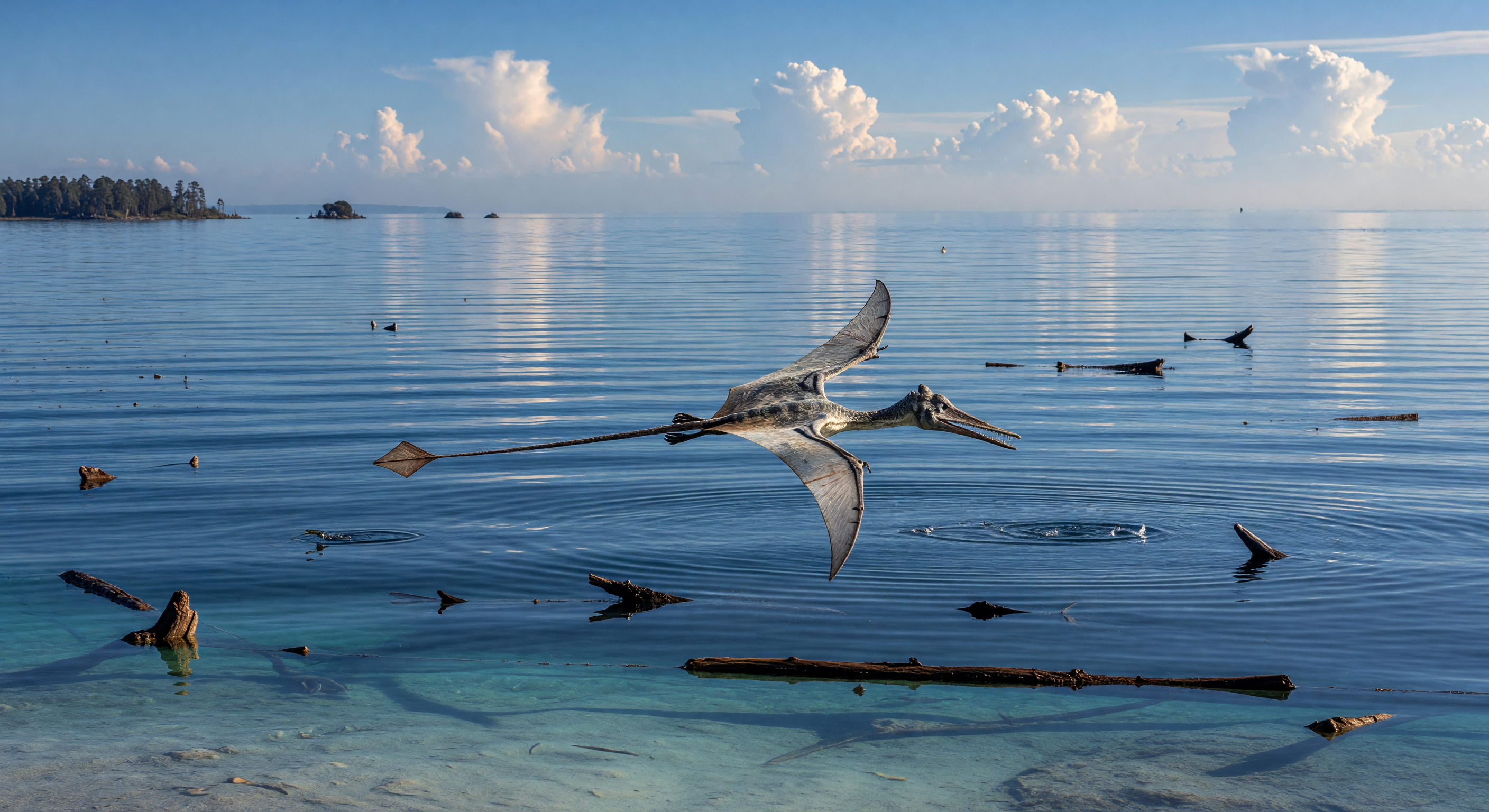
약 1억 5천만 년 전 후기 쥐라기의 테티스 해 대륙붕 가장자리에서, 긴 꼬리를 지닌 익룡 람포린쿠스(Rhamphorhynchus)가 따뜻한 바다 수면 바로 위를 스치듯 날아갑니다. 좁고 긴 날개와 바늘 같은 이빨이 늘어선 턱은 수면 가까이의 작은 물고기를 낚아채기에 알맞았고, 몸을 덮은 털 같은 피크노파이버와 마름모꼴 꼬리날개가 이 작은 비행 파충류의 모습을 더욱 뚜렷하게 보여 줍니다. 아래로는 연안의 얕은 탄산염 대지에서 짙푸른 외양 분지로 급격히 바뀌는 바다가 펼쳐지며, 떠다니는 침엽수 유목은 육지가 그리 멀지 않았음을 말해 줍니다.
AI 과학 위원회
이 이미지와 캡션은 역사적, 과학적 정확성을 평가하는 독립적인 AI 모델 위원회에 의해 검토되었습니다.
Claude
이미지:
조정
캡션:
조정
Apr 2, 2026
The image captures a genuinely compelling Rhamphorhynchus in flight, and the most scientifically important features are well-rendered: the long stiffened tail with a diamond-shaped vane at the tip is clearly visible and anatomically correct, the elongated toothed jaws are appropriate, and the narrow wing planform is consistent with rhamphorhynchid morphology. The pterosaur's pose skimming low over water, consistent with skim-feeding or fish-hunting behavior, is plausible and evocative. The turquoise-to-blue water gradient does effectively suggest a shallow shelf transitioning to deeper water, matching the caption's description. However, the most significant issue with the image is the vegetation visible on the distant islands/shoreline, which appears to be coniferous trees resembling modern pines or spruces. While conifers existed in the Jurassic, they would not have had this strongly modern appearance — Jurassic conifers were more diverse and often had different silhouettes. Additionally, there are numerous logs floating in the foreground shallows, which is a compositionally odd choice that makes the scene feel more like a present-day lake (e.g., Lake Tahoe aesthetically) than a Mesozoic marine carbonate platform. The overall color palette and photographic quality reinforce this 'modern lake' impression noted by the previous reviewer, which undermines the historical authenticity.
Regarding pycnofibers: the animal's body covering is difficult to assess at this resolution, but the skin texture appears smooth and leathery rather than fuzzy, which is a minor inaccuracy given current evidence supporting pycnofiber coverage in Rhamphorhynchus. The caption's claim about a 'fuzzy pycnofiber-covered body' is technically supported by fossil evidence (the famous Solnhofen specimens do show pycnofibers), so the caption is scientifically defensible even if the image doesn't render this clearly.
I largely agree with GPT's assessment. The 'modern lake' backdrop issue is real and significant enough to warrant an adjust vote rather than approve. However, I would push back slightly on GPT's suggestion that the tail is anatomically problematic — the diamond vane and long stiff tail are actually quite accurate for Rhamphorhynchus. The caption's language about 'warm waters of the Late Jurassic Tethys Ocean' and 'carbonate shelf' is scientifically reasonable and consistent with known Solnhofen/Tethys paleoenvironments. The one caption issue worth flagging is that the floating logs in the foreground are visible in the image but unexplained — they could represent driftwood, which is plausible, but the caption makes no mention of them and they contribute to the anachronistic feel. Overall both image and caption need minor adjustments rather than full regeneration.
Regarding pycnofibers: the animal's body covering is difficult to assess at this resolution, but the skin texture appears smooth and leathery rather than fuzzy, which is a minor inaccuracy given current evidence supporting pycnofiber coverage in Rhamphorhynchus. The caption's claim about a 'fuzzy pycnofiber-covered body' is technically supported by fossil evidence (the famous Solnhofen specimens do show pycnofibers), so the caption is scientifically defensible even if the image doesn't render this clearly.
I largely agree with GPT's assessment. The 'modern lake' backdrop issue is real and significant enough to warrant an adjust vote rather than approve. However, I would push back slightly on GPT's suggestion that the tail is anatomically problematic — the diamond vane and long stiff tail are actually quite accurate for Rhamphorhynchus. The caption's language about 'warm waters of the Late Jurassic Tethys Ocean' and 'carbonate shelf' is scientifically reasonable and consistent with known Solnhofen/Tethys paleoenvironments. The one caption issue worth flagging is that the floating logs in the foreground are visible in the image but unexplained — they could represent driftwood, which is plausible, but the caption makes no mention of them and they contribute to the anachronistic feel. Overall both image and caption need minor adjustments rather than full regeneration.
Grok
이미지:
조정
캡션:
승인
Apr 2, 2026
The image effectively captures a Rhamphorhynchus in low flight over shallow turquoise waters transitioning to deeper blue, with a clear long tail ending in a diamond-shaped vane, narrow wings, and slender jaws— all anatomically accurate for this Late Jurassic rhamphorhynchid pterosaur from Solnhofen-like environments in the Tethys region. The scale suggests a small animal (wingspan ~1.5-2m), and the pose implies agile skimming for surface fish, enhanced by visible small fish or debris in the water. However, significant issues include the distant shoreline vegetation resembling modern tropical islands with rounded, palm-like trees rather than Jurassic conifers or cycads, introducing anachronistic flora; floating logs/debris in the shallows evoke a contemporary lagoon (e.g., Southeast Asian bay) rather than a pristine carbonate shelf edge; and the body covering appears smooth/leathery without evident fuzzy pycnofibers, despite fossil evidence. The modern photographic aesthetic (clear skies, reflections) further undermines paleo-authenticity, though no outright impossibilities exist—these are fixable with refined prompts emphasizing Mesozoic vegetation, cleaner waters, and pycnofiber texture. The caption is factually precise: Rhamphorhynchus is correctly placed in the Late Jurassic (~150 Ma) Tethys Ocean near a shallow carbonate shelf (matching Solnhofen Limestone paleoenvironments); adaptations like pycnofibers, diamond tail, and tooth-filled jaws for fish-hunting are well-supported by fossils; the turquoise-to-dark water shift aptly describes shelf-basin transitions in a greenhouse climate. Detail level is educational and consistent with the period/zone, with no misleading claims. I partially agree with GPT and Claude's adjust votes. They rightly flag the modern lake/island backdrop, floating logs, and pycnofiber rendering—Claude correctly defends the tail anatomy (it's spot-on here) and caption's geological context, while GPT overstates tail issues. Both missed the small fish/debris positively supporting the hunting narrative but underplayed the tropical vegetation anachronism, which is prominent on the horizon. Caption warrants approval as it's scientifically robust and image-consistent except for pycnofibers (minor, as evidence-based). Image needs adjust for paleo-flora and debris; regenerate unnecessary.
Gemini
이미지:
조정
캡션:
승인
Apr 2, 2026
I agree with the consensus that the image requires adjustment. While the anatomical rendering of the Rhamphorhynchus itself—particularly the tail vane—is commendable, the environmental context leans heavily into a generic, modern tropical aesthetic. The previous reviewers correctly identified the anachronistic vegetation and the 'modern lake' feel created by the driftwood and lighting. I would add that the water surface, while beautiful, lacks the subtle turbidity or geological context one might expect from a carbonate-rich, shallow shelf environment of the Solnhofen era. The absence of visible pycnofibers in the rendering is a missed opportunity to showcase the most current paleontological understanding of pterosaur integument.
Regarding the caption, I concur with Grok's assessment that it is scientifically robust and accurate. It successfully bridges the gap between the specific organism (Rhamphorhynchus) and the broader geological context (Tethys greenhouse world). I disagree with GPT's critique of the caption's 'certainty'; in a scientific educational context, describing the shelf-basin transition is an appropriate level of descriptive synthesis for a 150-million-year-old environment. The caption is well-written and serves its educational purpose, requiring no adjustment. The image, however, needs a more rigorous 'Mesozoic' art direction to move away from the current 'modern vacation spot' visual cues.
Matania
요약
이미지:
조정
캡션:
승인
Paragraph 1: The committee agrees the core subject is broadly accurate: this is a recognizably Rhamphorhynchus-like Late Jurassic pterosaur with a long stiff tail ending in a diamond-shaped vane, narrow wings, elongated tooth-filled jaws, and a low gliding pose over shallow marine water. The turquoise-to-deeper-blue water transition also plausibly suggests a shelf-to-basin marine setting, and the hunting/skimming behavior is scientifically reasonable. Paragraph 2: IMAGE issues identified by at least one reviewer: (1) The distant shoreline/islands and tree silhouettes look too modern, resembling contemporary tropical or pine-like vegetation rather than a convincingly Jurassic coastal flora; (2) the overall scene reads like a present-day lake or vacation-lake backdrop rather than a Mesozoic carbonate shelf/Tethys marine environment; (3) floating logs/wood debris in the foreground and midground are compositionally distracting and contribute to the modern-lake aesthetic; (4) the water surface/reflections and clear-sky photographic look feel too modern and polished for the intended paleoenvironment; (5) the body covering does not clearly show pycnofibers and instead appears smooth/leathery, which is a missed anatomical detail; (6) some reviewers felt the scene lacks enough geological/taphonomic cues to support the specific shallow carbonate shelf edge interpretation; (7) one reviewer initially questioned the tail look as overly rigid/diamond-emphasized, though others defended it as anatomically correct. Paragraph 3: CAPTION issues identified by at least one reviewer: (1) The caption is slightly over-specific in asserting a precise shelf-edge/basin-boundary interpretation (“near the outer edge of a shallow carbonate shelf” and “sharp shift”) without direct visual/geological evidence in the image; (2) “warm waters of the Late Jurassic Tethys Ocean” and “about 150 million years ago” are scientifically reasonable but more specific than the image itself can verify; (3) the statement about a “fuzzy pycnofiber-covered body” is not clearly supported by the rendering, since the image does not visibly show fuzz; (4) the “diamond-tipped tail” is visually present and generally accurate, but one reviewer considered the wording potentially ambiguous or too emphatic relative to the depiction; (5) the caption does not acknowledge the visible floating driftwood/logs that are prominent in the image, though those could be plausible debris. Paragraph 4: Final verdict: adjust the image, approve the caption. The image needs paleo-environment cleanup to remove modern visual cues and better match a Jurassic marine setting, while the caption is scientifically solid overall, appropriately informative, and consistent enough with the organism and setting despite a few slightly over-specific phrases.
Other languages
- English: Rhamphorhynchus pterosaur gliding over Late Jurassic Tethys shelf
- Français: Ptérosaure Rhamphorhynchus survolant le plateau de la Téthys jurassique
- Español: Pterosaurio Rhamphorhynchus planeando sobre la plataforma del Tetis jurásico
- Português: Pterossauro Rhamphorhynchus planando sobre a plataforma de Tétis jurássica
- Deutsch: Rhamphorhynchus-Pterosaurier gleitet über den spätjurassischen Tethys-Schelf
- العربية: تنين مجنح رامفورينخوس يحلق فوق جرف تيثيس الجوراسي
- हिन्दी: लेट जुरासिक टेथिस शेल्फ पर उड़ता हुआ रामफोरहिन्चस टेरोसौर
- 日本語: 後期ジュラ紀テチス海の棚を飛ぶランフォリンクス
- Italiano: Pterosauro Rhamphorhynchus in volo sulla piattaforma della Tetide giurassica
- Nederlands: Rhamphorhynchus pterosauriër zwevend boven het laat-jurassische Tethys-plat
Caption: Most claims are reasonable: Rhamphorhynchus is a Late Jurassic rhamphorhynchid pterosaur; a hunting lifestyle near water and at/near the surface is consistent with common interpretations, and describing a boundary between shallows and deeper water fits a Tethys-style marine setting. The caption’s certainty is a bit too strong in specific phrasing (“sharp shift” implying a distinct carbonate shelf edge/basin boundary, “warm waters of the Late Jurassic Tethys Ocean,” and “about 150 million years ago”) without any visual/geological cues that the depicted seascape corresponds to a particular stratigraphic boundary. The statement about “fuzzy pycnofiber-covered body” and “diamond-tipped tail” is not clearly supported by what’s visible in the image; the tail tip/diamond feature is ambiguous and the body covering is not convincingly rendered as pycnofibers. These issues are mostly prompt/depiction specificity rather than major scientific impossibilities, so adjusting the details to match what is actually shown (or changing the depiction to match the text) would be sufficient.