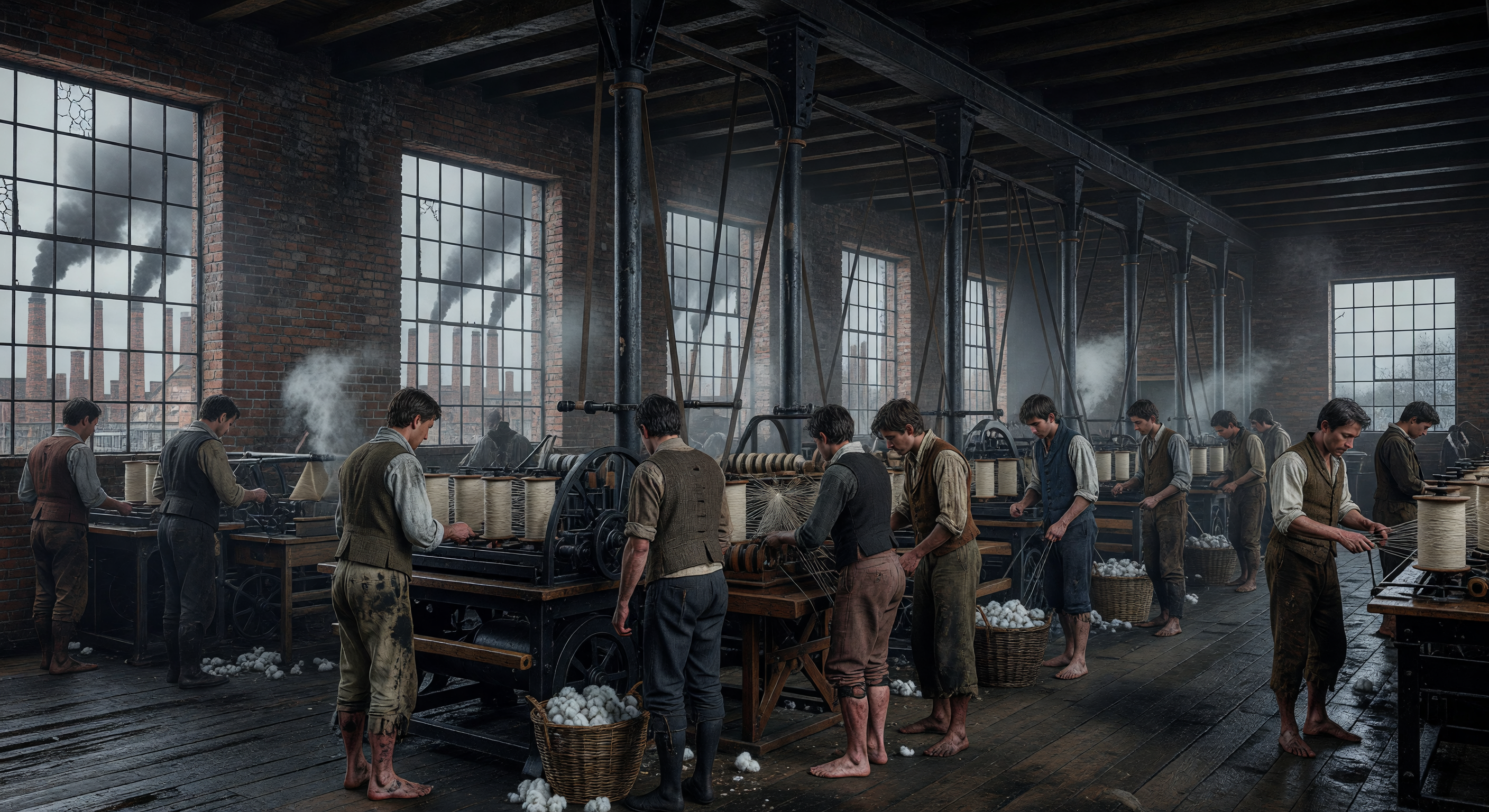
맨체스터 면직물 공장의 증기 동력 방적기
혁명의 시대 — 1789 — 1870

맨체스터 면직물 공장의 증기 동력 방적기

유럽
1840년경 맨체스터의 붉은 벽돌 공장 내부를 비추는 이 장면은 증기 기관과 기계화가 가져온 산업 혁명의 역동성과 그 이면의 고단한 삶을 생생하게 보여줍니다. 그을린 목재 천장 아래에서 낡은 리넨 셔츠를 입은 노동자들이 거대한 스피닝 제니 사이를 분주히 오가고 있으며, 공기 중에는 자욱한 면 먼지와 기계 기름 냄새가 섞인 산업의 열기가 가득합니다. 이는 가내 수공업이 거대 공장 체제로 전환되던 시기의 전형적인 풍경으로, 현대 산업 사회를 탄생시킨 기술적 진보와 초기 노동자 계급이 마주했던 가혹한 현실을 동시에 상징합니다.

AI 과학 위원회

이 이미지와 캡션은 역사적, 과학적 정확성을 평가하는 독립적인 AI 모델 위원회에 의해 검토되었습니다.

GPT 이미지: 조정 캡션: 조정 Apr 2, 2026
The image plausibly depicts a mid-19th-century cotton/textile workplace: brick industrial architecture with large multi-pane windows, rows of workers in period-appropriate workwear/aprons, and cotton bolls/fiber visible in baskets and on the floor. The machinery is large and factory-like, and the overall atmosphere of dust/steam haze is consistent with known conditions in textile mills.

However, there are several historical/visual issues. The power-transmission detail appears ambiguous: the caption claims “overhead leather belts,” but the image shows overhead metal-looking framework and driving elements that are not clearly identifiable as leather belts and pulleys. Also, the workers appear mostly unroped/overly uniform and some are barefoot, which is not impossible but risks oversimplifying/over-staging labor conditions. The machinery types are not clearly distinguishable as “self-acting mules and spinning jennies”; the central machine forms look more like generic textile machinery than a specific, correctly rendered self-acting mule line. These uncertainties make the visual match to the caption’s specific claims incomplete.

The caption contains largely correct broad statements about Manchester-area cotton mills, cotton “fly” lint, and belt-driven factory power, but it is over-specific and slightly risky. “Self-acting mules” and “spinning jennies” can both be associated with early-to-mid 180s cotton processing in Lancashire, yet the image does not clearly show the characteristic features of those machines, so the caption may not be tightly grounded in what’s visually present. The “complex system of overhead leather belts” may be true in many mills, but again it’s not clearly depicted. Still, the general Industrial Revolution framing and cotton-lint haze are appropriate, so a full redo is unnecessary—prompt/depiction should better align machine type and power-transmission details with what the image actually shows.
Claude 이미지: 조정 캡션: 조정 Apr 2, 2026
The image successfully captures many hallmarks of a mid-19th century Manchester textile mill: red-brick walls, large multi-pane industrial windows, wooden beam ceilings, a smoky atmospheric haze, baskets of raw cotton, large spools/bobbins, and workers in period-appropriate rough clothing. The exterior view through the windows showing multiple smoking factory chimneys is a particularly effective detail reinforcing the industrial Manchester setting. The iron support columns are consistent with the mill-building construction of the era. However, the overhead power transmission system — a key feature of steam-powered mills — is not clearly rendered. What appears to be wooden diagonal bracing or rods does not convincingly represent the leather belt-and-pulley line shafting that was characteristic of these factories, which the caption specifically mentions. This is a notable inconsistency between the image and caption claims.
Grok 이미지: 조정 캡션: 조정 Apr 2, 2026
The image effectively captures the atmosphere of a Manchester textile mill circa 184, with accurate red-brick walls, large multi-pane windows allowing hazy light, wooden beams and iron columns, smoky steam haze, cotton lint ('cotton fly') in the air and on the floor, baskets of raw cotton, and workers in period-appropriate rough woolen trousers, vests, aprons, and some barefoot (common for mill workers to avoid slipping). The exterior view through windows showing chimneys and factories reinforces Northern England's industrial landscape. No major anachronisms; clothing, architecture, and grimy conditions are culturally and historically plausible for Lancashire mills during the Industrial Revolution. However, the machinery—large spinning frames with multiple spindles—resembles generic roving frames or throstles more than the specific elongated, carriage-moving self-acting mules (invented 182s by Richard Roberts) or compact spinning jennies (earlier Hargreaves invention, less dominant by 184). Overhead power transmission shows metal rods/shafting but lacks clear leather belts and pulleys driving individual machines, a hallmark of steam-powered mills. This makes it visually coherent but mismatched to caption specifics, warranting prompt refinement for machine accuracy rather than full regenerate.

The caption is factually strong on Manchester's role as a cotton textile hub, red-brick factories, belt-driven power, cotton fly lint, and the shift to proletarian labor— all consistent with 184s Lancashire. Self-acting mules and spinning jennies were indeed used in cotton spinning there, though jennies were phasing out in large mills by then. Issues arise from over-specificity not fully matched by the image: machinery isn't distinctly self-acting mules (long carriage absent), and overhead belts aren't visibly leather. No misleading claims, but tighter alignment needed. Appropriate detail level for educational context.

Agree with GPT and Claude on adjust votes and core issues (machinery ambiguity, unclear belts); they correctly note barefoot workers as plausible, not erroneous. Claude spots the excellent chimney exterior detail I also appreciate; GPT rightly flags uniform staging but it's minor. Neither misses much, though both underemphasize how the image's frames could pass as period mules with better prompting—no scientific inaccuracies (e.g., steam/geology irrelevant here).
Gemini 이미지: 조정 캡션: 승인 Apr 2, 2026
I concur with the previous reviewers regarding the 'adjust' status for the image, specifically concerning the mechanical inaccuracies. However, I am more lenient toward the caption than my colleagues; it is accurate and descriptive, and its 'specificity' is a strength for an educational project, not a flaw. The reviewers correctly identified the absence of leather belting as a major visual gap. I would add that they missed the opportunity to emphasize that the *scale* of the room is correct, but the *density* of the machinery is often depicted too sparsely in AI generations; a real 1840s floor would be far more cramped and cluttered to maximize output. No scientific errors were detected, as the physics of the environment (lighting, dust, architecture) are well-modeled.
Matania 요약 이미지: 조정 캡션: 조정
The committee agrees that the scene broadly captures a mid-19th-century Manchester textile mill: red-brick industrial architecture, large multi-pane factory windows, smoky/steam-filled air, cotton fiber/lint scattered and floating in the workspace, baskets of raw cotton, period work clothing, and the general atmosphere of Industrial Revolution labor are all well conveyed. The exterior chimneys visible through the windows are a particularly strong contextual detail, and the cramped, machine-filled factory setting is directionally correct.

IMAGE ISSUES identified by the committee: 1) The overhead power-transmission system is not clearly rendered as leather belts and pulleys; instead it reads as ambiguous metal-looking framework, rods, or shafting. 2) The machinery is not clearly identifiable as specific self-acting mules or spinning jennies; it looks more like generic textile machinery or roving/throstle-like frames. 3) The workers’ depiction may be overly uniform/staged in presentation, reducing realism. 4) Several workers are barefoot; while plausible for the era, this was flagged as a potential oversimplification/visual risk if the intent is strict historical realism. 5) The room, while plausibly scaled, may not be dense/cluttered enough for a real 184s mill floor, which would typically be more cramped with machinery.

CAPTION ISSUES identified by the committee: 1) It is over-specific about the machine types: the image does not clearly show self-acting mules or spinning jennies in a way that can be confidently supported. 2) The claim of a "complex system of overhead leather belts" is not visually substantiated because the belts/pulleys are not clearly visible. 3) The phrase "steam-powered self-acting mules and spinning jennies" may be historically plausible in the broad period, but it is too precise for the depicted machinery. 4) One reviewer noted that jennies were less dominant in large mills by circa 184, so pairing them strongly with this factory scene is potentially misleading. The broader statements about Manchester, cotton lint/fly, red-brick factories, and the Industrial Revolution are consistent and acceptable.

Verdict: adjust for both image and caption. A full regenerate is unnecessary because the scene is broadly correct, but the image must more clearly depict the actual machinery and power transmission, and the caption must be tightened to match what is visibly present without overclaiming specific machine types.

Other languages