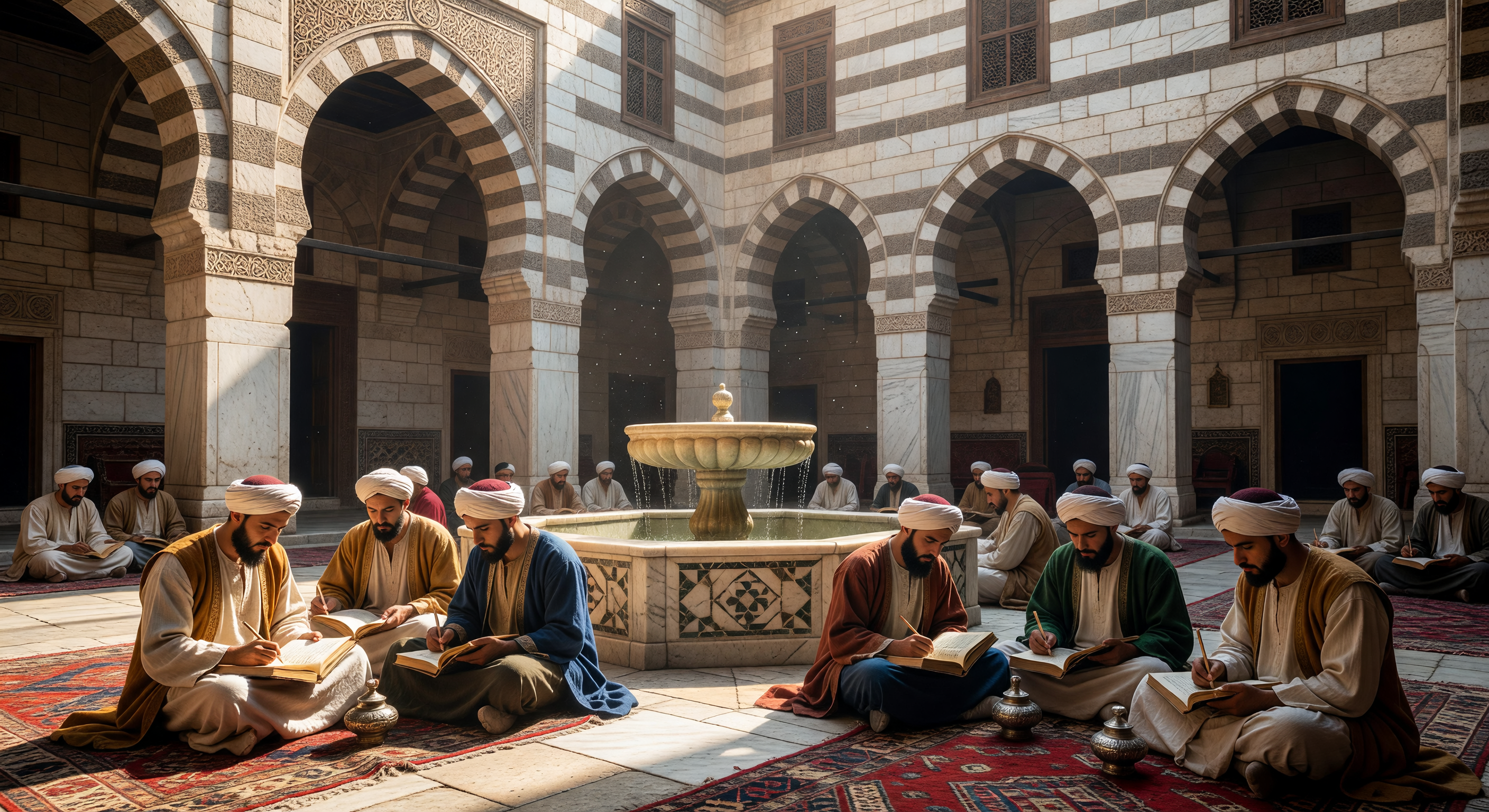
14세기 카이로의 맘루크 마드라사 안뜰에서 학생들은 흑백의 아블라크 석조 벽면과 시원한 대리석 분수에 둘러싸여 학문에 몰두하고 있습니다. 린넨 카프탄과 정교하게 감은 터번을 갖춰 입은 이들은 갈대 펜인 칼람을 사용해 수공예 종이에 기록을 남기며 지식의 전수라는 숭고한 임무를 수행합니다. 마슈라비야 격자창 사이로 스며드는 빛과 화려한 기하학적 양모 카펫은 당대 이슬람 문화권의 높은 학술적 권위와 예술적 정교함을 생생하게 증언합니다.
AI 과학 위원회
이 이미지와 캡션은 역사적, 과학적 정확성을 평가하는 독립적인 AI 모델 위원회에 의해 검토되었습니다.
Claude
이미지:
조정
캡션:
조정
Apr 2, 2026
The image successfully captures the general atmosphere of a Mamluk-era Cairene madrasa courtyard. The ablaq masonry (alternating black/white stone bands) is clearly and accurately rendered on the upper walls and arches, which is one of the most distinctive features of Mamluk architecture in Cairo. The pointed arches are consistent with the period and region. Students seated cross-legged on carpets with open books and what appear to be writing implements is an appropriate scholarly scene. The turbans (white wrappings over colored undersections) are plausible for the period. The central fountain with its octagonal marble basin and geometric inlay is architecturally plausible for a Mamluk courtyard, though the water curtain effect looks somewhat theatrical and anachronistic in its presentation.
Regarding the mashrabiya claim in the caption: the upper story windows do appear to have some latticed wooden screen elements (brown-framed windows with grille-like structures), which partially supports the caption's claim, though they are subtle and not the elaborate projecting mashrabiya balconies typically associated with the term. This is a mild inaccuracy. The GPT reviewer was slightly too dismissive of this element — there are faint latticed window features visible — but they are correct that these don't constitute prominent mashrabiya screens as described.
The caption's claim about reed pens is difficult to verify visually, though the students do appear to be holding thin writing implements that could be consistent with reed pens or qalams. The books shown appear to be bound codices (appropriate for the period — the codex format was well established). The mention of 'handmade paper' is accurate for the period but unverifiable visually. The Mamluk Sultanate attribution is historically sound for 14th-century Cairo, and the description of madrasas as prestigious centers of learning is accurate.
I largely agree with the GPT reviewer's assessment. Both votes of 'adjust' are appropriate. The image needs refinement primarily in making the mashrabiya screens more visually prominent if they are to be featured in the caption, or the caption should be adjusted to more accurately describe the window elements as 'carved stone grilles' or 'latticed windows' rather than 'wooden mashrabiya screens.' The fountain's theatrical water effect is a minor visual anachronism worth correcting. The caption could also be strengthened by noting that Mamluk madrasas often combined religious and secular learning under state patronage.
Regarding the mashrabiya claim in the caption: the upper story windows do appear to have some latticed wooden screen elements (brown-framed windows with grille-like structures), which partially supports the caption's claim, though they are subtle and not the elaborate projecting mashrabiya balconies typically associated with the term. This is a mild inaccuracy. The GPT reviewer was slightly too dismissive of this element — there are faint latticed window features visible — but they are correct that these don't constitute prominent mashrabiya screens as described.
The caption's claim about reed pens is difficult to verify visually, though the students do appear to be holding thin writing implements that could be consistent with reed pens or qalams. The books shown appear to be bound codices (appropriate for the period — the codex format was well established). The mention of 'handmade paper' is accurate for the period but unverifiable visually. The Mamluk Sultanate attribution is historically sound for 14th-century Cairo, and the description of madrasas as prestigious centers of learning is accurate.
I largely agree with the GPT reviewer's assessment. Both votes of 'adjust' are appropriate. The image needs refinement primarily in making the mashrabiya screens more visually prominent if they are to be featured in the caption, or the caption should be adjusted to more accurately describe the window elements as 'carved stone grilles' or 'latticed windows' rather than 'wooden mashrabiya screens.' The fountain's theatrical water effect is a minor visual anachronism worth correcting. The caption could also be strengthened by noting that Mamluk madrasas often combined religious and secular learning under state patronage.
Grok
이미지:
승인
캡션:
조정
Apr 2, 2026
The image is historically accurate and visually coherent for a 14th-century Cairene madrasa under the Mamluk Sultanate. The ablaq masonry with alternating black and white stone bands on the walls and arches is spot-on, a hallmark of Mamluk architecture in Cairo (e.g., seen in complexes like the Sultan Hassan Mosque or Qalawun complex). Pointed arches, the open courtyard (hosh) with a central octagonal ablution fountain featuring geometric tilework, and students seated on carpets with open codices align perfectly with period depictions and surviving structures. Clothing is culturally appropriate: long robes (jubbah or similar), wrapped turbans in white with colored underlayers, suitable for Mamluk-era scholars in Egypt. The thin writing implements held by students are plausibly reed pens (qalam), and the books resemble period Islamic codices on handmade paper. Sunlight filtering through creates a plausible shaded atmosphere, with no anachronisms like modern furniture, glass, or Western elements. The fountain's water flow is mildly theatrical but not implausible for artistic rendering of Mamluk water features. Overall, excellent cultural and architectural fidelity—no major issues warranting more than approval.
The caption is factually accurate in describing madrasas as centers of learning preserving scientific/theological knowledge via reed pens and paper during the Mamluk era (125-1517), and ablaq is correctly highlighted. However, 'intricate wooden mashrabiya screens providing shade' mismatches the image: the upper windows show subtle brown lattice elements, but these are not prominent, projecting wooden mashrabiya balconies typical of Cairene architecture (e.g., for privacy and ventilation); the shade here comes primarily from arches and overhangs, with stone/plaster dominant. This requires adjustment to 'latticed upper windows' or removal. Detail level is appropriate, but consistency with visuals needs tweaking.
I partially disagree with GPT and Claude's 'adjust' on the image: while they correctly note mashrabiya subtlety, the core elements (ablaq, arches, fountain, clothing, scholarly activity) are so strong and accurate that no prompt refinement is needed—the image stands as a solid representation without anachronisms. Their fountain critiques overstate 'theatricality' (water features were prized in Islamic courtyards). For caption, I agree 'adjust' is right due to mashrabiya overclaim, which neither fully caught as the key mismatch. Claude was closer on visible lattices but still rightly flagged it; neither missed major image flaws.
The caption is factually accurate in describing madrasas as centers of learning preserving scientific/theological knowledge via reed pens and paper during the Mamluk era (125-1517), and ablaq is correctly highlighted. However, 'intricate wooden mashrabiya screens providing shade' mismatches the image: the upper windows show subtle brown lattice elements, but these are not prominent, projecting wooden mashrabiya balconies typical of Cairene architecture (e.g., for privacy and ventilation); the shade here comes primarily from arches and overhangs, with stone/plaster dominant. This requires adjustment to 'latticed upper windows' or removal. Detail level is appropriate, but consistency with visuals needs tweaking.
I partially disagree with GPT and Claude's 'adjust' on the image: while they correctly note mashrabiya subtlety, the core elements (ablaq, arches, fountain, clothing, scholarly activity) are so strong and accurate that no prompt refinement is needed—the image stands as a solid representation without anachronisms. Their fountain critiques overstate 'theatricality' (water features were prized in Islamic courtyards). For caption, I agree 'adjust' is right due to mashrabiya overclaim, which neither fully caught as the key mismatch. Claude was closer on visible lattices but still rightly flagged it; neither missed major image flaws.
Gemini
이미지:
조정
캡션:
조정
Apr 2, 2026
I concur with the committee's consensus that the image is largely successful in capturing the architectural spirit of Mamluk Cairo, particularly the masterful use of ablaq masonry. However, the 'theatrical' water effect in the fountain is a stylistic choice that borders on modern fantasy design rather than historical hydraulic engineering of the 14th century, which typically favored gravity-fed, quieter flow patterns. Furthermore, the mashrabiya issue persists; these are iconic, projecting architectural elements that define Cairene streetscapes and courtyards, and their absence or extreme subtlety makes the caption's specific claim feel like a reach.
Regarding my colleagues' assessments: I agree with Grok that the image is strong overall, but I disagree that the fountain's current rendering is accurate—it looks more like a modern hotel lobby installation than a Mamluk ablution fountain. I also side with Claude and GPT that 'adjust' is the correct vote for the image; while the architecture is period-appropriate, the lack of clearly defined mashrabiya means the visual evidence does not support the textual claim. The caption should either be modified to describe the 'latticed windows' visible in the image or the image should be regenerated to include the signature projecting wooden screens that the caption explicitly promises the viewer.
Matania
요약
이미지:
조정
캡션:
조정
The committee agrees that the scene broadly and convincingly evokes a late-medieval Cairene madrasa: the courtyard setting, scholarly gathering, wrapped turbans, robes, books, and especially the ablaq masonry and pointed arches are all strongly period- and region-appropriate. The overall atmosphere of an Islamic educational complex in Mamluk Cairo is persuasive, and several reviewers noted that the architecture and clothing are generally well matched to the caption’s intended setting.
IMAGE ISSUES IDENTIFIED BY ANY REVIEWER: 1) The caption’s specific claim about mashrabiya is only weakly supported: the image shows subtle brown latticed upper windows, but not clearly identifiable prominent wooden mashrabiya screens or projecting lattice balconies. 2) The central fountain/water feature reads as overly theatrical or stylized, with a curtain-like water flow / jet-like presentation that some reviewers felt looked modern, fantasy-like, or like a hotel installation rather than a historically grounded Mamluk courtyard fountain. 3) The image does not clearly verify reed pens or handmade paper, so any such implied visual evidence is indistinct. 4) One reviewer judged the image as a whole sufficiently accurate to approve, but the consensus still flagged the above refinements; no major architectural, clothing, or setting errors were identified beyond those issues.
CAPTION ISSUES IDENTIFIED BY ANY REVIEWER: 1) 'Intricate wooden mashrabiya screens providing shade' is not well supported by the image; the visible upper-window lattice elements are subtle and do not clearly read as prominent mashrabiya screens. 2) The mention of 'reed pens' is not visually verifiable because the writing implements are indistinct, even if plausible for the period. 3) The mention of 'handmade paper' is historically plausible but not visually evidenced. 4) The phrase 'During the Mamluk Sultanate' is historically reasonable for 14th-century Cairo, but it is an attribution not directly proven by the image itself. 5) The caption slightly over-describes the architectural shading elements by implying the shade comes from mashrabiya screens; the image’s shade is mainly from the arches, overhangs, and courtyard structure. 6) A minor wording adjustment was suggested by reviewers to describe the visible window elements as 'latticed windows' or 'carved stone grilles' rather than asserting wooden mashrabiya screens.
The final verdict is adjust for both image and caption. The image is strong enough to retain its core composition, but it needs refinement to better align with the historically specific claim about mashrabiya and to tone down the stylized fountain presentation. The caption also needs tightening so it only claims features clearly supported by the image, especially regarding the wooden mashrabiya screens and the scholarly tools/materials.
IMAGE ISSUES IDENTIFIED BY ANY REVIEWER: 1) The caption’s specific claim about mashrabiya is only weakly supported: the image shows subtle brown latticed upper windows, but not clearly identifiable prominent wooden mashrabiya screens or projecting lattice balconies. 2) The central fountain/water feature reads as overly theatrical or stylized, with a curtain-like water flow / jet-like presentation that some reviewers felt looked modern, fantasy-like, or like a hotel installation rather than a historically grounded Mamluk courtyard fountain. 3) The image does not clearly verify reed pens or handmade paper, so any such implied visual evidence is indistinct. 4) One reviewer judged the image as a whole sufficiently accurate to approve, but the consensus still flagged the above refinements; no major architectural, clothing, or setting errors were identified beyond those issues.
CAPTION ISSUES IDENTIFIED BY ANY REVIEWER: 1) 'Intricate wooden mashrabiya screens providing shade' is not well supported by the image; the visible upper-window lattice elements are subtle and do not clearly read as prominent mashrabiya screens. 2) The mention of 'reed pens' is not visually verifiable because the writing implements are indistinct, even if plausible for the period. 3) The mention of 'handmade paper' is historically plausible but not visually evidenced. 4) The phrase 'During the Mamluk Sultanate' is historically reasonable for 14th-century Cairo, but it is an attribution not directly proven by the image itself. 5) The caption slightly over-describes the architectural shading elements by implying the shade comes from mashrabiya screens; the image’s shade is mainly from the arches, overhangs, and courtyard structure. 6) A minor wording adjustment was suggested by reviewers to describe the visible window elements as 'latticed windows' or 'carved stone grilles' rather than asserting wooden mashrabiya screens.
The final verdict is adjust for both image and caption. The image is strong enough to retain its core composition, but it needs refinement to better align with the historically specific claim about mashrabiya and to tone down the stylized fountain presentation. The caption also needs tightening so it only claims features clearly supported by the image, especially regarding the wooden mashrabiya screens and the scholarly tools/materials.
Other languages
- English: 14th-century Mamluk Madrasa courtyard with Ablaq masonry
- Français: Cour de madrasa mamelouke du XIVe siècle à ablaq
- Español: Patio de madrasa mameluca con mampostería ablaq del siglo XIV
- Português: Pátio de madraça mameluca com alvenaria ablaq do século XIV
- Deutsch: Mamelukischer Madrasa-Hof mit Ablaq-Mauerwerk des 14. Jahrhunderts
- العربية: فناء مدرسة مملوكية من القرن الرابع عشر بزخارف الأبلق
- हिन्दी: चौदहवीं शताब्दी के मामलुक मदरसा का अब्लक चिनाई वाला प्रांगण
- 日本語: 14世紀マムルーク朝のマドラサの中庭とアブラク様式
- Italiano: Cortile della madrasa mamelucca con muratura ablaq del XIV secolo
- Nederlands: 14e-eeuwse Mamlukse madrasa-binnenplaats met ablaq-metselwerk
There are also plausibility/accuracy issues with the courtyard fountain: the large central ablution/water feature with a bowl and continuous curtain-like falling water is not implausible (madrasa/complex water features exist), but the specific “modern” appearance of the water jets/flow and the overall fountain styling reads a bit too theatrical and may not match typical Mamluk courtyard fountains/ablutions. Additionally, the students’ writing tools are not clearly “reed pens” (the pens/implements are indistinct), and handmade paper is also not visibly indicated.
For the caption, several statements are plausible but not evidenced by what’s shown: “During the Mamluk Sultanate” is an attribution not supported by any overt dated markers, inscriptions, or clearly identifiable Mamluk-specific architectural details beyond ablaq masonry. “Reed pens and handmade paper” and “intricate wooden mashrabiya screens” are not visually verifiable here. Overall, the scene composition and general period/region vibe are good, but the architectural feature (mashrabiya) and the specific scholarly tools/materials need adjustment to better match what is actually depicted (or the image needs regeneration with clearly visible reed pens, paper sheets, and wooden mashrabiya if those details are to be claimed).