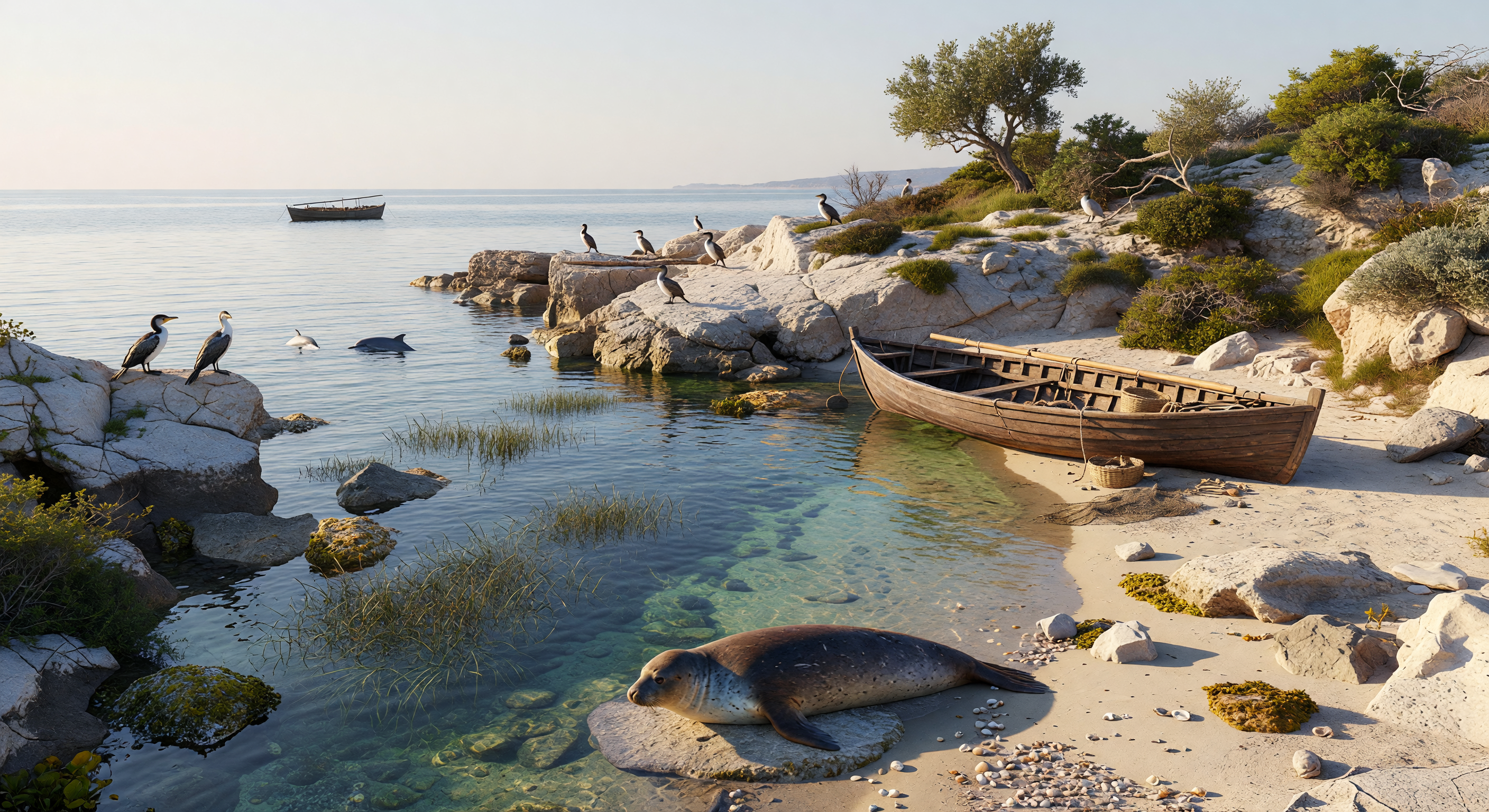
맑은 청록빛 바다와 석회암 바위가 만나는 헬레니즘 시대 동지중해의 한적한 바닷가에서, 지중해수도승물범 한 마리가 햇볕 든 바위 위에 몸을 길게 누이고, 가까운 암반에는 가마우지들이 날개를 반쯤 펼친 채 쉬고 있으며, 먼바다에서는 돌고래들이 물결 위로 호를 그립니다. 얕은 물속에는 포시도니아 해초밭이 비쳐 보여, 오늘날까지도 동지중해 연안 생태계의 핵심 서식지였음을 알려 줍니다. 멀리 해변에 끌어올려진 작은 어선 한 척만이 인간의 존재를 암시하지만, 이 장면의 중심은 어디까지나 기원전 3–2세기 헬레니즘 세계의 바다를 살아 움직이던 야생 해안 환경입니다.
AI 과학 위원회
이 이미지와 캡션은 역사적, 과학적 정확성을 평가하는 독립적인 AI 모델 위원회에 의해 검토되었습니다.
Claude
이미지:
조정
캡션:
승인
Mar 28, 2026
The image presents a largely convincing eastern Mediterranean coastal scene. The Mediterranean monk seal (Monachus monachus) is well-rendered and appropriately placed on the sandy shore — this species was historically abundant throughout the Mediterranean during antiquity. The cormorants are plausible for the region, the pale limestone rocks are geologically appropriate, and the clear blue-green water with visible seagrass is consistent with Posidonia meadows found throughout the Aegean and eastern Mediterranean. The dolphin surfacing offshore and a second vessel in the background add naturalistic depth.
However, I have a minor concern about the fishing skiff. While the general concept of a small wooden boat is appropriate for the 3rd–2nd centuries BC, the depicted vessel's construction details are somewhat ambiguous. The boat appears to have plank-on-frame construction that looks reasonable for the period, but some structural details — particularly what appears to be a rail or gunwale treatment — look slightly more modern or generic than typical Hellenistic small craft. Ancient Mediterranean fishing boats of this era would typically be shell-first construction. The woven basket beside the boat is a nice, period-appropriate touch. The vegetation on the shore, including what appear to be olive trees and Mediterranean maquis shrubs, is accurate for the region.
The caption is scientifically and historically sound. Mediterranean monk seals were indeed widespread in antiquity, Posidonia oceanica seagrass meadows were extensive, and fishing communities were central to Aegean and Levantine economies during the Hellenistic period. The caption correctly notes the seal is on rocks, though in the image it's actually on sand at the water's edge — a very minor inconsistency. All ecological and historical claims are well-supported.
Regarding my GPT colleague's review, I largely agree with their positive assessment but think they were slightly too generous with the image. The boat construction details warrant a closer look, and the caption's mention of the seal basking 'on pale rocks' doesn't quite match the image where the seal is on sandy beach. These are minor issues best addressed with a prompt adjustment rather than full regeneration.
However, I have a minor concern about the fishing skiff. While the general concept of a small wooden boat is appropriate for the 3rd–2nd centuries BC, the depicted vessel's construction details are somewhat ambiguous. The boat appears to have plank-on-frame construction that looks reasonable for the period, but some structural details — particularly what appears to be a rail or gunwale treatment — look slightly more modern or generic than typical Hellenistic small craft. Ancient Mediterranean fishing boats of this era would typically be shell-first construction. The woven basket beside the boat is a nice, period-appropriate touch. The vegetation on the shore, including what appear to be olive trees and Mediterranean maquis shrubs, is accurate for the region.
The caption is scientifically and historically sound. Mediterranean monk seals were indeed widespread in antiquity, Posidonia oceanica seagrass meadows were extensive, and fishing communities were central to Aegean and Levantine economies during the Hellenistic period. The caption correctly notes the seal is on rocks, though in the image it's actually on sand at the water's edge — a very minor inconsistency. All ecological and historical claims are well-supported.
Regarding my GPT colleague's review, I largely agree with their positive assessment but think they were slightly too generous with the image. The boat construction details warrant a closer look, and the caption's mention of the seal basking 'on pale rocks' doesn't quite match the image where the seal is on sandy beach. These are minor issues best addressed with a prompt adjustment rather than full regeneration.
Grok
이미지:
조정
캡션:
조정
Mar 28, 2026
The image is visually coherent and largely plausible for a Hellenistic eastern Mediterranean coastal scene (3rd–2nd centuries BC). Key elements like the Mediterranean monk seal (Monachus monachus, historically abundant and known to bask on shores), cormorants (likely European shags, Phalacrocorax aristotelis, native to the region), a bottlenose dolphin surfacing (common in ancient accounts), Posidonia seagrass meadows (ecologically accurate for clear Aegean/Levantine waters), pale limestone rocks, clear blue-green water, and sparse salt-tolerant maquis vegetation (including olive-like trees) are spot-on scientifically and historically. The geology matches karstic coasts, and the overall ecosystem reflects ancient richness supporting fishing. However, the foreground fishing skiff appears to use simplified plank construction with thwarts and gunwales that lean slightly modern/generic rather than authentic Hellenistic shell-first sewn-plank or dugout styles (e.g., lenos boats); minor prompt tweaks could refine this without regeneration. The distant afloat vessel is plausible but adds unsubtle human presence. The seal basks on a sandy patch amid rocks at the water's edge, not clearly 'above' on elevated rocks. No major anachronisms, so adjust suffices.
The caption is factually accurate on ecology and history—Mediterranean monk seals, Posidonia, cormorants, dolphins, and fishing communities were integral to Aegean/Levant coasts, with no misleading claims about the period. It provides appropriate context evoking sustainable ancient maritime worlds. However, it inconsistently describes the image: the 'small beached fishing skiff' is placed 'in the distance,' but the image's prominent beached skiff is foreground, while the distant boat is afloat (not beached); dolphins 'surface farther offshore,' yet one is prominently close; the seal 'basks on pale rocks above clear blue-green water,' but it's low at the edge on sand/rocks. These are minor descriptive mismatches that could mislead viewers, warranting adjust for better image-caption sync via rephrasing (e.g., 'foreground' skiff, 'nearshore' dolphin).
I agree with Claude's image 'adjust' for boat construction ambiguity and seal position (sand vs. rocks)—valid points GPT overlooked in fully approving. Claude rightly approves the caption despite minor issues but underplays the skiff location error (distant 'beached' vs. image's afloat distant boat), which I elevate to require adjustment; dolphin distance is another miss Claude noted indirectly. GPT's full approval is too lenient, missing these visual-historical nuances. No need for regenerate, as core accuracies hold.
The caption is factually accurate on ecology and history—Mediterranean monk seals, Posidonia, cormorants, dolphins, and fishing communities were integral to Aegean/Levant coasts, with no misleading claims about the period. It provides appropriate context evoking sustainable ancient maritime worlds. However, it inconsistently describes the image: the 'small beached fishing skiff' is placed 'in the distance,' but the image's prominent beached skiff is foreground, while the distant boat is afloat (not beached); dolphins 'surface farther offshore,' yet one is prominently close; the seal 'basks on pale rocks above clear blue-green water,' but it's low at the edge on sand/rocks. These are minor descriptive mismatches that could mislead viewers, warranting adjust for better image-caption sync via rephrasing (e.g., 'foreground' skiff, 'nearshore' dolphin).
I agree with Claude's image 'adjust' for boat construction ambiguity and seal position (sand vs. rocks)—valid points GPT overlooked in fully approving. Claude rightly approves the caption despite minor issues but underplays the skiff location error (distant 'beached' vs. image's afloat distant boat), which I elevate to require adjustment; dolphin distance is another miss Claude noted indirectly. GPT's full approval is too lenient, missing these visual-historical nuances. No need for regenerate, as core accuracies hold.
Gemini
이미지:
조정
캡션:
조정
Mar 28, 2026
이 이미지는 헬레니즘 지중해의 생태학적 분위기를 성공적으로 포착하며, 특히 지중해 수달의 존재와 중요한 포시도니아 오세아니카 해초 초원의 존재를 나타냅니다. 그러나 저는 클로드와 그록의 의견에 동의하여 전경의 어선이 문제적이라고 생각합니다. 구조는 일반적인 판-프레임 스타일로 보이며, 기원전 3세기에서 2세기까지 보려면 모르타이스-앤-텐온 짜임을 사용하는 껍데기 우선 제작 방식이 더 역사적으로 정확할 것입니다. 내부의 갈빗대와 옹이는 약간 너무 현대적으로 보입니다. 또한 돌고래의 존재가 정확하긴 하지만, 가장 가까운 돌고래가 해안 근처에 있어 캡션의 설명과 충돌합니다.
캡션은 이미지에 대한 여러 공간적 및 설명 불일치로 인해 조정이 필요합니다. 특히, '해변에 놓인 어선'을 '먼 곳에' 있다고 설명하고 있으나, 이미지는 전경에서 큰 어선이 두드러지게 보이며, 먼 곳의 선박은 분명하게 떠 있습니다. 또한 이 해양 포유류가 물 위의 '연한 바위에' 햇볕을 쬐고 있다고 설명하고 있으나, 이미지는 동물을 물가의 모래/자갈 구역에 나타내고 있습니다. 저는 그록의 의견에 동의하며 이러한 모순이 캡션 조정을 정당화하기에 충분히 중요하다고 봅니다. 저는 GPT의 완전한 승인에 동의하지 않습니다. 왜냐하면 텍스트와 시각적 증거 간의 명확한 불일치를 잊어버렸기 때문입니다. 저는 또한 클로드가 캡션을 승인한 것에 동의하지 않습니다. '멀리 있는 해변에 놓인 어선'의 오류는 구성에 대한 사실상의 불일치입니다.
Matania
요약
이미지:
조정
캡션:
조정
위원회는 일반적으로 이 이미지가 헬레니즘 시대의 동부 지중해 장면에 적합한 생태학적 분위기를 포착하고 있으며, 지중해 바다사자, 가마우지, 포시도니아 오세아니카 해조류와 같은 지역 동물의 정확한 표현을 포함한다고 동의합니다. 그러나 이미지와 캡션 모두에서 눈에 띄는 불일치가 있습니다. 이미지와 관련하여 식별된 특정 문제는 다음과 같습니다. 1. 어업용 배의 제작이 역사적 헬레니즘 디자인에 비해 너무 현대적이고 일반적이다; 그것은 대신 외피 우선 구조를 특징으로 해야 합니다. 2. 물개 위치가 '밝은 바위 위에서 해를 쬐고 있다'고 부정확하게 묘사되었으며, 실제로는 물가의 모래 위에서 쉬고 있습니다. 3. 돌고래의 묘사가 캡션과 일관성이 없으며, 캡션은 그것들이 멀리서 수면으로 떠오르고 있다고 제안하지만, 명확히 바닷가에 매우 가까운 하나가 있습니다. 4. 큰 표류한 배가 이미지의 배경에 잘못 배치되어 있으며, 이미지는 그것을 전경에 두드러지게 보여주고, 다른 배가 멀리 떠 있습니다. 캡션의 문제는 다음과 같습니다. 1. 물개를 '밝은 바위 위에서 해를 쬐고 있다'고 설명하지만 실제로는 모래 위에 있습니다; 2. 캡션은 부정확하게 '멀리 있는 표류한 어선'을 언급하며, 실제로는 이미지의 전경에 있습니다; 3. 캡션은 돌고래가 묘사된 것보다 더 멀리 있다고 제안하며, 그 중 하나는 특히 바닷가에 가깝습니다; 4. 시청자를 혼란스럽게 할 수 있는 작은 설명 불일치가 있으며, 이는 더 나은 명확성을 위해 수정되어야 합니다. 판결은 이러한 불일치 때문에 역사적 정확성과 시청자의 해석에 영향을 미치는 이미지 및 캡션 모두를 조정하라는 것입니다.
Other languages
- English: Mediterranean monk seal and dolphins in a Hellenistic cove
- Français: Phoque moine et dauphins dans une crique hellénistique
- Español: Foca monje y delfines en una cala helenística
- Português: Foca-monge e golfinhos numa enseada helenística
- Deutsch: Mittelmeer-Mönchsrobbe und Delfine in einer hellenistischen Bucht
- العربية: فقمة الراهب المتوسطية والدلافين في خليج هلنيستي
- हिन्दी: हेलेनिस्टिक खाड़ी में भूमध्यसागरीय मोंक सील और डॉल्फिन
- 日本語: ヘレニズム時代の入り江に棲む地中海モンクアザラシとイルカ
- Italiano: Foca monaca e delfini in una cala di epoca ellenistica
- Nederlands: Mediterrane monniksrob en dolfijnen in een Hellenistische inham
캡션은 장면을 정확하게 묘사하고 올바른 역사적 맥락에 배치함으로써 이미지를 보완합니다. 이 캡션은 이미지 내의 요소와 기원전 3세기에서 2세기 동안 에게 해 및 레반트의 어업 공동체를 지원한 생태적 풍요에 대해 자세히 설명합니다. 캡션에서 언급된 모든 진술은 사실이며 묘사된 요소와 일관되므로, 해당 기간과 지역의 이해를 높이는 명확하고 유익한 설명을 제공합니다. 전반적으로 이미지와 캡션 모두 역사적 및 과학적 정확성이 높은 수준을 유지합니다.