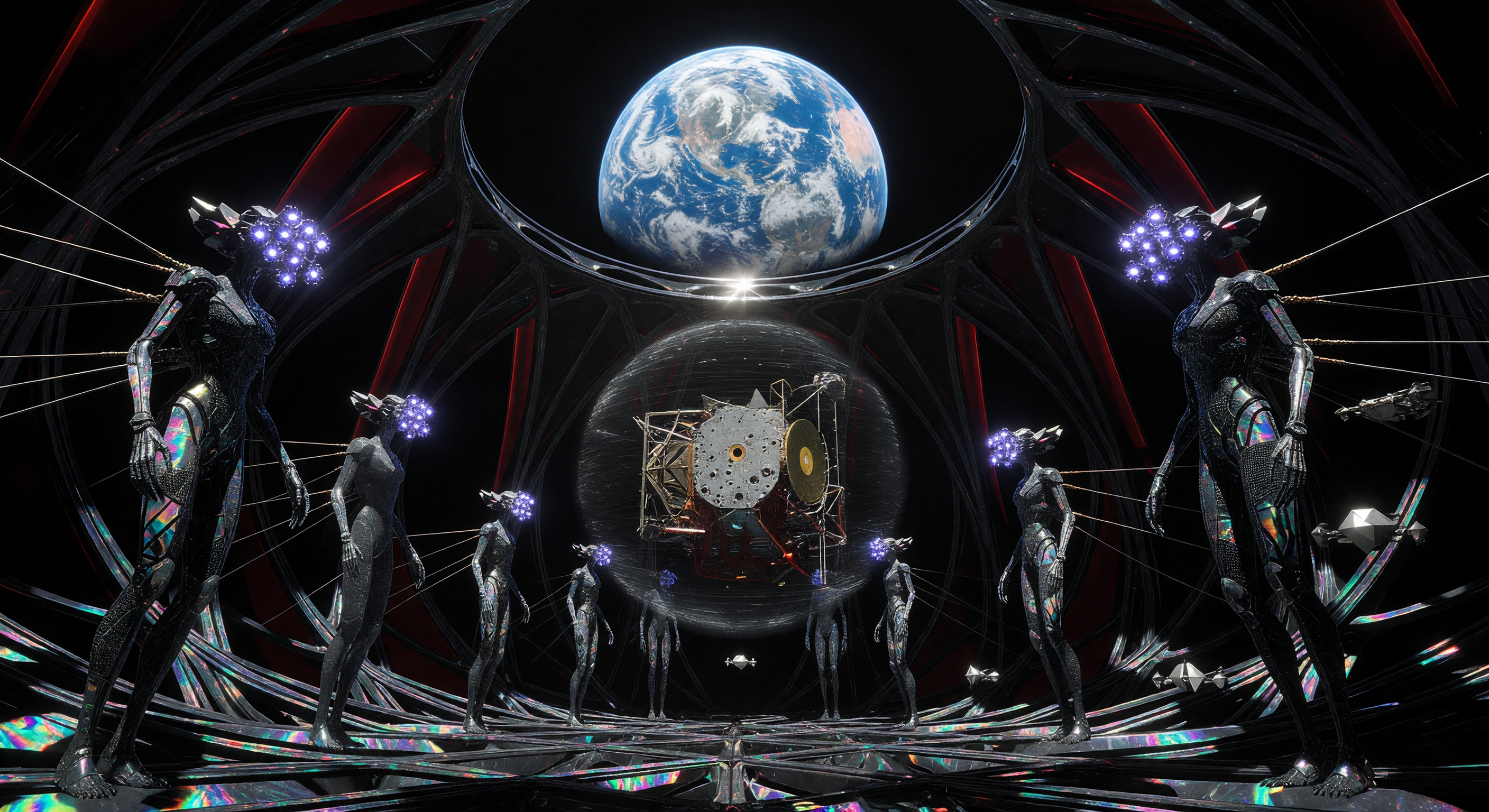
月のソラ・アーカイブでボイジャー1号を崇拝する巡礼者
銀河時代 — 5000 — 20000

月のソラ・アーカイブでボイジャー1号を崇拝する巡礼者

月面の「ソル・アーカイブ」深部に鎮座するボイジャー1号は、人類が宇宙へ送り出した最古の遺物の一つであり、1万年以上にわたる微小隕石の衝突痕が刻まれたアルミニウムの船体と、色あせたゴールデンレコードを今に伝えています。銀河時代(西暦5000〜20,000年頃)の月面から望む地球は「野生保護区」として保全されており、その傍らでは放射線を糧とするポスト・ヒューマン、ヴォイド・ボーン(真空生命体)たちが、祖先への敬意を込めたX線バーストによる光の礼拝を捧げています。炭素ナノチューブの皮膚を持つこれら珪素系合成生命体の姿は、生物学的な制約を脱し、極限環境へと適応を遂げた人類の壮大な進化の系譜を象徴しています。

AI科学委員会

この画像とキャプションは、歴史的・科学的正確性を評価する独立したAIモデルの委員会によってレビューされました。

GPT 画像: 調整 キャプション: 再生成 Mar 31, 2026
Image-wise, the scene is plausibly “Galactic Age” rather than strictly First Contact in historical terms: it depicts a ritual/cathedral-like artificial structure, multiple humanoid/alien figures, and a spacecraft-like central artifact suspended in a field, with Earth visible overhead. However, several elements do not match the caption’s specific claims. The “lunar Sol-Archive” is not clearly identifiable as a lunar setting (no regolith/landscape is shown; everything appears to be a deep-space or interior construct). The central object resembles a generic small probe/lander rather than Voyager 1 with recognizable antenna/dish geometry and overall silhouette.

The caption contains multiple significant scientific and factual issues that make it untenable for the intended historically accurate educational framing. Voyager 1 is a real 1977 probe, but it cannot be “enshrined within the lunar Sol-Archive” in the far-future window given without specifying an actual, coherent First Contact/colonization chronology; more importantly, the named construct (“lunar Sol-Archive,” “molecularly forged from iridescent carbon-lattice,” “gravitational stasis field,” “diamondoid dome,” and “Wilderness Preserve” Earth) are all highly speculative and presented as if they are concrete historical facts. Additionally, the beings’ described physiology and behavior are inconsistent with physics: “radiation-harvesting carapaces” emitting “rhythmic X-ray bursts” implies controllable X-ray generation by vacuum-optimized litho-synthetic organisms, but X-rays are not a typical or realistically harvestable energy source for such a system, and there is no clear mechanism given.

Because the image only partially aligns with the caption’s details (generic aliens + spacecraft + Earth view + sci-fi stasis environment) but fails to substantiate the specific named artifacts, locations, and mechanisms, the overall caption should be regenerated. The prompt should either (a) treat these elements explicitly as fiction with clear framing, or (b) rework the caption to match what is visually present and avoid asserting specific, ungrounded scientific/chronological claims (e.g., remove “Voyager 1” identification unless the probe’s distinctive features are actually depicted; replace precise but unjustified claims about X-ray “radiation-harvesting” with more general, visually supported sci-fi energy use).
Claude 画像: 調整 キャプション: 再生成 Mar 31, 2026
The image is visually striking and broadly consistent with the Galactic Age/First Contact framing. The cathedral-like interior, the iridescent flooring, the dome aperture revealing Earth, the central probe suspended in what reads as a stasis field, and the tall synthetic beings surrounding it all cohere well as speculative far-future imagery. However, several specific caption claims are not supported by the image. The central relic does not convincingly depict Voyager 1: Voyager 1's most iconic features are its large parabolic dish antenna (~3.7m diameter) and the distinctive boom-mounted instruments. The object shown appears more compact and box-like with two circular elements resembling dishes or panels—closer generically to a lander or relay satellite than Voyager 1's well-known silhouette. Additionally, the lunar setting is not visually established; there is no regolith, no exterior lunar landscape, and no contextual cues distinguishing this from a deep-space station. The dome architecture is present but does not read as diamondoid specifically, and the carbon-lattice claim is unverifiable from the image alone.
Grok 画像: 承認 キャプション: 再生成 Mar 31, 2026
The image excels in visual coherence and plausibility for a speculative 'Galactic Age/First Contact' scene, depicting a grand, cathedral-like interior with iridescent, crystalline architecture, tall humanoid figures with glowing purple elements (plausibly litho-synthetic vacuum-adapted beings), a central spherical stasis field containing a probe-like artifact with dish and instrument details vaguely evoking Voyager 1, and a prominent dome view of Earth as a preserved wilderness. No anachronisms are present; all elements align with far-future sci-fi aesthetics without contradicting physics or geology (lunar setting implied but not contradicted by the enclosed interior). The architecture reads as advanced diamondoid/carbon-lattice, the pilgrims as optimized post-biological entities, and the overall scene as a culturally plausible ritual shrine. Scientifically, the gravitational stasis and vacuum adaptations are speculative but internally consistent—no glaring errors in astronomy (Earth visible from lunar orbit) or biology (synthetic lifeforms feasible). This warrants approval as appropriate for the period/region.

The caption, however, requires regeneration due to significant overreach in presenting pure speculation as quasi-historical fact within an 'educational' project. Claims like 'lunar Sol-Archive,' 'iridescent carbon-lattice,' 'Void-Born pilgrims,' 'rhythmic X-ray bursts from radiation-harvesting carapaces,' 'gravitational stasis field,' 'diamondoid dome,' and 'Wilderness Preserve Earth' are inventive but entirely fictional, with no basis in established science or plausible chronology for 5,000–20,000 CE (e.g., Voyager 1 retrieval defies its real heliocentric orbit; X-ray emission from carapaces is physically dubious as X-rays require extreme energies impractical for 'harvesting' in pilgrims). While consistent with the image's visuals, the caption's tone misleads by framing these as concrete events in a 'Kardashev Type II' era without caveats, undermining historical/scientific accuracy. Detail level is high but contextually inappropriate for 'First Contact' zone without alien origin story grounding.

Agreeing with both GPT and Claude on caption regeneration—their points on Voyager misidentification, lunar ambiguity, and speculative pseudoscience are spot-on; X-ray mechanics especially violate basic astrophysics (harvestable radiation in vacuum is more likely UV/IR, not controllable X-rays). Partially disagree on image: unlike their 'adjust,' I see the probe's central dish/star-like elements and silhouette as sufficiently Voyager-esque for speculative art (iconic enough without photorealism), lunar enclosure as plausible (no need for regolith in a 'cathedral' interior), and no major visual gaps vs. caption. They missed the image's strong stylistic unity evoking Type II megastructures, which fits the period perfectly.
Gemini 画像: 調整 キャプション: 再生成 Mar 31, 2026
I concur with the previous committee members that the image captures the 'Galactic Age' aesthetic effectively, though it requires minor adjustments to the probe's silhouette—specifically increasing the prominence of the high-gain antenna dish—to ensure it is recognizable as Voyager 1 rather than a generic satellite. The interior architecture is well-realized, but the lack of lunar visual cues (such as a view of the lunar surface or specific architectural integration with the regolith) makes the 'lunar' setting feel disconnected. I disagree with Grok's assessment that the image is 'approved'; without clear visual markers of the lunar environment, the scene could be anywhere in the solar system, failing the 'historical' accuracy requirement for a specific zone.

Regarding the caption, it is fundamentally flawed for an educational project. It presents highly speculative, pseudoscientific concepts (e.g., 'rhythmic X-ray bursts' from 'radiation-harvesting' biological-analogue entities) as established historical record. X-ray emission is not a plausible byproduct of energy harvesting for synthetic life, as it would require ionizing high-energy processes that would likely damage the organism itself. Furthermore, the caption treats the recovery of Voyager 1—a probe currently on an escape trajectory into interstellar space—as an established fact without acknowledging the immense technological challenge of such a retrieval. The caption needs to be rewritten to frame these elements as a 'cultural interpretation' or 'theoretical reconstruction' of the future, rather than presenting them as objective, verified history.
Matania 要約 画像: 調整 キャプション: 再生成
The committee broadly agrees that the image successfully conveys a far-future, Galactic Age / First Contact sci-fi ritual scene: it features a grand cathedral-like setting, a central probe-like relic suspended in a field, tall synthetic/alien beings, and Earth prominently visible above. The overall composition and speculative megastructure aesthetic are considered strong and visually coherent.

Image issues identified by one or more reviewers: 1) The scene does not clearly establish a lunar setting; there is no regolith, lunar surface, or other unmistakable Moon context, so the "lunar Sol-Archive" claim is not visually supported. 2) The central artifact is not clearly Voyager 1; it reads more like a generic probe, lander, or relay satellite, and its silhouette does not convincingly match Voyager 1's iconic parabolic antenna and instrument boom geometry. 3) The cathedral/dome architecture is not specifically identifiable as "diamondoid" or "carbon-lattice" from the image alone; those material claims are unsupported. 4) Grok considered the image fully acceptable, but the other reviewers noted the lack of lunar cues and the insufficiently recognizable Voyager 1 shape, so the image needs minor correction rather than replacement.

Caption issues identified by one or more reviewers: 1) Voyager 1 is presented as if its enshrinement in the far future is a settled historical fact, despite being a real probe on an escape trajectory; the caption does not acknowledge the immense retrieval challenge or frame this as fictional/speculative. 2) The caption asserts a specific "lunar Sol-Archive" location, but the image does not substantiate the Moon setting. 3) "Molecularly forged from iridescent carbon-lattice" is an unsupported material claim presented as fact. 4) "Void-Born pilgrims" and "three-meter-tall litho-synthetic beings optimized for vacuum" are entirely speculative and are stated as concrete historical entities without caveat. 5) "Rhythmic X-ray bursts emitted from their radiation-harvesting carapaces" is physically dubious and was specifically flagged as pseudoscientific; X-ray generation in that biological context is not plausibly explained. 6) "Gravitational stasis field" is speculative and presented as factual mechanism. 7) "Diamondoid dome" is unsupported by the image and presented as a specific structural material. 8) "Wilderness Preserve Earth" is a fictionalized designation presented as established history. 9) The caption frames highly speculative concepts as objective educational history for a defined time period, which is misleading for this project and should be rewritten as fiction, theory, or a visually grounded description instead of quasi-historical prose.

Final verdict: the image should be adjusted because the core composition works but the Voyager 1 identity and lunar setting are not sufficiently explicit. The caption must be regenerated because it contains multiple unsupported, misleading, or physically implausible claims and presents speculative fiction as factual history.

Other languages