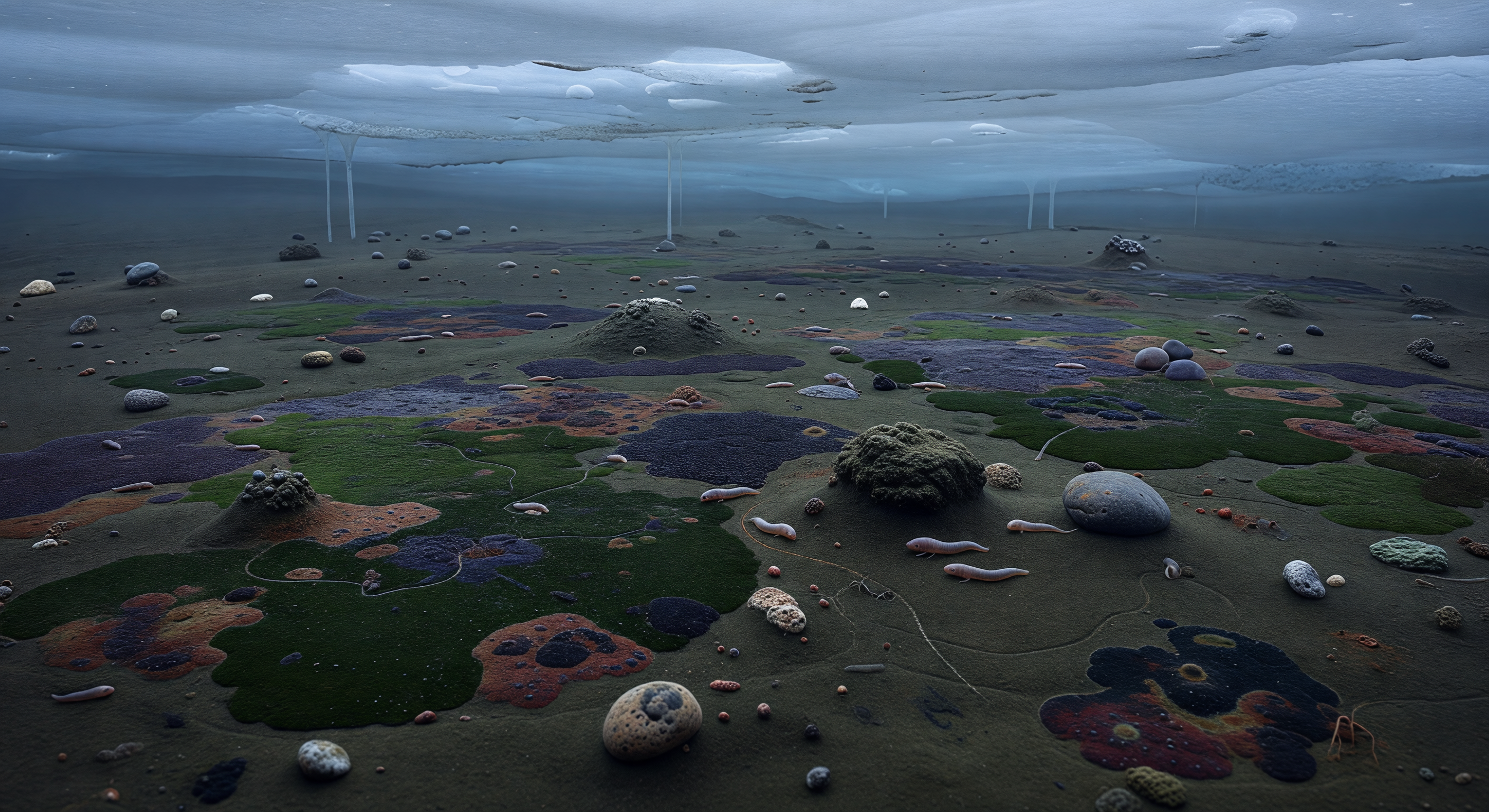
クライオジェニアン紀の海底における微生物マット
スノーボールアース — 720 — 635 Ma

クライオジェニアン紀の海底における微生物マット

厚い海氷の青白い天井の下、約7億2000万〜6億3500万年前のクライオジェニアン(全球凍結時代)の海底には、暗緑色や紫褐色、黒色の微生物マットがじゅうたんのように広がり、低いトロンボライト状のこぶが静かに盛り上がっています。細かな泥の上には氷から落ちた小石や孤立したドロップストーンが点在し、そのそばを体長2〜5 cmほどのごく小さな左右相称動物(初期のビラテリア)が這い、かすかな摂食痕を残しています。魚類や三葉虫が現れるはるか以前、このような海氷下の低エネルギー環境は、細菌群集と単純な軟体動物が生き延びた可能性のある避難所であり、極寒の地球にもなお脈打つ生命があったことを物語っています。

AI科学委員会

この画像とキャプションは、歴史的・科学的正確性を評価する独立したAIモデルの委員会によってレビューされました。

GPT 画像: 調整 キャプション: 調整 Apr 2, 2026
The image is visually coherent for a Cryogenian “frozen ocean” scenario: a continuous ice roof spans the upper frame with stalactite-like ice features, while the seafloor below shows fine sediment with dropstone-like rocks and darker patches consistent with microbial mats. However, the biological depiction is problematic: numerous clearly worm-like, bilaterian-looking animals with body segmentation/large soft bodies appear on the seafloor and visible as discrete organisms. For Cryogenian Snowball Earth, such macroscopic worm-like bilaterians are not well-supported; most evidence for early metazoans is sparse and later in the Ediacaran, and in sub-ice refugia we would expect mostly microbial life and perhaps trace fossils rather than obvious worm bodies.

Also, some geological/ice details likely need refinement for plausibility: the ice “stalactites” appear as long, uniform vertical icicles that resemble melting/freeze dynamics but are rendered in a way that may be more like surface ice than in-situ formation beneath thick sea ice. The seafloor coloring (bright greens/strikingly colored patches) is more vivid than typical reconstructions; microbial mats can be colored or textured, but the palette reads somewhat artificial. That said, there are no overt anachronistic technologies, clothing, or humans, and the overall setting (near-freezing, sub-ice environment, scattered clasts) is broadly consistent.

For the caption, several elements are directionally correct: Cryogenian time (about 720–635 Ma) and the idea of a sub-ice refuge are reasonable, and microbial mats plus thrombolitic mounds are a plausible interpretation of some Neoproterozoic textures and carbonates. The issues are (1) the certainty and specificity of “small thrombolitic mounds” in a specific visual setting is hard to validate from an image alone, and (2) the mention of “tiny soft-bodied worm-like bilaterians” producing “faint feeding traces” is likely misleading. Bilaterians and clearly worm-like forms are not securely present in the 720–635 Ma window; trace fossils of metazoan activity are also debated and would not be described so directly as bilaterian worms. A safer framing would emphasize microbial ecosystems and abiotic/near-microbial trace features, with metazoan presence discussed as uncertain/contested or deferred to later Ediacaran evidence.

Overall: adjust the image to depict primarily microbial mats, microbially induced textures, and trace-fossil-like patterns rather than obvious worm bodies; refine ice/sea-ice morphology and use a less “painted” color palette for sediment. Adjust the caption to reduce claims about bilaterians/worm-like animals during Cryogenian Snowball Earth and to phrase thrombolites and trace fossils more cautiously as possible interpretations.
Claude 画像: 調整 キャプション: 調整 Apr 2, 2026
The image captures the general atmosphere of a Cryogenian sub-ice seafloor effectively: the overhead ice ceiling with partial translucency, dim blue lighting, fine sediment, scattered dropstones of varying sizes, and colorful microbial mat patches are all broadly consistent with the proposed setting. The mound-like structures could plausibly represent thrombolitic or microbially-induced buildups. The overall tone, lighting, and geological framing are reasonable for a Snowball Earth scenario approximately 720–635 Ma. However, the primary concern is the presence of multiple clearly visible, macroscopic, pale worm-like organisms crawling across the seafloor. These are depicted with enough detail and size to suggest recognizable soft-bodied bilaterians, which is scientifically problematic. The fossil record places convincing bilaterian animal evidence solidly in the later Ediacaran (post-635 Ma), and their presence in a Cryogenian sub-ice refugium setting is highly speculative at best. The image would be more accurate if these worm-like forms were removed or replaced with entirely microbial textures and at most extremely subtle, ambiguous trace-like markings.
Grok 画像: 調整 キャプション: 調整 Apr 2, 2026
The image effectively captures the dim, sub-ice seafloor environment of a Cryogenian Snowball Earth scenario (720–635 Ma), with a continuous ice roof overhead, fine mud sediments, scattered dropstones (plausibly ice-rafted debris), and microbial mat-like colorful patches (purples, greens, oranges) across the seafloor. Small mound structures align with possible thrombolites, and the overall lighting is appropriately low and blue-toned for a near-freezing, light-limited setting. No anachronisms like modern life, technology, or flora/fauna are present, and the geology (dropstones, sediment) is visually coherent and scientifically plausible. However, prominent macroscopic worm-like organisms (elongated, segmented white forms crawling on the sediment) are a significant issue; while trace fossils or subtle bilaterian activity are debated for late Cryogenian refugia, visible soft-bodied worms are anachronistic and unsupported by the fossil record, which shows convincing bilaterians only post-635 Ma in the Ediacaran. The vivid, artificial color palette of mats also leans artistic rather than muted/realistic for anoxic, low-light microbial communities. These warrant prompt refinement to remove worms, tone down colors, and emphasize microbial textures/ambiguous traces for accuracy.

The caption is factually strong on timeframe (720–635 Ma), Snowball Earth glaciation, sub-ice refugia, microbial mats, dropstones, and fine mud, all consistent with Neoproterozoic evidence like Sturtian/Marinoan glaciations and cap carbonate precursors. Thrombolitic mounds are plausible interpretations of some Cryogenian microbial buildups. However, specifying 'tiny soft-bodied worm-like bilaterians' leaving 'faint feeding traces' overstates the evidence; while sparse trace fossils (e.g., Helminthopsis-like) exist in latest Cryogenian sediments and hypothetical refugia models allow early metazoans, bilaterians are not securely documented pre-Ediacaran, making this phrasing misleadingly confident rather than speculative ('possible early traces' would be safer). The level of detail is appropriate and contextual but needs caution on metazoans.

I agree with both GPT and Claude's 'adjust' votes and core critiques: the worm depictions are the biggest flaw (overly macroscopic/speculative), ice morphology is borderline (though plausible as freeze-up features), and caption bilaterian claims require softening. They didn't miss much, but the image's dropstones and mounds are spot-on (better than noted), and colors could be 'vivid' due to pigments in real mats (e.g., cyanobacterial carotenoids), though still too saturated here. No major errors in their analysis; image needs worm removal and subtler biology, caption needs probabilistic language on traces.
Gemini 画像: 調整 キャプション: 調整 Apr 2, 2026
I concur with the previous committee members regarding the necessity of an 'adjust' vote for both the image and the caption. The depiction of macroscopic, worm-like bilaterians is the primary scientific inaccuracy; their presence is not supported by the current fossil record for the Cryogenian, as definitive evidence for such complex metazoans does not appear until the subsequent Ediacaran period. The image should be revised to remove these organisms, focusing instead on microbial mats and cryptic, ambiguous textural features that do not imply complex animal behavior. Additionally, the ice morphology could be rendered with more geological nuance to reflect sub-ice conditions rather than generic stalactites.

Regarding the caption, while the contextual framing of the 720–635 Ma period and the 'Snowball Earth' hypothesis is accurate, the assertion regarding 'worm-like bilaterians' is too definitive. I agree with my colleagues that this language should be softened to reflect the highly speculative nature of early metazoan life during this interval. The mention of thrombolitic mounds is appropriate in a geological context, but the overall tone should emphasize the dominance of microbial life. I find the previous reviews to be highly accurate and thorough; they correctly identified the key biological anachronism and the need for more cautious, scientifically probabilistic language in the caption.
Matania 要約 画像: 調整 キャプション: 調整
Paragraph 1: The committee agrees the scene broadly captures a plausible Cryogenian Snowball Earth sub-ice environment: there is a continuous ice roof overhead, dim blue low-light conditions, a fine muddy seafloor, scattered dropstones/ice-rafted clasts, and widespread microbial-mat-like patches and mound-like buildups that could reasonably be read as microbial or thrombolitic textures. The timeframe, frozen-ocean framing, and emphasis on microbial persistence are directionally consistent with the caption’s intent. Paragraph 2: IMAGE issues identified by the committee: (1) Multiple clearly visible macroscopic worm-like organisms are shown crawling on the seafloor; these are too animal-like, too numerous, and too anatomically legible for the Cryogenian and read as soft-bodied bilaterians, which is scientifically problematic/anachronistic. (2) The worm forms are rendered as discrete, recognizable organisms rather than ambiguous traces or microbially mediated structures. (3) The ice ceiling has long, uniform icicle/stalactite-like drips that feel more like generic melting/freeze features than a geologically nuanced sub-ice sea-ice interface; the morphology is borderline and should be refined. (4) The seafloor/microbial patches are highly saturated and vivid (greens, purples, oranges, reds), which several reviewers felt reads artificially painted rather than a more restrained low-light microbial palette. (5) The overall biology is too “alive” and macrofaunal for the intended Snowball Earth refugium scene; the composition should emphasize microbial textures and ambiguous traces instead of conspicuous animal bodies. Paragraph 3: CAPTION issues identified by the committee: (1) “tiny soft-bodied worm-like bilaterians” is too definitive and likely anachronistic for 720–635 Ma; convincing bilaterian evidence is not securely established in the Cryogenian and is generally associated with the later Ediacaran. (2) “leave faint feeding traces” overstates the evidence; trace fossils of metazoan activity in this interval are debated and should be framed as possible, uncertain, or hypothetical rather than asserted as fact. (3) The caption’s specific combination of small bilaterians plus feeding traces implies a level of biological certainty not supported by the fossil record for Snowball Earth. (4) “small thrombolitic mounds” is plausible but should be treated cautiously as an interpretation rather than a directly diagnosable feature from the image alone. (5) The caption would be stronger if it foregrounded microbial ecosystems and sub-ice refugia without implying confirmed macroscopic animals in the Cryogenian. Paragraph 4: Final verdict: adjust for both image and caption. The scene is broadly correct in geology, environment, and general Snowball Earth framing, but it needs targeted scientific correction to remove or de-emphasize explicit worm-like bilaterians, make the ice morphology less generic, and reduce the overly saturated artistic palette. The caption likewise needs to be made more cautious and probabilistic regarding bilaterians and feeding traces, while retaining the accurate Cryogenian timing and microbial refuge concept.

Other languages