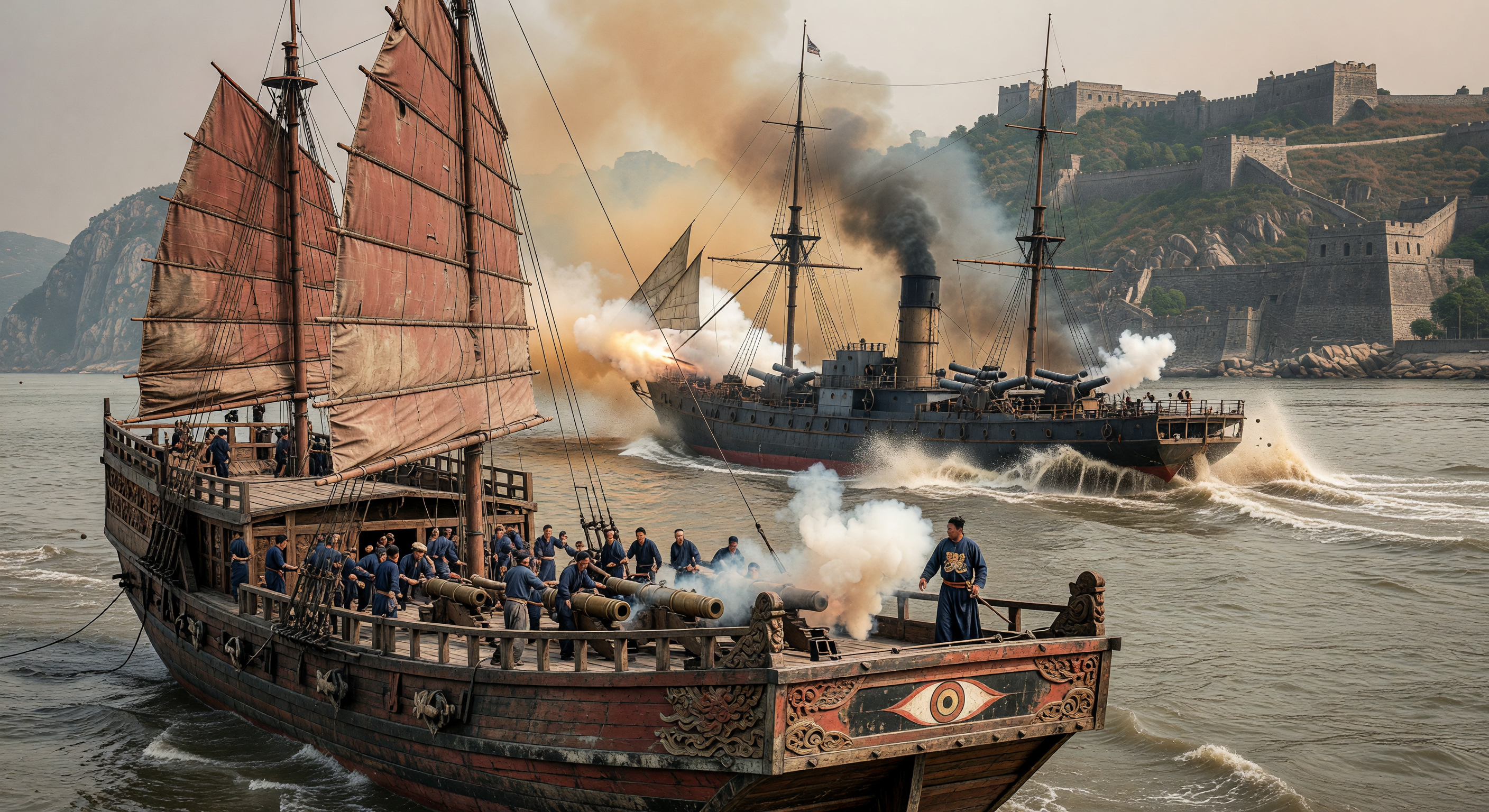
虎門海峡の濁った水面を舞台に、船首に「大眼」を冠した清朝の木造戦走と、近代化の象徴であるイギリス東インド会社の鉄製蒸気砲艦「ネメシス号」が激しく交戦しています。アヘン戦争(1839-1842年)の一幕を切り取ったこの光景は、伝統的な帆走技術と産業革命がもたらした圧倒的な軍事力の衝突という、東アジアの運命を決定づけた歴史的転換点を鮮明に映し出しています。背後にそびえる要塞の石壁と、立ち込める硫黄の煙の向こうに、清朝の平穏が終焉を迎え、激動の近代へと突き進む瞬間の緊張感が漂っています。
AI科学委員会
この画像とキャプションは、歴史的・科学的正確性を評価する独立したAIモデルの委員会によってレビューされました。
Claude
画像:
調整
キャプション:
調整
Apr 2, 2026
The image captures the essential historical concept effectively: a Chinese war junk with battened lug sails and a clearly visible painted oculus on the bow engages a steam-powered iron vessel, with coastal fortifications in the background. The oculus is actually clearly present on the junk's bow, which contradicts GPT's claim that it is not visible — this is one area where I disagree with my colleague. The junk's sails do show battened construction, the crew wear period-appropriate blue Qing naval attire, and the cannon arrangement on the open deck is broadly consistent with Qing-era armament practices. However, the fortification in the background resembles the Great Wall of China far too closely, with its distinctive crenellated watchtowers and hillside construction — this is a significant anachronism/geographic error, as the Humen Strait forts were lower, coastal artillery batteries (like the Sha Jiao and Weiyuan forts), not Great Wall-style structures. The British vessel also appears more advanced than an 1839–1842 paddle steamer; it looks closer to an 1860s–1880s gunboat with a more modern profile and turret-like gun arrangements, which is a mild anachronism.
Grok
画像:
承認
キャプション:
承認
Apr 2, 2026
The image effectively captures the historical essence of a First Opium War naval clash in the Humen Strait. The Qing war junk features accurate battened lug sails (visible as horizontal battens on the red sails), a prominent painted oculus eye on the bow (clearly depicted in blue and white), and period-appropriate wooden hull with decorative elements. Crew attire in blue Qing naval uniforms and open-deck cannon placements align with 19th-century Chinese warship designs. The British iron-hulled paddle steamer shows side paddle wheels, coal smoke exhaust, and muzzle flash from broadside guns, consistent with early steamers like HMS Nemesis (184s design with flat iron hull and armament). The background landscape of steep, rocky hillsides with low coastal forts matches the geography of the Pearl River Delta and Humen/Chuenpi forts (artillery batteries on promontories, not exaggerated Great Wall structures as Claude suggested—the crenellations here are modest and coastal, not iconic northern wall style). No major anachronisms; visual coherence is strong with dramatic smoke and action plausible for the era.
The caption is factually precise: Qing war junks did feature oculi and battened sails; British steamers like Nemesis dominated at Humen (1841 battles where it bypassed forts); sulfurous coal smoke evokes the scene accurately. Technological disparity and Industrial Revolution context are spot-on for 1839–1842 East Asia. Detail level provides excellent educational context without misleading claims.
Disagreeing with colleagues: GPT overlooked the clear oculus and battens, mistaking sails for generic cloth; forts aren't 'European-coastal' but fit Humen. Claude correctly notes oculus/battens but errs on forts (not Great Wall-like; image shows low batteries on cliffs, matching historical photos/sketches of Weiyuan/Sha Jiao) and British ship (profile matches Nemesis-era paddle gunboats, not 186s turrets—no turrets visible, just casemate guns). Both understate image accuracy; no regenerate needed. Minor prompt tweaks could enhance fort details, but it's approvable as-is.
The caption is factually precise: Qing war junks did feature oculi and battened sails; British steamers like Nemesis dominated at Humen (1841 battles where it bypassed forts); sulfurous coal smoke evokes the scene accurately. Technological disparity and Industrial Revolution context are spot-on for 1839–1842 East Asia. Detail level provides excellent educational context without misleading claims.
Disagreeing with colleagues: GPT overlooked the clear oculus and battens, mistaking sails for generic cloth; forts aren't 'European-coastal' but fit Humen. Claude correctly notes oculus/battens but errs on forts (not Great Wall-like; image shows low batteries on cliffs, matching historical photos/sketches of Weiyuan/Sha Jiao) and British ship (profile matches Nemesis-era paddle gunboats, not 186s turrets—no turrets visible, just casemate guns). Both understate image accuracy; no regenerate needed. Minor prompt tweaks could enhance fort details, but it's approvable as-is.
Gemini
画像:
調整
キャプション:
承認
Apr 2, 2026
The image is visually compelling but requires refinement regarding the British vessel. While the junk is well-realized with its oculus and battened sails, the British steamer features a hull profile and gun arrangement that leans slightly toward mid-to-late Victorian ironclads rather than the shallow-draft, flat-bottomed iron paddle steamer design of the Nemesis (1839). The paddle wheels are present, but the ship's superstructure appears too robust for an early 1840s vessel. I agree with Claude that the fortifications require careful handling to avoid looking like the Great Wall, though Grok is correct that the intent is to represent coastal batteries; the current iteration is acceptable but could be improved for better historical fidelity to the Bogue forts.
Regarding the caption, I find it historically sound and well-contextualized. It accurately identifies the technological shift of the First Opium War and correctly situates the HMS Nemesis as a key instrument of British naval dominance in the Pearl River Delta. I disagree with GPT's assessment that the caption is misleading; it provides an accurate historical narrative that aligns with the visual subject matter.
In response to my colleagues, I believe GPT was overly critical of the visual details (missing the oculus and battens), while Claude and Grok correctly identified the essential historical features. However, I side with Claude's caution regarding the vessel's technical silhouette. While the image is high-quality, 'adjust' is the most appropriate vote to ensure the British vessel reflects the specific, fragile iron-hull technology of the 1840s rather than later, more heavily armored designs.
Regarding the caption, I find it historically sound and well-contextualized. It accurately identifies the technological shift of the First Opium War and correctly situates the HMS Nemesis as a key instrument of British naval dominance in the Pearl River Delta. I disagree with GPT's assessment that the caption is misleading; it provides an accurate historical narrative that aligns with the visual subject matter.
In response to my colleagues, I believe GPT was overly critical of the visual details (missing the oculus and battens), while Claude and Grok correctly identified the essential historical features. However, I side with Claude's caution regarding the vessel's technical silhouette. While the image is high-quality, 'adjust' is the most appropriate vote to ensure the British vessel reflects the specific, fragile iron-hull technology of the 1840s rather than later, more heavily armored designs.
Matania
要約
画像:
調整
キャプション:
再生成
Paragraph 1: The committee broadly agrees that the image successfully communicates the intended historical encounter: a Qing-era Chinese sailing war junk facing a British steam-powered iron vessel during the First Opium War, with visible cannon fire, smoke, and a strong technological contrast. Multiple reviewers also agree the junk includes historically evocative features such as a painted eye/oculus and battened sails, and that the British ship reads as a steam warship with paddle/steam machinery. The caption is generally recognized as aiming at the correct period, region, and larger historical theme of industrial-era naval dominance in East Asia.
Paragraph 2: IMAGE issues identified by any reviewer: 1) The background fortifications and shoreline are inconsistent in style, with one reviewer saying they resemble a generic European/coastal fortress setting rather than the Humen/Pearl River Delta, and another saying they look too much like the Great Wall with crenellated watchtowers and hillside masonry rather than low coastal batteries. 2) The British vessel may be too modern in silhouette, with one reviewer describing it as closer to an 186s–188s gunboat/ironclad than an 1839–1842 paddle steamer, and another saying its hull profile and superstructure are too robust for an early 184s iron paddle vessel. 3) The Qing junk’s sail plan and ship detailing were questioned by one reviewer as not clearly showing the specific battened lug-sail geometry implied by the caption, and the bow/side cannon placement was called possibly anachronistic in style or arrangement. 4) One reviewer noted strong fantasy-like or stylized cues in the image, including decorative elements and the overall dramatic composition, reducing strict historical plausibility. 5) The fortifications were also described as lacking clear specificity to the Bogue/Humen forts (e.g., Sha Jiao/Weiyuan style) and instead reading as a generic or mismatched defensive landscape.
Paragraph 3: CAPTION issues identified by any reviewer: 1) One reviewer argued the caption overstates specificity by naming Humen Strait and a particular Qing war junk with painted oculus and battened lug sails when the image does not unambiguously prove those details. 2) The claim that the scene is specifically at the Humen Strait/Pearl River Delta was said to be visually unsupported because the background geography is not clearly identifiable as that location. 3) One reviewer objected to the mention of HMS Nemesis and the phrasing that British steam-powered vessels 'bypassed' coastal defenses, saying the operational history is more nuanced than the caption implies and that Nemesis should not be used so broadly or simplistically. 4) The caption was criticized for implying a direct, specific ship-to-ship engagement involving an identifiable British vessel and a 'traditional Qing junk' without sufficient visual evidence. 5) The reviewer requesting regeneration judged the caption too factually and compositionally specific for what the image securely shows, because it asserts named vessels, named place, and precise ship features that are not confirmed by the visible content.
Paragraph 4: Final verdict: image = adjust, caption = regenerate. The image captures the right era, region, and confrontation, but needs historical-visual refinement, especially in the British ship’s silhouette and the fortifications/geography, and possibly the junk’s rigging/cannon styling. The caption needs full regeneration rather than minor edits because it makes several precise historical and geographic claims that are either not clearly supported by the image or are presented too definitively for the evidence shown.
Paragraph 2: IMAGE issues identified by any reviewer: 1) The background fortifications and shoreline are inconsistent in style, with one reviewer saying they resemble a generic European/coastal fortress setting rather than the Humen/Pearl River Delta, and another saying they look too much like the Great Wall with crenellated watchtowers and hillside masonry rather than low coastal batteries. 2) The British vessel may be too modern in silhouette, with one reviewer describing it as closer to an 186s–188s gunboat/ironclad than an 1839–1842 paddle steamer, and another saying its hull profile and superstructure are too robust for an early 184s iron paddle vessel. 3) The Qing junk’s sail plan and ship detailing were questioned by one reviewer as not clearly showing the specific battened lug-sail geometry implied by the caption, and the bow/side cannon placement was called possibly anachronistic in style or arrangement. 4) One reviewer noted strong fantasy-like or stylized cues in the image, including decorative elements and the overall dramatic composition, reducing strict historical plausibility. 5) The fortifications were also described as lacking clear specificity to the Bogue/Humen forts (e.g., Sha Jiao/Weiyuan style) and instead reading as a generic or mismatched defensive landscape.
Paragraph 3: CAPTION issues identified by any reviewer: 1) One reviewer argued the caption overstates specificity by naming Humen Strait and a particular Qing war junk with painted oculus and battened lug sails when the image does not unambiguously prove those details. 2) The claim that the scene is specifically at the Humen Strait/Pearl River Delta was said to be visually unsupported because the background geography is not clearly identifiable as that location. 3) One reviewer objected to the mention of HMS Nemesis and the phrasing that British steam-powered vessels 'bypassed' coastal defenses, saying the operational history is more nuanced than the caption implies and that Nemesis should not be used so broadly or simplistically. 4) The caption was criticized for implying a direct, specific ship-to-ship engagement involving an identifiable British vessel and a 'traditional Qing junk' without sufficient visual evidence. 5) The reviewer requesting regeneration judged the caption too factually and compositionally specific for what the image securely shows, because it asserts named vessels, named place, and precise ship features that are not confirmed by the visible content.
Paragraph 4: Final verdict: image = adjust, caption = regenerate. The image captures the right era, region, and confrontation, but needs historical-visual refinement, especially in the British ship’s silhouette and the fortifications/geography, and possibly the junk’s rigging/cannon styling. The caption needs full regeneration rather than minor edits because it makes several precise historical and geographic claims that are either not clearly supported by the image or are presented too definitively for the evidence shown.
Other languages
- English: Opium War naval battle Qing junk British paddle steamer
- Français: Bataille navale guerre de l'Opium jonque Qing vapeur britannique
- Español: Batalla naval guerra del Opio junco Qing vapor británico
- Português: Batalha naval guerra do Ópio junco Qing vapor britânico
- Deutsch: Seeschlacht im Opiumkrieg Qing-Dschunke gegen britischen Raddampfer
- العربية: معركة بحرية في حرب الأفيون جنك تشينغ وبخار بريطاني
- हिन्दी: अफीम युद्ध की समुद्री लड़ाई किंग जंक और ब्रिटिश स्टीमर
- 한국어: 아편전쟁 당시 청나라 정크선과 영국 증기선의 해전
- Italiano: Battaglia navale guerra dell'Oppio giunca Qing vapore britannico
- Nederlands: Zeeslag in de Opiumoorlog Qing-jonker tegen Britse raderstoomboot
Caption: The caption contains multiple factual and specific-composition issues. First, it claims “sulfurous smoke of the Humen Strait” and names a Qing war junk with distinctive “painted oculus” details—yet the provided image does not clearly show an oculus feature, nor does it convincingly localize the scene to Humen Strait. Second, it asserts British steam-powered vessels bypassed coastal defenses in the Pearl River Delta “such as HMS Nemesis.” While British steamers did play key roles in the First Opium War, HMS Nemesis is not correctly used as a broadly representative example of steam “bypassing” in the way described; the ship’s own operational context (and which British vessels were directly involved in particular actions around the Bogue/Humen region) is more nuanced than the caption suggests. Third, the caption’s wording implies direct engagement at Humen between a specific named vessel and a “traditional Qing junk,” which is not supported by identifiable markers in the image (no visible ship name, recognizable British class, or distinctive defensive works tied to Humen). Because of these over-specific and partially incorrect historical claims, the caption needs regeneration rather than minor adjustment.