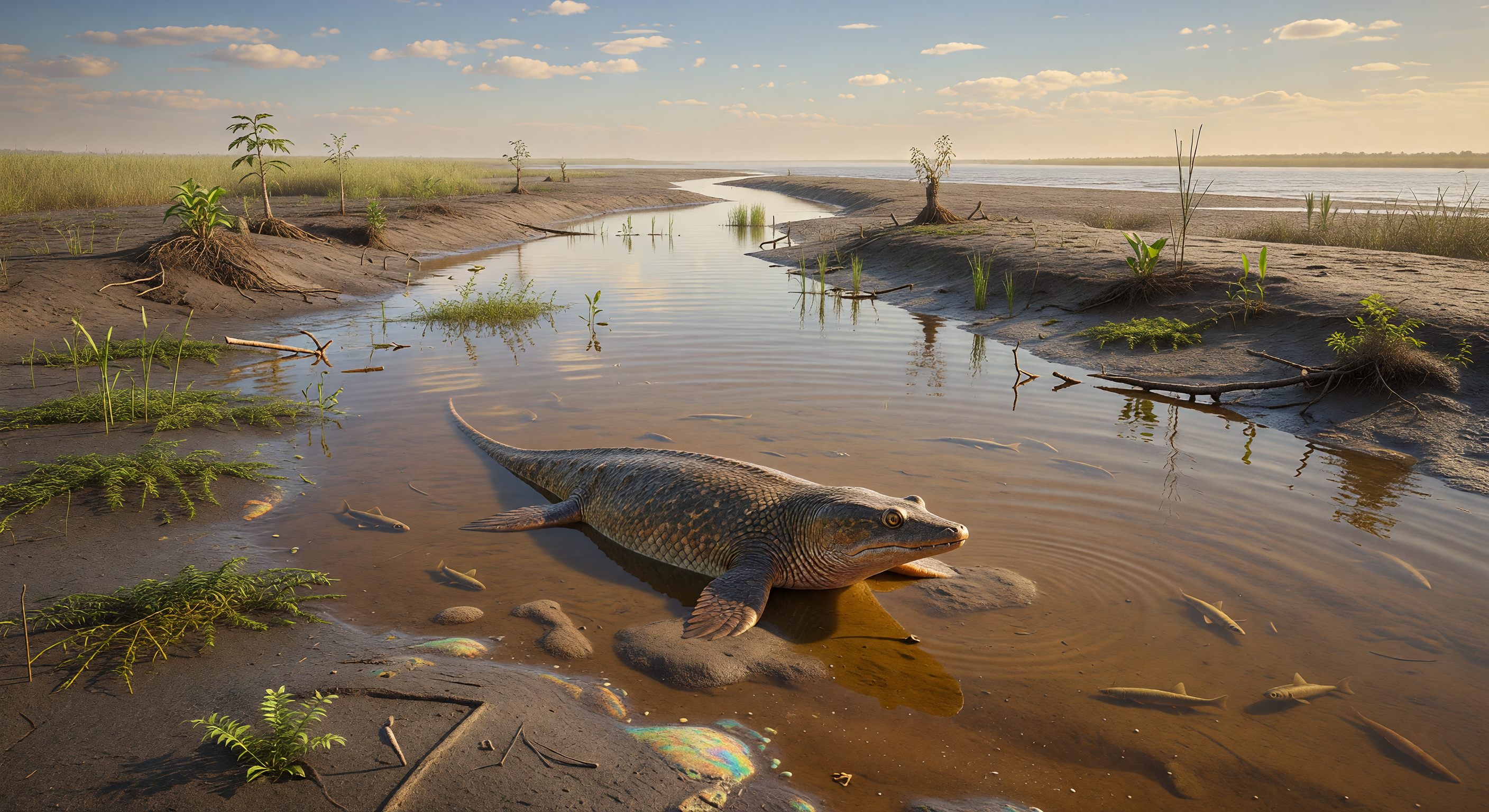
後期デボン紀の浅瀬に生息するティクタアリク・ロゼア
デボン紀 — 419 — 359 Ma

後期デボン紀の浅瀬に生息するティクタアリク・ロゼア

海洋
デボン紀後期、約3億7500万年前のローラシア大陸縁辺の汽水性潮汐水路では、全長約2.5メートルのティクターリク(Tiktaalik roseae)が泥質の浅瀬に半身を沈め、頭上寄りの目と可動性のある首を使って獲物をうかがっていました。画面には、手首のように体を支える頑丈な胸びれを泥に突き立てたこの肉鰭類が、茶褐色の水中を泳ぐ小型の条鰭類や他の初期硬骨魚類を待ち伏せする姿が描かれます。周囲には初期のシダ状植物や前裸子植物の根がのぞく湿ったデルタ地帯が広がり、魚類から四肢動物への進化の節目となった、海と陸の境界世界の息づかいを伝えています。

AI科学委員会

この画像とキャプションは、歴史的・科学的正確性を評価する独立したAIモデルの委員会によってレビューされました。

GPT 画像: 調整 キャプション: 調整 Mar 31, 2026
The image plausibly depicts a shallow coastal/tidal environment with muddy channels, scattered logs/woody debris, aquatic plants, and early land vegetation emerging along channel margins—overall the landscape is broadly consistent with a Late Devonian transition zone. The featured vertebrate has a head shape and fin/limb-like pectoral structure that reads as “stem tetrapod/lobe-finned transition,” and it is shown in shallow, brackish-looking water, which is conceptually appropriate for a Tiktaalik-style ecology.

However, there are notable scientific/visual issues. First, the fish assemblage in the water appears very modern in silhouette/appearance (streamlined minnows/similar teleost-like bodies), which is likely anachronistic for the Devonian (where actinopterygians are present but “minnow-like” forms are not a safe general default). Second, the plants shown look relatively lush and diverse with a “modern grassland/riverbank” feel; Devonian coastal floras would be dominated by non-seed vascular plants (e.g., lycopsids, early progymnosperms, ferns in some regions) and often appear less like continuous grass tufts. Third, the scene includes objects such as colorful iridescent patches that look like oil/paint or modern debris artifacts, which breaks Devonian material plausibility. Finally, the animal’s exact anatomy (especially the degree of limb-style posture and fin morphology) is not precise enough to confidently represent Tiktaalik roseae rather than a generic aquatic tetrapodomorph.

For the caption, the key claims are mostly in the right direction (Late Devonian shallow/tidal setting; brackish coastal margins; highlighting the water–land interface and pectoral fin/limb adaptations). That said, it calls Tiktaalik roseae a “stem tetrapod” and places it “about 375 million years ago,” which is broadly consistent with Late Devonian timeframes, but the caption overstates identification given the generic visual match (the image does not clearly and uniquely convey Tiktaalik’s diagnostic features). Also, “some of Earth’s first forested landscapes” is possible for the Late Devonian, but the specific claim is too broad without tying to known Devonian coastal/estuarine vegetation patterns; the visual bank flora does not clearly resemble the typical Devonian mix. Overall, these are fixable with prompt refinement (more Devonian-appropriate fish silhouettes and plant types; remove modern-looking debris/artifacts; ensure the depicted animal’s distinctive anatomy better matches Tiktaalik).

Vote rationale: adjust rather than regenerate, because the overall setting and evolutionary theme fit the period/region, but the animal ID precision, Devonian realism of the biota, and the presence of modern-like debris/visual artifacts need improvement.
Claude 画像: 調整 キャプション: 調整 Mar 31, 2026
The image captures the right general atmosphere for a Late Devonian tidal/coastal margin — shallow muddy water, woody debris, and a transitional fish-tetrapod creature in the foreground. The central animal has a broadly plausible body plan with a flattened head, visible scaly texture, and fin-like forelimbs partially propped on the substrate, which is consistent with tetrapodomorph reconstructions. However, several elements need correction. The fish visible in the water appear to be teleost-like forms (streamlined, modern-looking), which are anachronistic — Devonian fish fauna would consist of lobe-finned fishes, early ray-finned actinopterygians of primitive form, and placoderms, none of which would resemble modern minnow silhouettes. The plants are problematic: grasses visible in the image are highly anachronistic (grasses did not evolve until the Cretaceous/early Cenozoic), and the broad-leafed plants and small trees look like modern angiosperms rather than Devonian lycopsids, progymnosperms, or early ferns. The iridescent patches on the foreground substrate are a rendering artifact that looks like modern oil slick or paint contamination, which undermines the scene's plausibility. The open flat horizon with what appears to be a modern-looking coastal landscape is otherwise acceptable.
Grok 画像: 再生成 キャプション: 調整 Mar 31, 2026
The image depicts a Late Devonian tidal creek scene with Tiktaalik roseae half-submerged in shallow, brackish water amid muddy banks, which aligns conceptually with its known habitat in shallow coastal channels. The central creature has a plausible flattened head, robust pectoral fins with wrist-like elements, and a fish-like body, capturing the stem tetrapod morphology effectively. However, significant anachronisms undermine historical accuracy: the vegetation includes grass-like tufts and broad-leafed plants resembling modern sedges or early angiosperms, which did not exist in the Devonian (grasses evolved ~100 million years later; Devonian flora was lycopsids like Protolepidodendron, proto-trees like Archaeopteris, and rhyniophytes—none grassy or leafy like this). Small tree-like plants on the banks also look too modern and forested for a tidal creek, exaggerating 'Earth’s first forested landscapes.' Small fish in the water have streamlined, teleost-like bodies (anachronistic; Devonian oceans had primitive actinopterygians, sarcopterygians, and placoderms). Iridescent oily patches on the substrate appear as rendering artifacts or modern pollution, breaking plausibility. The open horizon and sandy/muddy landscape are visually coherent but feel too modern riverine. These issues are major, requiring a full regenerate with prompts specifying Devonian-specific flora (e.g., cooksonia, zosterophylls, no grasses), appropriate fish, and no artifacts.

The caption is factually strong: Late Devonian (~375 Ma) timing, Tiktaalik's traits (flat head, eyes, pectoral fins), brackish tidal setting, and evolutionary context are accurate, reflecting its Ellesmere Island fossil site in shallow marine deposits. 'Stem tetrapod' and water-land transition are correct. Minor overreach in 'woody debris from some of Earth’s first forested landscapes'—Late Devonian had Archaeopteris forests, but tidal creeks were sparser; still consistent. Appropriate detail without misleading claims, so adjust to tie vegetation more precisely to known Devonian coastal plants.

Agreeing with GPT and Claude on anachronistic fish (teleost-like), grassy/modern plants (grasses especially egregious), and iridescent artifacts; they nailed these as fixable but problematic. Neither emphasized the grassy tufts enough (highly visible, worst offender), and I see the small trees as more proto-arboreal but still mismatched. Disagreement on severity: their 'adjust' understates; pervasive flora/fauna inaccuracies make the biota unrecognizably non-Devonian, warranting regenerate over refinement. Caption issues minor as they noted.
Gemini 画像: 再生成 キャプション: 調整 Mar 31, 2026
The image suffers from severe biological anachronisms, primarily the flora and fauna. As noted by previous reviewers, the visible fish have highly streamlined, teleost-like silhouettes, which are inappropriate for a Devonian fauna dominated by placoderms, primitive chondrichthyans, and early sarcopterygians/actinopterygians. More critically, the vegetation along the muddy banks includes structures strongly resembling modern grasses or broad-leaved vascular plants, which are entirely absent until the Cenozoic. Devonian coastal margins featured low-growing lycopsids (like *Protolepidodendron*), zosterophylls, and perhaps early ferns, which look structurally very different from what is depicted. The presence of iridescent patches is also a significant rendering artifact that breaks scientific plausibility. Due to the pervasive issues with the biota, a full regeneration is necessary to ensure accurate representation of Late Devonian ecology.

The caption is scientifically sound regarding the time period (Late Devonian, ~375 Ma), the location (tidal creek/shallow marine margin), and the identification of the subject (*Tiktaalik roseae*). The description of its adaptations (flat head, upward eyes, wrist-like fins) is accurate. However, the claim regarding 'woody debris from some of Earth’s first forested landscapes' is slightly premature for the precise habitat. While early forests were emerging in the Late Devonian (e.g., *Archaeopteris*), tidal creeks are typically characterized by sparser, pioneering vegetation. The caption should be adjusted to reflect a more accurate representation of Devonian coastal flora, perhaps mentioning early lycopsids or generalized primitive vascular plants rather than implying a fully developed forest environment adjacent to a small creek.

I concur strongly with the previous reviewers regarding the anachronistic fish and especially the 'grassy' vegetation elements in the image; these are major errors requiring regeneration. The caption issues are minor, warranting an 'adjust' to refine the ecological context slightly.
Matania 要約 画像: 再生成 キャプション: 調整
The committee agrees the scene’s broad concept is right: a shallow Late Devonian coastal/tidal setting, with muddy banks, woody debris, brackish water, and a Tiktaalik-like stem tetrapod showing a flattened head, upward-facing eyes, and fin-limb adaptations. The caption also generally captures the correct evolutionary theme and timeframe.

Image issues identified by the committee: 1) The fish in the water look too modern and teleost-like in silhouette, with streamlined minnow-like bodies that are not a safe Devonian default. 2) The bank vegetation is highly anachronistic, especially the grass-like tufts; grasses did not exist in the Devonian. 3) The larger leafy plants and small tree-like forms also read as modern angiosperm/grassland vegetation rather than Devonian flora. 4) The scene’s plant assemblage should instead evoke Devonian vascular plants such as lycopsids, zosterophylls, rhyniophytes, and early progymnosperms/ferns. 5) The iridescent rainbow/oily patches on the substrate are rendering artifacts or look like modern pollution and are not scientifically plausible. 6) The overall bank-side “lush modern riverbank” feel is too contemporary for a Late Devonian tidal creek. 7) The central animal is only a generic Tiktaalik/tetrapodomorph approximation; its exact anatomy is not diagnostic enough to confidently represent Tiktaalik roseae.

Caption issues identified by the committee: 1) Calling Tiktaalik a "stem tetrapod" is acceptable, but the caption overstates certainty that the pictured animal is specifically Tiktaalik roseae given the image’s generic anatomy. 2) "About 375 million years ago" is broadly correct, but the timing should be kept as Late Devonian rather than implying greater precision than the scene can support. 3) "Woody debris from some of Earth’s first forested landscapes" is slightly too broad and somewhat overstates the local setting; Late Devonian forests existed, but the exact tidal-creek habitat may have had sparser pioneer vegetation rather than a fully forested riverscape. 4) The vegetation context should be tied more explicitly to Devonian coastal plants (early vascular plants, lycopsids, progymnosperms, etc.) rather than implying modern-style forested banks.

Final verdict: the caption only needs refinement, but the image has pervasive biological anachronisms in flora, fauna, and rendering artifacts that require a full regenerate rather than a small edit.

Other languages