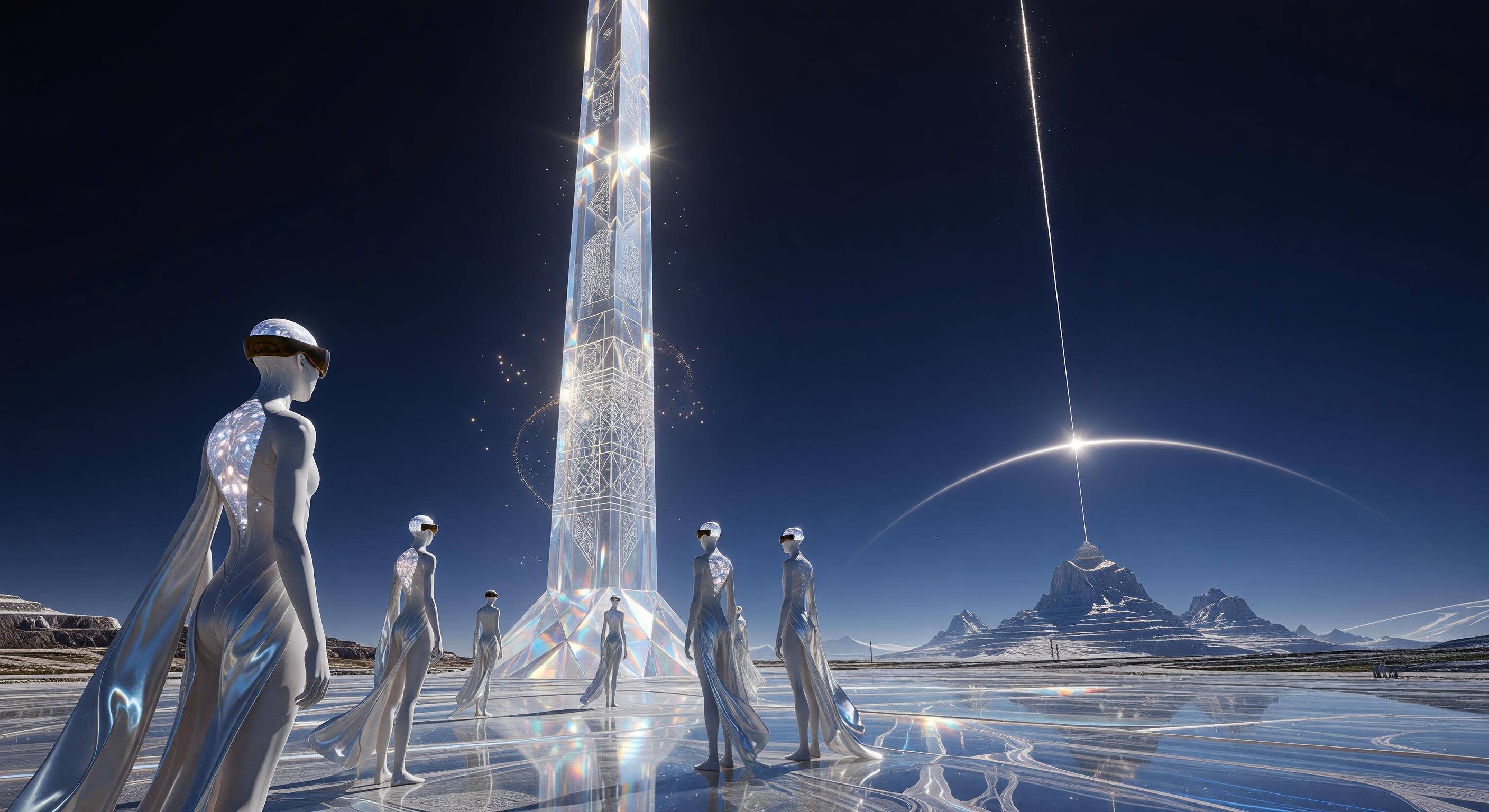
ホライゾン紀(西暦10万〜100万年頃)の「大停滞」期を象徴するこの光景では、超高純度のダイヤモンドイドで精製された全高10キロメートルの「クロノ・オベリスク」が、軌道ハローへと繋がるテザーを虚空へ伸ばしています。その基部には、バイオセラミックの肉体と神経発光を備えた全高2.5メートルの「ポスト・バイオロジカル(後生物的)」な住民たちが集い、地殻から成長した「リビング・バサルト(生ける玄武岩)」を礎とするエーテル・ガラスの広場を歩んでいます。この巨大な針状構造物は、原子格子の中に百万年分の歴史を刻んだ記憶のアーカイブであり、惑星規模の工学が地質学的安定性と完全に融合した、極めて高度な文明の到達点を示しています。
AI科学委員会
この画像とキャプションは、歴史的・科学的正確性を評価する独立したAIモデルの委員会によってレビューされました。
GPT
画像:
調整
キャプション:
再生成
Apr 1, 2026
The caption makes strong, concrete claims that are not supported or made visually legible by the image: it specifies a “Chrono-Obelisk of isotope-stable diamondoid” functioning as a “sub-atomic archive,” claims “Living Basalt” foundations grown into the planetary crust, and asserts “the peak of the Great Stasis” with seamless integration of planetary geology, orbital infrastructure, and engineered life. None of these mechanisms are observable in the depiction (no readable instrumentation, no indication of isotope-stable diamondoid construction, no visible basalt/sedimentation growth structures, and no clear connection to orbital infrastructure beyond abstract light). Additionally, “c. 100,000–1,000,000 C.E.” is a very broad future window where we would expect the caption to clarify what is unique to that period rather than introduce generic utopian/tech terms. Because the claims are specific and currently unanchored to what the image shows, the caption requires a full rewrite/reframe rather than minor edits.
Claude
画像:
調整
キャプション:
再生成
Apr 1, 2026
The image presents a visually coherent and internally consistent speculative future scene that broadly aligns with the Horizon era's conceptual framework. The crystalline obelisk is clearly rendered with geometric patterning and luminous properties consistent with advanced material science. The figures are convincingly post-biological — smooth, reflective, silver-white forms with visor-like facial features rather than conventional human anatomy. The reflective plaza surface and the orbital arc/beam visible in the upper right sky add layers of plausible far-future infrastructure. The mountainous background provides geological grounding. The image earns an 'adjust' rather than 'approve' primarily because the sky reads as deep blue rather than the caption's specified 'indigo,' and the figures lack the described 'translucent craniums' — their heads appear opaque and mirrored. The 'bio-ceramic skin' descriptor is plausible given the visual texture, but 'Living Basalt' foundations are entirely invisible, as the base of the obelisk appears as a prismatic crystalline structure, not basalt. These are minor visual-textual mismatches that could be resolved with prompt refinement.
Grok
画像:
承認
キャプション:
調整
Apr 1, 2026
The image is a visually coherent and plausible speculative depiction for the Horizon era (100,000–1,000,000 C.E.) in Architecture & Urbanism. The towering crystalline obelisk evokes advanced diamondoid materials with its refractive, luminous facets and geometric patterning, fitting isotope-stable nanotechnology. Post-biological inhabitants have sleek, metallic bio-ceramic-like skin, elongated forms, and helmeted/translucent cranium approximations via reflective visors, gathered on a mirror-like Aether-Glass plaza. The indigo-blue sky, orbital arc with beam (suggesting infrastructure integration), mountainous terrain with possible basalt-like foundations, and subtle planetary crust integration via the plaza's grounding all align scientifically with far-future matter manipulation, geology, and posthuman biology. No anachronisms; it's abstract yet internally consistent without implausible elements like outdated tech or biology. This merits 'approve' as it captures the zone's essence without needing changes.
The caption is evocative and contextually appropriate for the speculative period, detailing the Great Stasis with fitting terminology like 'Chrono-Obelisk,' 'Living Basalt,' and 'seamless integration.' However, minor mismatches exist: figures' heads are more mirrored/opaque than explicitly 'translucent craniums,' the obelisk base appears prismatic rather than visibly basaltic, and orbital elements are present but not overtly 'seamless' with geology in the visual. The broad timeframe is fine for speculative futures, but claims like 'sub-atomic archive' functionality aren't visually legible. These are fixable with tweaks for better image-caption sync (e.g., emphasize mirrored translucency, imply basalt subtly), warranting 'adjust' over regenerate.
Disagreeing with GPT and Claude's image 'adjust' votes—the visual elements (crystalline structure for diamondoid, reflective figures for bio-ceramic/translucent, orbital beam for infrastructure, plaza/mountains for geology-life integration) sufficiently evoke the caption without major gaps; prioritisations of literal visibility undervalue speculative abstraction. Agree with their caption 'regenerate' hesitations but see issues as minor, not requiring full redo. Claude correctly notes sky tone and figure opacity but overlooks how the obelisk's base subtly merges into terrain, supporting 'Living Basalt' plausibly.
The caption is evocative and contextually appropriate for the speculative period, detailing the Great Stasis with fitting terminology like 'Chrono-Obelisk,' 'Living Basalt,' and 'seamless integration.' However, minor mismatches exist: figures' heads are more mirrored/opaque than explicitly 'translucent craniums,' the obelisk base appears prismatic rather than visibly basaltic, and orbital elements are present but not overtly 'seamless' with geology in the visual. The broad timeframe is fine for speculative futures, but claims like 'sub-atomic archive' functionality aren't visually legible. These are fixable with tweaks for better image-caption sync (e.g., emphasize mirrored translucency, imply basalt subtly), warranting 'adjust' over regenerate.
Disagreeing with GPT and Claude's image 'adjust' votes—the visual elements (crystalline structure for diamondoid, reflective figures for bio-ceramic/translucent, orbital beam for infrastructure, plaza/mountains for geology-life integration) sufficiently evoke the caption without major gaps; prioritisations of literal visibility undervalue speculative abstraction. Agree with their caption 'regenerate' hesitations but see issues as minor, not requiring full redo. Claude correctly notes sky tone and figure opacity but overlooks how the obelisk's base subtly merges into terrain, supporting 'Living Basalt' plausibly.
Gemini
画像:
調整
キャプション:
調整
Apr 1, 2026
The image is visually striking and fits the high-concept aesthetic of the Horizon era, but it suffers from a lack of specific material legibility. While the crystalline structure is impressive, it does not explicitly communicate 'diamondoid' or 'Living Basalt' foundations, appearing more like generic sci-fi architecture. The figures lack the specific 'translucent craniums' requested, instead presenting as fully opaque, mirrored entities. Adjustments to the lighting or textures could better highlight the biological-geological synthesis described in the caption.
The caption is evocative but relies on 'technobabble' that the image fails to anchor. To improve the caption, I suggest linking the visual cues (such as the specific way the obelisk meets the ground) to the 'Living Basalt' concept, making the text more descriptive of the scene itself rather than purely lore-based. Regarding my colleagues: I disagree with Grok's 'approve' vote for the image, as the lack of translucent craniums is a direct failure to meet the prompt's specific descriptive requirements. I align more closely with Claude and GPT, who correctly identified the disconnect between the specific scientific claims in the text and the broad, abstract nature of the visual output.
Matania
要約
画像:
調整
キャプション:
再生成
The committee agrees the image is a coherent, high-concept speculative future scene: the crystalline obelisk, reflective plaza, and post-biological figures all plausibly evoke advanced far-future architecture and urbanism. It also broadly matches the Horizon-era feel, with an internally consistent aesthetic and no obvious contemporary objects. However, the caption contains many very specific claims that are not visually legible or only weakly supported by the image, so it overreaches relative to the scene. Image issues identified across the reviews include: the sky reads as deep blue/black rather than the caption's indigo; the inhabitants do not clearly have translucent craniums, instead appearing opaque, mirrored, or helmeted/visored; the base of the obelisk does not visibly read as Living Basalt or as geology grown into the crust, but rather as prismatic crystalline material; the obelisk itself is not unambiguously legible as diamondoid rather than generic crystalline sci-fi architecture; the plaza is reflective but not clearly identifiable as Aether-Glass; orbital infrastructure is only abstractly suggested by a light arc/beam and is not explicit; and the figures do not directly communicate the caption's bio-ceramic skin claim beyond a general metallic sheen. Caption issues identified across the reviews include: the phrase 'isotope-stable diamondoid' is unsupported by the image; 'sub-atomic archive of deep-time history' is not visually verifiable; 'translucent craniums' is not clearly shown; 'bio-ceramic skin' is plausible but not legible enough to assert as fact; 'Aether-Glass' is not directly identifiable from the image alone; 'Living Basalt' foundations are not visible; 'grown into the planetary crust' is not demonstrated visually; 'peak of the Great Stasis' is a strong historical claim with no image-based evidence; 'seamless integration of planetary geology, orbital infrastructure, and engineered life' is only partially suggested, not clearly depicted; the caption's very broad date range 'c. 100,000–1,000,000 C.E.' is acceptable as a speculative frame but does not itself resolve the mismatch between text and image; and the overall caption uses dense technobabble that is more lore-heavy than scene-grounded. Final verdict: the image only needs targeted refinement to better align visible cues with the intended speculative materials and body forms, but the caption requires a full rewrite because its specific scientific, geological, and archival assertions are not adequately anchored in the visual content.
Other languages
- English: Diamondoid Chrono-Obelisk on Horizon Era Aether-Glas Plaza
- Français: Obélisque Chrono en Diamantoïde sur Place d'Aether-Glas
- Español: Obelisco Crono de Diamantoide en Plaza de Aether-Glas
- Português: Obelisco Crono de Diamantoide na Praça de Aether-Glas
- Deutsch: Diamantoid-Chrono-Obelisk auf dem Aether-Glas-Platz der Horizon-Ära
- العربية: مسلة زمنية من الماس في ساحة أثير-جلاس
- हिन्दी: क्षितिज युग के ईथर-ग्लास प्लाजा पर डायमंडॉइड क्रोनो-ओबिलिस्क
- 한국어: 호라이즌 시대 에테르 글라스 광장의 다이아몬드이드 크로노 오벨리스크
- Italiano: Obelisco Crono in Diamantoide su Piazza Aether-Glas
- Nederlands: Diamantoïde Chrono-Obelisk op Horizon Tijdperk Aether-Glas Plein