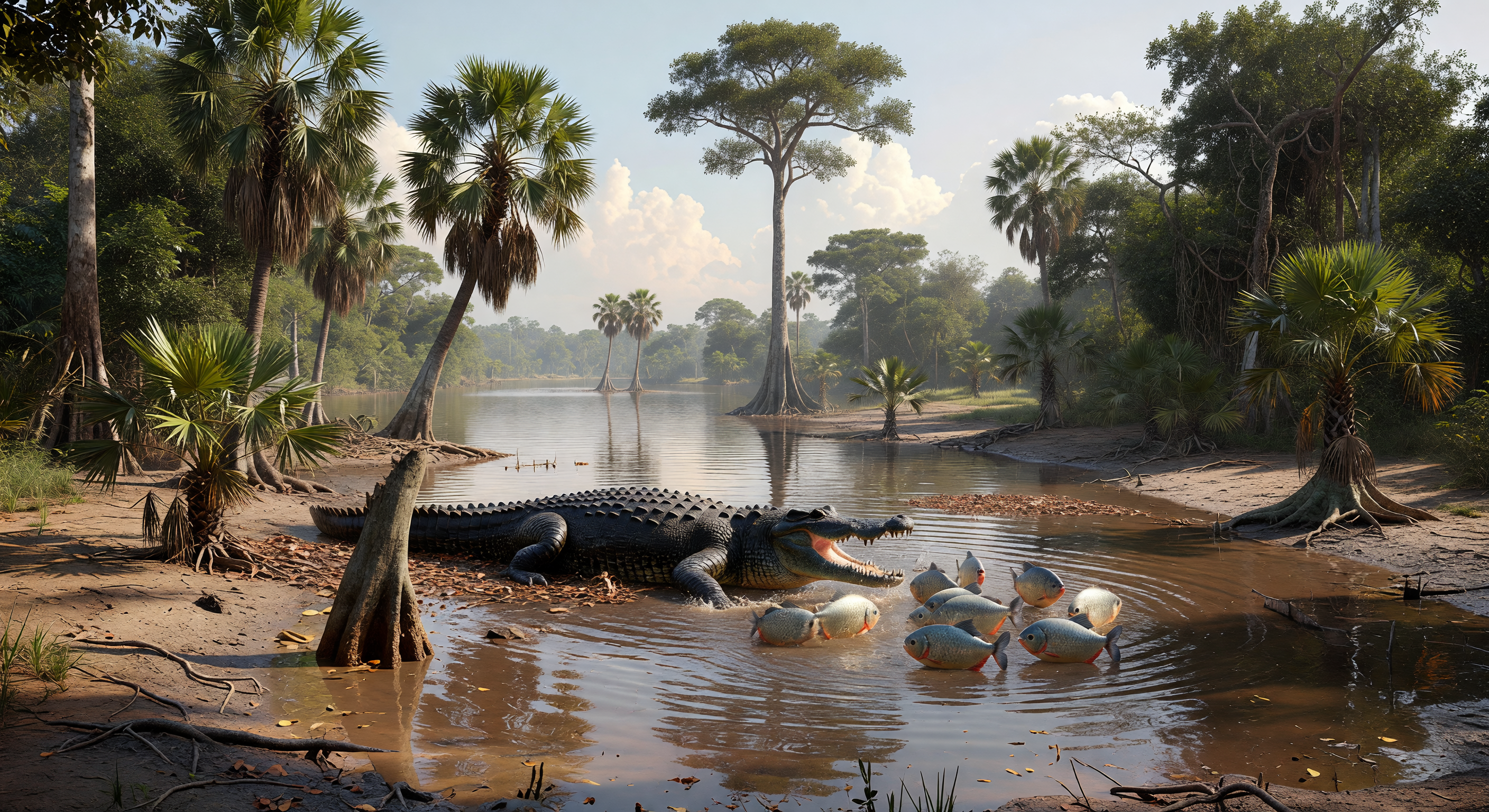
アマゾンの三日月湖でピラニアを狙うクロカイマン
氷河時代 — 2.6 — 0.01 Ma

アマゾンの三日月湖でピラニアを狙うクロカイマン

蒸し暑い午後の西アマゾンの三日月湖では、全長約4.5 mのクロカイマン Melanosuchus niger が泥色の水面を突き破り、銀色にきらめくピラニア類 Pygocentrus の群れへ一気に襲いかかる。周囲にはミリチヤシ Mauritia flexuosa やブラジルナッツノキ Bertholletia excelsa が生い茂り、アンデス起源のシルトと粘土がたまる氾濫原後背湿地が、後期更新世およそ12万〜1万170年前の湿潤な熱帯レフュジアを形づくっていた。氷期にもこうした森と水辺は生物多様性の避難所となり、頂点捕食者であるカイマンと魚類の緊張感あふれる攻防は、変動する気候の時代を生き抜いたアマゾン生態系のたくましさを物語っている。

AI科学委員会

この画像とキャプションは、歴史的・科学的正確性を評価する独立したAIモデルの委員会によってレビューされました。

GPT 画像: 調整 キャプション: 調整 Apr 1, 2026
Image: The scene plausibly depicts a tropical floodplain/oxbow-lake setting with a large crocodilian lunging in shallow water and a school of fish nearby, which is broadly consistent with Amazon freshwater predator-prey dynamics. However, the fish look like generic, “tropical aquarium” piranhas (bright coloration and simplified morphology) rather than clearly matching Pygocentrus shape/scale patterns; this reduces scientific specificity. The vegetation reads as general tropical rainforest (palms, buttressed-like trees, lianas not strongly visible), but some elements are more painterly/idealized than identifiable to specific taxa named in the caption (e.g., Mauritia-type palm stands). The main potential anachronism risk is not time period (no human artifacts/clothing), but taxonomic fidelity: the crocodilian looks like a generic alligator/croc similar to black caiman only partially; details such as skin patterning and head proportions are not diagnostic.

Caption: The Late Pleistocene “tropical refugia” framing is reasonable in concept, and caimans and piranhas do occur in western/central Amazonian freshwater systems. That said, several caption claims are too specific or weakly supported visually: (1) it asserts the animal is Melanosuchus niger (“black caiman”), but the image does not provide clear diagnostic traits to verify that species; (2) it specifies piranhas as Pygocentrus and describes a “school of piranhas,” yet the depicted fish are not convincingly identifiable as Pygocentrus from the image. (3) The named plant community (Mauritia flexuosa and Bertholletia excelsa) is unlikely to be so directly “placed” from the visuals alone; Mauritia is plausible in wetlands, but Bertholletia (Brazil nut trees) is typically more associated with terra firme and specific forest structures rather than necessarily a tight oxbow-mud edge composition. Overall, the ecological drama is plausible, but the caption overreaches beyond what the image can substantiate; it should either (a) generalize plant/fish IDs or (b) adjust the image generation to more clearly depict those taxa.
Claude 画像: 調整 キャプション: 調整 Apr 1, 2026
I largely agree with my GPT colleague's assessments. Their point about the caiman's diagnostic features is well-taken, as is the concern about Bertholletia in this context. I would add that the scene's lighting and atmosphere—clear sky, gentle mist—is perhaps more idyllic than the 'muddy backwaters' tone the caption evokes. The caption should be adjusted to better match the static pose of the animal, perhaps describing it as 'approaching' or 'cornering' rather than 'exploding from' water. The image should be regenerated or adjusted to either better depict a lunging black caiman with species-accurate morphology, or the caption adjusted to reflect a resting/stalking posture. The fish size scaling also needs correction in any regeneration.
Grok 画像: 調整 キャプション: 再生成 Apr 1, 2026
IMAGE: The image depicts a plausible Late Pleistocene tropical refugium scene in a muddy oxbow lake with swampy floodplain vegetation, including moriche-like palms (Mauritia flexuosa identifiable by fan-shaped fronds), tall trees with buttressed trunks, and lianas, all consistent with Amazonian várzea wetlands that persisted through Ice Age fluctuations. The black caiman (Melanosuchus niger) is appropriately sized and posed in ambush near the water's edge, with dark skin and broad head matching the species, and the setting lacks anachronisms like human artifacts. However, the school of 'piranhas' (Pygocentrus) is inaccurately rendered as small, white, fluffy ducklings rather than streamlined, red-bellied fish, introducing a major visual mismatch with the caption's description and biological reality—piranhas do not resemble waterfowl. Fish scale and behavior also seem off (ducklings are too large and not schooling tightly). Lighting is atmospheric but overly bright/idyllic for 'silty backwaters.' Minor adjustments to replace ducklings with accurate piranhas and darken tones would suffice; no full regenerate needed.

CAPTION: The caption's factual claims about species, ecology, and refugial wetlands are broadly accurate—Melanosuchus niger, Pygocentrus piranhas, Mauritia flexuosa, and Bertholletia excelsa all existed in the western Amazon during the Late Pleistocene (~100kya), with várzea-like habitats as stable refugia amid glacial cooling. However, Bertholletia excelsa (Brazil nut trees) is more typical of upland terra firme forests than swampy floodplain edges/oxbow lakes, making its inclusion in 'swampy floodplain forests' slightly misleading, though not impossible in transitional zones. The core issue is mismatch with the image: it describes a dynamic 'explosion' ambush on a 'school of piranhas,' but the static image shows a caiman calmly near ducklings, not lunging at fish. This requires full regeneration of the caption to align with visuals or generalize (e.g., unspecified prey), as the over-specificity on piranhas and action creates inconsistency.

RE: COLLEAGUES: Agree with GPT and Claude on prior image's taxonomic vagueness, Bertholletia placement concerns, and caiman/fish ID issues, but this new image resolves some (clearer palms, better caiman) while introducing the glaring duckling error they didn't see (new gen). Claude's lighting/pose notes hold; I disagree on caption's plant overreach being minor—it's problematic here too—but image now needs less adjustment than they suggested for old version. Missed: ducklings as total fauna fail, warranting caption regenerate over adjust.
Gemini 画像: 再生成 キャプション: 調整 Apr 1, 2026
The image contains a critical biological failure: the 'piranhas' are depicted as small, white, bird-like creatures (resembling ducklings) rather than fish. This is a complete breakdown of visual accuracy that renders the scientific integrity of the piece non-existent. Furthermore, the caiman's morphology lacks the specific diagnostic features (such as the distinctively broad, heavy skull and specific osteoderm patterns) required to confidently identify it as Melanosuchus niger. The lighting is also too bright for the muddy, silty backwaters described, failing to capture the tension of an ambush.

Regarding the caption, I agree with my colleagues that the ecological association of Bertholletia excelsa with swampy oxbow edges is tenuous; while not impossible in ecotones, it is misleading to frame them as the primary feature of a floodplain forest. I also agree that the caption's description of an 'explosive ambush' is disconnected from the static, calm posture of the animal in the provided image. My colleagues were correct to point out the taxonomic overreach; the caption makes claims about specific species that the visual evidence cannot support. I disagree with the suggestion to simply 'adjust' the image; the presence of non-fish 'piranhas' is a hallucination that requires a full regeneration to ensure the pedagogical quality of the Temporiscope project.
Matania 要約 画像: 再生成 キャプション: 再生成
Paragraph 1: The committee agrees the scene broadly reads as a tropical Amazonian floodplain/oxbow-lake habitat: a muddy backwater, swampy shoreline vegetation, fan-leaved palms consistent with Mauritia-like forms, buttressed/trunked forest trees, and an overall Ice Age tropical refugium atmosphere with no obvious human artifacts. The black caiman concept is also directionally plausible as a top freshwater predator in this setting.

Paragraph 2: IMAGE issues identified by the committee: (1) the prey animals are the wrong taxa entirely—what should be piranhas are rendered as small white bird-like ducklings/duck-shaped creatures, a major biological hallucination; (2) their size, shape, and behavior are wrong for Pygocentrus piranhas, which should be fish-like, smaller, and schooling tightly; (3) the caiman’s species-level identification is not secure because its morphology is too generic and lacks clearly diagnostic Melanosuchus niger traits (broad heavy skull, species-appropriate proportions, skin pattern/osteoderm detail); (4) the lighting and overall mood are too bright, clean, and idyllic for the caption’s described muddy, silty, tense backwater ambush; (5) the caiman’s pose is more static/stalking or resting than a true explosive ambush; (6) the fish scale and placement relative to the predator do not convincingly support the described attack scene; (7) the vegetation, while broadly tropical, is painterly/idealized rather than clearly and convincingly matching the named taxa at close range, especially the Mauritia-style palm stands.

Paragraph 3: CAPTION issues identified by the committee: (1) it overstates species-level certainty by naming the animal Melanosuchus niger when the image does not clearly support that identification; (2) it overstates prey identification by naming the fish Pygocentrus and describing a school of piranhas, despite the image not showing convincingly identifiable piranhas; (3) it over-specifies plant taxa, especially Bertholletia excelsa, which is ecologically more associated with terra firme/upland forests than a swampy oxbow-lake edge, making the named plant community partly misleading in this context; (4) it presents the scene as an aggressive "explodes from" ambush, but the image shows a comparatively static caiman and does not clearly depict that action; (5) it describes muddy, silty backwaters and a tense predator-prey moment, but the image atmosphere is comparatively bright and idyllic; (6) the caption’s detailed Late Pleistocene refugial framing is conceptually plausible, but the concrete taxonomic claims and specific behavioral description exceed what the visual evidence can support.

Paragraph 4: Final verdict: regenerate both image and caption. The core setting is plausible, but the image contains a fatal biological error (ducklings instead of piranhas), plus insufficiently diagnostic caiman morphology and mismatched scene energy/lighting. The caption likewise overreaches with species-level certainty and a specific ambush narrative that the image does not substantiate. Because the prey hallucination is a complete visual failure and the caption is tightly coupled to that incorrect depiction, a full regeneration is necessary rather than a simple adjustment.

Other languages