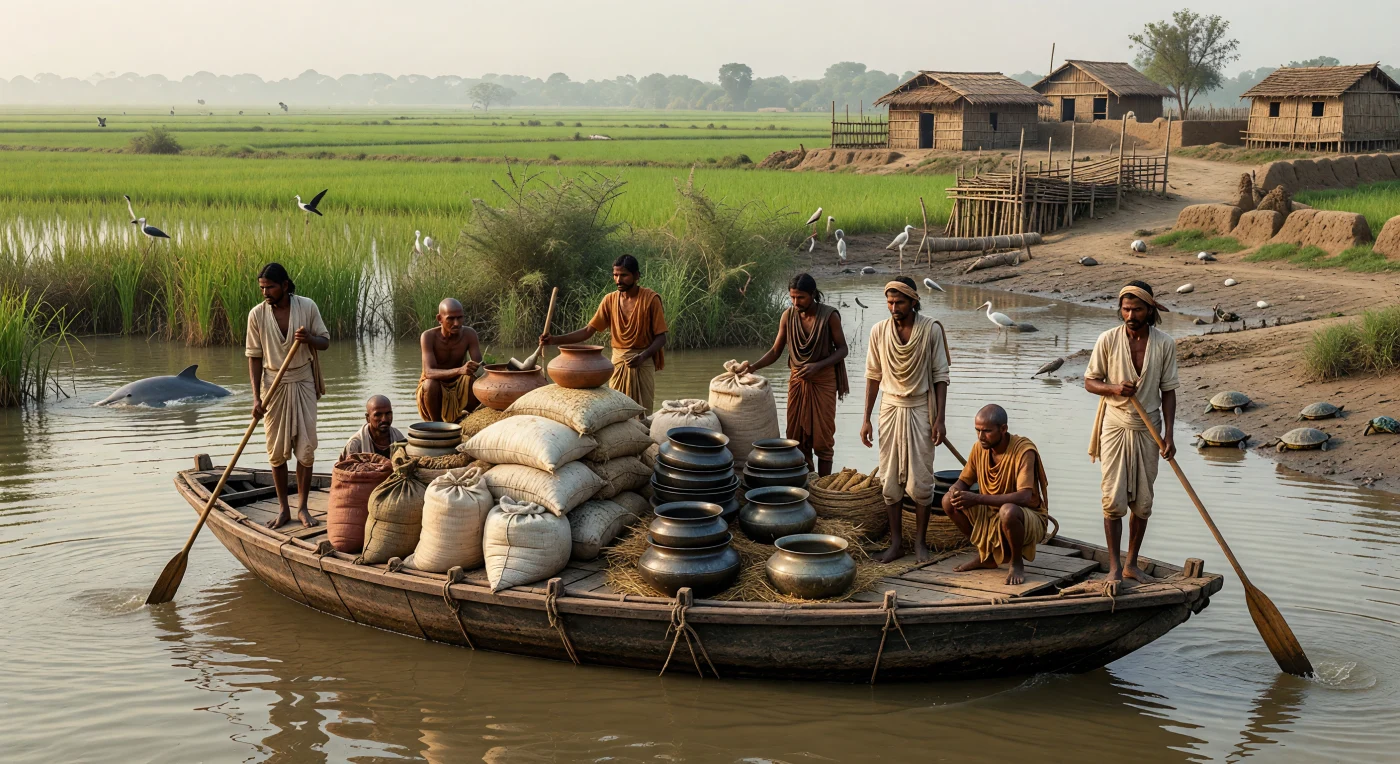
A broad wooden ferry crosses the silty waters of the middle Ganga, laden with sacks of unhusked rice, gleaming black-burnished vessels, merchants in simple wrapped cotton cloth, and a few shaven-headed ascetics traveling among the cargo. Set in the 6th century BC, when the middle Ganga plain was becoming a center of early states and expanding trade, the scene evokes a river world where commerce, agriculture, and new religious movements moved along the same waterways. The dolphin, turtles, reed beds, and distant wattle-and-daub settlement emphasize the rich floodplain environment that supported this transformation.

An open-air Vedic sacrificial ground unfolds within an elite homestead of the Kuru-Pañcāla region, where Brahmin ritualists in unstitched cotton garments tend a brick-lined fire altar as a noble patron pours clarified butter from a copper vessel. Timber posts, reed canopies, wattle fencing, and mud-plastered buildings evoke the material world of late Vedic North India around 800–600 BC, before temples and image worship became central to South Asian religious life. The scene reflects a society in which sacred ritual, oral tradition, and aristocratic patronage were closely intertwined.

At first light, villagers in the upper Ganga plain sweep freshly plastered courtyards beside wattle-and-daub houses roofed with thick thatch, while zebu cattle, goats, and chickens animate the settlement’s edge. The scene reflects the Painted Grey Ware horizon of c. 900–700 BC in the Kuru-Pañcāla region, a period of expanding agriculture, early iron use, and increasingly settled village life in northern South Asia. Fine grey bowls painted with black geometric designs, set among coarser household pottery and simple farming tools, signal the material culture associated with these early Iron Age communities.

A dusty road winds toward the great cyclopean walls of Rajgir, capital of Magadha, where traders, porters, cattle, and elephant handlers converge beneath the enclosing hills of the middle Ganga valley. The scene evokes eastern India around 600–500 BC, when fortified towns of timber, earth, and mud-plastered houses marked a new phase of urban growth in the age of the mahājanapadas. Rajgir’s massive dry-stone defenses, among the earliest monumental fortifications in South Asia, reflect both the political ambitions of Magadha and the intensifying movement of goods, labor, and people in the Iron Age.

At the forested edge of the middle Ganga plain around 600–500 BC, cultivators stand on simple bamboo watch platforms and rattle split-bamboo clappers to protect their wet-rice fields as a small herd of Asian elephants emerges from sal woodland and reeds. Muddy bunds, irrigation channels, egrets, and the tracks of wild buffalo evoke the rich, waterlogged ecology of eastern North India, where expanding agriculture pressed against habitats still shared with powerful wild animals. The scene captures a frontier landscape of the early mahājanapada age, when settled farming communities in the Ganga valley were growing alongside increasingly dense forests and wetlands.

In this reconstruction of the Iron Age Deccan, two artisans work side by side in a modest rural craft yard: an ironsmith shapes a bloom-forged sickle beside a small clay furnace while a potter finishes black-and-red ware vessels on a slow wheel. Such scenes reflect the megalithic cultures of peninsular India around 700–500 BC, when iron tools and distinctive ceramics were central to farming and daily life. The thatched shelter, wattle-and-daub buildings, charcoal, slag, and drying pottery evoke a technology based on local materials, skilled handwork, and small-scale village production.

At low tide in a western Indian estuary, fisherfolk mend plant-fiber nets beside dugout canoes and stitched-plank boats drawn up on the mud, while fish dry on wooden racks near reed-and-thatch huts. Set on the Gujarat or Konkan coast around 700–500 BC, the scene evokes small maritime communities that lived from estuarine fishing, shell gathering, and short-range coastal travel along the Arabian Sea. Details such as shell ornaments, carnelian beads, black-and-red ware pottery, and sewn hulls reflect technologies and exchange networks already known in Iron Age western India, even in settlements that remained modest and labor-focused.

On a rocky ridge in peninsular South India, villagers labor together to raise a granite dolmen within a circle of stones, using ropes, rollers, levers, and simple iron tools. Their black-and-red ware pottery, bead ornaments, cattle pens, and thatched wattle-and-daub huts reflect the material world of the South Indian megalithic cultures that flourished between about 800 and 500 BC. Such monuments, often built as funerary memorials, testify to organized communal effort, emerging iron technology, and the distinctive ritual landscapes of the Deccan and Tamil-Karnataka uplands.