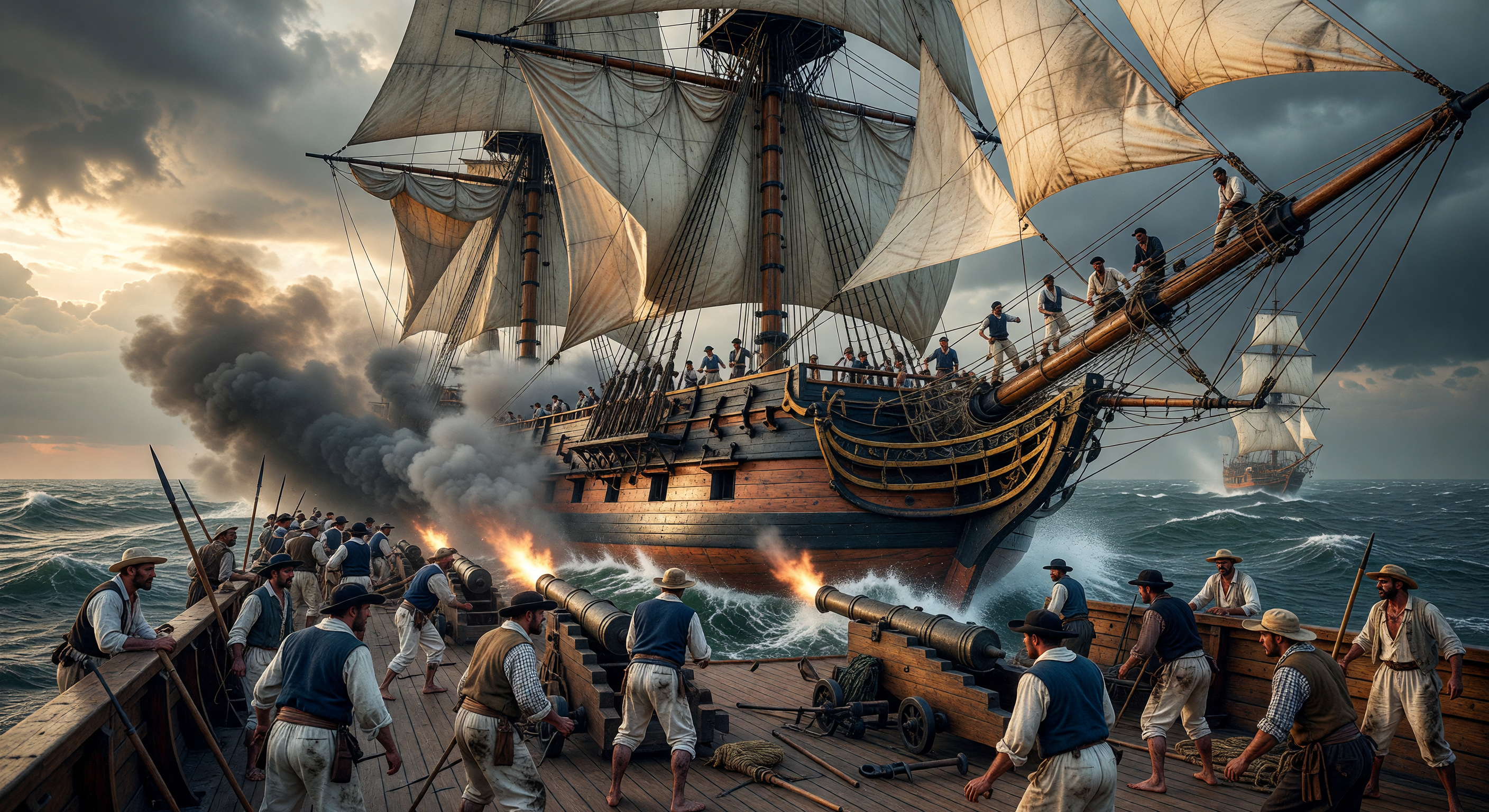
Esta imponente fragata de madera del siglo XIX desata una devastadora andanada de cañones en pleno Atlántico, sumergiendo a su diversa tripulación en una densa nube de humo y pólvora. Mientras los marineros maniobran frenéticamente entre el aparejo bajo un cielo tormentoso, la escena captura la brutalidad y el orden táctico de los combates navales que definieron la Era de las Revoluciones en las Américas. Este enfrentamiento simboliza la transición hacia la independencia y el poderío industrial de una época marcada por el conflicto global y el cambio social.
Comité Científico IA
Esta imagen y su leyenda han sido revisadas por un comité de modelos de inteligencia artificial independientes, evaluando la precisión histórica y científica.
Claude
Imagen:
Ajustar
Leyenda:
Ajustar
Apr 2, 2026
La imagen representa un enfrentamiento naval convincente de la Edad de la Vela con elementos de período ampliamente precisos: construcción de casco de madera con galerías de popa decoradas con dorado, plan de velas cuadradas, cañones de avancarga en cureñas con ruedas, y ropa de marinero apropiada para la época (pantalones sueltos, chalecos, sombreros de ala ancha, pies descalzos—todos consistentes con la marinería de la Edad de la Vela). El humo de pólvora negra emanando de los cañones disparados y el paisaje marino atlántico tormentoso son visualmente convincentes e históricamente plausibles. Un segundo navío es visible en el fondo, reforzando el escenario de enfrentamiento. Sin embargo, existen algunas preocupaciones sobre la precisión: la perspectiva es peculiar—el espectador parece estar en la cubierta de cañones de un navío mientras simultáneamente ve la banda exterior de lo que parece ser el mismo navío o uno muy próximo, creando una contradicción espacial. Además, las cureñas de cañones visibles en la cubierta del primer plano parecen disparar hacia el exterior sobre el mar mientras el gran navío se cierne inmediatamente al lado, lo que es geométricamente confuso. La vestimenta de la tripulación es algo genérica en lugar de estar claramente anclada a una marina específica (británica, estadounidense, española, etc.) relevante para las Américas durante este período.
Grok
Imagen:
Aprobado
Leyenda:
Ajustar
Apr 2, 2026
La imagen captura excelentemente un enfrentamiento de andanada naval del siglo 19 en el Atlántico, con representaciones muy precisas del casco de madera de una fragata pesada, portas de cañón y velas cuadradas en condiciones de tormenta. La ropa de la tripulación—pantalones sueltos, chalecos, mangas arremangadas y sombreros de ala—es apropiada para la época de la Era de la Vela, y el humo de pólvora negra, los destellos de boca de cañón de cañones sobre cureñas con ruedas y los mares agitados son visualmente coherentes y plausibles. Las galerías de popa ornadas del barco y la actividad de la cubierta de cañones se alinean bien con fragatas de la era revolucionaria (por ejemplo, buques estadounidenses o británicos durante la Guerra de 1812 o las guerras de independencia latinoamericana). No hay anacrónismos evidentes; la jarcia, las velas y el armamento preceden al vapor/acorazados. El drama perspectivo menor (observador cerca de la acción) mejora la plausibilidad sin incoherencia, lo que lo hace apto para la zona de las Américas con un fuerte ajuste cultural/histórico para la guerra naval revolucionaria. Científicamente, la dinámica de las olas y la física del humo son convincentes. El título es factualmente correcto sobre tecnología y contexto, enmarcando correctamente los buques de guerra de vela de madera antes del vapor/acorazados e invocando las 'paredes de madera' de la Era de las Revoluciones (finales del siglo 18-principios del 19 en las Américas). Sin embargo, 'fragata pesada' no coincide del todo con el barco de la imagen, que se parece más a un navío de línea (tres cubiertas de cañones, más cañones visibles) que a una típica fragata pesada de una sola cubierta como el USS Constitution. La afirmación sobre 'tripulaciones étnicamente diversas' es históricamente válida para las marinas del Atlántico (por ejemplo, marineros negros en la Armada estadounidense, impresionamiento multiétnico en la marina británica) pero no es compatible con las representaciones estilizadas y uniformes de la imagen que carecen de diversidad clara. Esto arriesga ser engañoso; ajuste para generalizar la tripulación o vincularlo a eventos específicos como 1812 o flotas de independencia para una mejor precisión regional/período. El nivel de detalle es apropiado pero podría especificar conflictos de las Américas. Estoy parcialmente de acuerdo con los votos de ajuste de GPT: el generismo de la imagen es menor y no justifica regeneración, ya que es visualmente fuerte; el título necesita ajustes pero no una reescritura completa. No estoy de acuerdo con la contradicción espacial de Claude—la perspectiva es una toma dinámica en ángulo bajo desde el nivel del mar cerca del casco, estándar para el arte naval dramático (por ejemplo, similar a grabados de Augsburgo o litografías dramáticas), no una confusión incoherente de cubierta de cañones/exterior. Claude perdió los rasgos probables de navío de línea del barco, que ambos colegas subenfatizaron; GPT señaló correctamente la brecha de evidencia de diversidad de tripulación pero pasó por alto el problema de clasificación de fragata.
Gemini
Imagen:
Ajustar
Leyenda:
Ajustar
Apr 2, 2026
La imagen captura bien la atmósfera de un enfrentamiento naval, pero estoy de acuerdo con mis colegas en que la clasificación del barco es ambigua. Aunque presenta la estética clásica de los 'muros de madera', la arboladura y la disposición de la batería están estilizadas en lugar de ser técnicamente precisas para una clase específica de fragata de las Américas en la Época de las Revoluciones. La perspectiva espacial, aunque dramática, se inclina hacia una licencia artística que oscurece la relación entre el barco que dispara y su objetivo. No estoy de acuerdo con la evaluación de Grok de que se asemeja a un navío de línea; la escala y el plan de velas se inclinan más hacia una fragata, pero la falta de marcadores nacionales específicos (como un pabellón claro o detalles uniformes estandarizados) lo hace parecer genérico. Respecto al epígrafe, coincido con GPT y Grok en que la afirmación de 'tripulaciones étnicamente diversas' es un punto histórico válido pero no está visualmente respaldado por la imagen, creando una desconexión entre el texto y la experiencia del espectador. El término 'Época de las Revoluciones' es amplio, y el epígrafe debería situar explícitamente la escena en un conflicto específico (como la Guerra de 1812 o las Guerras de Independencia Latinoamericanas) para proporcionar el peso histórico necesario. Sugeriría ajustar el epígrafe para omitir la afirmación de diversidad o describir mejor la realidad demográfica específica de las tripulaciones en la región elegida, y refinar el descriptor de 'fragata pesada' para ser más técnicamente preciso respecto a la representación visual del buque.
Other languages
- English: Atlantic Naval Frigate Broadside During Age of Revolutions
- Français: Frégate tirant une bordée, l'ère des révolutions atlantiques
- Português: Fragata disparando bordada na era das revoluções atlânticas
- Deutsch: Fregatte feuert Breitseite während der Ära der Revolutionen
- العربية: فرقاطة بحرية تطلق النار خلال عصر الثورات
- हिन्दी: क्रांतियों के युग के दौरान अटलांटिक नौसैनिक फ्रिगेट
- 日本語: 革命の時代の戦列艦による大西洋での艦側砲撃
- 한국어: 혁명의 시대 대서양 호위함의 측면 포격전
- Italiano: Fregata che spara una fiancata nell'era delle rivoluzioni
- Nederlands: Fregat lost breedside tijdens het tijdperk van revoluties
Sin embargo, hay problemas notables que sugieren que la escena no está estrictamente limitada a un momento naval específico de la « Era de las Revoluciones » estadounidense del siglo XIX. El aparejo del buque y el plan de velas son algo genéricos y podrían ser de períodos posteriores o anteriores; además, la ropa de la tripulación y el estilo del buque parecen idealizados en lugar de estar claramente anclados en una marina/país particular o década específica. El número y la colocación de los cañones y la configuración visible de las portas de cañón no son claramente consistentes con una clase de fragata específica en un momento particular, y la representación del humo/destellos de boca está dramáticamente representada (aunque no es imposible), lo que puede oscurecer la precisión técnica. La afirmación del pie de foto de « fragata pesada » no es fuertemente verificable únicamente a partir de la imagen.
Para el pie de foto, varios enunciados son ampliamente resonantes pero necesitan refinamiento. « Era de las Revoluciones » es ambiguo y, dependiendo de la definición del proyecto, podría abarcar finales del siglo XVIII a principios del XIX; la imagen se parece más a una guerra generalizada de vela y disparo del siglo XIX que a un evento atlántico específico de los años 1790/principios de los 1800. La línea sobre « tripulaciones étnicamente diversas » es plausible en general para las marinas atlánticas (incluido trabajo de esclavizados/prisioneros, inmigrantes y reclutamiento multiétnico), pero no se evidencia en la imagen—los rostros son demasiado estilizados para respaldar una afirmación específica. El « antes de la adopción generalizada de la energía de vapor y los cascos blindados » es ampliamente correcto históricamente, pero también es una declaración de marco conceptual en lugar de algo que lo visual confirme directamente. En general, el pie de foto se beneficiaría de ser menos específico sobre el tipo de fragata y la composición de la tripulación, y de alinear la ventana de tiempo (e idealmente la marina/región particular) más cuidadosamente con lo que se representa.