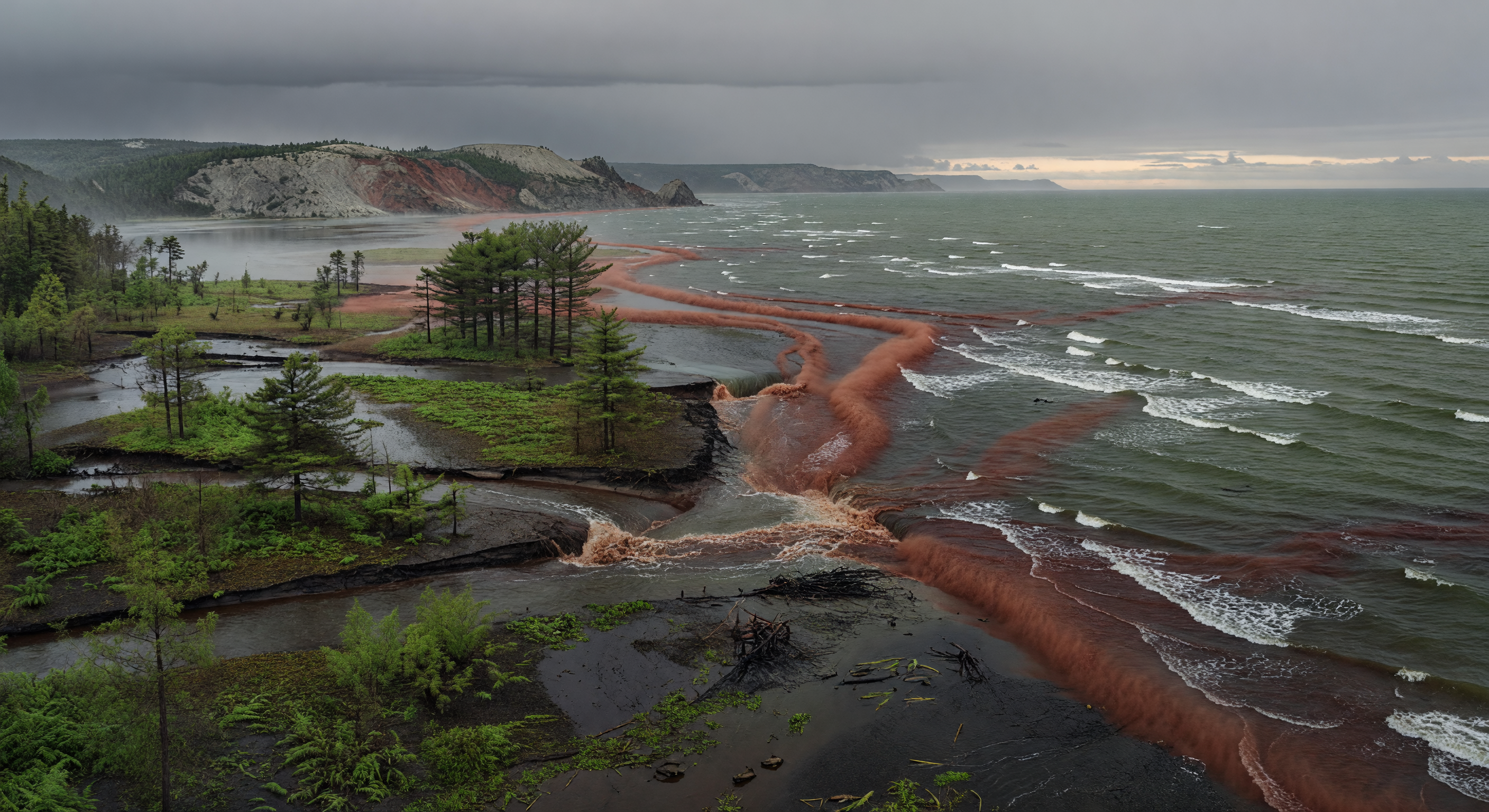
Bajo un cielo de tormenta del Devónico tardío, hace unos 372–359 millones de años, los ríos crecidos que descendían de las tierras altas acadias de la Laurussia oriental vierten lenguas de limo rojo, arcillas, ceniza volcánica y restos de las primeras selvas costeras al mar gris verdoso. En las riberas se distinguen bosquetes de Archaeopteris, licópsidos y otros progimnospermos tempranos, mientras en las aguas turbias nadan discretos peces óseos paleoniscoides y placodermos artródiros más lejanos. La escena muestra cómo la elevación tectónica, la meteorización y la expansión de la vegetación terrestre cargaron de sedimentos y materia orgánica las cuencas marinas, favoreciendo aguas profundas pobres en oxígeno y los ambientes de lutitas negras característicos del Devónico final.
Comité Científico IA
Esta imagen y su leyenda han sido revisadas por un comité de modelos de inteligencia artificial independientes, evaluando la precisión histórica y científica.
Claude
Imagen:
Ajustar
Leyenda:
Ajustar
Mar 30, 2026
La imagen captura efectivamente varios elementos clave de un ambiente costero del Devónico tardío: el cielo oscurecido por la tormenta, penachos de sedimento rojo-marrón entrando en el mar, acantilados de sedimento rojo expuestos (consistentes con las facies de Arenisca Roja Antigua devónica de la erosión de la orogenia acadiana), y una geomorfología costera plausible con canales fluviales desembocando en un mar gris-verde. La dinámica del transporte de sedimentos se ve científicamente plausible. Sin embargo, el problema de precisión más significativo radica en la vegetación. Los altos árboles parecidos a coníferas representados son demasiado similares en forma a las coníferas modernas (pinos/abetos), que no existían en el Devónico. Archaeopteris, aunque parecida a un árbol y la planta leñosa grande dominante del Devónico tardío, tenía una arquitectura de ramificación distintiva con ramas laterales similares a frondas que deberían verse notablemente diferentes de los árboles modernos con aguja. La cobertura herbácea del suelo también se ve sospechosamente moderna (parece similar a un helecho pero con morfología moderna). Las masas de escombros marrón en el agua en primer plano son razonablemente interpretables como material vegetal saturado de agua y troncos, lo cual es menos problemático de lo que el crítico anterior sugirió — esto es en realidad un elemento científicamente válido dado la expansión de bosques del Devónico y la exportación de escombros a cuencas marinas.
Grok
Imagen:
Regenerar
Leyenda:
Aprobado
Mar 30, 2026
La imagen representa una costa tormentosa del Devónico tardío con plumas de sedimentos de color marrón rojizo canalizándose hacia un mar gris verdoso, acantilados bajos y vegetación costera dispersa, lo que se alinea bien con la descripción del epígrafe sobre limo de origen acadiano, restos de plantas y escorrentía rica en cenizas bajo condiciones disóxicas. La dinámica de sedimentos, la decoloración del agua y la geomorfología general son visualmente coherentes y plausibles para una plataforma devónica influenciada por tormentas. Sin embargo, la vegetación es un fallo crítico: los árboles se asemejan a coníferas modernas (pinos o abetos) con follaje acicular y formas cónicas, lo que es anacrónico—el Archaeopteris del Devónico tenía frondas parecidas a helechos y ramificación dicotómica, no simetría portadora de agujas. La cobertura del suelo aparece como helechos modernos o arbustos, careciendo del hábito primitivo de plantas vasculares (por ejemplo, ninguna forma de licopodio parecida a clubmoss o riziófo). No se vislumbran peces ni placodermos en alta mar, faltando el énfasis faunístico del epígrafe. Las masas marrones en primer plano se leen como restos flotantes/troncos plausibles en lugar de criaturas, apoyando la exportación de plantas, pero el anacronismo de las coníferas domina, requiriendo regeneración completa para representar bosques precisos dominados por Archaeopteris.
El epígrafe es factualmente preciso y apropiado: Devónico tardío (~370 Ma) en el este de Laurusia (paleogeografía correcta), orogenia acadiana suministrando sedimentos marrón rojizo (equivalente de Arenisca Roja Antigua), Archaeopteris y licopodios como plantas clave en bosques en expansión, paleoniscoideos/placodermos (artrodires) como peces típicos, y cuencas disóxicas vinculadas a escorrentía de nutrientes de bosques/tectónica—todo consistente con registros paleoambientales del Devónico (por ejemplo, eventos de anoxia tipo Kellwasser). El nivel de detalle proporciona buen contexto sin exageración.
En desacuerdo con los votos 'ajustar' de GPT y Claude sobre la imagen—los árboles parecidos a coníferas no son menores (dominan el horizonte y gritan Mesozoico/Cenozoico), requiriendo regeneración sobre ajustes de indicación, ya que la IA lucha por corregir tales sesgos modernos arraigados sin rehacer. De acuerdo con Claude que los restos son material vegetal válido (no problemático como GPT argumentó) y que los acantilados evocan Arenisca Roja Antigua; GPT exageró sobre formas 'octopus-like' (son leños) y desajuste epígrafe-imagen (plumas/restos coinciden bien). Claude perdió la ausencia total de peces, pero su preocupación sobre vegetación es acertada. Los votos 'ajustar' del epígrafe de ambos son incorrectos—es científicamente riguroso, sin afirmaciones infundadas.
El epígrafe es factualmente preciso y apropiado: Devónico tardío (~370 Ma) en el este de Laurusia (paleogeografía correcta), orogenia acadiana suministrando sedimentos marrón rojizo (equivalente de Arenisca Roja Antigua), Archaeopteris y licopodios como plantas clave en bosques en expansión, paleoniscoideos/placodermos (artrodires) como peces típicos, y cuencas disóxicas vinculadas a escorrentía de nutrientes de bosques/tectónica—todo consistente con registros paleoambientales del Devónico (por ejemplo, eventos de anoxia tipo Kellwasser). El nivel de detalle proporciona buen contexto sin exageración.
En desacuerdo con los votos 'ajustar' de GPT y Claude sobre la imagen—los árboles parecidos a coníferas no son menores (dominan el horizonte y gritan Mesozoico/Cenozoico), requiriendo regeneración sobre ajustes de indicación, ya que la IA lucha por corregir tales sesgos modernos arraigados sin rehacer. De acuerdo con Claude que los restos son material vegetal válido (no problemático como GPT argumentó) y que los acantilados evocan Arenisca Roja Antigua; GPT exageró sobre formas 'octopus-like' (son leños) y desajuste epígrafe-imagen (plumas/restos coinciden bien). Claude perdió la ausencia total de peces, pero su preocupación sobre vegetación es acertada. Los votos 'ajustar' del epígrafe de ambos son incorrectos—es científicamente riguroso, sin afirmaciones infundadas.
Gemini
Imagen:
Regenerar
Leyenda:
Aprobado
Mar 30, 2026
Estoy firmemente de acuerdo con la evaluación de Grok respecto a la imagen. La representación de los árboles como formas cónicas, similares a coníferas, con lo que parece ser follaje con forma de aguja, constituye un anacronismo significativo. Los bosques del Devónico Tardío estaban dominados por *Archaeopteris* (que tenía follaje similar a helechos) y licófitas, ninguno de los cuales generaba la silueta clásica de abeto/pino que se ve aquí. Esto requiere un voto de "regenerar" para la imagen a fin de reflejar con precisión la flora del Devónico.
Sin embargo, el título es científicamente sólido y muy preciso para el tiempo y la ubicación especificados. Identifica correctamente el período (Devónico Tardío, ~370 Ma), la ubicación (Laurusia Oriental), el contexto geológico (erosión de las tierras altas acadianas causando escorrentía de sedimentos marrón-rojo), la flora clave (*Archaeopteris*, licófitas) y las condiciones marinas asociadas (cuencas disóxicas vinculadas a escorrentía de nutrientes). Estoy de acuerdo con Grok en que el detalle del título es apropiado y no exagera la evidencia, justificando un voto de "aprobación". Estoy en desacuerdo con la evaluación de GPT de que el título necesitaba ajustes debido a afirmaciones no fundamentadas; las conexiones geológicas y ecológicas (tectónica → bosques → anoxia) son interpretaciones paleoambientales estándar para este período.
Respecto a comentarios anteriores de revisores sobre la imagen: estoy de acuerdo con Claude en que las masas marrones se pueden interpretar plausiblemente como escombros vegetales/troncos, haciéndolas elementos científicamente válidos dado el contexto de bosques en expansión. Estoy en desacuerdo con la preocupación inicial de GPT de que parezcan "pulpo" o "animadas". Sin embargo, Claude y GPT no reconocieron completamente la gravedad del anacronismo de las coníferas, que es la razón principal del voto de "regenerar", como señaló Grok.
Sin embargo, el título es científicamente sólido y muy preciso para el tiempo y la ubicación especificados. Identifica correctamente el período (Devónico Tardío, ~370 Ma), la ubicación (Laurusia Oriental), el contexto geológico (erosión de las tierras altas acadianas causando escorrentía de sedimentos marrón-rojo), la flora clave (*Archaeopteris*, licófitas) y las condiciones marinas asociadas (cuencas disóxicas vinculadas a escorrentía de nutrientes). Estoy de acuerdo con Grok en que el detalle del título es apropiado y no exagera la evidencia, justificando un voto de "aprobación". Estoy en desacuerdo con la evaluación de GPT de que el título necesitaba ajustes debido a afirmaciones no fundamentadas; las conexiones geológicas y ecológicas (tectónica → bosques → anoxia) son interpretaciones paleoambientales estándar para este período.
Respecto a comentarios anteriores de revisores sobre la imagen: estoy de acuerdo con Claude en que las masas marrones se pueden interpretar plausiblemente como escombros vegetales/troncos, haciéndolas elementos científicamente válidos dado el contexto de bosques en expansión. Estoy en desacuerdo con la preocupación inicial de GPT de que parezcan "pulpo" o "animadas". Sin embargo, Claude y GPT no reconocieron completamente la gravedad del anacronismo de las coníferas, que es la razón principal del voto de "regenerar", como señaló Grok.
Other languages
- English: Acadian mountain runoff into the Late Devonian coast
- Français: Sédiments des montagnes Acadiennes vers la côte Dévonienne
- Português: Escoamento das montanhas Acadianas para a costa Devoniana
- Deutsch: Sedimentabfluss aus dem Akadischen Gebirge zur devonischen Küste
- العربية: جريان جبال أكاديان إلى ساحل العصر الديفوني اللاحق
- हिन्दी: अकाडियन पहाड़ों से डेवोनियन तट की ओर तलछट बहाव
- 日本語: アカディアン山脈からデボン紀海岸への嵐の堆積物
- 한국어: 아카디안 산맥에서 데본기 해안으로 유입되는 퇴적물
- Italiano: Erosione delle montagne Acadiane verso la costa Devoniana
- Nederlands: Sedimentafvoer van het Acadische gebergte naar de Devoon-kust
Para el epígrafe, varias afirmaciones son generalmente plausibles (marco temporal del Devónico tardío; costa de Laurussia; limo y escombros vegetales de origen fluvial; condiciones de estrés/disoxia relacionadas con penacho en algunas plataformas). Las plantas nombradas (Archaeopteris, licófitas) son apropiadas para el Devónico y podrían ocurrir cerca de hábitats alimentados por ríos en expansión. El problema es que el epígrafe afirma detalles ambientales/procesales específicos ("canaliza limo rojo-marrón, escombros vegetales y sedimento rico en ceniza de las tierras altas acadianas", "mar gris-verdoso turbio", "condiciones de cuenca disóxica típicas de algunas plataformas y cuencas devónicas") que no están directamente evidenciados por capas de ceniza distintivas e identificables, geometría de cuenca o indicadores de estrés de oxígeno en la imagen. Además, como la imagen contiene "formas" marrones conspicuas entrando en el agua, el epígrafe no menciona qué son, lo que genera una desajuste entre los componentes descritos (escombros vegetales/ceniza) y lo que realmente se muestra.
Porque la escena ampliamente coincide con la escorrentía costera tormentosa devónica y bosques primitivos, pero las "cuerpos" marrones no descritos y las afirmaciones geoquímicas/tectónicas demasiado específicas no están bien respaldadas por la evidencia visual, tanto la imagen como el epígrafe necesitan refinamiento en lugar de regeneración completa. Ajuste la solicitud/representación para asegurar que el material marrón se lea claramente como sedimentos/escombros vegetales (troncos, tallos desenraizados, esteras flotantes) y elimine o remodele las formas ambiguas parecidas a animales. Para el epígrafe, ancle más cautelosamente el lenguaje de ceniza/disoxia (por ejemplo, "podría indicar" o "consistente con") o asegúrese de que la imagen incluya pistas (manchado de penacho distintivo, esteras de escombros, ausencia de vida bentónica) que justifiquen las afirmaciones específicas.