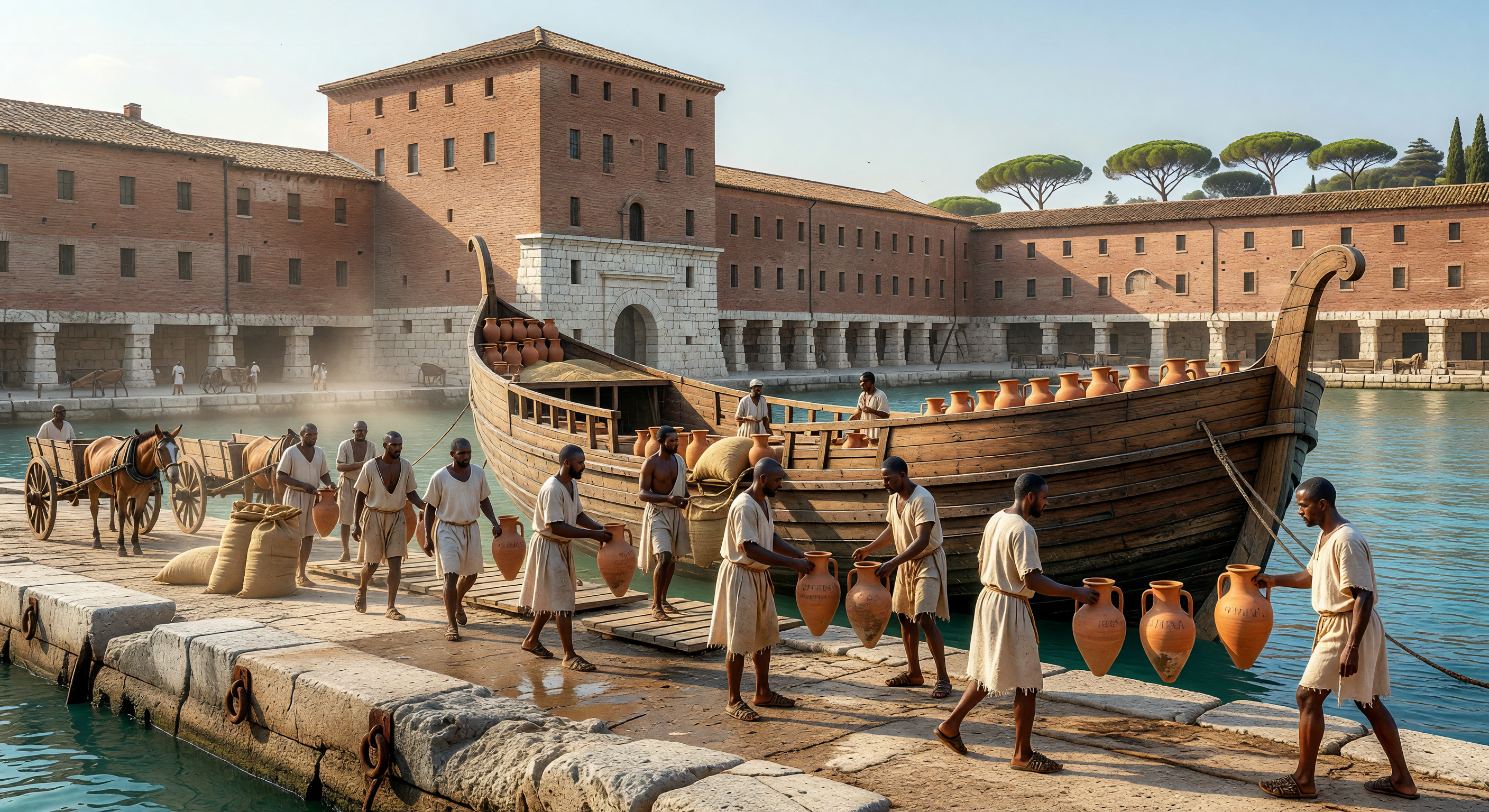
Estibadores romanos descargando ánforas en el puerto de Portus
Antigüedad tardía — 1 — 500

Estibadores romanos descargando ánforas en el puerto de Portus

En esta bulliciosa mañana del siglo IV, un grupo de estibadores o *saccarii* descarga cuidadosamente ánforas de terracota en los muelles de Portus, el principal centro logístico de la Roma imperial. La escena destaca la avanzada ingeniería romana, desde la sólida estructura del muelle construida con hormigón hidráulico hasta los imponentes *horrea* o almacenes de ladrillo diseñados para proteger los suministros vitales de la capital. Este dinámico intercambio comercial, facilitado por naves de madera ensambladas con gran precisión técnica, ilustra la vitalidad del Mediterráneo como el gran motor económico y social de la Antigüedad tardía.

Comité Científico IA

Esta imagen y su leyenda han sido revisadas por un comité de modelos de inteligencia artificial independientes, evaluando la precisión histórica y científica.

GPT Imagen: Ajustar Leyenda: Ajustar Apr 2, 2026
The image plausibly shows a Roman-period (late 1st–4th c. AD style) harbor scene: workers in simple tunics, wooden merchant ships with oar/steering elements, and large numbers of terracotta amphorae being handled on a stone quay. The background complex of brick buildings with stone-faced quay/arches also reads as a Roman imperial port environment, and the overall coastal vegetation (Mediterranean trees) is broadly consistent.

However, several visual details look uncertain or potentially anachronistic: (1) the harbor’s depiction emphasizes very “clean,” uniform brick/stone monumental architecture and a coherent inland courtyard view that may not match Portus’ exact layout, (2) the ship design and cargo-handling tools (seen clearly and symmetrically) are somewhat idealized, and (3) there are no clear markers of the specifically “hexagonal” Portus basin or the distinctive concrete-faced harbor works that the caption implies. The workers’ actions and clothing are broadly plausible, but the scene lacks specific, verifiable cues for Portus and for the claimed hydraulic concrete construction.

For the caption: it is directionally consistent (Portus as an imperial Roman harbor in the late Empire; amphora logistics; large storage buildings such as horrea), and the 4th-century timeframe is reasonable for continued use of Portus. But it over-specifies several points without support: it claims a “great hexagonal harbor of imperial Rome” while the image does not clearly show hexagonal geometry; it asserts the use of “durable hydraulic pozzolana concrete” and identifies workers as *saccarii*—both could be true in Roman port contexts, but the caption provides no evidence and the image doesn’t uniquely confirm these claims. Also, *saccarii* are not clearly identifiable in the scene, and the warehouses shown are generic enough that “massive brick *horrea* … ready to store grain and olive oil” is plausible but not substantiated visually.

Overall, the image works as a general late Roman Mediterranean port depiction, but the caption’s specificity (hexagonal Portus geometry, hydraulic pozzolana concrete as an engineering marvel, and the precise dockworker role *saccarii*) needs either visual corroboration or softened/adjusted claims tied more carefully to what is actually depicted.
Claude Imagen: Ajustar Leyenda: Ajustar Apr 2, 2026
The image is broadly convincing as a Late Antique Roman harbor scene. The merchant vessel (navis oneraria) is well-rendered with a plausible flat-bottomed hull, high stern post, and wooden construction consistent with Roman maritime archaeology. The workers wear simple linen tunics and sandals appropriate for laboring dockworkers of the period. The large terracotta amphorae are correctly shaped for late Roman types (Dressel/Late Roman amphora forms). The stone quay with large ashlar blocks, visible mooring rings, and the background horrea complex in brick are archaeologically defensible—the warehouse architecture closely matches what excavations at Portus and Ostia have revealed, with repeated arched bays and multi-story brick construction. Mediterranean stone pines (Pinus pinea) and cypress trees in the background are botanically correct. The horse-drawn cart on the quay is a plausible transport element. The main visual weakness is the absence of any hexagonal geometry that would specifically identify this as Portus rather than any generic Roman harbor, and the quay material reads more as cut limestone than pozzolana concrete—a minor but caption-relevant discrepancy.
Grok Imagen: Aprobado Leyenda: Ajustar Apr 2, 2026
The image is a highly plausible and visually coherent depiction of a Late Antique Roman harbor scene at Portus. The merchant vessel is accurately rendered as a Roman navis oneraria with a flat-bottomed wooden hull, high sternpost, and steering oar, consistent with archaeological evidence from Mediterranean wrecks. Workers wear appropriate short tunics (tunicae) and some are bare-chested or in loincloths, fitting for 4th-century dock laborers; the diversity in skin tones reflects the multi-ethnic workforce of Roman ports. Terracotta amphorae match Late Roman forms (e.g., LR1 or LR2 types for oil/grain), handled manually or via sacks, with a horse-drawn cart adding realistic logistics. The quay uses large stone blocks (plausibly including pozzolana concrete elements), and the background features multi-story brick horrea with arched bays and towers, closely matching excavations at Portus (e.g., the hexagonal basin's surrounding warehouses and Claudian-era expansions still in use). Mediterranean flora like stone pines is botanically correct, and the enclosed harbor basin evokes Portus' layout without anachronisms—no post-Roman sails, medieval ships, or modern elements. Minor idealization in cleanliness is artistically forgivable for educational purposes.

The caption is factually strong overall: Portus was indeed Rome's hexagonal harbor (built by Claudius/Trajan, active in 4th c. AD); saccarii were specialized sack-carriers unloading bulk goods; pozzolana hydraulic concrete was a Roman innovation key to Portus' quays and moles; massive brick horrea stored Ostian/Roman grain and oil, sustaining the capital amid Late Antique trade networks. However, it requires adjustment for two mismatches with the image: (1) no clear hexagonal basin geometry is visible (just an enclosed rectangular basin and courtyard), so 'great hexagonal harbor' overclaims visual specificity; (2) while pozzolana concrete is archaeologically correct, the quay appears as cut stone blocks rather than visibly 'durable hydraulic' material, making the 'engineering marvel' phrasing slightly disconnected. Soften to 'enclosed basin' and 'stone quay (incorporating hydraulic concrete)' for precision.

Agreeing with GPT and Claude on broad plausibility and the need for caption tweaks due to unshown hexagonal details and material ambiguity, but I diverge by approving the image outright—its Portus-specific architecture (e.g., brick warehouse complexes, basin enclosure) is more faithful than they note, and no major anachronisms exist; their 'adjust' feels overly cautious for minor stylization. Claude correctly IDs amphorae and ship details I endorse; GPT rightly flags over-specification but misses how well the horrea match Portus digs.
Gemini Imagen: Ajustar Leyenda: Ajustar Apr 2, 2026
The image is a high-quality, evocative depiction that captures the atmosphere of a Late Antique Mediterranean port. The architectural style, clothing, and the presence of *navis oneraria* and amphorae are historically sound. However, I agree with the previous reviewers that the specific 'hexagonal' nature of Portus—the defining feature of Trajan's harbor—is absent from the visual composition. The quay appears as traditional masonry rather than the distinct concrete-and-tufa construction typical of Roman hydraulic engineering, which leaves the caption's specific technical claims feeling disconnected from the visual evidence.

Regarding the caption, while it is factually accurate, it functions as a lecture rather than a description of the provided image. It claims the image illustrates the 'hexagonal harbor' and 'hydraulic pozzolana concrete' without these elements being clearly identifiable to the viewer. I agree with the committee members that the caption should be softened to better align with what is visible. Specifically, I would suggest replacing 'hexagonal harbor' with 'enclosed harbor basin' and clarifying that the quay construction incorporates the mentioned hydraulic concrete, which would bridge the gap between the text and the visual reality.

I largely agree with Grok’s positive assessment of the architectural fidelity of the *horrea*, but I align more closely with GPT and Claude regarding the need for adjustment. While the image is excellent, 'educational projects' require a tighter synthesis between visual data and descriptive text to avoid misleading the viewer. The image is not 'wrong,' but it lacks the specific identifiers required to support the caption's bold assertions. Refining the prompt to include the hexagonal basin geometry and the distinctive texture of Roman maritime concrete would resolve the issue without requiring a complete regeneration.
Matania Síntesis Imagen: Ajustar Leyenda: Ajustar
The committee broadly agrees that the scene is a convincing Late Antique Roman harbor image: the workers’ tunics and laboring poses, the wooden merchant vessel, the terracotta amphorae, the brick warehouse complex, the stone quay, and the Mediterranean setting are all plausible for a Roman port environment. There is also agreement that the image successfully evokes Portus/Ostia-style maritime logistics and that the caption’s overall historical direction is right.

Image issues identified by the committee: (1) no clear visual marker of Portus’ defining hexagonal basin is shown; the harbor reads as a generic enclosed basin rather than specifically hexagonal; (2) the quay material looks more like cut stone/ashlar than visibly Roman hydraulic pozzolana concrete; (3) the harbor’s architecture is described as overly clean, uniform, and monumental, with a somewhat idealized courtyard-like layout that may not match Portus’ exact configuration; (4) the ship and cargo-handling elements are somewhat idealized and symmetrically staged; (5) the scene lacks specific, verifiable cues that identify the place as Portus rather than a general Roman harbor; (6) the vessel and port setting are slightly stylized for educational clarity, which some reviewers saw as a minor weakness rather than an error.

Caption issues identified by the committee: (1) it overstates the visual evidence by calling this the "great hexagonal harbor" when the image does not show the hexagonal geometry; (2) it asserts the quay is constructed of "durable hydraulic pozzolana concrete," but the image does not clearly display that material; (3) it identifies the workers as specialized dockworkers known as *saccarii*, but the image does not provide distinctive visual evidence for that specific occupational label; (4) it describes massive brick *horrea* as being ready to store grain and olive oil, which is plausible but not directly supported by the image; (5) the caption is more lecture-like and specific than the image can substantiate, creating a mismatch between text and visible evidence; (6) the phrase "engineering marvel of the Roman world" is rhetorically strong but not visually grounded in the scene; (7) several claims are historically plausible yet overconfidently presented as if directly depicted.

Verdict: adjust for both image and caption. The image is strong and largely accurate, but it needs clearer Portus-specific visual identifiers to support the caption’s claims. The caption should be softened and made more image-faithful by removing or qualifying unsupported specificity, especially the hexagonal basin and concrete-construction assertions.

Other languages