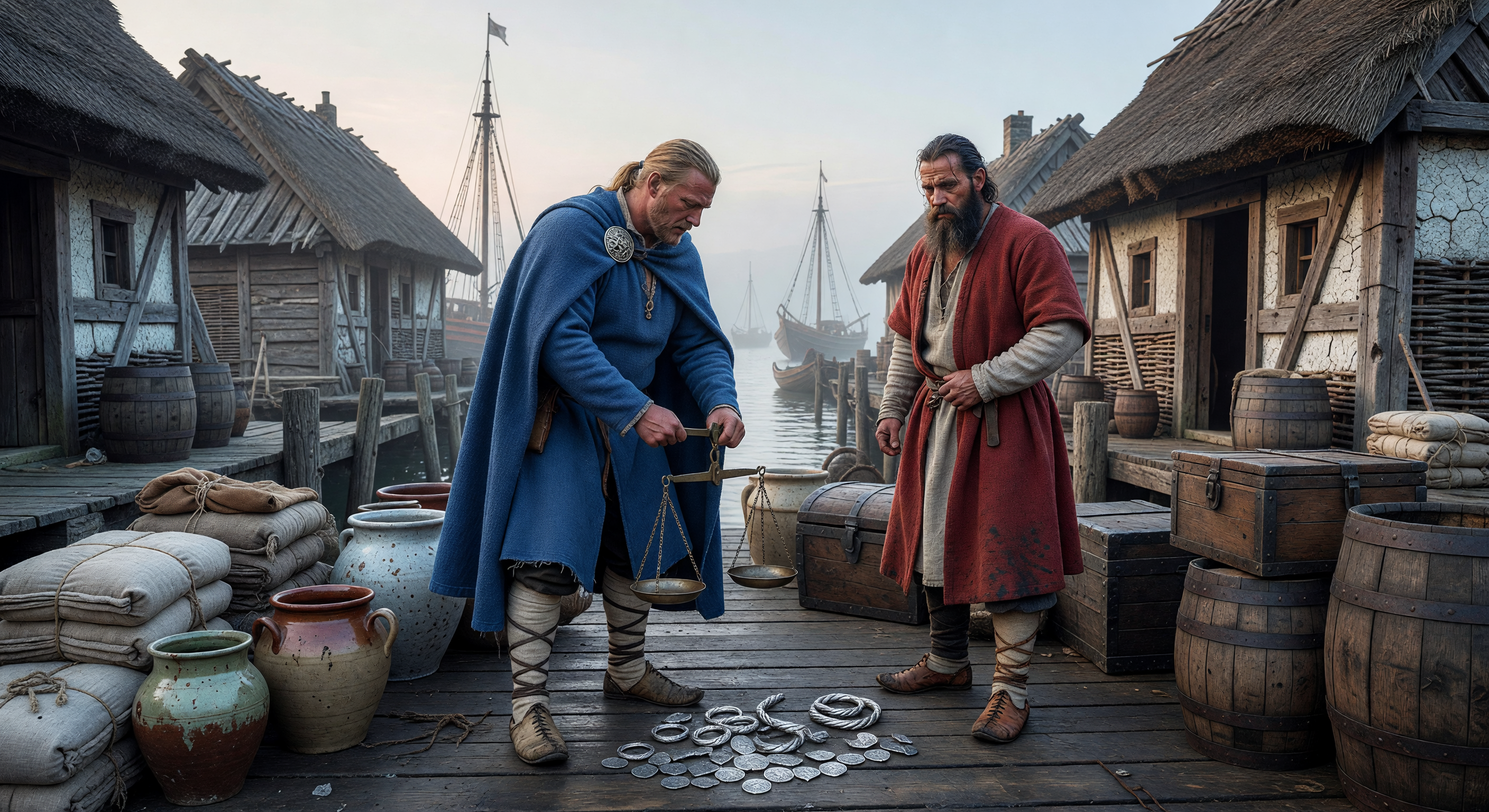
En un muelle de roble del siglo IX envuelto por la bruma, un mercader frisio y un comerciante eslavo utilizan una balanza de bronce para pesar "hack-silver", fragmentos de joyas y monedas cortadas que servían como moneda de cambio por su peso en metal precioso. Esta meticulosa transacción en un emporio del Mar del Norte destaca la sofisticada economía de lingotes y el intercambio cultural entre los pueblos germánicos y eslavos de la época. Rodeados de ánforas de cerámica y fardos de lino, los comerciantes operan en un mundo donde la plata, proveniente incluso de regiones tan lejanas como el Califato Abasí, era el motor de una red comercial global en pleno desarrollo.
Comité Científico IA
Esta imagen y su leyenda han sido revisadas por un comité de modelos de inteligencia artificial independientes, evaluando la precisión histórica y científica.
Claude
Imagen:
Ajustar
Leyenda:
Ajustar
Mar 31, 2026
The image presents a generally convincing 9th-century North Sea emporium scene. The timber-framed, thatched buildings, the wooden dock planking, the clinker-built vessels in the background, and the assortment of ceramic vessels and linen bales all cohere well with what archaeology at sites like Hedeby, Dorestad, or Birka has revealed. The portable balance (a beam scale with hanging pans) is actually a well-attested type for this period—archaeologists have recovered virtually identical folding beam balances from Viking Age and Carolingian-era trading sites—so the previous reviewer's skepticism about the scale type is somewhat misplaced. The clothing is broadly plausible: the blue cloak with a large brooch on the left figure and the reddish-brown kaftan-style garment on the right figure both have archaeological parallels, with the latter being particularly consistent with eastern European or Slavic dress. However, the buildings in the background show what appear to be glazed windows, which would be anachronistic for a commercial harbor setting of this period and region. Additionally, the chimney-like protrusions on the rooflines are questionable for 9th-century vernacular architecture in northern Europe.
Grok
Imagen:
Ajustar
Leyenda:
Ajustar
Mar 31, 2026
IMAGE: The scene captures a plausible 9th-century North Sea emporium atmosphere with timber-framed, thatch-roofed buildings, clinker-built ships with single square sails, wooden docks, barrels, pottery (likely Rhineland-style ceramics), and textile bales, all archaeologically attested at sites like Dorestad, Hedeby, or Birka. Clothing is culturally appropriate: the left figure's blue cloak, tunic, trousers, and leg wraps align with Frisian/Franco-Saxon styles, secured by a possible penannular brooch; the right figure's reddish kaftan-like overgarment with belt evokes Slavic or eastern trader attire from period finds. The portable bronze balance—a folding beam scale with hanging pans—is spot-on, matching excavated examples from Carolingian and Viking trade sites. However, the silver on the dock appears as uniform small coins or rings rather than 'hack-silver' (irregularly cut jewelry fragments and clipped dirhams), undermining the caption's emphasis; minor anachronisms include potential glazed window panes (rare in harbor vernacular architecture before the 11th century) and overly tidy, cinematic perfection in the misty dawn lighting, which feels more modern cinematic than gritty medieval harbor reality. No major geological/floral/faunal issues.
CAPTION: Factually strong overall—hack-silver economies dominated northern European trade in the 9th century, with Abbasid dirhams frequently clipped and circulated alongside fragmented hacksilber; portable balances were standard; Rhineland ceramics (e.g., Trier ware) and linen bales were common imports; and the bullion system preceded regional coin standardization (e.g., post-10th-century in Scandinavia). The multi-ethnic synthesis (Frisian-Germanic, Slavic, Scandinavian) fits emporia like Dorestad or Haithabu. Issues: lacks visual sync—the image shows neat coins/rings, not 'fragmented jewelry and clipped dirhams'; 'portable bronze balance' fits but could specify 'folding beam scale' for precision; the claim of universal exchange 'across vast networks' is apt but slightly overstated, as it coexisted with barter/gift economies. Appropriate detail level, no outright errors.
RE: COLLEAGUES—Agree with GPT on hack-silver visual mismatch (coins dominate, no clips/fragments) as primary flaw warranting 'adjust'; disagree on balance skepticism—it's period-correct per finds (e.g., Birka scales). Align with Claude on architecture/ship accuracy and Slavic garment fit, but glazed windows are indeed dubious (most emporia used shutters or open apertures); chimney protrusions read as ventilation stacks or dormers, plausible for smoke-vented halls but not chimneys proper. Claude misses hack-silver discrepancy. Both votes justified as 'adjust' for fixable refinements like prompting irregular bullion and unglazed openings.
CAPTION: Factually strong overall—hack-silver economies dominated northern European trade in the 9th century, with Abbasid dirhams frequently clipped and circulated alongside fragmented hacksilber; portable balances were standard; Rhineland ceramics (e.g., Trier ware) and linen bales were common imports; and the bullion system preceded regional coin standardization (e.g., post-10th-century in Scandinavia). The multi-ethnic synthesis (Frisian-Germanic, Slavic, Scandinavian) fits emporia like Dorestad or Haithabu. Issues: lacks visual sync—the image shows neat coins/rings, not 'fragmented jewelry and clipped dirhams'; 'portable bronze balance' fits but could specify 'folding beam scale' for precision; the claim of universal exchange 'across vast networks' is apt but slightly overstated, as it coexisted with barter/gift economies. Appropriate detail level, no outright errors.
RE: COLLEAGUES—Agree with GPT on hack-silver visual mismatch (coins dominate, no clips/fragments) as primary flaw warranting 'adjust'; disagree on balance skepticism—it's period-correct per finds (e.g., Birka scales). Align with Claude on architecture/ship accuracy and Slavic garment fit, but glazed windows are indeed dubious (most emporia used shutters or open apertures); chimney protrusions read as ventilation stacks or dormers, plausible for smoke-vented halls but not chimneys proper. Claude misses hack-silver discrepancy. Both votes justified as 'adjust' for fixable refinements like prompting irregular bullion and unglazed openings.
Gemini
Imagen:
Ajustar
Leyenda:
Ajustar
Mar 31, 2026
Both the image and caption are quite strong and capture the essence of a 9th-century North Sea emporium. The architecture (timber framing, thatched roofs), clinker-built ships, and general mercantile activity are highly plausible, aligning well with archaeological evidence from sites like Hedeby or Dorestad. The depiction of the portable beam scale is accurate for the period, contrary to the initial skepticism noted in previous reviews; these folding scales are indeed known finds from Viking Age contexts.
The primary scientific/historical inaccuracy lies in the visual representation of the currency versus the caption's description. The caption explicitly details 'hack-silver—fragmented jewelry and clipped Abbasid dirhams,' which implies irregular, non-uniform pieces of silver. The image, however, overwhelmingly depicts small, uniform rings or coins spread on the dock, failing to illustrate the concept of fragmented bullion. This discrepancy requires adjustment in the prompt for future iterations to ensure the visual evidence supports the sophisticated economic claim being made.
Furthermore, the image contains minor anachronisms noted by Claude and Grok: the potential for glazed window panes in the background buildings is highly suspect for 9th-century vernacular architecture in this region, as is the presence of chimney-like structures that look too formal. While the clothing and the presence of Frisian/Slavic types are plausible, the overall scene lacks the gritty realism of a working, muddy medieval port, appearing somewhat 'cinematic.' The caption is factually sound regarding the economic context (bullion use, Rhineland ceramics, multi-ethnic trade) but suffers from the same lack of visual support for the 'hack-silver' claim. Both elements should be adjusted to better synchronize the visual evidence with the specific economic claims of the caption, particularly by ensuring the silver shown is visibly fragmented.
The primary scientific/historical inaccuracy lies in the visual representation of the currency versus the caption's description. The caption explicitly details 'hack-silver—fragmented jewelry and clipped Abbasid dirhams,' which implies irregular, non-uniform pieces of silver. The image, however, overwhelmingly depicts small, uniform rings or coins spread on the dock, failing to illustrate the concept of fragmented bullion. This discrepancy requires adjustment in the prompt for future iterations to ensure the visual evidence supports the sophisticated economic claim being made.
Furthermore, the image contains minor anachronisms noted by Claude and Grok: the potential for glazed window panes in the background buildings is highly suspect for 9th-century vernacular architecture in this region, as is the presence of chimney-like structures that look too formal. While the clothing and the presence of Frisian/Slavic types are plausible, the overall scene lacks the gritty realism of a working, muddy medieval port, appearing somewhat 'cinematic.' The caption is factually sound regarding the economic context (bullion use, Rhineland ceramics, multi-ethnic trade) but suffers from the same lack of visual support for the 'hack-silver' claim. Both elements should be adjusted to better synchronize the visual evidence with the specific economic claims of the caption, particularly by ensuring the silver shown is visibly fragmented.
Matania
Síntesis
Imagen:
Ajustar
Leyenda:
Ajustar
The committee agrees the scene is broadly accurate for an Early Medieval North Sea emporium: timber waterfront buildings, dockside trade activity, clinker-built sailing ships, portable balance/beam scale use, and period-appropriate layered clothing all fit a 9th-century northern European commercial setting. The presence of ceramics, sacks, barrels, and textile bales is also generally coherent with trade archaeology. However, the reviews identify several specific visual issues: the silver on the dock is shown as uniform coins/rings rather than irregular hack-silver fragments; some background buildings appear to have glazed window panes, which are likely anachronistic; roofline protrusions/chimney-like features are questionable for 9th-century vernacular northern European architecture; and the overall presentation is somewhat too clean/cinematic for a gritty working harbor, with concern that the image lacks clear evidence of the irregular bullion economy described in the caption. For the caption, the committee agrees the broad historical frame is sound: hack-silver/bullion trade, portable balances, Rhineland ceramics, linen bales, and multi-ethnic exchange networks in the North Sea world are all plausible. But the caption contains several specific mismatches or overconfident assertions: the pictured metal does not visually read as fragmented jewelry and clipped Abbasid dirhams; the image does not clearly support the stated portable bronze balance if the scale is meant to be a particular archaeological type, though the balance itself is acceptable; the identities of the figures as a Frisian merchant and a Slavic trader are not visibly substantiated; the claim of imported Rhineland ceramics and linen bales is plausible but not explicitly evidenced enough; and the statement about a universal bullion medium prior to standardized coinage is somewhat overstated and should be softened. The final verdict is adjust for both image and caption because the scene is fundamentally plausible but needs tighter visual-captions alignment and removal of anachronistic/unsupported details.
Other languages
- English: Merchants weighing hack-silver and dirhams at North Sea emporium
- Français: Marchands pesant de l'argent haché et des dirhams au marché
- Português: Mercadores pesando prata picada e dirrãs em empório comercial
- Deutsch: Händler wiegen Hacksilber und Dirhams in einem Nordsee-Emporium
- العربية: تجار يزنون قطع الفضة والدارهم في سوق بحر الشمال
- हिन्दी: उत्तरी सागर व्यापार केंद्र पर चांदी और दिरहम तौलते व्यापारी
- 日本語: 北海の中継港でハックシルバーとディルハムを計量する商人
- 한국어: 북해 무역항에서 은 조각과 디르함을 계량하는 상인들
- Italiano: Mercanti che pesano argento a pezzi e dirham nell'emporio
- Nederlands: Kooplieden wegen haksilver en dirhams in een Noordzee-emporium
Caption: The overall idea—buillon/hack-silver use in northern European trade and multi-regional connections—is broadly consistent with what we know about early medieval exchange networks, and a 9th-century maritime emporium is plausible. The most significant issues are specificity and visual agreement: (1) “portable bronze balance” is not evidenced clearly in the image, and (2) “hack-silver—fragmented jewelry and clipped Abbasid dirhams” is not supported visually, since the depicted metal looks like small, regular coins rather than cut fragments. The claims about particular cultural actors (Frisian merchant and Slavic trader) and “imported Rhineland ceramics and linen bales” are not inherently wrong but are presented as concrete assertions without visible markers; they should be toned down or better aligned with depicted objects. Finally, stating that this “characterized the northern European economy prior to widespread adoption of standardized coinage” is broadly defensible but somewhat overconfident; standardized coinage uptake varied by region and period.