An 18th-century Ottoman *Kalyon* maneuvers through the Golden Horn, its three tiers of brass gun ports reflecting the warm glow of a 1720s sunset during the height of the Tulip Period. In the foreground, slender walnut *caïques* glide across the deep water, manned by rowers in traditional cream linen shirts and woolen caps. The backdrop reveals the architectural evolution of Istanbul, featuring timber-framed waterfront *konaks* and the distant, iconic silhouettes of the Galata Tower and Süleymaniye Mosque. This scene illustrates the sophisticated naval transition of the Ottoman Empire and the vibrant maritime life that defined the imperial capital’s golden age.

A pair of Anatolian leopards (*Panthera pardus tulliana*) prowls a rugged limestone ridge in the Taurus Mountains, their thick winter coats camouflaged against a landscape of gnarled juniper trees and weathered karst. In the valley below, the smoke from Yörük nomad encampments and a distant camel caravan illustrate the human presence along the vital trade routes of the 17th-century Ottoman Empire. This reconstruction highlights the intersection of the empire’s wild frontiers and the nomadic traditions that persisted alongside the bustling commerce of the Silk Road.

In this mid-18th-century Istanbul coffeehouse, Ottoman men gather for the ritual of coffee and tobacco, a cornerstone of urban social life during the culturally vibrant Tulip Period. The interior showcases the empire's sophisticated craftsmanship, from the intricate Kütahya tilework and hand-woven Ushak carpets to the delicate porcelain cups used for serving thick Yemeni coffee. This scene captures the cosmopolitan atmosphere of the capital, where diverse ethnicities and social ranks converged within timber-framed spaces overlooking the bustling Bosphorus.
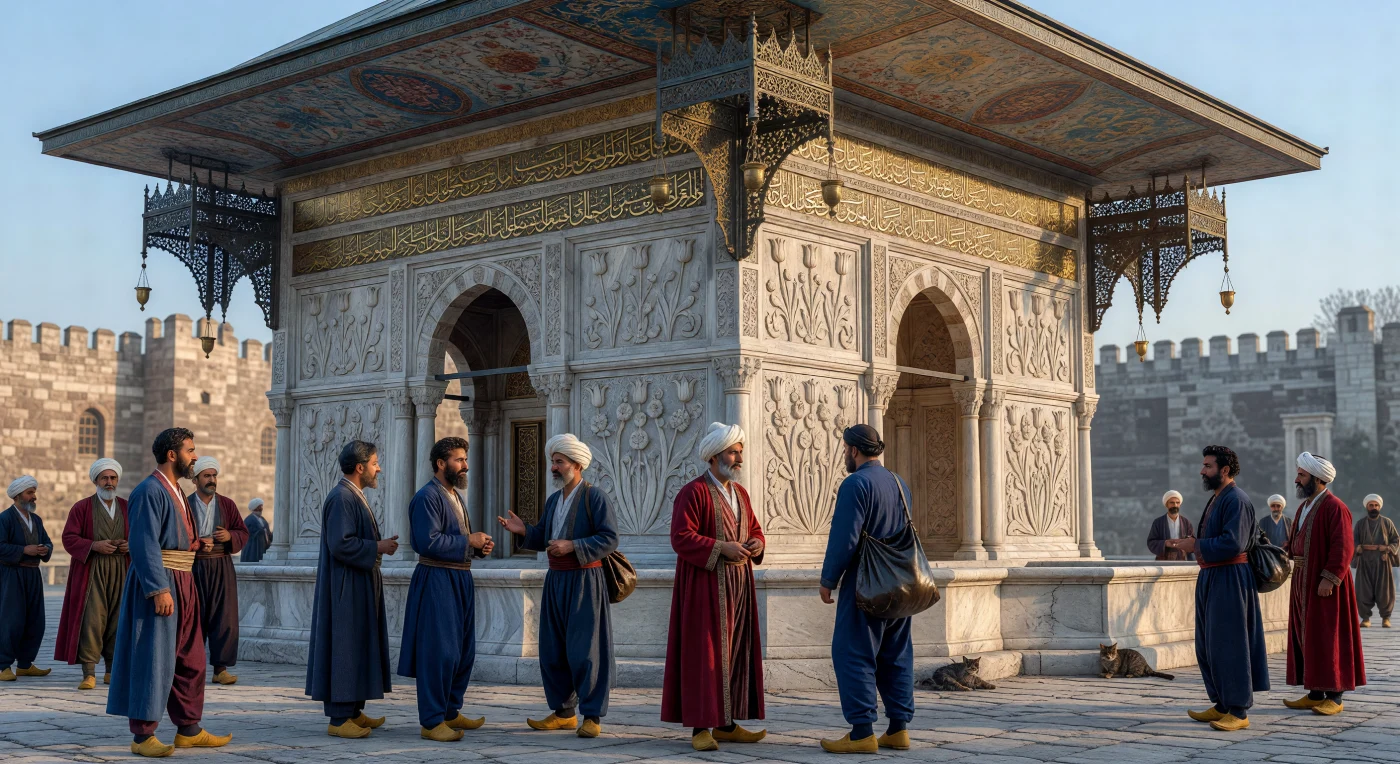
The scene depicts the Fountain of Ahmed III in Istanbul, a masterpiece of Ottoman Baroque architecture completed in 1728 during the culturally vibrant Tulip Period. Citizens in traditional wool kaftans and silk turbans gather beneath the pavilion’s wide, lead-covered eaves, which are adorned with intricate floral reliefs and gilded thuluth calligraphy. Located at the entrance of Topkapi Palace, this ornate public structure served as both a vital source of water and a bustling social hub, reflecting the era’s emphasis on public welfare and decorative elegance.
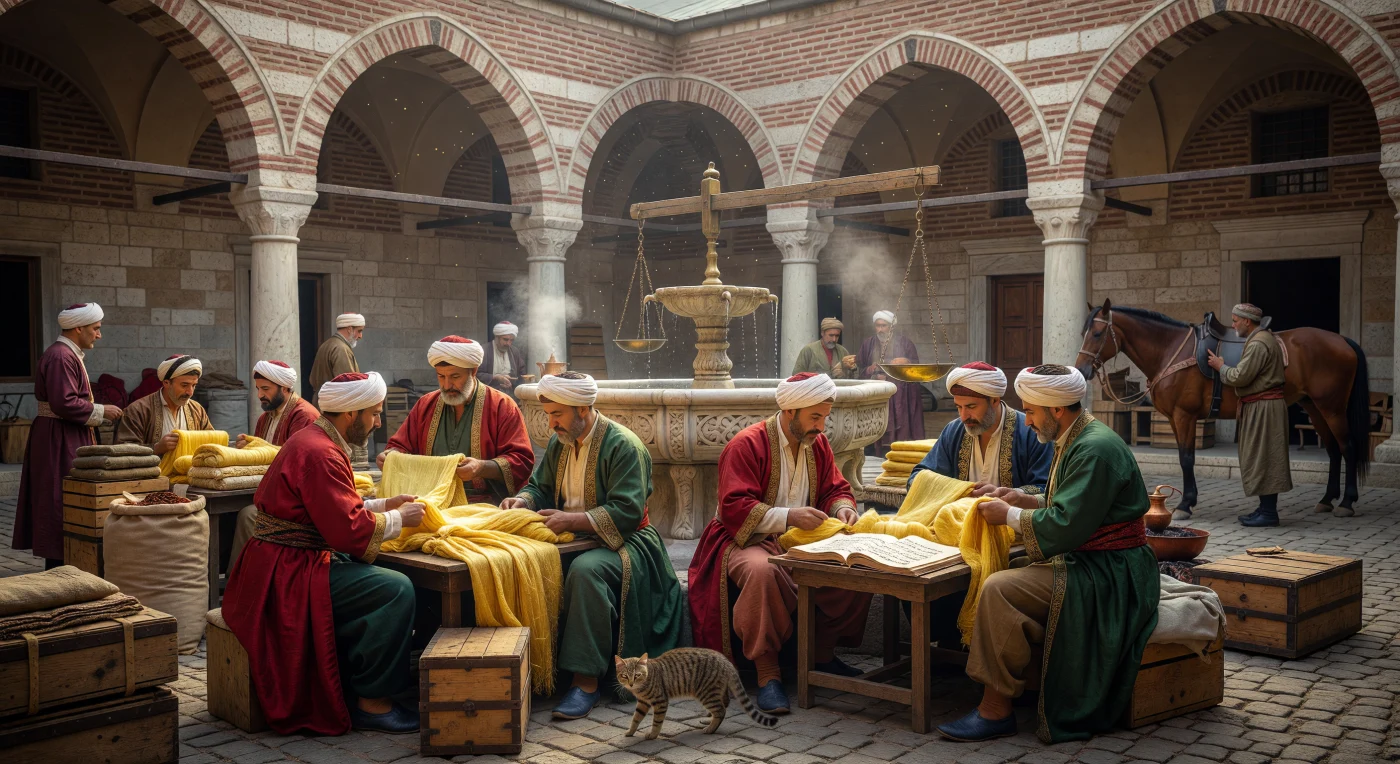
In a sun-drenched courtyard of Bursa’s Koza Han, Turkish and Armenian merchants gather to inspect hanks of raw yellow silk, the cornerstone of the city’s thriving 18th-century economy. The surrounding architecture features the distinctive alternating layers of red brick and limestone characteristic of Ottoman masonry, centered on an ornate stone fountain used for both cooling and ritual. The scene captures the complex social fabric of the Empire, where diverse ethnic groups collaborated in global trade, their identities subtly marked by the specific colors of their slippers and turbans in accordance with contemporary sumptuary laws.
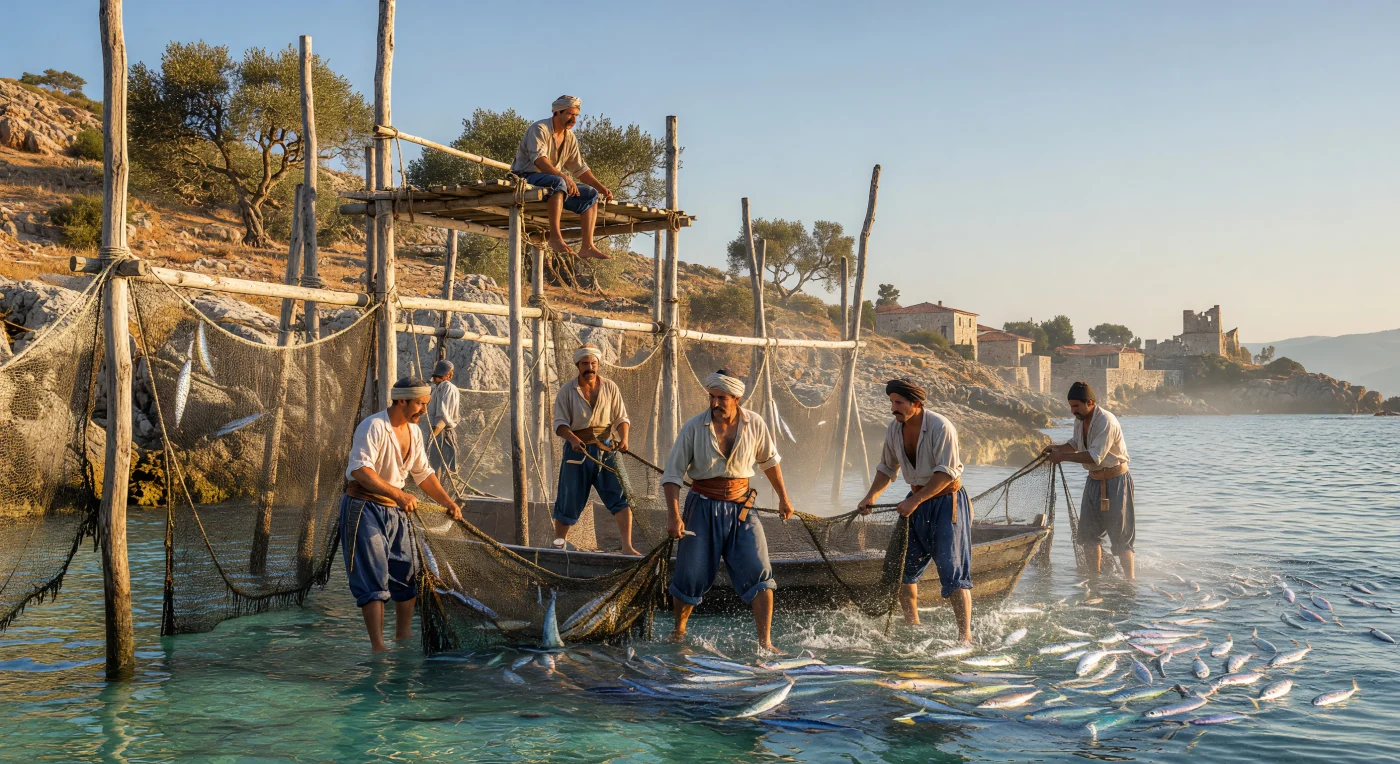
In this 18th-century scene along the Ottoman Aegean coast, fishermen operate a *dalyan*, a sophisticated stationary weir designed to trap migrating schools of *palamut* (Atlantic bonito). Laborers in traditional cotton *şalvar* and linen *gömlek* haul heavy hemp nets onto a wooden *kayık*, while an observer perched on a timber platform monitors the turquoise waters for the dark shadows of approaching fish. This labor-intensive method, which remained largely unchanged for centuries, underscores the vital importance of seasonal maritime harvests to the regional economy and the Ottoman diet during the Early Modern era.

Members of the Mevlevi Order perform the *Sema* ceremony within an 18th-century Istanbul lodge, a period characterized by the refined "Ottoman Baroque" architectural style. The dervishes are depicted in the traditional *sikke* hat and pleated *tennure* skirt, symbolizing the ego’s tombstone and shroud as they whirl in a meditative pursuit of divine love. The scene captures the spiritual gravity of the era, set against a backdrop of vibrant Iznik tiling, Thuluth calligraphy, and the haunting melodies of the *ney* reed flute.

Two Janissary guards stand watch at a limestone fortress overlooking a rugged Balkan mountain pass during the late 17th century, a period of persistent military activity on the Ottoman frontier. The soldiers wear the iconic white felt *börk* hats and crimson wool tunics characteristic of their elite corps, while their diverse features reflect the *Devshirme* system of recruitment from across the empire's multi-ethnic territories. Beside them sits an ornate bronze cannon decorated with Ottoman calligraphy and floral motifs, illustrating the sophisticated craftsmanship and the central role of gunpowder technology in maintaining the Sultan’s vast borders.