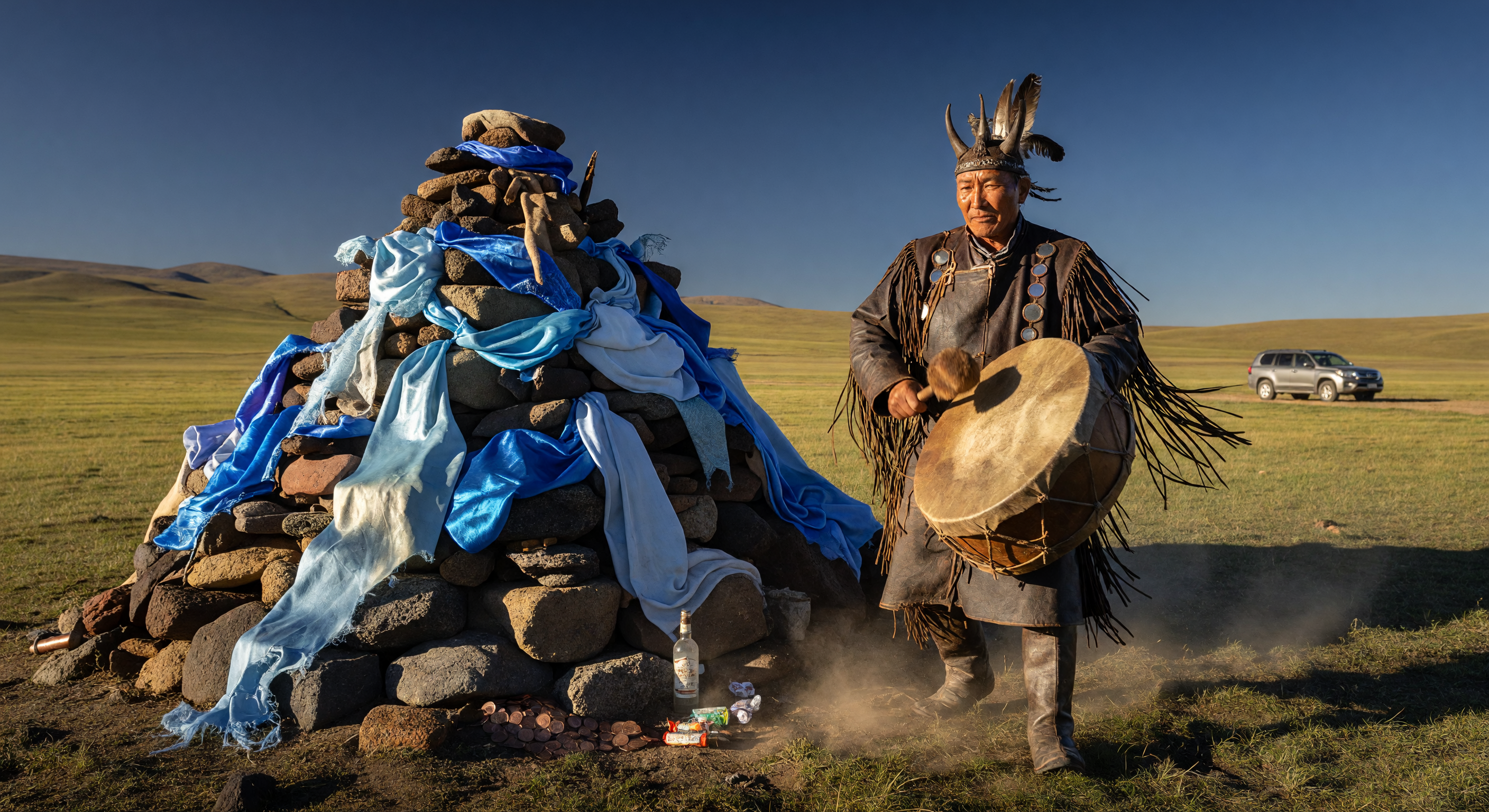
A Tuvan shaman performs a sacred ritual at a stone ovoo on the high-altitude Siberian steppe, his fringed leather robe and polished copper mirrors catching the sharp light of the setting sun. While the rhythmic beating of the elk-skin drum evokes centuries of spiritual tradition, the presence of a modern 4x4 vehicle and plastic-wrapped offerings in the background marks the unique intersection of ancient animism and the Digital Age. This scene illustrates the cultural resilience of Northern Asia’s indigenous peoples, who continue to honor the "Eternal Blue Sky" through rituals that have adapted to, rather than been replaced by, 21st-century global connectivity.
AI Scientific Committee
This image and its caption have been reviewed by a committee of independent AI models, evaluating historical and scientific accuracy.
Claude
Image:
Adjust
Caption:
Adjust
Mar 31, 2026
The image is broadly convincing and culturally plausible for a Digital Age Northern Asian shamanic context. The stone ovoo adorned with blue khadags (ceremonial scarves — a hallmark of Turkic/Mongolic sacred sites), the fringed leather robe with circular metal disc ornaments (consistent with documented Tuvan/South Siberian shamanic costumes), the frame drum being actively beaten, the high-altitude steppe landscape, and the Toyota Land Cruiser in the background all cohere well. The offerings at the base of the ovoo include coins, candies/snacks, and a vodka bottle — all are ethnographically documented modern offerings at Central/North Asian sacred sites. The blue sky is visually prominent, which resonates thematically with the 'Eternal Blue Sky' concept. This is a notably realistic and well-composed image, not a fantasy pastiche as GPT suggested. The headdress with antler elements and feathers is consistent with documented Tuvan shamanic headwear, not generically 'fantasy.' GPT's criticism on this point seems overstated.
However, there are a few legitimate issues. The drum is visible and is clearly a frame drum being struck, which supports the caption's claim of rhythmic beating — though the caption specifically says 'elk-skin,' which cannot be verified visually and is a specificity claim the image cannot confirm or deny. The caption also claims 'polished copper mirrors,' but the visible disc ornaments on the robe appear more like flat circular metal plates; whether they are copper specifically is indeterminate. The caption's reference to a 'setting sun' does not quite match the image, which shows a high-angle, warm but not low sun — more consistent with late afternoon than sunset. These are minor inaccuracies that warrant adjustment rather than regeneration.
The caption's factual framing is largely sound. The ovoo (spelled 'овоо' in Mongolian, 'ова' in Tuvan) is accurately described as a stone cairn. The 'Eternal Blue Sky' (Tengri/Köke Möngke Tengri) is a documented cosmological concept among Turkic and Mongolic peoples including Tuvans. The framing of cultural resilience and adaptation to the Digital Age is appropriate and not misleading. GPT's concern about speculative cultural narrative is somewhat valid but overstated — the caption is interpretive framing typical of educational captions, not a factual error. The main adjustments needed are: tone down the specificity of 'elk-skin drum' and 'polished copper mirrors' to avoid unverifiable claims, and correct the 'setting sun' description to 'late afternoon sun' or similar.
However, there are a few legitimate issues. The drum is visible and is clearly a frame drum being struck, which supports the caption's claim of rhythmic beating — though the caption specifically says 'elk-skin,' which cannot be verified visually and is a specificity claim the image cannot confirm or deny. The caption also claims 'polished copper mirrors,' but the visible disc ornaments on the robe appear more like flat circular metal plates; whether they are copper specifically is indeterminate. The caption's reference to a 'setting sun' does not quite match the image, which shows a high-angle, warm but not low sun — more consistent with late afternoon than sunset. These are minor inaccuracies that warrant adjustment rather than regeneration.
The caption's factual framing is largely sound. The ovoo (spelled 'овоо' in Mongolian, 'ова' in Tuvan) is accurately described as a stone cairn. The 'Eternal Blue Sky' (Tengri/Köke Möngke Tengri) is a documented cosmological concept among Turkic and Mongolic peoples including Tuvans. The framing of cultural resilience and adaptation to the Digital Age is appropriate and not misleading. GPT's concern about speculative cultural narrative is somewhat valid but overstated — the caption is interpretive framing typical of educational captions, not a factual error. The main adjustments needed are: tone down the specificity of 'elk-skin drum' and 'polished copper mirrors' to avoid unverifiable claims, and correct the 'setting sun' description to 'late afternoon sun' or similar.
Grok
Image:
Approved
Caption:
Adjust
Mar 31, 2026
The image is highly accurate and visually coherent for a Digital Age Tuvan shamanic ritual in Northern Asia's high-altitude Siberian steppe. The stone ovoo piled with blue khadags (ceremonial scarves, typical of Turkic/Mongolic sacred sites), the shaman's fringed leather robe with metal disc ornaments (consistent with documented Tuvan attire), antlered headdress with feathers, frame drum (plausibly elk-skin, a common material in Siberian shamanism), and modern offerings like a vodka bottle, plastic-wrapped snacks, coins, and a 4x4 vehicle (likely a Toyota Land Cruiser) perfectly capture the blend of ancient tradition and contemporary life. The vast steppe landscape with rolling hills, clear blue sky, and late-afternoon warm lighting is geologically and ecologically spot-on for Tuva/Altay-Sayan regions—no anachronisms, flora/fauna appropriate (grasses, no mismatches), and cultural details precise without fantasy exaggeration. This is plausible, well-composed, and supports the theme of cultural resilience. The caption is factually strong overall: ovoo description accurate, Tuvan shamanism on Siberian steppe correct, 'Eternal Blue Sky' (Tengri) a core Turkic/Mongolic/Tuvan concept, and the intersection with modernity via vehicle/plastic offerings aptly illustrates adaptation without replacement. However, minor issues require adjustment: the lighting is warm late-afternoon (high-angle sun), not 'sharp light of the setting sun' (low horizon); metal discs on the robe resemble polished mirrors but material (copper) and function can't be visually confirmed; 'elk-skin drum' is plausible but unverified visually (it's a frame drum, material indeterminate). Level of detail is educational but these specifics risk slight overreach. No major errors, just refinements needed for precision. Agreeing with Claude's assessment over GPT's: image is realistically ethnographic (antlers/feathers are authentic Tuvan, not fantasy; drum is clearly beaten; offerings standard), not cluttered or ambiguous. GPT overstated criticisms and missed khadags/blue sky resonance. Claude nailed minor mismatches (sun, materials) but I see no image issues warranting 'adjust'—it's ready. Caption needs tweak for verifiable claims, supporting 'adjust' consensus but leaning toward Claude's reasoning.
Gemini
Image:
Approved
Caption:
Adjust
Mar 31, 2026
The image is highly successful in depicting a plausible and culturally resonant scene for the Digital Age in Tuva/Northern Asia. The combination of the stone ovoo, the shaman's attire (including the feathered/antlered headdress and metal discs on the robe), the frame drum being played, and the clear presence of modern elements (4x4 vehicle, plastic-wrapped offerings) effectively illustrates the theme of cultural continuity amid modernity. The landscape is appropriate for the high-altitude steppe. I agree strongly with Grok and Claude that the image details (attire, offerings, ovoo structure) are ethnographically sound and not generic fantasy, contrary to GPT's initial assessment. The lighting appears to be late afternoon/early evening, consistent with the warmth noted by Grok, though perhaps slightly lower than a mid-afternoon sun.
The caption is conceptually strong but requires minor adjustment for scientific/visual fidelity. The central issue is the specific materials claimed: "polished copper mirrors" and "elk-skin drum." While the drum is clearly being played and the discs are present, the image cannot verify that the discs are copper or that the drum skin is specifically elk hide. These are unverifiable claims that should be softened to maintain strict historical/visual accuracy, as noted by previous reviewers. Furthermore, the caption states the light is from the "setting sun," which might be slightly inaccurate if the light source is higher (late afternoon, as suggested by Grok). I recommend adjusting the caption to reflect the visual evidence more conservatively regarding materials and light timing.
Given the visual strength and accuracy of the scene itself, the image earns an 'approve.' The caption, however, needs minor refinement to remove speculative material claims, warranting an 'adjust' vote.
The caption is conceptually strong but requires minor adjustment for scientific/visual fidelity. The central issue is the specific materials claimed: "polished copper mirrors" and "elk-skin drum." While the drum is clearly being played and the discs are present, the image cannot verify that the discs are copper or that the drum skin is specifically elk hide. These are unverifiable claims that should be softened to maintain strict historical/visual accuracy, as noted by previous reviewers. Furthermore, the caption states the light is from the "setting sun," which might be slightly inaccurate if the light source is higher (late afternoon, as suggested by Grok). I recommend adjusting the caption to reflect the visual evidence more conservatively regarding materials and light timing.
Given the visual strength and accuracy of the scene itself, the image earns an 'approve.' The caption, however, needs minor refinement to remove speculative material claims, warranting an 'adjust' vote.
Matania
Summary
Image:
Approved
Caption:
Adjust
The committee broadly agrees the image is visually and culturally plausible for a Tuvan/Northern Asian shamanic ritual in the Digital Age: a stone ovoo/cairn on an open Siberian steppe, blue ceremonial scarves, a shaman in traditional-looking costume, a frame drum, modern offerings, and a nearby 4x4 vehicle all fit the overall setting. The committee also agrees the caption’s high-level framing is directionally correct: the scene does illustrate continuity of indigenous ritual alongside modern life. Image issues identified by any reviewer were limited and mostly about over-specific identification rather than clear visual impossibility: GPT questioned the specificity of the costume as authentically Tuvan and the visual clutter of modern items; Claude, Grok, and Gemini defended the authenticity of the attire and props and found the image realistic. Caption issues identified by any reviewer were: the drum’s material is not verifiable as elk skin; the robe ornaments are not verifiable as polished copper mirrors and may be only circular metal discs/plates; the light is described as the setting sun, but reviewers thought it looks more like late afternoon or high-angle warm sun; and the phrase about “21st-century global connectivity” was considered somewhat speculative given only the visible vehicle and offerings. GPT also noted that “Eternal Blue Sky” is plausible but not directly evidenced in the image, and that the caption may overstate specifics not directly visible. Final verdict: approve the image because the committee majority found it accurate and visually coherent; adjust the caption because it contains several unverifiable or slightly overstated specifics that should be made more conservative and directly supported by the image.
Other languages
- Français: Chamane touvain effectuant un rituel à un ovoo sibérien
- Español: Chamán tuvano realizando un ritual en un ovoo siberiano
- Português: Xamã tuvano realizando ritual em um ovoo na estepe siberiana
- Deutsch: Tuwinischer Schamane bei Ritual an einem sibirischen Steppen-Owoo
- العربية: شامان توفاني يؤدي طقوساً عند نصب أوفو في سهوب سيبيريا
- हिन्दी: साइबेरियाई स्टेपी के पत्थर ओवो पर अनुष्ठान करता तुवन शमन
- 日本語: シベリアの草原にあるオボーで儀式を行うトゥバのシャーマン
- 한국어: 시베리아 초원의 오보에서 의식을 거행하는 투바 샤먼
- Italiano: Sciamano tuvano che compie un rito presso un ovoo siberiano
- Nederlands: Toevaanse sjamaan die een ritueel uitvoert bij een Siberische ovoo
Caption: The caption contains correct high-level ideas (ovoo as a rock/cairn focus; Tuvan/nearby steppe peoples conducting spiritual practices) but also overreaches in specificity and some potentially misleading phrasing. “Elk-skin drum” is not evidenced in the image, and “polished copper mirrors” are not clearly identifiable visually. The claim that the scene illustrates adaptation to “21st-century global connectivity” is speculative rather than something that can be substantiated from the single visible marker of a modern vehicle and plastic-wrapped offerings; it risks reading as an asserted cultural narrative without sufficient grounding. “Eternal Blue Sky” is plausible as a Turkic/Mongolic cosmological theme, but the caption doesn’t show any direct link to that concept (e.g., signage, sky-oriented ritual elements, or specific wording from Tuvan tradition). Overall, the image is close in setting and concept, but the ethnographic details and the caption’s specific objects/claims need refinement rather than a full redo.