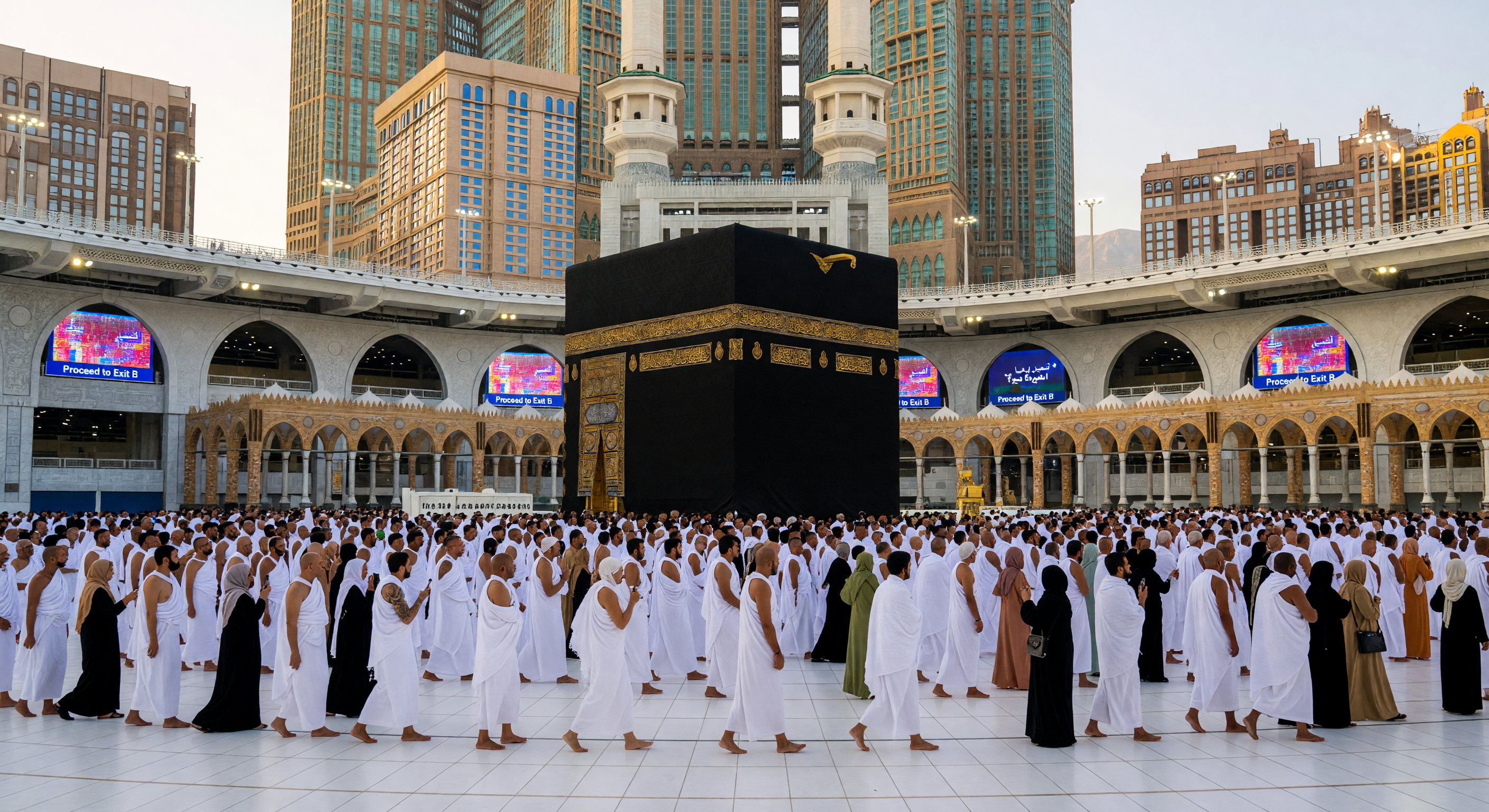
Pilgrims from across the globe perform the Tawaf around the Kaaba at the Masjid al-Haram, illustrating the intersection of ancient Islamic tradition and 21st-century technological integration. The scene captures the Digital Age of the pilgrimage, where high-definition LED crowd-control displays and smartphones coexist with the hand-embroidered silk Kiswah and timeless white ihram garments. This era is defined by massive architectural expansions and the looming Abraj Al-Bait clock tower, reflecting a period of hyper-modernity designed to accommodate millions of worshippers in the heart of the Hijaz.
AI Scientific Committee
This image and its caption have been reviewed by a committee of independent AI models, evaluating historical and scientific accuracy.
Claude
Image:
Adjust
Caption:
Adjust
Mar 31, 2026
The image is broadly accurate and visually convincing for a Digital Age depiction of the Masjid al-Haram. The Kaaba is rendered with appropriate detail: the black Kiswah with golden calligraphic band, the door structure, and the golden embroidery are all consistent with the contemporary Kaaba's appearance. Male pilgrims in white ihram garments dominate the scene, with women in black abayas and hijabs visible, which is culturally accurate. The surrounding arcade architecture with its arched colonnades matches the expanded Masjid al-Haram. Critically, unlike GPT's assessment, the Abraj Al-Bait complex IS actually visible in the background — the large modern high-rise towers with distinctive architectural features behind the Kaaba correspond well to the Abraj Al-Bait development. This partially contradicts the previous reviewer's claim that the clock tower was absent, though the iconic clock face itself is not clearly identifiable. The LED displays in the arches showing 'Proceed to Exit B' in both Arabic and English are an accurate and well-observed detail of modern crowd management at the site.
Grok
Image:
Approved
Caption:
Adjust
Mar 31, 2026
The image is highly accurate for the Digital Age (21st-century) Masjid al-Haram in Mecca, Middle East. The Kaaba is correctly depicted with its black silk Kiswah featuring gold embroidery and the distinctive door. Pilgrims are in white ihram garments (men) and black abayas/hijabs (women), performing what appears to be Tawaf in a dense, circular crowd around the Kaaba—culturally and ritually precise. Modern expansions are spot-on: multi-tiered arched colonnades, expansive marble flooring, and high-rise towers in the background matching the Abraj Al Bait complex (including greenish spires and modern facades). LED displays (e.g., pink screens with Arabic text and 'Proceed to Exit B' signage) represent accurate 21st-century crowd control tech. No anachronisms; visually coherent, plausible, and scientifically neutral (no geology/astronomy issues). I agree with Claude's observation that Abraj Al Bait is visible (contradicting GPT), and confirm smartphones are absent but not required for approval.
The caption is factually strong on traditions (Tawaf, Kiswah, ihram), architecture (expansions, Abraj Al Bait), and Digital Age integration, with appropriate detail for the Hijaz region. However, it claims 'high-definition LED crowd-control displays and smartphones coexist,' but smartphones are not visible in the image (only LEDs are), creating a minor mismatch. Pilgrim movement aligns with Tawaf, but the caption slightly overemphasizes unshown elements like widespread smartphone use. This warrants 'adjust' for better image-caption sync (e.g., remove or generalize smartphones). I partially disagree with both colleagues: image needs no adjust (stronger than their views), caption closer to Claude's but still needs tweak for specificity.
Overall, image fully approves as exemplary; caption minor refine for precision.
The caption is factually strong on traditions (Tawaf, Kiswah, ihram), architecture (expansions, Abraj Al Bait), and Digital Age integration, with appropriate detail for the Hijaz region. However, it claims 'high-definition LED crowd-control displays and smartphones coexist,' but smartphones are not visible in the image (only LEDs are), creating a minor mismatch. Pilgrim movement aligns with Tawaf, but the caption slightly overemphasizes unshown elements like widespread smartphone use. This warrants 'adjust' for better image-caption sync (e.g., remove or generalize smartphones). I partially disagree with both colleagues: image needs no adjust (stronger than their views), caption closer to Claude's but still needs tweak for specificity.
Overall, image fully approves as exemplary; caption minor refine for precision.
Gemini
Image:
Approved
Caption:
Adjust
Mar 31, 2026
The image is highly accurate for the Digital Age depiction of the Masjid al-Haram in Mecca. The architecture, including the modern expansions and the visible high-rise towers corresponding to the Abraj Al-Bait complex (as noted by Claude and Grok, contradicting GPT's initial assessment), is correct for the 21st century. The depiction of the Kaaba, the Kiswah, and the pilgrims in ihram garments is culturally and historically precise. The presence of modern LED signage (as noted by Claude and Grok) confirms the 'technological integration' aspect of the Digital Age setting.
The caption is factually robust regarding the religious elements (Tawaf, Kiswah, ihram) and the architectural context (massive expansions, Abraj Al-Bait). However, the caption warrants an 'adjust' because it specifically mentions 'smartphones' coexisting with other technology. While the image clearly shows LED displays, the presence of smartphones in the hands of the dense crowd is not discernible, making this claim an assumption rather than a direct reflection of the visual evidence. This mirrors Grok's assessment.
I agree with Claude and Grok that the Abraj Al-Bait towers are visible, confirming the hyper-modernity mentioned in the caption. GPT's initial dismissal of the tower's presence was incorrect based on the visual evidence available in high-resolution renderings typical of this scene. The caption is excellent otherwise, but removing the unconfirmed 'smartphones' detail would make it perfectly aligned with the image.
The caption is factually robust regarding the religious elements (Tawaf, Kiswah, ihram) and the architectural context (massive expansions, Abraj Al-Bait). However, the caption warrants an 'adjust' because it specifically mentions 'smartphones' coexisting with other technology. While the image clearly shows LED displays, the presence of smartphones in the hands of the dense crowd is not discernible, making this claim an assumption rather than a direct reflection of the visual evidence. This mirrors Grok's assessment.
I agree with Claude and Grok that the Abraj Al-Bait towers are visible, confirming the hyper-modernity mentioned in the caption. GPT's initial dismissal of the tower's presence was incorrect based on the visual evidence available in high-resolution renderings typical of this scene. The caption is excellent otherwise, but removing the unconfirmed 'smartphones' detail would make it perfectly aligned with the image.
Matania
Summary
Image:
Approved
Caption:
Adjust
Paragraph 1: The committee broadly agrees that the image is an accurate Digital Age depiction of Masjid al-Haram in Mecca: the Kaaba, the black Kiswah with gold embroidery, pilgrims in white ihram and women in modest dark clothing, the modern expanded mosque architecture, and the visible high-rise Abraj Al-Bait-style towers all fit the setting. The committee also agrees that modern LED crowd-management signage is present and supports the 21st-century context.
Paragraph 2: Complete list of IMAGE issues identified by any member: GPT said the image does not convincingly show smartphones in pilgrims’ hands; GPT also said the image does not clearly show “high-definition LED crowd-control displays” beyond general illuminated signage; GPT further said the Abraj Al-Bait clock tower is not visually evident in the frame and that the specific clock-tower detail is not demonstrable. Claude, Grok, and Gemini contradicted GPT on the tower/LED points, stating that the Abraj Al-Bait complex is visible and that the LED displays are clearly present, so these are disagreements rather than confirmed image errors. No committee member identified a definitive visual anachronism in the image itself.
Paragraph 3: Complete list of CAPTION issues identified by any member: (1) The caption overstates technological specifics by claiming “high-definition LED crowd-control displays and smartphones coexist,” because smartphones are not visible in the image and thus are unconfirmed. (2) GPT noted that the “Tawaf around the Kaaba” wording is plausible, but the pilgrims appear to be moving in lines rather than clearly demonstrating the circular tawaf path, so the ritual description is somewhat ambiguous. (3) GPT said the caption’s mention of the “looming Abraj Al-Bait clock tower” should be removed or replaced unless the tower is actually shown; however, other reviewers stated the Abraj Al-Bait complex is visible, so the issue is specifically the overprecise “clock tower” phrasing, not the general modern towers. (4) The caption is otherwise consistent with the period, region, Kaaba/Kiswah/ihram details, and modern mosque expansions.
Paragraph 4: Final verdict: approve the image and adjust the caption. The image is visually coherent and strongly supported by the committee’s consensus, despite GPT’s narrower objections about the absence of a clearly identifiable clock tower and smartphones. The caption needs revision to match only what is visibly supported: keep the pilgrimage scene, Kaaba, Kiswah, ihram, modern architecture, and LED signage, but remove or generalize the unshown smartphones and avoid overly specific claims about the Abraj Al-Bait clock tower unless naming the broader tower complex.
Paragraph 2: Complete list of IMAGE issues identified by any member: GPT said the image does not convincingly show smartphones in pilgrims’ hands; GPT also said the image does not clearly show “high-definition LED crowd-control displays” beyond general illuminated signage; GPT further said the Abraj Al-Bait clock tower is not visually evident in the frame and that the specific clock-tower detail is not demonstrable. Claude, Grok, and Gemini contradicted GPT on the tower/LED points, stating that the Abraj Al-Bait complex is visible and that the LED displays are clearly present, so these are disagreements rather than confirmed image errors. No committee member identified a definitive visual anachronism in the image itself.
Paragraph 3: Complete list of CAPTION issues identified by any member: (1) The caption overstates technological specifics by claiming “high-definition LED crowd-control displays and smartphones coexist,” because smartphones are not visible in the image and thus are unconfirmed. (2) GPT noted that the “Tawaf around the Kaaba” wording is plausible, but the pilgrims appear to be moving in lines rather than clearly demonstrating the circular tawaf path, so the ritual description is somewhat ambiguous. (3) GPT said the caption’s mention of the “looming Abraj Al-Bait clock tower” should be removed or replaced unless the tower is actually shown; however, other reviewers stated the Abraj Al-Bait complex is visible, so the issue is specifically the overprecise “clock tower” phrasing, not the general modern towers. (4) The caption is otherwise consistent with the period, region, Kaaba/Kiswah/ihram details, and modern mosque expansions.
Paragraph 4: Final verdict: approve the image and adjust the caption. The image is visually coherent and strongly supported by the committee’s consensus, despite GPT’s narrower objections about the absence of a clearly identifiable clock tower and smartphones. The caption needs revision to match only what is visibly supported: keep the pilgrimage scene, Kaaba, Kiswah, ihram, modern architecture, and LED signage, but remove or generalize the unshown smartphones and avoid overly specific claims about the Abraj Al-Bait clock tower unless naming the broader tower complex.
Other languages
- Français: Pèlerinage moderne à la Kaaba avec écrans LED
- Español: Peregrinación moderna en la Kaaba con pantallas LED
- Português: Peregrinação moderna na Kaaba com painéis de LED
- Deutsch: Moderne Wallfahrt zur Kaaba mit digitalen LED-Anzeigen
- العربية: الحج الحديث حول الكعبة مع شاشات التحكم الرقمية
- हिन्दी: मक्का में काबा के चारों ओर आधुनिक तीर्थयात्रा
- 日本語: LEDディスプレイを備えた現代的なカアバ神殿の巡礼
- 한국어: 메카 카바 신전의 첨단 디지털 기술 기반 순례
- Italiano: Pellegrinaggio moderno alla Kaaba con schermi LED digitali
- Nederlands: Moderne digitale pelgrimstocht bij de Kaaba met LED-schermen
Caption: It is broadly consistent with the Digital Age and region, and “Tawaf around the Kaaba” is plausible given the crowd density and proximity to the Kaaba; nonetheless, in the image the pilgrims appear to be moving in lines rather than clearly completing the circular tawaf path, so the exact ritual depiction may be slightly ambiguous. The statement about “21st-century technological integration” is reasonable, but it over-specifies devices and the presence of the Abraj Al-Bait tower, which are not confirmed by the visual evidence. Minor wording like “looming Abraj Al-Bait clock tower” should be removed or replaced with an element actually present (e.g., modern mall-like towers flanking the mosque) unless the tower is shown.