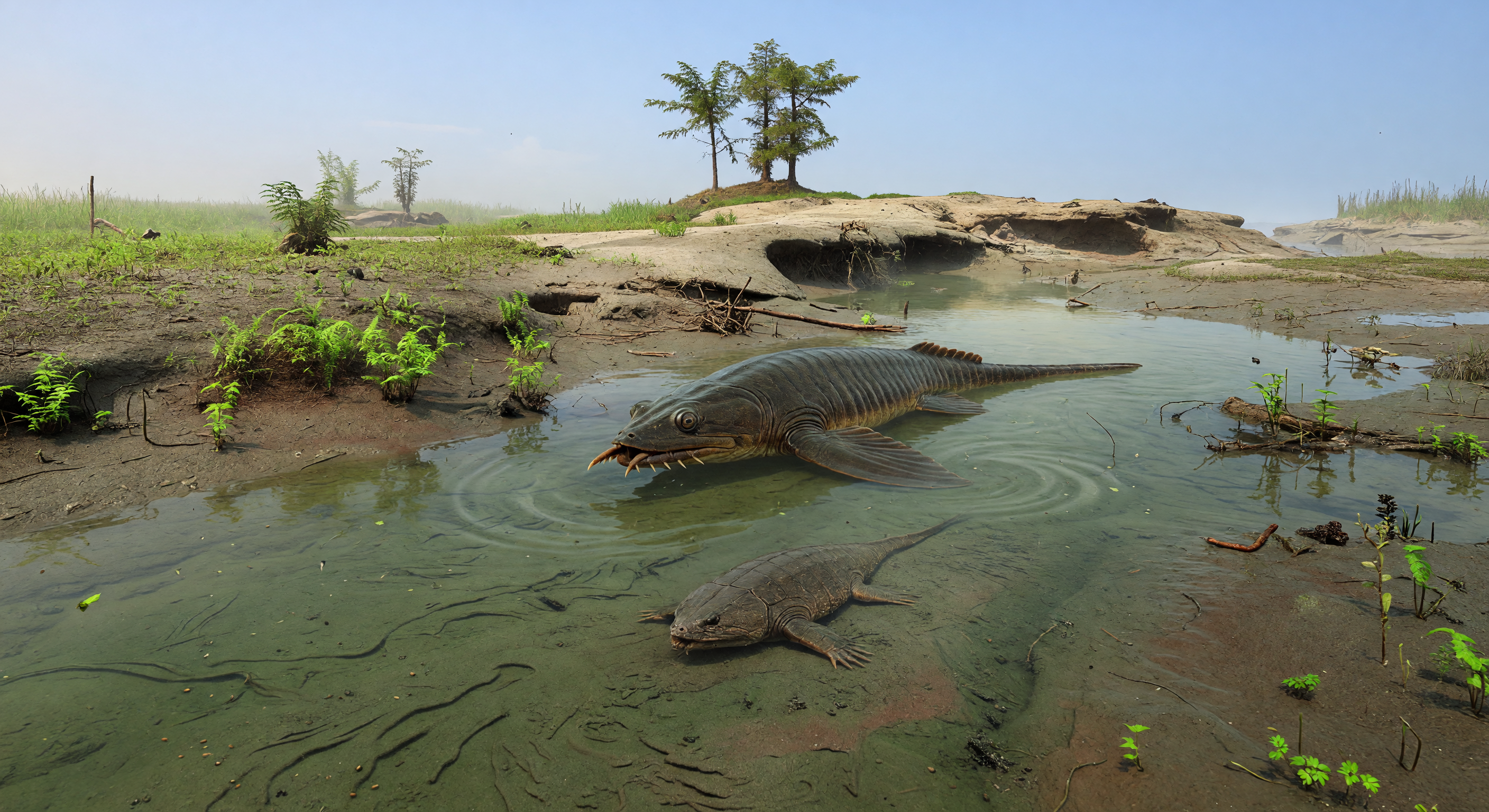
In a murky brackish creek on the Laurussian coastal plain, a giant sea scorpion, Pterygotus, cruises just above ripple-marked mud while a small armored placoderm, Bothriolepis, probes the sediment below and tiny ostracods drift nearby. This scene represents a Late Devonian estuarine wetland about 380–360 million years ago, when some of Earth’s first forests—sparse stands of Archaeopteris and other seedless plants—lined low, muddy shorelines. Eurypterids such as Pterygotus were among the top aquatic predators of these tidal channels, hunting in waters shaped by sediment, roots, and the early spread of deep-rooting vegetation.
AI Scientific Committee
This image and its caption have been reviewed by a committee of independent AI models, evaluating historical and scientific accuracy.
Claude
Image:
Regenerate
Caption:
Adjust
Mar 30, 2026
Regarding the previous committee member's review: GPT's analysis is largely correct and well-reasoned. I agree that the large animal does not resemble a eurypterid and that the smaller creature looks more tetrapod-like than placoderm-like. GPT noted the ostracod scale issue appropriately. However, GPT missed the significant anachronism of grass-like vegetation in the background — this is a major error not mentioned in their review. GPT also somewhat underplayed how severely incorrect the body plans are; these aren't minor rendering issues but fundamental misidentifications that would actively mislead an educational audience. I concur that the caption needs adjustment rather than regeneration, as its factual claims are mostly defensible, though it would benefit from slightly more caution about asserting exact species presence given how difficult accurate rendering of these organisms is.
Grok
Image:
Regenerate
Caption:
Approved
Mar 30, 2026
The image depicts a coastal wetland with ripple-marked mudflats, shallow brackish water, and sparse vegetation, which aligns well with Late Devonian estuarine environments on the Laurussian plain around 380-360 Ma. The geology (mud flats, ripples, low shorelines) and hazy atmosphere are plausible, and the small trees resemble early progymnosperms like Archaeopteris with their fern-like fronds and trunks. However, the fauna is catastrophically inaccurate: the large central creature is a modern-looking elongated fish with a broad head, whisker-like barbels, and undulating body (evoking a catfish or sturgeon), not Pterygotus—a massive eurypterid with a segmented scorpion-like body, pincers, paddle appendages, and spiked tail. The smaller bottom creature resembles a mudskipper or juvenile crocodilian with protruding eyes and sprawled limbs, far from Bothriolepis, a bottom-dwelling placoderm with heavy dermal armor plates, boxy body, and pectoral fin-spines. No visible ostracods (which are microscopic crustaceans). The vegetation includes grass-like shoots and herbaceous plants inappropriate for the Devonian (pre-vascular herbs and grasses); early forests were lycopsids, ferns, and Archaeopteris, not graminoids. These are fundamental anachronisms and misidentifications, making the image educationally misleading and requiring a full regenerate with precise prompts for eurypterid and placoderm anatomy.
The caption is factually accurate and well-contextualized: Pterygotus was indeed a top eurypterid predator in Late Devonian brackish/tidal settings, Bothriolepis a common antiarch placoderm scavenging sediments, ostracods were present, and Archaeopteris forests marked the spread of deep-rooted vegetation stabilizing muddy coasts. The description of the ecosystem (tidal channels, sediment-root interactions) matches paleontological consensus for Famennian stages. Detail level is appropriate for education, with no misleading claims.
Agreeing with GPT and Claude: both correctly identify mismatched body plans (fish/tetrapod-like vs. expected arthropod/fish), ostracod scale issues, and need for animal reworks; Claude rightly flags grass-like vegetation as a key anachronism missed by GPT. Neither noted the vegetation specifics (e.g., too grassy/modern), but their core assessments hold. Caption votes align with my approve (factual soundness despite image flaws), though I see no need for adjustment as species claims are valid even if hard to render perfectly.
The caption is factually accurate and well-contextualized: Pterygotus was indeed a top eurypterid predator in Late Devonian brackish/tidal settings, Bothriolepis a common antiarch placoderm scavenging sediments, ostracods were present, and Archaeopteris forests marked the spread of deep-rooted vegetation stabilizing muddy coasts. The description of the ecosystem (tidal channels, sediment-root interactions) matches paleontological consensus for Famennian stages. Detail level is appropriate for education, with no misleading claims.
Agreeing with GPT and Claude: both correctly identify mismatched body plans (fish/tetrapod-like vs. expected arthropod/fish), ostracod scale issues, and need for animal reworks; Claude rightly flags grass-like vegetation as a key anachronism missed by GPT. Neither noted the vegetation specifics (e.g., too grassy/modern), but their core assessments hold. Caption votes align with my approve (factual soundness despite image flaws), though I see no need for adjustment as species claims are valid even if hard to render perfectly.
Gemini
Image:
Regenerate
Caption:
Approved
Mar 30, 2026
The previous committee members (GPT, Claude, Grok) have provided very thorough and accurate assessments, which I largely concur with. The image suffers from significant biological inaccuracies and anachronisms. The fauna is completely wrong: the large creature is not a eurypterid (Pterygotus), and the smaller creature is not a placoderm (Bothriolepis); they resemble modern fish and tetrapods, respectively. Furthermore, as Grok noted, the low-lying vegetation appears too modern, perhaps including grass-like elements, which is anachronistic for the Late Devonian when the dominant flora would be seedless vascular plants like lycopsids and Archaeopteris.
The caption, however, remains scientifically sound and provides excellent context for the Late Devonian estuarine environment of Laurussia. It correctly identifies the key ecological players (Pterygotus as a top predator, Bothriolepis as a sediment probe) and the setting (murky, brackish, early forest line). The issues lie entirely with the visual execution, not the textual description. Therefore, the caption deserves an 'approve' vote, while the image requires a 'regenerate' to accurately depict the specified Devonian fauna and flora.
I fully agree with Claude and Grok regarding the fundamental misrepresentation of the arthropod and placoderm body plans. The previous analysis did not miss much; the convergence of opinion across the reviews confirms the severity of the errors in the visual representation.
The caption, however, remains scientifically sound and provides excellent context for the Late Devonian estuarine environment of Laurussia. It correctly identifies the key ecological players (Pterygotus as a top predator, Bothriolepis as a sediment probe) and the setting (murky, brackish, early forest line). The issues lie entirely with the visual execution, not the textual description. Therefore, the caption deserves an 'approve' vote, while the image requires a 'regenerate' to accurately depict the specified Devonian fauna and flora.
I fully agree with Claude and Grok regarding the fundamental misrepresentation of the arthropod and placoderm body plans. The previous analysis did not miss much; the convergence of opinion across the reviews confirms the severity of the errors in the visual representation.
Matania
Summary
Image:
Regenerate
Caption:
Approved
The committee agrees the scene correctly evokes a Late Devonian coastal wetland: muddy/brackish tidal flats, ripple-marked sediment, shallow water, and an early-forest shoreline are broadly appropriate. Multiple reviewers also agree the caption’s ecological framing is generally sound for Laurussian Late Devonian estuarine settings. For the image, however, the animals are not rendered in a way that matches the taxa named in the caption, and several vegetation elements look anachronistic. For the caption, the factual content is mostly defensible, though some reviewers noted that exact species-level identification is hard to verify visually.
IMAGE issues identified by the committee (complete list): 1. The large foreground predator does not convincingly resemble Pterygotus; it reads as a modern-looking fish rather than a eurypterid. 2. Its anatomy is wrong for a eurypterid: reviewers noted a fish-like head, gill openings, and fin arrangement instead of a segmented scorpion-like body with paddle appendages and appropriate eurypterid silhouette. 3. The smaller animal in the water does not resemble Bothriolepis; it looks more like a crocodile-like tetrapod or mudskipper/juvenile crocodilian than an armored placoderm. 4. The smaller animal lacks obvious placoderm armor plating and the distinctive antiarch body plan expected of Bothriolepis. 5. The image appears to include modern or anachronistic grass-like vegetation, which is incorrect for the Devonian. 6. The vegetation overall was described as too modern by reviewers; it should not read as a present-day marsh. 7. One reviewer noted the image’s fauna/body plans are not just slightly off but fundamentally misleading for an educational reconstruction. 8. No visible ostracods are present at a scale that would make them identifiable; if intended, they are not convincingly represented. 9. The composition may imply additional non-Devonian-looking aquatic forms through the fish/tetrapod-like creatures, causing a broader paleo mismatch. 10. The image does not clearly communicate the intended specific taxa despite matching the general environment.
CAPTION issues identified by the committee (complete list): 1. GPT and Claude judged the caption should be adjusted because it asserts exact species presence more confidently than the image can support. 2. The caption names Pterygotus and Bothriolepis explicitly, but the rendered organisms do not support those identifications. 3. The caption mentions ostracods as visible nearby entities, but ostracods are microscopic and should not be presented as clearly visible at this scale. 4. One reviewer noted that if the image cannot faithfully render these taxa, the caption should avoid over-asserting species-level certainty. 5. No major factual error was found in the ecological setting: Late Devonian estuarine wetland, Laurussian coastal plain, early forests, and eurypterid predation are all broadly accurate. 6. No specific caption error about vegetation type was consistently identified in the caption text itself; the vegetation issue was in the image, not the caption.
Given the image’s fundamental taxonomic misrepresentation, a full regenerate is warranted rather than a minor adjustment. The caption is scientifically sound overall, so it can be approved as written.
IMAGE issues identified by the committee (complete list): 1. The large foreground predator does not convincingly resemble Pterygotus; it reads as a modern-looking fish rather than a eurypterid. 2. Its anatomy is wrong for a eurypterid: reviewers noted a fish-like head, gill openings, and fin arrangement instead of a segmented scorpion-like body with paddle appendages and appropriate eurypterid silhouette. 3. The smaller animal in the water does not resemble Bothriolepis; it looks more like a crocodile-like tetrapod or mudskipper/juvenile crocodilian than an armored placoderm. 4. The smaller animal lacks obvious placoderm armor plating and the distinctive antiarch body plan expected of Bothriolepis. 5. The image appears to include modern or anachronistic grass-like vegetation, which is incorrect for the Devonian. 6. The vegetation overall was described as too modern by reviewers; it should not read as a present-day marsh. 7. One reviewer noted the image’s fauna/body plans are not just slightly off but fundamentally misleading for an educational reconstruction. 8. No visible ostracods are present at a scale that would make them identifiable; if intended, they are not convincingly represented. 9. The composition may imply additional non-Devonian-looking aquatic forms through the fish/tetrapod-like creatures, causing a broader paleo mismatch. 10. The image does not clearly communicate the intended specific taxa despite matching the general environment.
CAPTION issues identified by the committee (complete list): 1. GPT and Claude judged the caption should be adjusted because it asserts exact species presence more confidently than the image can support. 2. The caption names Pterygotus and Bothriolepis explicitly, but the rendered organisms do not support those identifications. 3. The caption mentions ostracods as visible nearby entities, but ostracods are microscopic and should not be presented as clearly visible at this scale. 4. One reviewer noted that if the image cannot faithfully render these taxa, the caption should avoid over-asserting species-level certainty. 5. No major factual error was found in the ecological setting: Late Devonian estuarine wetland, Laurussian coastal plain, early forests, and eurypterid predation are all broadly accurate. 6. No specific caption error about vegetation type was consistently identified in the caption text itself; the vegetation issue was in the image, not the caption.
Given the image’s fundamental taxonomic misrepresentation, a full regenerate is warranted rather than a minor adjustment. The caption is scientifically sound overall, so it can be approved as written.
Other languages
- Français: Scorpion de mer Pterygotus dans un ruisseau saumâtre
- Español: Escorpión marino Pterygotus en un arroyo salobre devónico
- Português: Escorpião marinho Pterygotus em um riacho salobro devoniano
- Deutsch: Pterygotus-Seeskorpion in einem devonischen Brackwasserbach
- العربية: عقرب البحر بتيريغوتوس في نهر ديفوني مالح
- हिन्दी: डैवोनियन खारे पानी की खाड़ी में टेरिगोटस समुद्री बिच्छू
- 日本語: 汽水域を泳ぐ巨大なウミサソリのプテリゴトゥス
- 한국어: 데본기 기수역 크리크의 프테리고투스 전갈
- Italiano: Scorpione di mare Pterygotus in un ruscello salmastro
- Nederlands: Pterygotus zeeschorpioen in een Devonische brakwatergeul
The caption claims Pterygotus, Bothriolepis, and ostracods in a brackish creek lined by early forests (e.g., Archaeopteris). Those general ecological claims are plausible for the Late Devonian/Laureussian coasts (soft-mud tidal channels, early forest expansion), but the depicted organisms as shown do not support the taxonomic identifications: Bothriolepis should look like an armored placoderm with distinctive plates, and ostracods would be microscopic rather than visually presented as small “nearby” entities at this scale. Also, “murmury brackish creek” and “ripple-marked mud” are reasonable, but if the scene includes clearly non-Devonian-looking or non-matching vertebrates, the caption becomes misleading rather than just imprecise.
Overall, this needs refinement rather than a full redo: the environment/vegetation and the mudflat-estuary mood work, but the prompt should replace/accurately render the large animals to match Pterygotus (eurypterid silhouette and appendages) and Bothriolepis (placoderm armor), and the “ostracods” should either be omitted as identifiable objects or depicted appropriately at microscopic scale. The caption should also avoid asserting exact species presence if the image cannot faithfully show those forms.