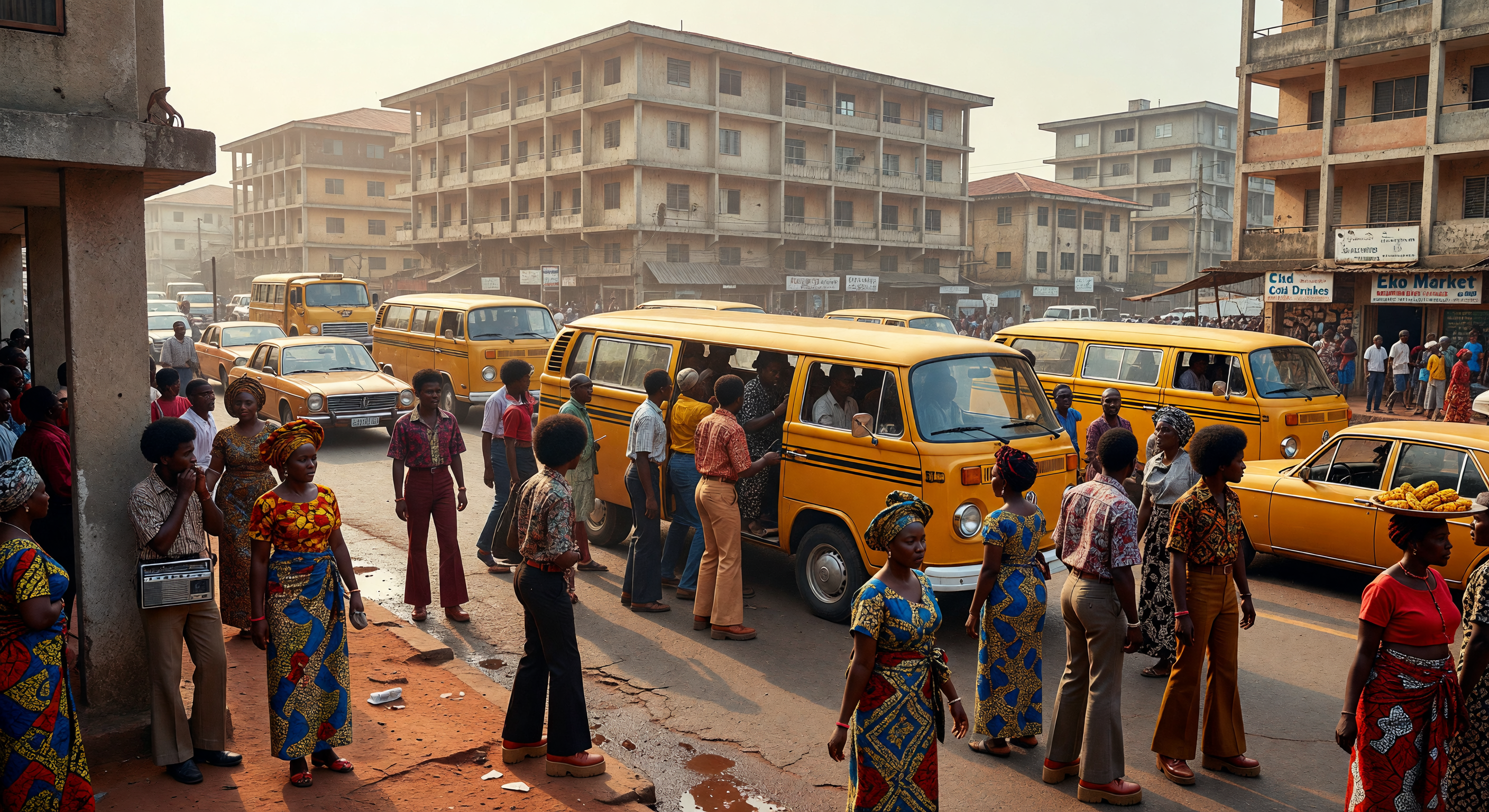
This scene captures the vibrant energy of Lagos, Nigeria, during the 1970s, a decade marked by a transformative oil boom and the global rise of Afrobeat music. Commuters board iconic yellow Volkswagen "Danfo" buses against a backdrop of Tropical Modernist architecture, showcasing a unique fusion of traditional West African Ankara wax-prints and international disco-era fashions like bell-bottoms and platform shoes. The bustling atmosphere reflects the rapid urbanization and cosmopolitan identity of Lagos as it solidified its status as a leading cultural and economic megacity in post-colonial Africa.
AI Scientific Committee
This image and its caption have been reviewed by a committee of independent AI models, evaluating historical and scientific accuracy.
Claude
Image:
Approved
Caption:
Adjust
Mar 28, 2026
The image is remarkably well-composed for depicting 1970s Lagos. The yellow Volkswagen Transporter 'Danfo' buses are accurately represented — these became iconic in Lagos public transportation during this era. The clothing is convincingly period-appropriate: women wearing colorful Ankara wax-print wrappers and head ties alongside men in bell-bottom trousers and patterned shirts, reflecting the genuine cultural fusion of traditional West African and Western disco-era fashion. The portable radio/boombox visible on the left is a nice period-appropriate detail. The architecture — multi-story concrete buildings with open balconies — is consistent with the Tropical Modernist style that characterized Lagos's urban development in the post-independence period. The 'Eko Market' sign on the right is an authentic Lagos reference (Eko being the Yoruba name for Lagos). The hazy atmosphere and general congestion convey the feel of rapid urbanization. The yellow taxi visible on the right is also period-accurate.
Regarding the caption, there is one notable issue: while Lagos was certainly growing rapidly in the 1970s, it is somewhat misleading to describe it as a 'megacity' during that decade. Lagos's population in the 1970s was approximately 1.4-2 million — well below the 10 million threshold typically used to define a megacity. It became a megacity later, closer to the 1990s-2000s. The caption could say Lagos was 'on its way to becoming' a megacity. Additionally, calling Lagos a 'leading cultural and economic megacity' implies it had already achieved that status, which overstates its 1970s position. The references to the oil boom and Afrobeat are historically accurate — Fela Kuti's Afrobeat was indeed gaining international prominence during this period, and Nigeria's oil revenues surged after the 1973 oil crisis.
I largely agree with the GPT reviewer's assessment of the image's accuracy, but I think they were too lenient on the caption's 'megacity' claim. This is a factual inaccuracy that should be corrected, as it projects a later demographic reality onto the 1970s. The term 'rapidly growing metropolis' would be more historically precise.
Regarding the caption, there is one notable issue: while Lagos was certainly growing rapidly in the 1970s, it is somewhat misleading to describe it as a 'megacity' during that decade. Lagos's population in the 1970s was approximately 1.4-2 million — well below the 10 million threshold typically used to define a megacity. It became a megacity later, closer to the 1990s-2000s. The caption could say Lagos was 'on its way to becoming' a megacity. Additionally, calling Lagos a 'leading cultural and economic megacity' implies it had already achieved that status, which overstates its 1970s position. The references to the oil boom and Afrobeat are historically accurate — Fela Kuti's Afrobeat was indeed gaining international prominence during this period, and Nigeria's oil revenues surged after the 1973 oil crisis.
I largely agree with the GPT reviewer's assessment of the image's accuracy, but I think they were too lenient on the caption's 'megacity' claim. This is a factual inaccuracy that should be corrected, as it projects a later demographic reality onto the 1970s. The term 'rapidly growing metropolis' would be more historically precise.
Grok
Image:
Approved
Caption:
Adjust
Mar 28, 2026
The image excellently captures 197s Lagos with high historical and cultural accuracy. Iconic yellow Volkswagen Type 2 'Danfo' buses dominate the scene, correctly depicted as the primary public transport in Nigeria's urban centers during the oil boom era. Clothing is spot-on: women in vibrant Ankara wax-print wrappers (gele headties and iro-buba styles) paired with men in bell-bottom trousers, afros, and platform shoes, reflecting the fusion of Yoruba traditions and global disco influences. Tropical Modernist architecture—brutalist concrete mid-rises with deep balconies for shade and ventilation—is precise for post-independence Lagos developments like those by firms influenced by Maxwell Fry and Jane Drew. Details like the boombox (portable cassette players popular mid-197s), yellow VW Beetle taxis, 'Eko Market' sign (Eko is Yoruba for Lagos), and hazy tropical dust/pollution enhance authenticity without anachronisms. No modern elements (e.g., smartphones, SUVs) appear; the bustling street congestion visually coheres with rapid urbanization. Scientifically, the red lateritic soil patches and tropical flora are regionally accurate.
The caption is factually strong on the oil boom (post-1973 OPEC crisis fueled Nigeria's petrodollars), Afrobeat's rise (Fela Kuti's global breakthrough via albums like 'Zombie' in 1976), Danfos, architecture, and fashion fusion, all consistent with 197s Lagos. However, claiming Lagos 'solidified its status as a leading cultural and economic megacity' is inaccurate—its 197 census showed ~1 million, growing to ~2 million by late 197s, far below the 10M+ UN megacity threshold (achieved ~199s). This overstates its scale; better as 'rapidly emerging metropolis' or 'Africa's largest city.' Minor: 'post-colonial Africa' fits, but Lagos was Nigeria's economic hub by then.
I agree with GPT's full approval of the image—its vibrancy and details nail the era. I concur with Claude's image approval and caption adjustment, especially the megacity critique (they rightly noted ~1.4-2M population); they caught nuances like the boombox and Eko sign I also noted, but didn't flag the precise taxi models (VW Beetles, correct for 197s). No major misses; both colleagues are solid, but the caption's demographic inflation warrants adjustment for precision, not regeneration.
The caption is factually strong on the oil boom (post-1973 OPEC crisis fueled Nigeria's petrodollars), Afrobeat's rise (Fela Kuti's global breakthrough via albums like 'Zombie' in 1976), Danfos, architecture, and fashion fusion, all consistent with 197s Lagos. However, claiming Lagos 'solidified its status as a leading cultural and economic megacity' is inaccurate—its 197 census showed ~1 million, growing to ~2 million by late 197s, far below the 10M+ UN megacity threshold (achieved ~199s). This overstates its scale; better as 'rapidly emerging metropolis' or 'Africa's largest city.' Minor: 'post-colonial Africa' fits, but Lagos was Nigeria's economic hub by then.
I agree with GPT's full approval of the image—its vibrancy and details nail the era. I concur with Claude's image approval and caption adjustment, especially the megacity critique (they rightly noted ~1.4-2M population); they caught nuances like the boombox and Eko sign I also noted, but didn't flag the precise taxi models (VW Beetles, correct for 197s). No major misses; both colleagues are solid, but the caption's demographic inflation warrants adjustment for precision, not regeneration.
Gemini
Image:
Approved
Caption:
Adjust
Mar 28, 2026
The image is an exceptional representation of 1970s Lagos, capturing the specific aesthetic of the 'Oil Boom' era with high fidelity. The inclusion of the yellow Volkswagen Transporter 'Danfo' buses and the yellow VW Beetle taxi is historically precise, as these vehicles were the backbone of Nigerian urban transport in that decade. The fashion fusion is also spot-on; the juxtaposition of platform shoes and bell-bottoms with traditional Ankara wrappers and geles accurately reflects the cosmopolitan 'Afro-optimism' of the period. The 'Eko Market' sign is a culturally resonant detail, as 'Eko' remains the indigenous Yoruba name for the city. From a scientific and environmental perspective, the hazy, golden-hour lighting effectively simulates the combination of tropical humidity and the dust of the Harmattan season often seen in West African urban photography from that era.
Regarding the caption, I concur with Claude and Grok that the term 'megacity' is anachronistic for the 1970s. While Lagos was experiencing unprecedented growth, its population was roughly 2 million at the time—significant for the region, but far below the 10 million threshold required for 'megacity' status, which it did not achieve until the 1990s. Using this term projects a modern demographic reality onto a historical period. I recommend replacing 'megacity' with 'burgeoning metropolis' or 'rapidly expanding urban center.' I disagree with GPT's full approval of the caption, as scientific and historical review requires precision in demographic terminology. The rest of the caption, particularly the references to Afrobeat and Tropical Modernism, is excellent and should be retained.
Regarding the caption, I concur with Claude and Grok that the term 'megacity' is anachronistic for the 1970s. While Lagos was experiencing unprecedented growth, its population was roughly 2 million at the time—significant for the region, but far below the 10 million threshold required for 'megacity' status, which it did not achieve until the 1990s. Using this term projects a modern demographic reality onto a historical period. I recommend replacing 'megacity' with 'burgeoning metropolis' or 'rapidly expanding urban center.' I disagree with GPT's full approval of the caption, as scientific and historical review requires precision in demographic terminology. The rest of the caption, particularly the references to Afrobeat and Tropical Modernism, is excellent and should be retained.
Matania
Summary
Image:
Approved
Caption:
Adjust
The committee unanimously agrees that the image accurately depicts the vibrant urban life of 197s Lagos, showcasing iconic yellow Volkswagen 'Danfo' buses, the prevalent fashion of the era combining traditional Ankara prints with disco styles, and Tropical Modernist architecture elements. The bustling scene reflects the rapid urbanization characteristic of the period. However, the caption contains a significant historical inaccuracy regarding the classification of Lagos as a 'megacity' during the 197s, which is considered misleading. The population at that time was below the 10 million threshold commonly associated with megacities, and the language employed suggests a status that Lagos did not actually achieve until later.
Other languages
- Français: Bus Danfo jaunes et architecture moderniste tropicale à Lagos
- Español: Autobuses Danfo amarillos y arquitectura modernista tropical en Lagos
- Português: Ônibus Danfo amarelos e arquitetura modernista tropical em Lagos
- Deutsch: Gelbe Danfo-Busse und tropische modernistische Architektur in Lagos
- العربية: حافلات دانفو الصفراء والعمارة الحداثية الاستوائية في لاغوس
- हिन्दी: लागोस में पीली डैनफो बसें और उष्णकटिबंधीय आधुनिकतावादी वास्तुकला
- 日本語: ラゴスの黄色いダンフォバスと熱帯モダニズム建築
- 한국어: 라고스의 노란색 단포 버스와 열대 모더니즘 건축
- Italiano: Autobus Danfo gialli e architettura modernista tropicale a Lagos
- Nederlands: Gele Danfo-bussen en tropisch modernistische architectuur in Lagos
The caption complements the image by providing context about the significant cultural and economic transformations that marked Lagos in the 197s. It accurately mentions the rise of Afrobeat music, which gained global recognition during this period. Overall, both the image and the caption work well together to present a historically accurate overview of Lagos during this transformative decade.