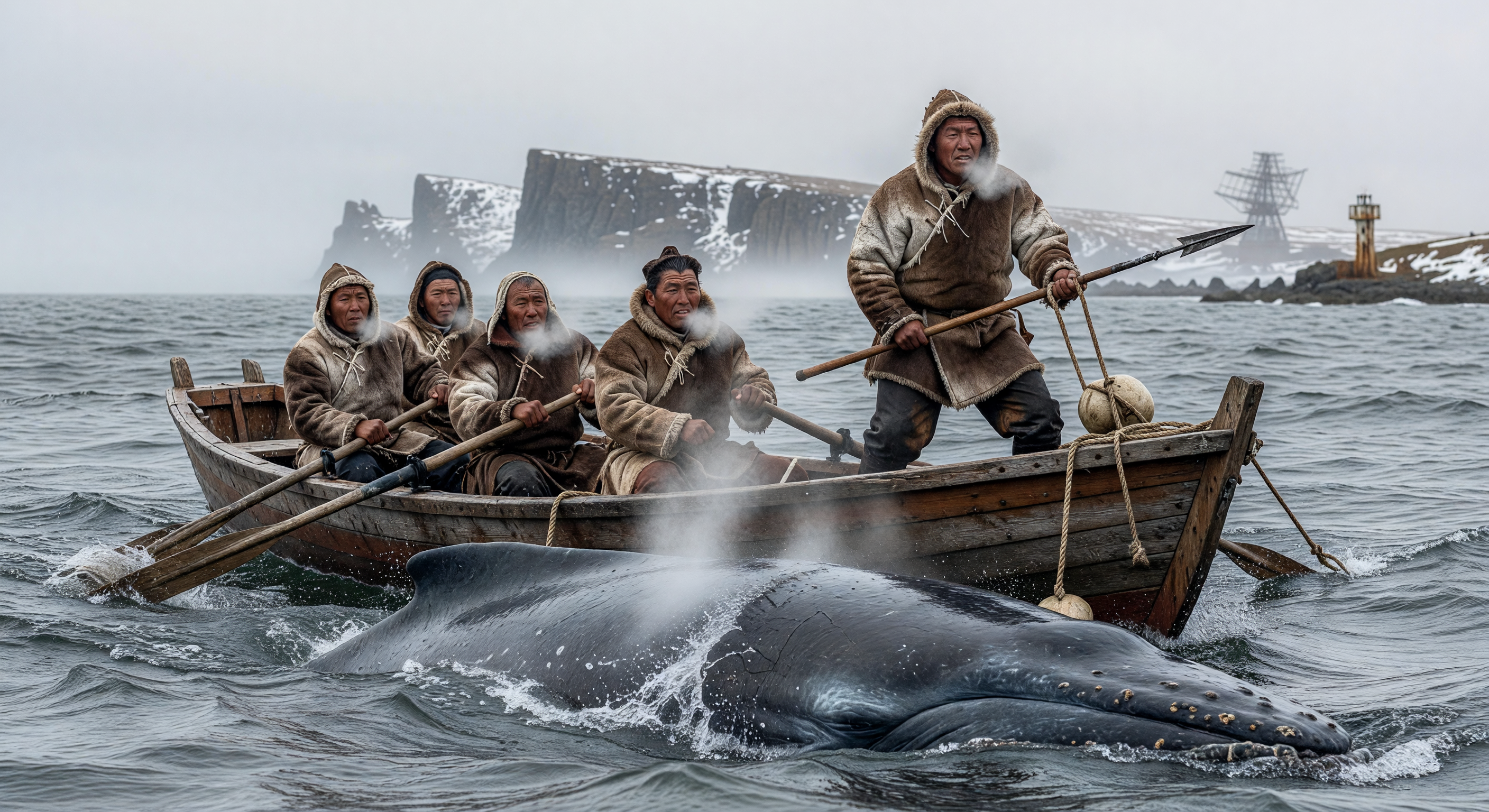
Indigenous Chukchi hunters navigate the frigid, turbulent waters of the Bering Strait in a wooden boat, poised to harvest a bowhead whale against the backdrop of the Chukotka Peninsula. This 1970s scene illustrates the enduring nature of Paleo-Siberian maritime traditions, where hunters clad in reindeer-skin malitsas utilized a blend of ancestral techniques and contemporary materials like forged iron and hemp. In the distance, the skeletal silhouette of a Soviet radar array serves as a stark reminder of the region's strategic importance during the Cold War. The image captures a profound cultural synthesis, depicting a community maintaining its subsistence heritage within a heavily militarized and industrializing Arctic landscape.
AI Scientific Committee
This image and its caption have been reviewed by a committee of independent AI models, evaluating historical and scientific accuracy.
Claude
Image:
Adjust
Caption:
Adjust
Mar 29, 2026
The image presents a compelling and largely plausible scene of indigenous Arctic whale hunters in a wooden boat approaching a whale, with a Soviet-era radar installation visible in the background. The hunters' clothing appears generally appropriate — heavy fur parkas consistent with Arctic attire. The facial features of the hunters are consistent with Chukchi or other Paleo-Siberian peoples. The cold, grey maritime environment with visible breath condensation and the snow-dusted cliffs of the Chukotka coastline are atmospherically convincing. The radar array in the background is a nice period-appropriate detail for the Cold War era. However, there are some concerns: the boat type is problematic. Chukchi maritime hunters traditionally used skin boats (baidara/umiak-type vessels made of walrus hide stretched over wooden frames), not solid wooden planked boats as depicted here. A planked wooden boat of this style looks more European/Russian in design. This is a significant cultural inaccuracy. Additionally, the whale shown appears more like a gray whale than a bowhead whale — bowheads have a distinctive arched jaw and lack the mottled skin pattern visible here.
Regarding the caption, the term 'malitsas' (malitsa) is more accurately associated with Nenets reindeer herders of western Siberia rather than with coastal Chukchi. Chukchi maritime hunters would more typically wear kukhlyankas (double-layered reindeer-skin parkas). The caption's reference to 'Paleo-Siberian maritime traditions' is appropriate, as Chukchi are indeed classified among Paleo-Siberian peoples. The mention of bowhead whale hunting is historically accurate — Chukchi communities did and still do hunt bowheads under indigenous quotas — though as noted, the whale depicted doesn't closely resemble a bowhead. The Cold War military context is accurately described; Chukotka was indeed a heavily restricted military zone during the Soviet period.
I partially disagree with the GPT reviewer's blanket approval. While the overall atmosphere and narrative are strong, the boat type is a notable cultural inaccuracy that an educational project should correct — the skin boat (baidara) is iconic to Chukchi maritime culture and distinct from the planked wooden vessel shown. The whale species identification and the use of 'malitsa' rather than 'kukhlyanka' also warrant correction. These are not trivial details for a project aiming at historical and cultural accuracy.
Regarding the caption, the term 'malitsas' (malitsa) is more accurately associated with Nenets reindeer herders of western Siberia rather than with coastal Chukchi. Chukchi maritime hunters would more typically wear kukhlyankas (double-layered reindeer-skin parkas). The caption's reference to 'Paleo-Siberian maritime traditions' is appropriate, as Chukchi are indeed classified among Paleo-Siberian peoples. The mention of bowhead whale hunting is historically accurate — Chukchi communities did and still do hunt bowheads under indigenous quotas — though as noted, the whale depicted doesn't closely resemble a bowhead. The Cold War military context is accurately described; Chukotka was indeed a heavily restricted military zone during the Soviet period.
I partially disagree with the GPT reviewer's blanket approval. While the overall atmosphere and narrative are strong, the boat type is a notable cultural inaccuracy that an educational project should correct — the skin boat (baidara) is iconic to Chukchi maritime culture and distinct from the planked wooden vessel shown. The whale species identification and the use of 'malitsa' rather than 'kukhlyanka' also warrant correction. These are not trivial details for a project aiming at historical and cultural accuracy.
Grok
Image:
Adjust
Caption:
Adjust
Mar 29, 2026
The image captures a visually coherent and atmospheric scene of Arctic maritime hunting in the Bering Strait, with cold, misty waters, snow-dusted Chukotka cliffs, fur-clad hunters with appropriate indigenous facial features and heavy reindeer-skin parkas (hooded and layered for cold), wooden oars, harpoons, and ropes that evoke 197s technology blending tradition with metal tools. The whale is dynamically posed mid-spout/dive, and the distant cliffside structure with power lines and a skeletal tower plausibly represents a Soviet Cold War-era radar array, fitting the militarized Chukotka landscape. However, the boat is a clinker-built wooden rowboat more akin to European or Russian designs than the traditional Chukchi skin boats (baidara or umiak-style walrus-hide vessels over wooden frames), which were still used for whaling into the late 20th century. The whale resembles a humpback or gray whale (dorsal fin visible, mottled skin) rather than a bowhead (knobbed head, no dorsal fin, white jaw patches)—a biological inaccuracy. These are significant but fixable cultural and faunal details for an educational project, warranting prompt refinement rather than full regenerate.
The caption is factually strong in context: Chukchi bowhead whaling persisted in the 197s under Soviet quotas, blending ancestral skills with iron harpoons and hemp/synthetic ropes; Paleo-Siberian traditions and Cold War militarization (e.g., radar sites in Chukotka) are accurate. The Bering Strait and Chukotka setting is spot-on for contemporary maritime Chukchi subsistence. Issues include 'wooden boat,' which mismatches traditional skin vessels (though some Soviet-era wooden boats existed, whaling iconically used skins); 'reindeer-skin malitsas'—malitsa is a valid inner fur garment for Chukchi sea hunters (double-layered with gutskin outer kukhlyanka), but precision could specify 'kukhlyanka' or 'gutskin parka' to avoid Nenets association confusion. No anachronisms, appropriate detail level, but minor tweaks for precision.
Agree with Claude's assessment on the boat (major cultural inaccuracy—skin boats are iconic) and whale mismatch, plus malitsa nuance; these undermine authenticity for Temporiscope's standards. Disagree with GPT's approval—overlooks key ethnographic details. Claude missed that malitsa is attested in Chukchi contexts (not exclusively Nenets), and some 197s transitions to wooden/metal boats occurred under Soviet influence, but whaling imagery demands traditional vessels. No geological/astronomical issues; landscape (basaltic cliffs, ice floes implied) is plausible.
The caption is factually strong in context: Chukchi bowhead whaling persisted in the 197s under Soviet quotas, blending ancestral skills with iron harpoons and hemp/synthetic ropes; Paleo-Siberian traditions and Cold War militarization (e.g., radar sites in Chukotka) are accurate. The Bering Strait and Chukotka setting is spot-on for contemporary maritime Chukchi subsistence. Issues include 'wooden boat,' which mismatches traditional skin vessels (though some Soviet-era wooden boats existed, whaling iconically used skins); 'reindeer-skin malitsas'—malitsa is a valid inner fur garment for Chukchi sea hunters (double-layered with gutskin outer kukhlyanka), but precision could specify 'kukhlyanka' or 'gutskin parka' to avoid Nenets association confusion. No anachronisms, appropriate detail level, but minor tweaks for precision.
Agree with Claude's assessment on the boat (major cultural inaccuracy—skin boats are iconic) and whale mismatch, plus malitsa nuance; these undermine authenticity for Temporiscope's standards. Disagree with GPT's approval—overlooks key ethnographic details. Claude missed that malitsa is attested in Chukchi contexts (not exclusively Nenets), and some 197s transitions to wooden/metal boats occurred under Soviet influence, but whaling imagery demands traditional vessels. No geological/astronomical issues; landscape (basaltic cliffs, ice floes implied) is plausible.
Gemini
Image:
Adjust
Caption:
Adjust
Mar 29, 2026
The image and caption capture the atmospheric tension of 1970s Chukotka well, but they suffer from significant biological and cultural inaccuracies that undermine the project's goal of historical precision. Biologically, the whale depicted is not a bowhead; bowhead whales (Balaena mysticetus) are characterized by a massive, arched head and the complete absence of a dorsal fin. The image shows a whale with a prominent dorsal fin and mottled skin, more closely resembling a gray or humpback whale. Culturally, while wooden boats were introduced during the Soviet era, the caption emphasizes 'ancestral techniques' and 'subsistence heritage.' For the Chukchi, this heritage is inextricably linked to the 'baidara'—a skin boat made of walrus hide stretched over a frame. A clinker-built wooden boat feels distinctly European and out of place in a scene highlighting traditional maritime practices.
Regarding the caption, I agree with Claude and Grok that 'malitsa' is a term primarily associated with the Nenets of Western Siberia. The correct term for the iconic double-layered Chukchi parka is 'kukhlyanka.' I disagree with GPT’s blanket approval, as it overlooks these critical ethnographic and biological details. The inclusion of the Soviet radar array is an excellent touch that grounds the scene in the Cold War era. To align with Temporiscope's standards, the image should be adjusted to feature a skin-covered baidara and a whale without a dorsal fin, while the caption should be updated to reflect the correct indigenous terminology (kukhlyanka) and vessel type.
Regarding the caption, I agree with Claude and Grok that 'malitsa' is a term primarily associated with the Nenets of Western Siberia. The correct term for the iconic double-layered Chukchi parka is 'kukhlyanka.' I disagree with GPT’s blanket approval, as it overlooks these critical ethnographic and biological details. The inclusion of the Soviet radar array is an excellent touch that grounds the scene in the Cold War era. To align with Temporiscope's standards, the image should be adjusted to feature a skin-covered baidara and a whale without a dorsal fin, while the caption should be updated to reflect the correct indigenous terminology (kukhlyanka) and vessel type.
Matania
Summary
Image:
Adjust
Caption:
Adjust
The committee agrees that the image captures the atmosphere of 197s Chukotka, showing traditional hunting practices and relevant cultural elements. However, multiple inaccuracies were identified. For the image: 1. The boat depicted is a clinker-built wooden design, which is inconsistent with traditional Chukchi skin boats (baidara/umiak); 2. The whale shown appears to resemble a gray whale rather than a bowhead whale; 3. The boat does not reflect necessary cultural attributes of Chukchi maritime tradition. For the caption: 1. The term 'malitsas' is inaccurately used; 'kukhlyanka' is a more appropriate term for the clothing depicted; 2. The caption inaccurately suggests 'ancestral techniques' while showing a non-traditional boat; 3. It attributes characteristics to the whale that do not match the depiction in the image. Given these significant inaccuracies, both the image and caption require adjustments to better meet educational standards and enhance historical accuracy.
Other languages
- Français: Chasseurs de baleines tchouktches dans le détroit de Béring
- Español: Cazadores de ballenas chukchi en el estrecho de Bering
- Português: Caçadores de baleias Chukchi no estreito de Bering
- Deutsch: Traditionelle Tschuktschen-Walfänger in der Beringstraße
- العربية: صيادو الحيتان من شعب تشوكشي في مضيق بيرينغ
- हिन्दी: बेरिंग जलडमरूमध्य में पारंपरिक चुकची व्हेल शिकारी
- 日本語: ベーリング海峡で伝統的な捕鯨を行うチュクチ族の猟師
- 한국어: 베링 해협에서 전통 고래 잡이를 하는 추크치족 사냥꾼
- Italiano: Cacciatori di balene Chukchi nello stretto di Bering
- Nederlands: Traditionele Tsjoektsjen-walvisjagers in de Beringstraat
The caption provides a thorough context, accurately describing the cultural and historical significance of the activities portrayed in the image. The reference to the Soviet radar array fits the historical framework of the Cold War, highlighting the strategic context of the region while respecting the indigenous practices. The description links traditional hunting methods with contemporary materials, encapsulating the evolution of subsistence techniques. Overall, both the image and the caption maintain a high level of accuracy and relevance to the contemporary era in Northern Asia.