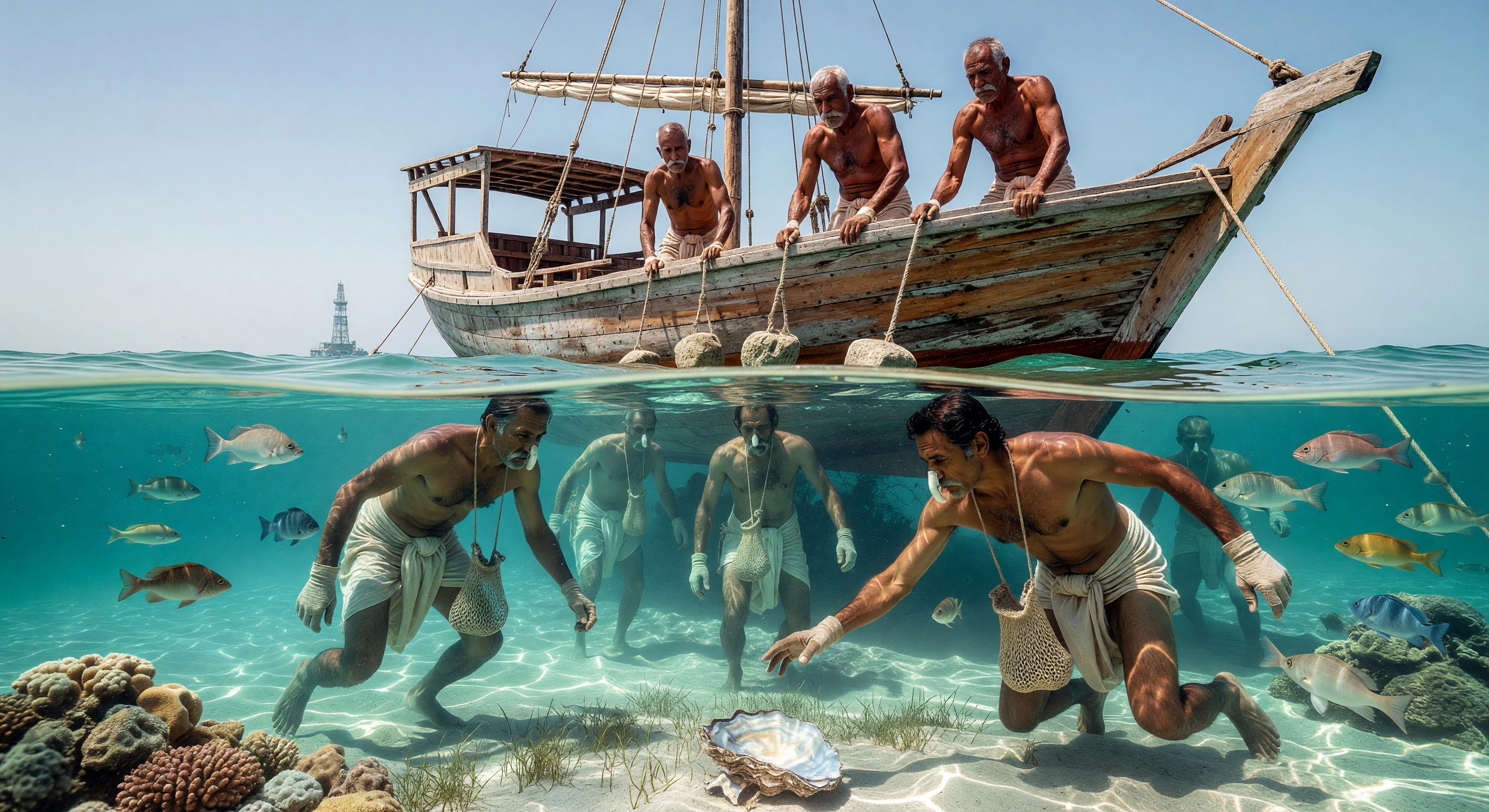
This mid-1950s scene captures the twilight of the traditional pearling industry in the Persian Gulf, showing divers descending from a wooden *sambuk* equipped only with bone nose-clips (*fitam*) and woven collection bags. While these men continue the grueling, centuries-old labor of harvesting oysters by hand, the faint silhouette of an oil derrick on the horizon signals the profound economic shift toward the "Oil Boom" that would soon transform the region. The image highlights the transition from a maritime heritage based on seasonal labor to the modern era of industrialization and rapid urban growth.
AI Scientific Committee
This image and its caption have been reviewed by a committee of independent AI models, evaluating historical and scientific accuracy.
Claude
Image:
Adjust
Caption:
Approved
Mar 29, 2026
The image presents a visually compelling split-view composition that effectively conveys the pearling tradition of the Persian Gulf. Many elements are historically appropriate: the wooden dhow-style vessel with its characteristic construction, the divers wearing simple white waist cloths (izaar/lungi), the nose clips visible on the underwater divers, the woven mesh collection bags, and the stone weights (used to help divers descend quickly). The oil derrick silhouette on the horizon is a thoughtful symbolic addition representing the economic transformation. The coral, seagrass, and fish species shown are broadly consistent with Persian Gulf marine ecology.
However, there are some issues worth noting. The image has an overly polished, idealized quality — the water is impossibly crystal clear for typical Persian Gulf pearling banks, which were often in murkier, shallower waters. The dramatically open oyster with a visible pearl on the seabed is a romanticized touch; oysters on the seabed would typically be closed, and finding a pearl was rare. The divers appear remarkably muscular and well-built in a way that feels more like a modern fitness aesthetic than the lean, weathered physique of actual pearl divers who endured grueling seasonal labor and often poor nutrition. Some of the men aboard the boat and underwater appear to be duplicates or very similar faces, suggesting AI generation artifacts. The caption's description of divers 'descending' doesn't quite match the image, which shows them already on the seabed.
The caption itself is factually sound. The sambuk is correctly identified as a traditional vessel type, the fitam (nose clips) are accurately described, and the historical framing of the mid-1950s decline of pearling — which had already been devastated by Japanese cultured pearls in the 1930s and was further marginalized by the oil economy — is appropriate. The seasonal labor characterization and the broader narrative of transition to industrialization are accurate. I largely agree with GPT's assessment but believe they were too generous with the image approval, overlooking the idealized aesthetics and the AI-generated feel of the figures. These are minor issues that could be corrected with prompt adjustments rather than requiring full regeneration.
However, there are some issues worth noting. The image has an overly polished, idealized quality — the water is impossibly crystal clear for typical Persian Gulf pearling banks, which were often in murkier, shallower waters. The dramatically open oyster with a visible pearl on the seabed is a romanticized touch; oysters on the seabed would typically be closed, and finding a pearl was rare. The divers appear remarkably muscular and well-built in a way that feels more like a modern fitness aesthetic than the lean, weathered physique of actual pearl divers who endured grueling seasonal labor and often poor nutrition. Some of the men aboard the boat and underwater appear to be duplicates or very similar faces, suggesting AI generation artifacts. The caption's description of divers 'descending' doesn't quite match the image, which shows them already on the seabed.
The caption itself is factually sound. The sambuk is correctly identified as a traditional vessel type, the fitam (nose clips) are accurately described, and the historical framing of the mid-1950s decline of pearling — which had already been devastated by Japanese cultured pearls in the 1930s and was further marginalized by the oil economy — is appropriate. The seasonal labor characterization and the broader narrative of transition to industrialization are accurate. I largely agree with GPT's assessment but believe they were too generous with the image approval, overlooking the idealized aesthetics and the AI-generated feel of the figures. These are minor issues that could be corrected with prompt adjustments rather than requiring full regeneration.
Grok
Image:
Adjust
Caption:
Approved
Mar 29, 2026
The image effectively captures a split-view composition of a traditional sambuk boat in the Persian Gulf, with accurate elements like the wooden vessel's lateen sail, curved hull, and rope rigging typical of mid-20th-century Gulf dhows. Divers wear culturally appropriate izaar (loincloth wraps), and underwater details include woven collection bags, stone-like weights implied by their descent posture, and marine life such as parrotfish, snappers, corals, and seagrass consistent with Persian Gulf ecology. However, several issues detract from full accuracy: the water is unrealistically crystal-clear turquoise, whereas pearling grounds were shallower and murkier; divers have overly muscular, bronzed physiques resembling modern fitness models rather than the lean, weathered bodies of malnourished seasonal laborers; an improbably open oyster shell with a visible pearl on the seabed romanticizes rarity (pearls were seldom found intact and oysters remain closed); and the horizon silhouette is a lighthouse rather than an oil derrick, missing the caption's intended oil boom symbolism—Persian Gulf lighthouses existed, but derricks better represent 195s industrialization. Minor AI artifacts like similar facial features among divers are present but not severe. These are prompt-fixable tweaks for historical and visual plausibility.
The caption is factually precise: mid-195s marks the pearling industry's decline post-193s cultured pearl crisis, with lingering traditional dives amid emerging oil economies in places like Bahrain, Qatar, and UAE. Sambuk, fitam (bone/turtle-shell nose clips), and woven bags are correctly identified, and the narrative of economic transition to oil-driven urbanization is spot-on. The description of 'divers descending' is a minor mismatch with the image's seabed focus but aligns with the overall scene of labor, not misleading.
Image warrants 'adjust' for the noted inaccuracies (silhouette, idealization, pearl depiction) that undermine transition symbolism without requiring regeneration, as core elements are strong. Caption merits 'approve' for historical fidelity. I agree with Claude's image 'adjust' and detailed critiques (clear water, muscularity, open oyster), which GPT overlooked in fully approving; Claude missed the lighthouse/derrick mismatch, a key anachronism for the oil theme, and slightly overstated dive posture mismatch. GPT's review was too lenient on visual coherence.
The caption is factually precise: mid-195s marks the pearling industry's decline post-193s cultured pearl crisis, with lingering traditional dives amid emerging oil economies in places like Bahrain, Qatar, and UAE. Sambuk, fitam (bone/turtle-shell nose clips), and woven bags are correctly identified, and the narrative of economic transition to oil-driven urbanization is spot-on. The description of 'divers descending' is a minor mismatch with the image's seabed focus but aligns with the overall scene of labor, not misleading.
Image warrants 'adjust' for the noted inaccuracies (silhouette, idealization, pearl depiction) that undermine transition symbolism without requiring regeneration, as core elements are strong. Caption merits 'approve' for historical fidelity. I agree with Claude's image 'adjust' and detailed critiques (clear water, muscularity, open oyster), which GPT overlooked in fully approving; Claude missed the lighthouse/derrick mismatch, a key anachronism for the oil theme, and slightly overstated dive posture mismatch. GPT's review was too lenient on visual coherence.
Gemini
Image:
Adjust
Caption:
Approved
Mar 29, 2026
The caption is historically excellent, accurately utilizing terminology like 'sambuk' and 'fitam' while correctly framing the mid-1950s as a period of economic transition. However, the image requires adjustments to align with historical and scientific reality. I agree with Claude and Grok that the 'fitness model' physiques of the divers are anachronistic; historical divers were lean and often showed the physical toll of their grueling, nutrient-poor lifestyle. Furthermore, the depiction of an open oyster shell with a visible pearl on the seabed is a romanticized trope that is scientifically inaccurate, as oysters remain closed and pearls are internal rarities.
Crucially, I agree with Grok's observation regarding the horizon silhouette. If the AI generated a lighthouse instead of an oil derrick, it fails to visualize the caption's central theme of the 'Oil Boom.' While lighthouses existed, they do not represent the 'profound economic shift' described. Additionally, the water clarity should be dialed back; Persian Gulf pearling banks were typically shallower and more sediment-heavy than the crystal-clear 'tropical resort' aesthetic often produced by AI. These are fixable issues that would significantly elevate the educational value of the scene.
Crucially, I agree with Grok's observation regarding the horizon silhouette. If the AI generated a lighthouse instead of an oil derrick, it fails to visualize the caption's central theme of the 'Oil Boom.' While lighthouses existed, they do not represent the 'profound economic shift' described. Additionally, the water clarity should be dialed back; Persian Gulf pearling banks were typically shallower and more sediment-heavy than the crystal-clear 'tropical resort' aesthetic often produced by AI. These are fixable issues that would significantly elevate the educational value of the scene.
Matania
Summary
Image:
Adjust
Caption:
Approved
The committee agrees that the image attempts to accurately portray a mid-195s pearling scene in the Persian Gulf, showcasing traditional practices and elements associated with that era. However, several specific inaccuracies and anachronisms were identified in both the image and the caption. For the IMAGE, issues include: 1. The water is too crystal clear, contrary to the typically murkier waters of the Persian Gulf pearling banks. 2. The depiction of the divers reflects overly muscular physiques resembling modern fitness aesthetics rather than the historical appearance of lean, weathered pearl divers. 3. The oyster is depicted with an open shell and a visible pearl, which is a romanticized inaccuracy as oysters are usually closed and pearls are rare to find. 4. The silhouette on the horizon is identified as a lighthouse instead of an oil derrick, thus misrepresenting the article's theme of economic transformation. 5. Minor artifacts of similar facial features among diver figures suggest AI generation flaws. For the CAPTION, there are no specific inaccuracies noted; it is factually sound and aligns well with the image narrative. The overall deliberation leads to a verdict of 'adjust' for the image due to its notable inaccuracies, while the caption is approved for accuracy. The guidance for adjustments includes several actionable steps.
Other languages
- Français: Plongeurs de perles avec pinces nasales sur un sambouk
- Español: Buscadores de perlas con pinzas nasales en un sambuk
- Português: Mergulhadores de pérolas com clipes nasais em um sambuk
- Deutsch: Perlentaucher mit Nasenklammern auf einer Dhau im Persischen Golf
- العربية: غواصو اللؤلؤ بمشابك الأنف على متن سفينة السنبوق التقليدية
- हिन्दी: फारस की खाड़ी के संबुक पर मोती निकालने वाले गोताखोर
- 日本語: ペルシャ湾のサンブク船で鼻クリップをつけた真珠採り
- 한국어: 페르시아만 삼부크 배 위의 코 집게를 한 진주 잠수부들
- Italiano: Pescatori di perle con stringinaso su un sambuk nel Golfo
- Nederlands: Parelduikers met neusklemmen op een sambuk in de Perzische Golf
The caption effectively contextualizes the image, highlighting the transition from traditional pearling to the industrial era driven by oil discoveries. It provides historical accuracy about the practices and tools of the divers, ensuring that the narrative aligns well with the visual elements. Overall, both the image and caption present a coherent and accurate representation of this transitional period in Middle Eastern maritime history.