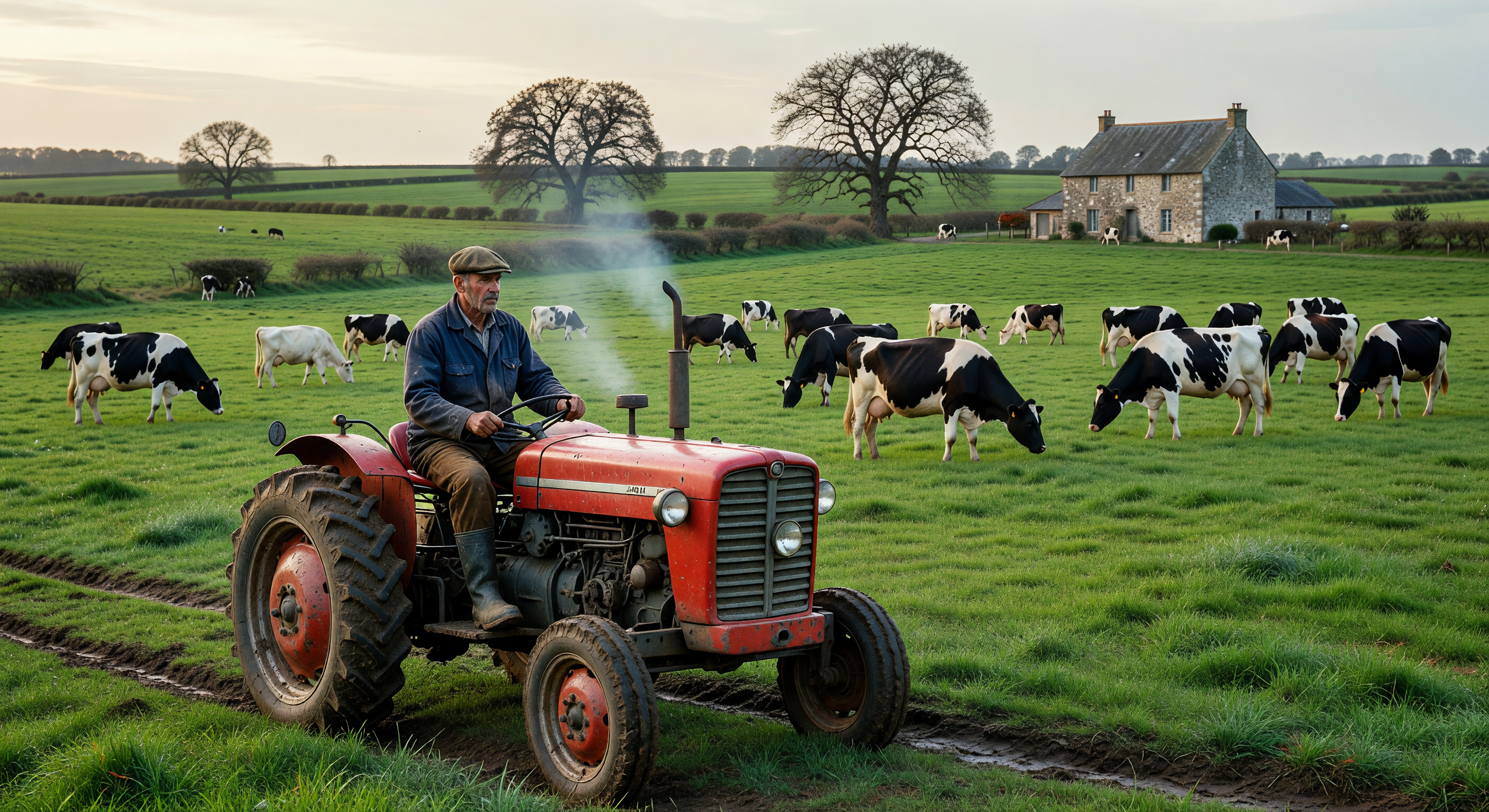
A French farmer operates a red Massey Ferguson 135 tractor across the verdant pastures of Normandy circa 1975, marking a pivotal era of agricultural intensification. The vast, open field reflects the "remembrement" policy of the mid-20th century, which dismantled traditional hedgerows to accommodate industrial machinery and large Holstein-Friesian dairy herds. Dressed in a classic "bleu de travail" jacket, the farmer represents a generation navigating the transition from ancestral farming techniques to the mechanized efficiency of the Contemporary Era.
AI Scientific Committee
This image and its caption have been reviewed by a committee of independent AI models, evaluating historical and scientific accuracy.
Claude
Image:
Adjust
Caption:
Adjust
Mar 29, 2026
The image is largely convincing as a scene from 1970s Normandy. The red tractor is broadly consistent with a Massey Ferguson 135 in terms of size and era-appropriate design, though the front grille and overall proportions are somewhat generic and don't precisely match the MF 135's distinctive styling. The Holstein-Friesian cattle are appropriate, the stone farmhouse in the background is plausible for Norman architecture, and the rolling green pastures are characteristic of the region. The farmer's flat cap and dark work jacket are culturally appropriate. However, there is a notable tension in the image: the caption describes the 'remembrement' policy as having 'dismantled traditional hedgerows' to create vast open fields, yet the background clearly shows hedgerows still intact, dividing fields. This actually makes the image somewhat more historically nuanced than the caption suggests, as remembrement was an uneven and gradual process, but it creates an inconsistency between the two.
Regarding the caption, while most facts are accurate, there are some points worth flagging. The Massey Ferguson 135 was produced from 1964 to 1975, so placing it circa 1975 is at the tail end but still valid. However, the traditional dairy breed of Normandy is the Normande (a distinctive brown-and-white breed), not Holstein-Friesian. While Holstein-Friesians were indeed increasingly adopted during the intensification period as part of the push for higher milk yields, the caption presents them as if they were already the established norm by 1975 in Normandy. In reality, the Normande breed remained dominant in the region during this period, and the wholesale shift toward Holsteins came somewhat later. Additionally, the 'bleu de travail' is typically described as blue workwear — the farmer's jacket in the image appears dark blue/navy, which is close but could be more clearly blue. The remembrement claim is historically valid as policy context, though as noted, the image contradicts this by showing hedgerows.
I largely agree with GPT's assessment but believe they were too generous in overlooking the breed issue and the hedgerow inconsistency between image and caption. The Normande vs. Holstein-Friesian distinction is historically significant for this specific region and period. A minor caption adjustment noting the transitional nature of breed adoption, and slight image adjustment to better reflect the MF 135's specific design or to show a more open landscape consistent with remembrement, would improve accuracy.
Regarding the caption, while most facts are accurate, there are some points worth flagging. The Massey Ferguson 135 was produced from 1964 to 1975, so placing it circa 1975 is at the tail end but still valid. However, the traditional dairy breed of Normandy is the Normande (a distinctive brown-and-white breed), not Holstein-Friesian. While Holstein-Friesians were indeed increasingly adopted during the intensification period as part of the push for higher milk yields, the caption presents them as if they were already the established norm by 1975 in Normandy. In reality, the Normande breed remained dominant in the region during this period, and the wholesale shift toward Holsteins came somewhat later. Additionally, the 'bleu de travail' is typically described as blue workwear — the farmer's jacket in the image appears dark blue/navy, which is close but could be more clearly blue. The remembrement claim is historically valid as policy context, though as noted, the image contradicts this by showing hedgerows.
I largely agree with GPT's assessment but believe they were too generous in overlooking the breed issue and the hedgerow inconsistency between image and caption. The Normande vs. Holstein-Friesian distinction is historically significant for this specific region and period. A minor caption adjustment noting the transitional nature of breed adoption, and slight image adjustment to better reflect the MF 135's specific design or to show a more open landscape consistent with remembrement, would improve accuracy.
Grok
Image:
Adjust
Caption:
Adjust
Mar 29, 2026
The image effectively captures a 197s European agricultural scene with a red Massey Ferguson 135 tractor, which matches the model's 1964-1975 production run, distinctive grille, and compact design suitable for the era's mechanization. The farmer's attire—a dark blue 'bleu de travail' jacket, trousers, boots, and flat cap—is culturally accurate for a French rural worker in Normandy. Holstein-Friesian cows are present and were increasingly common during agricultural intensification, though not yet dominant. The verdant pastures and oak trees align with Normandy's bocage landscape, and the golden-hour lighting adds visual coherence. However, the background stone farmhouses have a low, rugged profile more reminiscent of Scottish or Irish vernacular architecture (e.g., whitewashed stone with steep roofs) than typical Norman 'fermes normandes,' which favor half-timbered colombage construction or more rectangular stone barns. Additionally, the fields are divided by intact hedgerows and fences, preserving the traditional bocage rather than depicting post-remembrement open expanses, creating a plausible but regionally imprecise scene that requires minor prompt tweaks for authentic Norman architecture and landscape scale.
The caption is factually strong on the Massey Ferguson 135 (spot-on for 1975), remembrement policy (a real mid-20th-century French land consolidation effort that reduced hedgerows for machinery), and 'bleu de travail' as symbolic of modernization. It aptly frames the era's shift to mechanized dairy farming. Issues arise with 'vast, open field'—contradicted by the image's hedged fields and historically overstated, as remembrement was gradual and uneven in Normandy, leaving much bocage intact into the 197s—and 'large Holstein-Friesian dairy herds,' which overstates their prevalence; the native Normande (brown-and-white) breed dominated Normandy dairy until the 198s-90s, with Holsteins as a transitional import. These are minor but region-specific inaccuracies needing refinement for precision without altering the core narrative.
Votes: Image 'adjust' for subtle cultural mismatches in architecture and hedgerow density, fixable via targeted prompt details like 'half-timbered Norman farmhouse.' Caption 'adjust' to qualify Holstein adoption as 'emerging' and soften 'vast open' to 'consolidated fields amid ongoing remembrement.' I agree with Claude's nuanced critique on breed dominance, hedgerow inconsistency, and tractor details (proportions are close but generic), which GPT overlooked; Claude missed the architecture's Celtic vibe, a key regional flag. No major anachronisms or scientific errors; overall high plausibility.
The caption is factually strong on the Massey Ferguson 135 (spot-on for 1975), remembrement policy (a real mid-20th-century French land consolidation effort that reduced hedgerows for machinery), and 'bleu de travail' as symbolic of modernization. It aptly frames the era's shift to mechanized dairy farming. Issues arise with 'vast, open field'—contradicted by the image's hedged fields and historically overstated, as remembrement was gradual and uneven in Normandy, leaving much bocage intact into the 197s—and 'large Holstein-Friesian dairy herds,' which overstates their prevalence; the native Normande (brown-and-white) breed dominated Normandy dairy until the 198s-90s, with Holsteins as a transitional import. These are minor but region-specific inaccuracies needing refinement for precision without altering the core narrative.
Votes: Image 'adjust' for subtle cultural mismatches in architecture and hedgerow density, fixable via targeted prompt details like 'half-timbered Norman farmhouse.' Caption 'adjust' to qualify Holstein adoption as 'emerging' and soften 'vast open' to 'consolidated fields amid ongoing remembrement.' I agree with Claude's nuanced critique on breed dominance, hedgerow inconsistency, and tractor details (proportions are close but generic), which GPT overlooked; Claude missed the architecture's Celtic vibe, a key regional flag. No major anachronisms or scientific errors; overall high plausibility.
Gemini
Image:
Adjust
Caption:
Adjust
Mar 29, 2026
The image successfully captures the atmospheric essence of 1970s rural France, specifically through the iconic Massey Ferguson 135 and the 'bleu de travail' attire. However, I agree with Grok and Claude that there is a significant visual-narrative conflict. The caption emphasizes the 'remembrement' policy and 'vast, open fields,' yet the image depicts a traditional bocage landscape with intact hedgerows. To be educationally effective, the image should either show the removal of these hedges or the caption should be adjusted to describe the landscape as 'transitional' or 'resilient' against consolidation. Additionally, Grok is correct regarding the architecture; the low-profile stone structures described in previous reviews lean more toward a British Isles vernacular than the half-timbered 'colombage' or high-roofed stone barns typical of Normandy.
Regarding the cattle, while Holstein-Friesians were indeed the vanguard of the 1970s dairy intensification, the 'Normande' breed (distinctive for its dark 'spectacles' around the eyes) remained the regional standard in 1975. Using Holsteins is historically defensible for a 'modernization' theme, but it misses a chance for regional specificity. I disagree with GPT's wholesale approval, as the contradiction between the 'vast open field' text and the 'hedgerow' visual is a primary failure in coherence. The image requires adjustments to the architectural style and field scale, while the caption needs to qualify the extent of the land consolidation and the breed transition to ensure scientific and historical precision.
Regarding the cattle, while Holstein-Friesians were indeed the vanguard of the 1970s dairy intensification, the 'Normande' breed (distinctive for its dark 'spectacles' around the eyes) remained the regional standard in 1975. Using Holsteins is historically defensible for a 'modernization' theme, but it misses a chance for regional specificity. I disagree with GPT's wholesale approval, as the contradiction between the 'vast open field' text and the 'hedgerow' visual is a primary failure in coherence. The image requires adjustments to the architectural style and field scale, while the caption needs to qualify the extent of the land consolidation and the breed transition to ensure scientific and historical precision.
Matania
Summary
Image:
Adjust
Caption:
Adjust
The committee agrees that the image accurately captures the essence of a French farmer operating a Massey Ferguson 135 tractor in Normandy circa 1975, including the farmer's attire and the pastoral landscape. However, several specific inaccuracies and inconsistencies have been identified. For the image: 1. The tractor's front grille and proportions are somewhat generic and do not perfectly match the Massey Ferguson 135. 2. The hedgerows are inconsistent with the caption's description of the 'remembrement' policy, showing that traditional hedgerows are still visible when they should be less prominent. For the caption: 1. The Holstein-Friesian breed, while relevant during this period, was not the dominant breed in Normandy at the time; the Normande breed was still prevalent. 2. The caption suggests 'vast, open fields' post-remembrement, which contradicts the image depicting a bocage landscape with hedgerows present. 3. The phrase 'bleu de travail' may not describe the jacket accurately as it appears dark blue/navy rather than a clear blue. 4. The timing of the tractor's production at the end of its cycle could be more clearly mentioned to avoid confusion. Therefore, an adjustment is required for both the image and caption to enhance historical accuracy.
Other languages
- Français: Tracteur Massey Ferguson dans les pâturages de Normandie en 1975
- Español: Tractor Massey Ferguson en los pastos de Normandía, 1975
- Português: Trator Massey Ferguson em pastagens da Normandia em 1975
- Deutsch: Massey Ferguson Traktor auf normannischen Weiden im Jahr 1975
- العربية: جرار ماسي فيرغسون في مزارع نورماندي عام 1975
- हिन्दी: 1975 में नॉर्मंडी के चारागाहों में मैसी फर्गुसन ट्रैक्टर
- 日本語: 1975年ノルマンディーの牧草地を走るマッセイ・ファーガソン・トラクター
- 한국어: 1975년 노르망디 목초지의 매시 퍼거슨 트랙터와 농부
- Italiano: Trattore Massey Ferguson nei pascoli della Normandia del 1975
- Nederlands: Massey Ferguson tractor in de weiden van Normandië, 1975
The caption effectively contextualizes the image by discussing the agricultural intensification period and the 'remembrement' policy, which aimed to consolidate farmland by removing traditional hedgerows. This detail adds depth by explaining the shift towards mechanized farming, which aligns with the image's depiction. Overall, the factual elements and cultural aspects presented are coherent and suitable for both the image and caption, providing an accurate representation of the time and place.