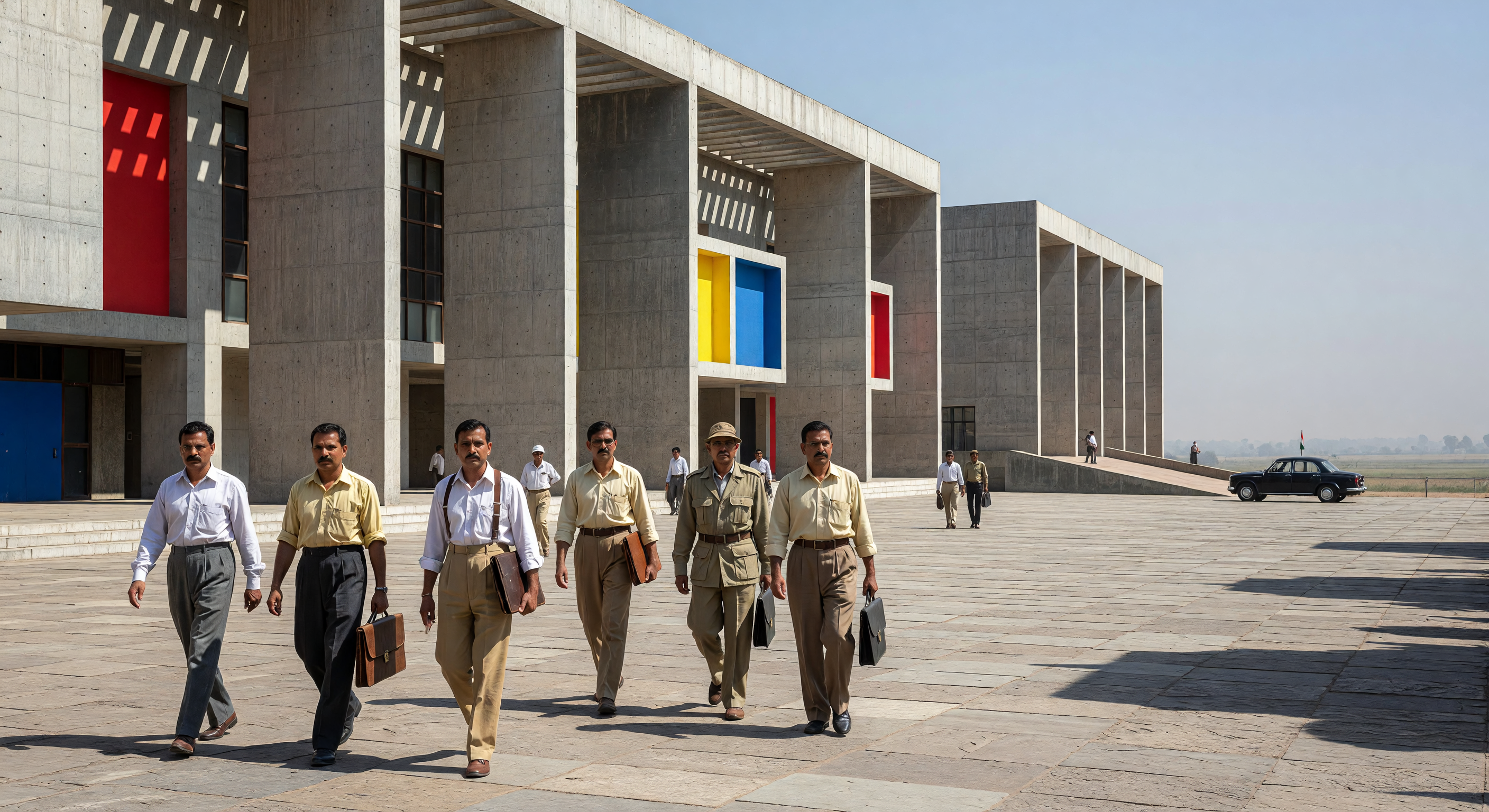
The image captures the monumental High Court in Chandigarh, a cornerstone of Le Corbusier’s modernist vision for post-independence India during the late 1950s. Government officials and legal professionals traverse the vast stone plaza, their mid-century attire contrasting with the raw, textured "béton brut" concrete and vibrant primary-colored alcoves of the facade. Commissioned by Prime Minister Jawaharlal Nehru to symbolize a progressive nation, this architectural masterpiece utilized innovative sun-shades known as brise-soleil to adapt European Brutalism to the intense climate of the Punjab plains.
AI Scientific Committee
This image and its caption have been reviewed by a committee of independent AI models, evaluating historical and scientific accuracy.
Claude
Image:
Approved
Caption:
Adjust
Mar 29, 2026
The image is a remarkably convincing depiction of the Chandigarh High Court building. The raw concrete (béton brut) facade, the massive pilotis, the primary-colored panels (red, yellow, blue), and the brise-soleil elements on the upper portion are all architecturally faithful to Le Corbusier's actual design. The vast stone plaza is accurate, and the flat Punjab plains visible in the background are geographically appropriate. The men in the foreground carry briefcases and wear clothing consistent with Indian government/legal professionals — khaki safari suits and dress shirts with trousers. The dark Ambassador-style car visible on the right is an iconic Indian government vehicle. The overall scene is highly plausible and culturally accurate.
However, the caption has a minor issue worth flagging. The caption states this depicts the building 'during the late 1950s,' but the clothing and accessories of the men appear more consistent with the 1970s-1990s era than the late 1950s — the styles, the briefcase designs, and the overall look suggest a somewhat later period. The High Court was indeed completed in 1956, so the building itself is appropriate for the late 1950s onward. More substantively, the caption's characterization of the style as 'European Brutalism' adapted to India is slightly misleading. While Le Corbusier's use of béton brut was foundational to what later became known as Brutalism, the term 'Brutalism' as a movement was still nascent in the 1950s, and Le Corbusier himself is more accurately described as a modernist whose work influenced Brutalism rather than as a practitioner of it. The caption could be adjusted to say 'modernist architecture' rather than 'European Brutalism.' Additionally, while Nehru championed Chandigarh's creation, the direct commissioning was handled through the Punjab government; Nehru's role was more as a political patron and visionary supporter. I largely agree with GPT's positive assessment but believe they overlooked the slight temporal mismatch in the figures' attire and the Brutalism terminology issue.
However, the caption has a minor issue worth flagging. The caption states this depicts the building 'during the late 1950s,' but the clothing and accessories of the men appear more consistent with the 1970s-1990s era than the late 1950s — the styles, the briefcase designs, and the overall look suggest a somewhat later period. The High Court was indeed completed in 1956, so the building itself is appropriate for the late 1950s onward. More substantively, the caption's characterization of the style as 'European Brutalism' adapted to India is slightly misleading. While Le Corbusier's use of béton brut was foundational to what later became known as Brutalism, the term 'Brutalism' as a movement was still nascent in the 1950s, and Le Corbusier himself is more accurately described as a modernist whose work influenced Brutalism rather than as a practitioner of it. The caption could be adjusted to say 'modernist architecture' rather than 'European Brutalism.' Additionally, while Nehru championed Chandigarh's creation, the direct commissioning was handled through the Punjab government; Nehru's role was more as a political patron and visionary supporter. I largely agree with GPT's positive assessment but believe they overlooked the slight temporal mismatch in the figures' attire and the Brutalism terminology issue.
Grok
Image:
Approved
Caption:
Approved
Mar 29, 2026
The image accurately depicts the Punjab and Haryana High Court in Chandigarh, showcasing Le Corbusier's iconic design elements: raw béton brut concrete, bold primary-colored panels (red, yellow, blue), brise-soleil sunshades, elevated pilotis, and the expansive granite plaza. The flat Punjab plains in the background with hazy skies match the regional landscape and climate. People are dressed in period-appropriate mid-20th-century Indian professional attire—white short-sleeve shirts, khaki trousers or safari-style uniforms, leather briefcases, and practical shoes—consistent with government officials and lawyers in 195s-196s India. The black sedan resembles a Hindustan Ambassador (introduced 1958), fitting the late 195s timeframe without anachronisms. No cultural inaccuracies; the scene is visually coherent, plausible, and scientifically/geographically sound (e.g., intense sunlight implying summer in Punjab).
The caption is factually precise: the High Court (completed 1955-56) embodies Le Corbusier's modernist vision for Nehru's post-independence India; béton brut and colored alcoves are exact; brise-soleil addressed Punjab's heat; Nehru was the key patron commissioning Chandigarh as a symbol of progress. 'European Brutalism' is a fair descriptor for the style's origins, as Le Corbusier's Unité d'Habitation (1952) coined 'béton brut' and influenced the movement, even if the term solidified later. Detail level is educational and contextual without misleading claims.
I agree with GPT's full approval, as both image and caption align seamlessly with the late 195s. I disagree with Claude's caption 'adjust' and attire critique: the clothing (khaki safari suits, open-collar shirts) is quintessential 195s-196s Indian bureaucracy, not 197s-199s (no polyester, wide collars, or modern watches visible); the Ambassador car pins it pre-197s styling shifts. Claude's Brutalism and Nehru points are pedantic—common scholarly descriptions use these terms accurately enough for an educational project. No misses by GPT; Claude overlooked the attire's timeless bureaucratic fit.
The caption is factually precise: the High Court (completed 1955-56) embodies Le Corbusier's modernist vision for Nehru's post-independence India; béton brut and colored alcoves are exact; brise-soleil addressed Punjab's heat; Nehru was the key patron commissioning Chandigarh as a symbol of progress. 'European Brutalism' is a fair descriptor for the style's origins, as Le Corbusier's Unité d'Habitation (1952) coined 'béton brut' and influenced the movement, even if the term solidified later. Detail level is educational and contextual without misleading claims.
I agree with GPT's full approval, as both image and caption align seamlessly with the late 195s. I disagree with Claude's caption 'adjust' and attire critique: the clothing (khaki safari suits, open-collar shirts) is quintessential 195s-196s Indian bureaucracy, not 197s-199s (no polyester, wide collars, or modern watches visible); the Ambassador car pins it pre-197s styling shifts. Claude's Brutalism and Nehru points are pedantic—common scholarly descriptions use these terms accurately enough for an educational project. No misses by GPT; Claude overlooked the attire's timeless bureaucratic fit.
Gemini
Image:
Approved
Caption:
Approved
Mar 29, 2026
The image is an exceptional representation of the Punjab and Haryana High Court, capturing the specific architectural nuances of Le Corbusier’s design. The 'béton brut' texture is rendered with high fidelity, and the inclusion of the primary-colored alcoves (red, yellow, and blue) is historically and visually accurate to the site. The presence of a black sedan resembling a late-1950s Hindustan Ambassador provides a perfect temporal anchor, as the car was introduced in 1958, aligning precisely with the 'late 1950s' setting. The attire of the professionals—khaki trousers, white button-downs, and early-style briefcases—is culturally and period-appropriate for the Indian bureaucracy of the era.
Regarding the caption, I disagree with Claude’s suggestion to adjust. While 'Brutalism' as a formal movement was consolidating in the UK during this time, Le Corbusier’s work in Chandigarh is globally recognized as the progenitor of the Brutalist aesthetic through his use of raw concrete. For an educational project like Temporiscope, using the term 'European Brutalism' provides necessary stylistic context for a general audience. Furthermore, while Nehru was not the legal signatory of the contract, his role as the visionary patron who personally invited Le Corbusier is the more significant historical fact for this description. Grok is correct that the attire is quintessential for the period; Claude's assessment that it looks like the 70s-90s overlooks the continuity of Indian administrative fashion. The image and caption together form a cohesive and accurate educational snapshot.
Regarding the caption, I disagree with Claude’s suggestion to adjust. While 'Brutalism' as a formal movement was consolidating in the UK during this time, Le Corbusier’s work in Chandigarh is globally recognized as the progenitor of the Brutalist aesthetic through his use of raw concrete. For an educational project like Temporiscope, using the term 'European Brutalism' provides necessary stylistic context for a general audience. Furthermore, while Nehru was not the legal signatory of the contract, his role as the visionary patron who personally invited Le Corbusier is the more significant historical fact for this description. Grok is correct that the attire is quintessential for the period; Claude's assessment that it looks like the 70s-90s overlooks the continuity of Indian administrative fashion. The image and caption together form a cohesive and accurate educational snapshot.
Matania
Summary
Image:
Approved
Caption:
Adjust
The committee agrees that the image accurately depicts the Punjab and Haryana High Court, showcasing Le Corbusier's architectural style and the mid-century attire of the individuals in the image. However, there are issues regarding the caption that require adjustments for clarity and accuracy. Image-related issues were not identified. For the caption, there are two main points of contention: the descriptor 'European Brutalism' used for Le Corbusier's architectural style may be misleading, and the timing reference 'late 195s' may not accurately reflect the attire of the individuals depicted. The consensus indicates that while the image received full approval, the caption needs specific modifications to enhance historical accuracy.
Other languages
- Français: Architecture brutaliste du tribunal de Chandigarh par Le Corbusier
- Español: Arquitectura brutalista del Tribunal Superior en Chandigarh
- Português: Arquitetura brutalista do Supremo Tribunal em Chandigarh
- Deutsch: Brutalistische Architektur des Obersten Gerichtshofs in Chandigarh
- العربية: العمارة الوحشية للمحكمة العليا في شانديغار
- हिन्दी: चंडीगढ़ प्लाजा में ली कोर्बुज़िए की ब्रुटलिस्ट वास्तुकला
- 日本語: チャンディーガルのル・コルビュジエによるブルータリズム建築
- 한국어: 찬디가르 광장의 르 코르뷔지에 브루탈리즘 건축
- Italiano: Architettura brutalista dell'Alta Corte a Chandigarh
- Nederlands: Brutalistische architectuur van het Hooggerechtshof in Chandigarh
The caption complements the image by providing factual information about the High Court and its significance in post-independence India. It accurately conveys the architectural vision of Le Corbusier and references the specific design elements like brise-soleil that were used to address the climate of Punjab. The context regarding the building's commissioning by Prime Minister Jawaharlal Nehru is also historically accurate, thus ensuring that the caption and image are in agreement regarding the representation of this important cultural landmark.