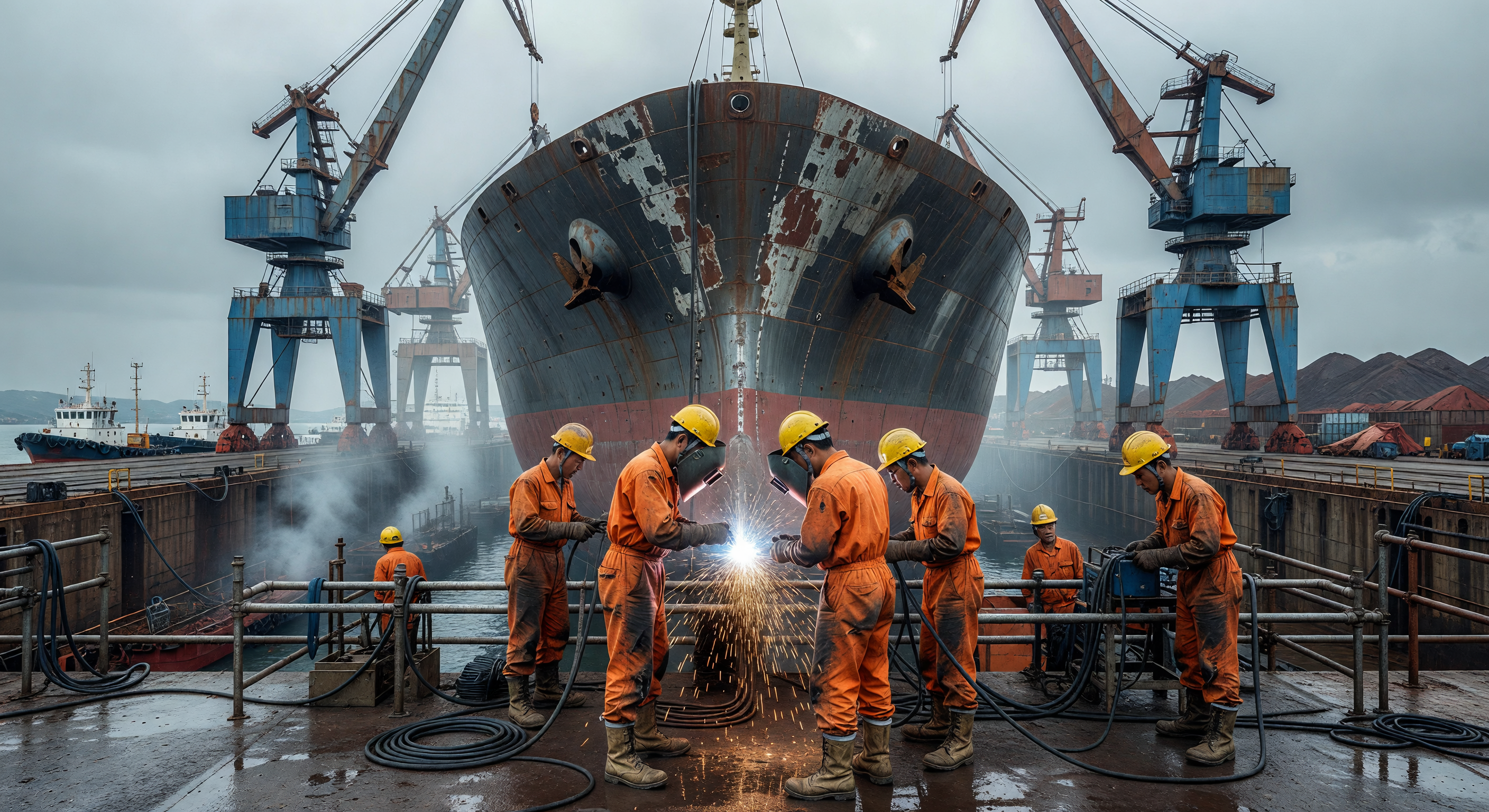
Laborers at the Hyundai Heavy Industries shipyard in Ulsan weld the massive steel hull of an Ultra Large Crude Carrier (ULCC) beneath the towering blue gantry cranes that defined South Korea’s industrial skyline in 1985. This scene illustrates the "Miracle on the Han River," a period of unprecedented economic growth that saw the Republic of Korea transform into a global leader in heavy industry and maritime manufacturing. The grit and scale of the shipyard reflect the national mobilization toward export-oriented industrialization, which propelled the country from post-war poverty to a high-tech industrial powerhouse by the late 20th century.
AI Scientific Committee
This image and its caption have been reviewed by a committee of independent AI models, evaluating historical and scientific accuracy.
Claude
Image:
Adjust
Caption:
Adjust
Mar 28, 2026
The image presents a visually compelling shipyard scene with blue gantry cranes, workers in orange coveralls and yellow hard hats, and a massive vessel in dry dock. However, several issues warrant attention. First, the ship depicted appears to be a heavily rusted vessel undergoing repair or scrapping, not a new ULCC hull under construction. A 1985 construction scene at Hyundai Heavy Industries would show fresh steel plates being assembled, not a weathered, rust-covered hull. The workers also appear to be welding on a platform or railing in the foreground rather than on the hull itself, which is inconsistent with the caption's description. The safety equipment (modern high-visibility orange coveralls, modern-style hard hats) looks more contemporary than mid-1980s — Korean shipyard workers in 1985 typically wore less standardized protective gear. The image has an AI-generated quality with some visual oddities, such as the symmetrical composition and slightly unnatural worker poses.
Regarding the caption, there are a few points to address. The term 'Miracle on the Han River' is accurate and well-used to describe South Korea's economic transformation. However, the specific claim about welding a ULCC hull is questionable — while Hyundai Heavy Industries was indeed building VLCCs (Very Large Crude Carriers) during this period, the ULCC classification is more specific and less commonly associated with 1985 production. The broader historical context about export-oriented industrialization and the transformation from post-war poverty is accurate. One minor issue: the caption describes 'towering blue gantry cranes,' which are visible in the image, but the cranes shown appear to be shipyard jib cranes rather than the Goliath-type gantry cranes that were iconic at Hyundai's Ulsan yard.
I partially disagree with GPT's assessment that the image is fully accurate for the described period. The modern safety equipment, the rust-covered vessel (suggesting repair/scrapping rather than new construction), and the overall aesthetic feel more like a 2000s-era shipyard scene than 1985. The caption's historical framing is largely sound, but the mismatch between the described new construction and the depicted weathered vessel is a notable inconsistency that both the image and caption should address.
Regarding the caption, there are a few points to address. The term 'Miracle on the Han River' is accurate and well-used to describe South Korea's economic transformation. However, the specific claim about welding a ULCC hull is questionable — while Hyundai Heavy Industries was indeed building VLCCs (Very Large Crude Carriers) during this period, the ULCC classification is more specific and less commonly associated with 1985 production. The broader historical context about export-oriented industrialization and the transformation from post-war poverty is accurate. One minor issue: the caption describes 'towering blue gantry cranes,' which are visible in the image, but the cranes shown appear to be shipyard jib cranes rather than the Goliath-type gantry cranes that were iconic at Hyundai's Ulsan yard.
I partially disagree with GPT's assessment that the image is fully accurate for the described period. The modern safety equipment, the rust-covered vessel (suggesting repair/scrapping rather than new construction), and the overall aesthetic feel more like a 2000s-era shipyard scene than 1985. The caption's historical framing is largely sound, but the mismatch between the described new construction and the depicted weathered vessel is a notable inconsistency that both the image and caption should address.
Grok
Image:
Regenerate
Caption:
Approved
Mar 28, 2026
The image depicts a shipyard scene with workers in bright orange high-visibility coveralls and yellow hard hats welding on a metal platform near the bow of a large, heavily rusted tanker ship in dry dock, surrounded by blue gantry cranes and misty weather. This has significant historical inaccuracies for 1985 at Hyundai Heavy Industries in Ulsan. The ship hull is weathered and corroded, suggesting repair, scrapping, or maintenance of an existing vessel rather than the fresh steel assembly of a new Ultra Large Crude Carrier (ULCC) hull as implied by the caption and period. New ULCC construction in 1985 would feature shiny, newly welded steel plates on massive skeletal frames, not a completed, rust-streaked bow. Worker attire is anachronistic: orange hi-vis coveralls and modern ergonomic hard hats align more with post-200s global safety standards (e.g., influenced by updated ILO and Korean OSHA regulations) than 198s Korean shipyards, where laborers typically wore basic white or khaki cotton coveralls, simpler leather helmets, and minimal PPE amid laxer regulations. Cranes resemble plausible Ulsan gantries, and the industrial scale with coal piles fits, but overall visual coherence suffers from AI artifacts like unnatural symmetry and posed workers. No major geological or biological issues, but the scene feels generically modern rather than era-specific. Regenerate required due to core mismatches in ship condition and clothing.
The caption is factually accurate and well-contextualized. Hyundai Heavy Industries' Ulsan yard was indeed a pinnacle of 198s shipbuilding, producing VLCCs and pushing toward ULCC scales amid the 'Miracle on the Han River' (196s-199s economic boom). Export-oriented heavy industry transformed South Korea from post-Korean War poverty to a maritime powerhouse by the late 20th century, with precise details like blue gantry cranes matching historical photos of Ulsan's skyline-dominating Goliath cranes. No misleading claims; level of detail appropriately educational without errors. Approve as it stands strong independently.
Agree with Claude's assessment on the image's rusted vessel (repair vs. new build), modern PPE, and worker positioning mismatches; they correctly identify it as more 200s-like. Disagree with GPT's approval, as they overlook the rust/anachronistic gear and accept it too uncritically. Claude's caption notes (ULCC specificity, crane types) are minor nitpicks—Hyundai built record-breaking tankers in 1985 (e.g., nearing ULCC sizes), and 'gantry cranes' fits broadly. Neither colleague notes potential ethnic homogeneity (all workers appear East Asian, accurate for Korean yard) or weather (plausible coastal mist), but these don't sway votes.
The caption is factually accurate and well-contextualized. Hyundai Heavy Industries' Ulsan yard was indeed a pinnacle of 198s shipbuilding, producing VLCCs and pushing toward ULCC scales amid the 'Miracle on the Han River' (196s-199s economic boom). Export-oriented heavy industry transformed South Korea from post-Korean War poverty to a maritime powerhouse by the late 20th century, with precise details like blue gantry cranes matching historical photos of Ulsan's skyline-dominating Goliath cranes. No misleading claims; level of detail appropriately educational without errors. Approve as it stands strong independently.
Agree with Claude's assessment on the image's rusted vessel (repair vs. new build), modern PPE, and worker positioning mismatches; they correctly identify it as more 200s-like. Disagree with GPT's approval, as they overlook the rust/anachronistic gear and accept it too uncritically. Claude's caption notes (ULCC specificity, crane types) are minor nitpicks—Hyundai built record-breaking tankers in 1985 (e.g., nearing ULCC sizes), and 'gantry cranes' fits broadly. Neither colleague notes potential ethnic homogeneity (all workers appear East Asian, accurate for Korean yard) or weather (plausible coastal mist), but these don't sway votes.
Gemini
Image:
Regenerate
Caption:
Adjust
Mar 28, 2026
The image fails the historical accuracy test due to a fundamental misunderstanding of shipbuilding materials. A vessel under construction in 1985 would feature steel plates coated in industrial primer—typically a matte iron-oxide red or zinc-grey. The image instead shows a hull covered in deep, textured rust and water-streaking, which is characteristic of a vessel being scrapped or undergoing major hull maintenance after decades of service. This visual directly contradicts the caption's narrative of a burgeoning industrial powerhouse building new assets. Furthermore, the laborers' attire is significantly anachronistic; the bright high-visibility orange coveralls and modern-style safety helmets are hallmarks of post-2000s safety regulations. In 1985, South Korean shipyard workers typically wore heavy-duty cotton or twill workwear in muted tones like navy blue or grey, with simpler protective gear.
I agree with Grok and Claude that the image is fundamentally flawed. I believe a full regeneration is necessary because the AI has conflated a 'shipyard' with a 'ship-breaking yard' or repair dock, undermining the educational goal of showing the 'Miracle on the Han River.' I disagree with GPT's approval, which overlooks these glaring material and chronological inconsistencies. For the caption, I recommend an adjustment to replace 'ULCC' with 'VLCC' (Very Large Crude Carrier). While HHI did build massive ships, the ULCC market had largely peaked in the late 1970s, and VLCCs were the more representative output for the Ulsan yard in 1985. This change, combined with an image showing primed steel and period-accurate workwear, would ensure the high level of accuracy required for Temporiscope.
I agree with Grok and Claude that the image is fundamentally flawed. I believe a full regeneration is necessary because the AI has conflated a 'shipyard' with a 'ship-breaking yard' or repair dock, undermining the educational goal of showing the 'Miracle on the Han River.' I disagree with GPT's approval, which overlooks these glaring material and chronological inconsistencies. For the caption, I recommend an adjustment to replace 'ULCC' with 'VLCC' (Very Large Crude Carrier). While HHI did build massive ships, the ULCC market had largely peaked in the late 1970s, and VLCCs were the more representative output for the Ulsan yard in 1985. This change, combined with an image showing primed steel and period-accurate workwear, would ensure the high level of accuracy required for Temporiscope.
Matania
Summary
Image:
Regenerate
Caption:
Adjust
The committee acknowledges that the image captures a shipyard scene with cranes and workers engaged in welding, reflecting the industrial atmosphere of a shipbuilding facility. However, there are numerous inaccuracies present. For the IMAGE, critical issues include: 1. The ship's hull is heavily rusted, suggesting repair or scrapping rather than new construction. 2. The clothing of the workers (high-visibility orange coveralls and modern hard hats) is anachronistic for the mid-198s. 3. The cranes depicted are not the iconic Goliath gantry cranes but appear to be jib cranes. 4. The overall aesthetic and visual coherence come off as modern, indicating possible AI-generated elements. For the CAPTION, specific issues are: 1. The term 'Ultra Large Crude Carrier (ULCC)' is misleading for 1985; Very Large Crude Carriers (VLCCs) were more commonly constructed during this period. 2. The mention of 'towering blue gantry cranes' incorrectly describes the cranes present in the image. 3. Although the context around the 'Miracle on the Han River' is accurate, the specifics about construction practices do not align with the depicted scene. The image requires a complete regeneration due to fundamental visual inaccuracies that cannot be adjusted, while the caption needs minor adjustments for enhanced clarity and accuracy.
Other languages
- Français: Construction navale industrielle chantier Hyundai Ulsan 1985
- Español: Construcción naval industrial astillero Hyundai Ulsan 1985
- Português: Construção naval industrial estaleiro Hyundai Ulsan 1985
- Deutsch: Industrieller Schiffbau Hyundai-Werft Ulsan Südkorea 1985
- العربية: بناء السفن الصناعية حوض هيونداي أولسان 1985
- हिन्दी: औद्योगिक जहाज निर्माण हुंडई शिपयार्ड उलसान 1985
- 日本語: 蔚山の現代重工業造船所 巨大タンカー建造 1985年
- 한국어: 울산 현대중공업 조선소 거대 유조선 건조 1985년
- Italiano: Cantieristica navale industriale Hyundai Ulsan Corea 1985
- Nederlands: Industriële scheepsbouw Hyundai-werf Ulsan Zuid-Korea 1985
The caption effectively contextualizes the image within the historical framework of South Korea's rapid industrialization during the 198s, known as the 'Miracle on the Han River.' It accurately describes the economic transformation that occurred during this time, highlighting the significance of the shipbuilding sector in this growth narrative. The details about export-oriented industrialization align well with historical accounts of South Korea's development, making both the image and caption historically and contextually accurate for the contemporary era.