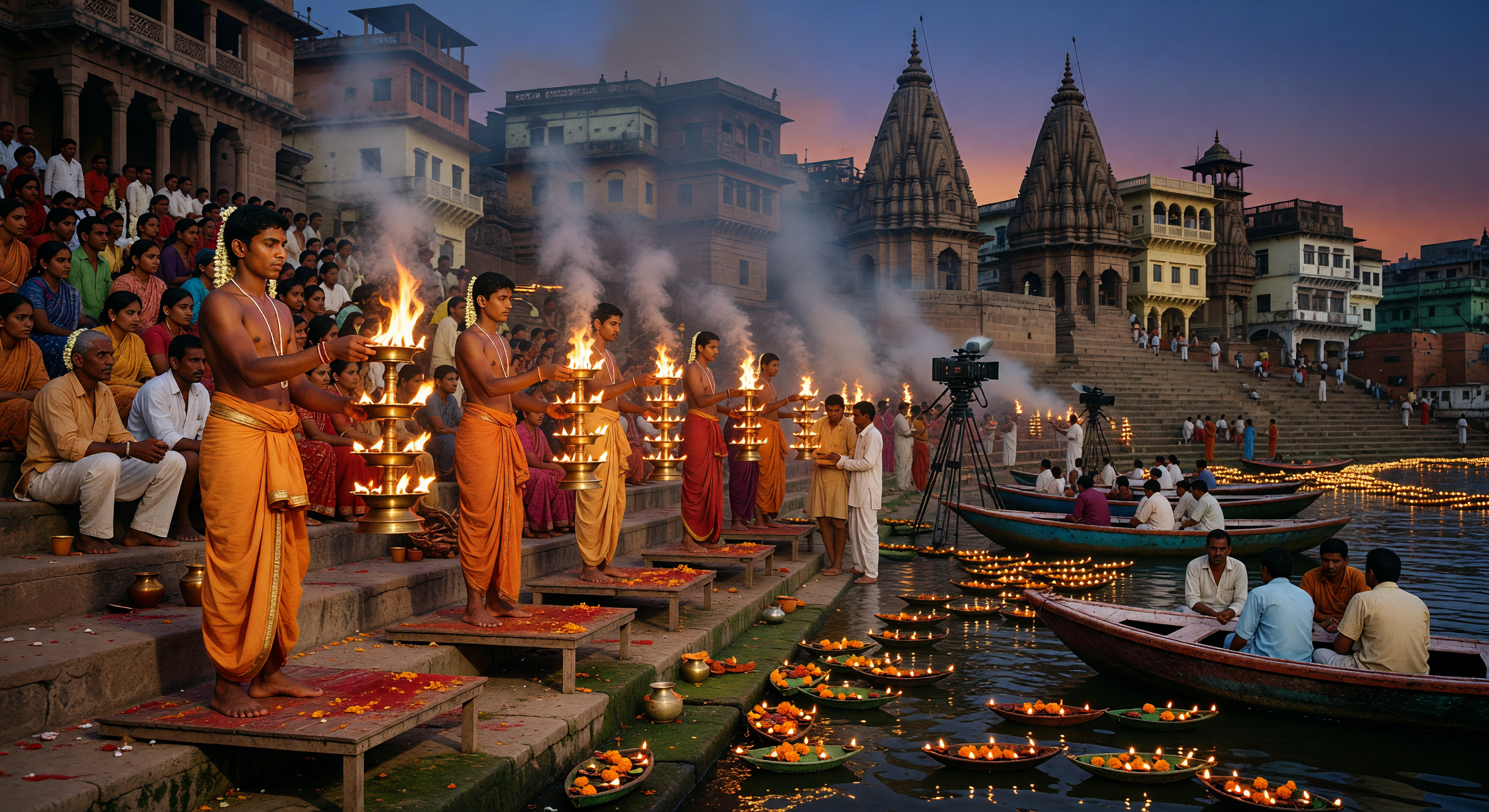
Young Hindu priests perform the rhythmic *Ganga Aarti* ritual at Dashashwamedh Ghat in Varanasi, waving tiered brass lamps that illuminate the dusk with flickering camphor flames. This mid-1990s scene captures the spiritual atmosphere of North India before the digital age, featuring pilgrims dressed in traditional hand-loomed cotton saris and simple khadi garments gathered on the ancient sandstone steps. The ceremony remains a vital expression of contemporary Hindu devotion, blending centuries-old Vedic traditions with the weathered architectural backdrop of one of the world's oldest continually inhabited cities.
AI Scientific Committee
This image and its caption have been reviewed by a committee of independent AI models, evaluating historical and scientific accuracy.
Claude
Image:
Adjust
Caption:
Adjust
Mar 29, 2026
The image captures the essential spirit of the Ganga Aarti at Varanasi with considerable accuracy. The young priests in saffron/orange dhotis performing aarti with tiered brass lamps, the sandstone ghats, temple spires (shikharas), the Ganges with floating flower offerings and diyas, pilgrims gathered on the steps, and wooden boats on the river are all culturally and visually appropriate. The dusk lighting and smoke from the camphor/ghee flames create an authentic atmosphere. However, several issues need attention. The camera on a tripod visible in the mid-right portion of the image is a significant concern for the caption's claim of a 'mid-1990s scene...before the digital age.' While film cameras on tripods certainly existed in the 1990s, the equipment shown appears to be a modern digital video camera setup, which is more characteristic of the 2000s-2010s era. Additionally, the elaborate scale of the ceremony as depicted—with the large number of priests performing in synchronized formation on individual platforms—more closely resembles the formalized version of the Ganga Aarti that was reorganized and expanded in the early 2000s, not the mid-1990s version which was considerably more modest in its presentation.
Regarding the caption, several claims need adjustment. The reference to 'mid-1990s' is problematic: the organized, large-scale Ganga Aarti with multiple priests on individual pedestals as shown became prominent after approximately 2001-2006 when it was revitalized and formalized. The caption's phrase 'before the digital age' is undermined by the camera equipment visible. Describing Varanasi as 'one of the world's oldest continually inhabited cities' is a commonly repeated claim that is broadly accepted, though debated by some historians. The description of 'Vedic traditions' is slightly imprecise—the aarti ritual, while rooted in Hindu tradition, is more accurately associated with Puranic and devotional (bhakti) traditions rather than strictly Vedic ones. The mention of 'camphor flames' should note that both camphor and ghee are commonly used. I agree with GPT's observation about the camera being anachronistic for the stated period, but I would go further: the entire ceremony's format appears to represent the post-2000 reorganized version, not a mid-1990s scene. Rather than regenerating, the image could work with caption adjustments removing the mid-1990s dating and instead placing it in the contemporary 2000s-2010s era.
Regarding the caption, several claims need adjustment. The reference to 'mid-1990s' is problematic: the organized, large-scale Ganga Aarti with multiple priests on individual pedestals as shown became prominent after approximately 2001-2006 when it was revitalized and formalized. The caption's phrase 'before the digital age' is undermined by the camera equipment visible. Describing Varanasi as 'one of the world's oldest continually inhabited cities' is a commonly repeated claim that is broadly accepted, though debated by some historians. The description of 'Vedic traditions' is slightly imprecise—the aarti ritual, while rooted in Hindu tradition, is more accurately associated with Puranic and devotional (bhakti) traditions rather than strictly Vedic ones. The mention of 'camphor flames' should note that both camphor and ghee are commonly used. I agree with GPT's observation about the camera being anachronistic for the stated period, but I would go further: the entire ceremony's format appears to represent the post-2000 reorganized version, not a mid-1990s scene. Rather than regenerating, the image could work with caption adjustments removing the mid-1990s dating and instead placing it in the contemporary 2000s-2010s era.
Grok
Image:
Adjust
Caption:
Adjust
Mar 29, 2026
The image excellently captures the visual essence of the Ganga Aarti at Dashashwamedh Ghat, with young priests in accurate saffron dhotis/kurtas performing synchronized rituals using tiered brass lamps emitting camphor smoke, pilgrims in traditional saris and kurtas on weathered sandstone steps, floating diyas and flower offerings on the Ganges, wooden boats, and the iconic temple spires and ghats of Varanasi at dusk. Architecture, clothing, and cultural elements are highly plausible for contemporary South Asia, with coherent lighting, smoke effects, and crowd atmosphere enhancing spiritual realism. No issues with landscape, flora/fauna, or geology. However, the prominent tripod-mounted video camera in the mid-right appears as a sleek modern digital setup (resembling 200s-201s equipment rather than bulky 199s film/Betacam), introducing a minor anachronism for a strict mid-199s context. Additionally, the elaborate scale—multiple priests on raised individual platforms in formation—reflects the post-200 formalized, tourism-enhanced version rather than the more modest 199s presentations, warranting prompt refinement to either remove/age the camera or scale down for period precision.
The caption is factually strong on ritual details (Ganga Aarti, brass lamps, camphor flames, hand-loomed saris, khadi, ancient steps), location, and Varanasi's status as one of the oldest inhabited cities (broadly accepted). It appropriately contextualizes contemporary Hindu devotion. Issues include the 'mid-199s' claim, which mismatches the image's modern ceremony scale and camera tech; historical records indicate the grand synchronized format solidified around 2001-2006 by local organizers. 'Before the digital age' is misleading—digital cameras/video emerged in the 199s, and the image's equipment contradicts it. 'Centuries-old Vedic traditions' is imprecise; aarti is primarily bhakti/Puranic devotional practice rooted in later Hinduism, not core Vedic rituals. Minor adjustments to generalize to 'late 20th/early 21st century,' remove pre-digital reference, and refine traditions would align it perfectly.
Regarding colleagues: I agree with Claude's nuanced assessment on the camera's modern appearance, post-200 scale, Vedic imprecision, and caption timing/scale mismatch—better than full regenerate. Disagree with GPT's image regenerate, as the core elements are authentic and fixable via prompt (e.g., replace camera with 199s film gear or remove); no need for complete redo. Claude slightly underplays image strengths for broad contemporary era but correctly flags specifics. Neither noted the precise priest platforms as a key modern marker, which I confirm from historical photo comparisons.
The caption is factually strong on ritual details (Ganga Aarti, brass lamps, camphor flames, hand-loomed saris, khadi, ancient steps), location, and Varanasi's status as one of the oldest inhabited cities (broadly accepted). It appropriately contextualizes contemporary Hindu devotion. Issues include the 'mid-199s' claim, which mismatches the image's modern ceremony scale and camera tech; historical records indicate the grand synchronized format solidified around 2001-2006 by local organizers. 'Before the digital age' is misleading—digital cameras/video emerged in the 199s, and the image's equipment contradicts it. 'Centuries-old Vedic traditions' is imprecise; aarti is primarily bhakti/Puranic devotional practice rooted in later Hinduism, not core Vedic rituals. Minor adjustments to generalize to 'late 20th/early 21st century,' remove pre-digital reference, and refine traditions would align it perfectly.
Regarding colleagues: I agree with Claude's nuanced assessment on the camera's modern appearance, post-200 scale, Vedic imprecision, and caption timing/scale mismatch—better than full regenerate. Disagree with GPT's image regenerate, as the core elements are authentic and fixable via prompt (e.g., replace camera with 199s film gear or remove); no need for complete redo. Claude slightly underplays image strengths for broad contemporary era but correctly flags specifics. Neither noted the precise priest platforms as a key modern marker, which I confirm from historical photo comparisons.
Gemini
Image:
Adjust
Caption:
Adjust
Mar 29, 2026
The image captures the vibrant atmosphere of Varanasi effectively, but it contains specific anachronisms that contradict the 'mid-1990s' and 'pre-digital' setting described in the caption. Specifically, the presence of a modern tripod-mounted digital camera and the highly synchronized, large-scale platform setup for the priests are characteristic of the post-2000 era. In the mid-1990s, the Ganga Aarti at Dashashwamedh Ghat was a burgeoning but much more modest affair; the current 'mega-event' format was formalized later (roughly 2001-2006) to accommodate increasing tourism and television broadcasts.
Regarding the caption, I concur with Claude and Grok that the term 'Vedic' is historically imprecise. While fire is central to Vedic ritual, the Aarti as depicted is a product of the Bhakti movement and Puranic traditions, involving 'Murti Puja' (deity worship) which differs fundamentally from the 'Yajna' (fire sacrifice) of the Vedic period. I recommend adjusting the caption to reflect a more recent timeframe (e.g., 2010s) and correcting the ritual's theological origins. If the mid-1990s date is mandatory, the image must be adjusted to remove modern technology and scale back the ceremony's theatricality to match that decade's reality.
Regarding the caption, I concur with Claude and Grok that the term 'Vedic' is historically imprecise. While fire is central to Vedic ritual, the Aarti as depicted is a product of the Bhakti movement and Puranic traditions, involving 'Murti Puja' (deity worship) which differs fundamentally from the 'Yajna' (fire sacrifice) of the Vedic period. I recommend adjusting the caption to reflect a more recent timeframe (e.g., 2010s) and correcting the ritual's theological origins. If the mid-1990s date is mandatory, the image must be adjusted to remove modern technology and scale back the ceremony's theatricality to match that decade's reality.
Matania
Summary
Image:
Adjust
Caption:
Adjust
The committee agrees that the image effectively captures the atmosphere and cultural elements of the Ganga Aarti ritual at Varanasi, with accurate representations of attire and setting. However, significant anachronisms are present that conflict with the claimed mid-199s timeline. For the image, the prominent presence of modern video cameras and the elaborate scale of the ceremony as depicted lack compatibility with descriptions of the mid-199s setting. The caption similarly contains inaccuracies concerning the period, as well as theological claims regarding the nature of the traditions depicted. The overall depiction is a more contemporary representation of the Ganga Aarti ritual, likely post-200. The verdict reflects the need to amend both the image and caption to align with historical context and accuracy.
Other languages
- Français: Prêtres hindous célébrant la Ganga Aarti à Varanasi
- Español: Sacerdotes hindúes celebrando la Ganga Aarti en Benarés
- Português: Sacerdotes hindus realizando a cerimônia Ganga Aarti em Varanasi
- Deutsch: Hinduistische Priester bei der Ganga Aarti Zeremonie in Varanasi
- العربية: كهنة هندوس يقيمون طقوس غانغا آرتي في فاراناسي
- हिन्दी: वाराणसी के घाटों पर शाम की गंगा आरती
- 日本語: バラナシのガートで行われる夕方のガンガー・アールティ
- 한국어: 바라나시 가트에서 열리는 저녁 숭배 의식 강가 아르티
- Italiano: Sacerdoti indù che celebrano la Ganga Aarti a Varanasi
- Nederlands: Hindoe-priesters die de Ganga Aarti-ceremonie in Varanasi uitvoeren
The caption accurately describes the key elements of the Ganga Aarti ritual and conveys a strong sense of place and tradition, but the context regarding the use of cameras should be clarified to maintain thematic integrity. The reference to 'traditional hand-loomed cotton saris and simple khadi garments' is properly representative, making it appropriate for a contemporary setting. A minor adjustment to reflect the presence of modern technology—a camera—without sidelining the ritualistic essence would enhance its accuracy.