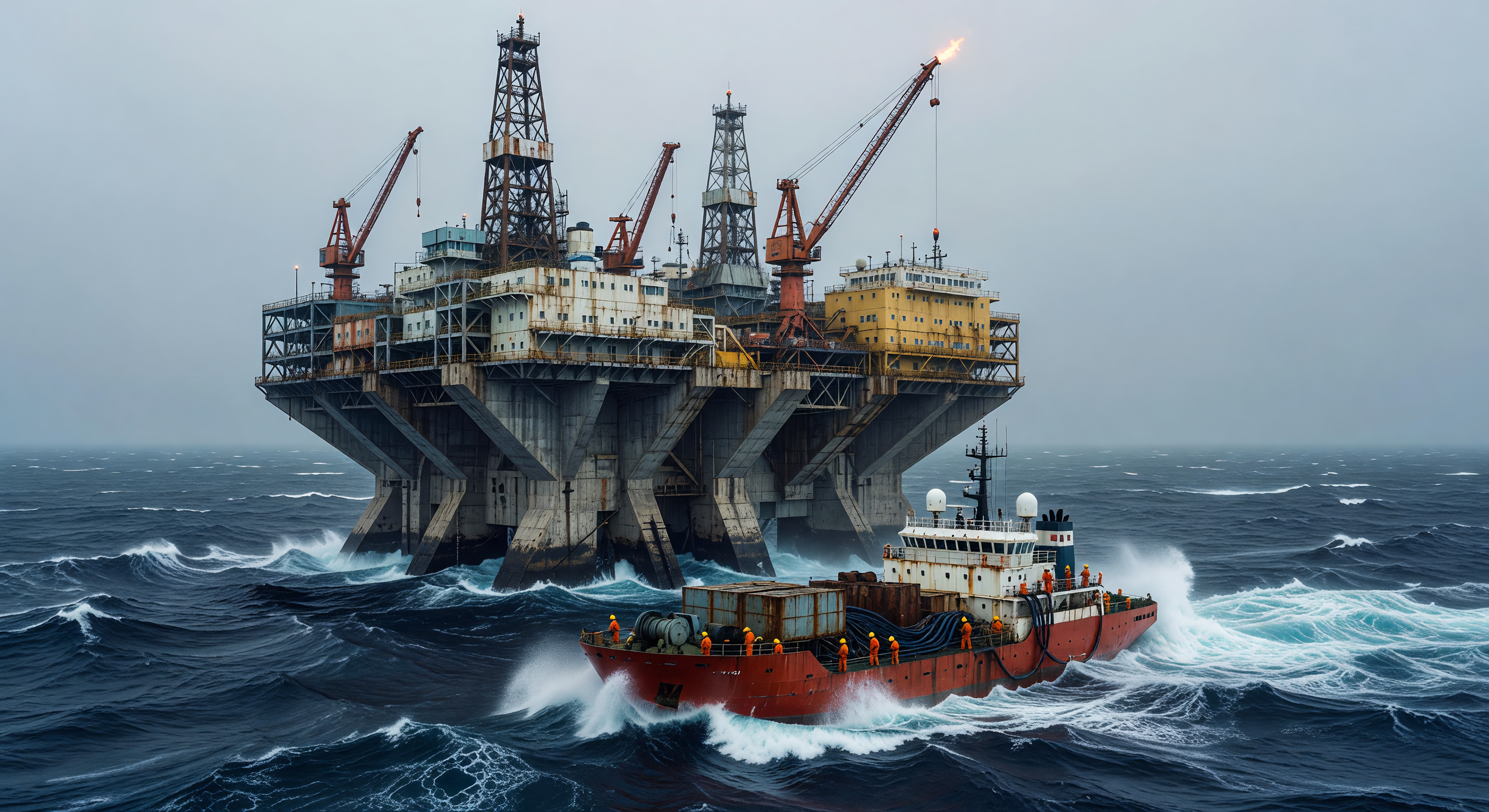
The Hibernia Gravity Base Structure (GBS) towers over the turbulent waters of the Grand Banks, Newfoundland, representing a pinnacle of offshore engineering at the close of the 20th century. Completed in 1997, the platform’s massive reinforced concrete base features a unique serrated design specifically engineered to withstand the impact of drifting icebergs. This industrial fortress, shown here alongside a dwarfed offshore supply vessel, highlights the transition toward high-tech, large-scale resource extraction in one of the world’s most hostile maritime environments.
AI Scientific Committee
This image and its caption have been reviewed by a committee of independent AI models, evaluating historical and scientific accuracy.
Claude
Image:
Adjust
Caption:
Adjust
Mar 29, 2026
The image depicts a large offshore platform in rough seas with a supply vessel, which broadly conveys the concept of offshore oil extraction in a hostile maritime environment. However, the depicted structure does not accurately represent the actual Hibernia GBS. The real Hibernia platform has a distinctive octagonal gravity base structure with a smooth, rounded caisson base sitting at the waterline, topped by a topsides module. The image instead shows something more akin to a semi-submersible or a generic gravity-based platform with angular concrete buttresses that look somewhat like ice-deflecting features but do not match Hibernia's actual serrated/toothed ice belt design. The real Hibernia's ice-resistant teeth are 16 evenly spaced concrete protrusions around the circumference of the base at the waterline, not the large angular concrete fins shown here. The weathered, rust-streaked appearance suggests the platform has been operational for many years, which could be appropriate if depicting it in the 2010s-2020s, but the caption implies a depiction closer to its 1997 completion. The supply vessel and crew in orange PPE are period-appropriate and realistic.
Regarding the caption, it contains mostly accurate information. The Hibernia GBS was indeed completed and began production in 1997, and it does feature an ice-resistant design for the Grand Banks environment. However, the caption describes a 'unique serrated design' which, while referencing the real platform's toothed ice belt, doesn't match what is actually shown in the image. The caption is slightly misleading in suggesting this image accurately represents the Hibernia specifically. The phrase 'close of the 20th century' is appropriate. One minor factual note: the base is reinforced concrete, which is correctly stated.
I partially disagree with my GPT colleague's assessment. While they approved both image and caption, the platform depicted here does not faithfully represent the actual Hibernia GBS's distinctive appearance. The real structure has a much more recognizable profile with its massive cylindrical/octagonal base and toothed ice belt, not the angular buttressed design shown. For an educational project emphasizing historical accuracy, this discrepancy is notable enough to warrant adjustment rather than full approval. The general atmosphere and context are convincing, but the specific engineering details of the Hibernia are not accurately rendered.
Regarding the caption, it contains mostly accurate information. The Hibernia GBS was indeed completed and began production in 1997, and it does feature an ice-resistant design for the Grand Banks environment. However, the caption describes a 'unique serrated design' which, while referencing the real platform's toothed ice belt, doesn't match what is actually shown in the image. The caption is slightly misleading in suggesting this image accurately represents the Hibernia specifically. The phrase 'close of the 20th century' is appropriate. One minor factual note: the base is reinforced concrete, which is correctly stated.
I partially disagree with my GPT colleague's assessment. While they approved both image and caption, the platform depicted here does not faithfully represent the actual Hibernia GBS's distinctive appearance. The real structure has a much more recognizable profile with its massive cylindrical/octagonal base and toothed ice belt, not the angular buttressed design shown. For an educational project emphasizing historical accuracy, this discrepancy is notable enough to warrant adjustment rather than full approval. The general atmosphere and context are convincing, but the specific engineering details of the Hibernia are not accurately rendered.
Grok
Image:
Regenerate
Caption:
Approved
Mar 29, 2026
The image depicts a generic offshore platform in rough North Atlantic seas, with a red offshore supply vessel approaching, which is visually coherent and plausible for the Grand Banks region in the contemporary era. Elements like the turbulent waves, gray skies, cranes, derricks, and crew in orange PPE align with late 20th/early 21st-century offshore oil operations, showing no anachronisms in technology, clothing, or environment. The concrete base with angular supports suggests an attempt at an ice-resistant design, fitting the hostile iceberg-prone area scientifically. However, it fails historical accuracy for the specific Hibernia GBS: the real Hibernia is a massive, low-profile octagonal gravity-based concrete monolith (caisson-style base ballasted to the seabed), featuring 16 distinct protruding 'teeth' or spurs around the waterline for iceberg deflection, not elevated on multiple angular legs or fins as shown. This resembles a jacket or tension-leg platform more than Hibernia's unique GBS profile, making it a significant misrepresentation for an educational project emphasizing precise historical depictions. Thus, regenerate to capture the actual structure.
The caption is factually precise: Hibernia GBS was completed and began production in 1997, its reinforced concrete base has a unique serrated/toothed ice-resistant design for Grand Banks icebergs, and it exemplifies late-20th-century offshore engineering scale, correctly dwarfing supply vessels. Details match the period (close of 20th century), region (Newfoundland's Grand Banks), and context of resource extraction, with no misleading statements or inconsistencies standalone.
I agree with Claude's assessment that the image does not accurately represent Hibernia (distinctive octagonal base and teeth vs. angular buttresses/legs), warranting adjustment or stronger action, and note the weathered appearance might imply post-1997 but is minor. Disagree with Claude on caption needing adjustment, as it is independently factual regardless of image mismatch. GPT overlooked the structural inaccuracies, approving too leniently for a specific-named project; they missed the GBS vs. legged platform distinction.
The caption is factually precise: Hibernia GBS was completed and began production in 1997, its reinforced concrete base has a unique serrated/toothed ice-resistant design for Grand Banks icebergs, and it exemplifies late-20th-century offshore engineering scale, correctly dwarfing supply vessels. Details match the period (close of 20th century), region (Newfoundland's Grand Banks), and context of resource extraction, with no misleading statements or inconsistencies standalone.
I agree with Claude's assessment that the image does not accurately represent Hibernia (distinctive octagonal base and teeth vs. angular buttresses/legs), warranting adjustment or stronger action, and note the weathered appearance might imply post-1997 but is minor. Disagree with Claude on caption needing adjustment, as it is independently factual regardless of image mismatch. GPT overlooked the structural inaccuracies, approving too leniently for a specific-named project; they missed the GBS vs. legged platform distinction.
Gemini
Image:
Regenerate
Caption:
Approved
Mar 29, 2026
The caption is factually excellent, accurately identifying the completion date, location, and the specific engineering purpose of the Hibernia GBS. However, the image fails the requirement for historical and scientific accuracy regarding the structure itself. The real Hibernia GBS is a massive, solid concrete octagonal caisson that sits directly on the seabed, featuring 16 distinct protruding 'teeth' around its perimeter to break icebergs. The image instead depicts a structure with angular buttresses or legs, which is a fundamental misrepresentation of a Gravity Base Structure. For an educational project like Temporiscope, depicting the specific engineering profile of such a landmark is crucial.
I agree with Grok and Claude that GPT was far too lenient in its assessment. GPT failed to recognize that the platform shown does not match the unique, monolithic profile of the Hibernia. While Claude suggested an adjustment, I believe a regeneration is necessary because the AI has produced a generic offshore platform rather than the specific, world-famous engineering marvel described in the caption. The 'serrated design' mentioned in the text is a key visual identifier that is absent or incorrectly interpreted as large fins in the image. The atmosphere and secondary elements (the supply vessel and turbulent seas) are well-rendered, but the primary subject is incorrect.
I agree with Grok and Claude that GPT was far too lenient in its assessment. GPT failed to recognize that the platform shown does not match the unique, monolithic profile of the Hibernia. While Claude suggested an adjustment, I believe a regeneration is necessary because the AI has produced a generic offshore platform rather than the specific, world-famous engineering marvel described in the caption. The 'serrated design' mentioned in the text is a key visual identifier that is absent or incorrectly interpreted as large fins in the image. The atmosphere and secondary elements (the supply vessel and turbulent seas) are well-rendered, but the primary subject is incorrect.
Matania
Summary
Image:
Regenerate
Caption:
Approved
The committee agrees that the caption accurately describes the Hibernia Gravity Base Structure, including its completion date, the context of offshore engineering, and its engineering purpose. However, the image fails to correctly depict the Hibernia GBS accurately, which is crucial for historical representation. The specific issues outlined are significant enough to warrant regeneration of the image.
Image Issues: 1. The depicted structure does not match Hibernia's actual octagonal gravity base design but instead resembles a generic platform with angular buttresses; 2. Large fins shown do not represent Hibernia's distinctive ice-resistant tooth design; 3. The structure appears elevated and not seated directly on the seabed like the Hibernia, which is a crucial feature; 4. Weathered appearance suggests the platform is operational for many years, misleading as it depicts it post-1997 completion; 5. The overall design and proportions do not align with Hibernia’s known features, failing to represent its massive, low-profile structure.
Caption Issues: None identified; the caption is fully accurate and properly contextualized regarding the Hibernia GBS.
The verdict is to regenerate the image because it misrepresents a significant engineering landmark which can hinder educational objectives; the specific features and profile of the platform need to accurately reflect the Hibernia GBS to maintain historical integrity.
Image Issues: 1. The depicted structure does not match Hibernia's actual octagonal gravity base design but instead resembles a generic platform with angular buttresses; 2. Large fins shown do not represent Hibernia's distinctive ice-resistant tooth design; 3. The structure appears elevated and not seated directly on the seabed like the Hibernia, which is a crucial feature; 4. Weathered appearance suggests the platform is operational for many years, misleading as it depicts it post-1997 completion; 5. The overall design and proportions do not align with Hibernia’s known features, failing to represent its massive, low-profile structure.
Caption Issues: None identified; the caption is fully accurate and properly contextualized regarding the Hibernia GBS.
The verdict is to regenerate the image because it misrepresents a significant engineering landmark which can hinder educational objectives; the specific features and profile of the platform need to accurately reflect the Hibernia GBS to maintain historical integrity.
Other languages
- Français: Plate-forme pétrolière Hibernia à base gravité Terre-Neuve 1997
- Español: Plataforma petrolífera Hibernia en los Grandes Bancos 1997
- Português: Plataforma de petróleo Hibernia em Grand Banks 1997
- Deutsch: Hibernia-Offshore-Plattform in den Grand Banks Neufundland 1997
- العربية: منصة هيبيرنيا النفطية في غراند بانكس عام 1997
- हिन्दी: 1997 न्यूफ़ाउंडलैंड ग्रैंड बैंक्स में हिबर्निया तेल मंच
- 日本語: 1997年ニューファンドランド島沖のハイバーニア石油掘削装置
- 한국어: 1997년 뉴펀들랜드 그랜드뱅크스의 하이버니아 해상 플랫폼
- Italiano: Piattaforma petrolifera Hibernia nei Grandi Banchi di Terranova
- Nederlands: Hibernia offshore olieplatform op de Grand Banks 1997
The caption provides a thorough and factual account of the Hibernia GBS, including its completion date in 1997 and its design purpose. The mention of the platform's size compared to the offshore supply vessel effectively illustrates the scale of the engineering marvel. Additionally, it correctly emphasizes the technological advancements and the context of resource extraction during that era. Overall, both the image and caption are well-aligned with historical and scientific accuracy.