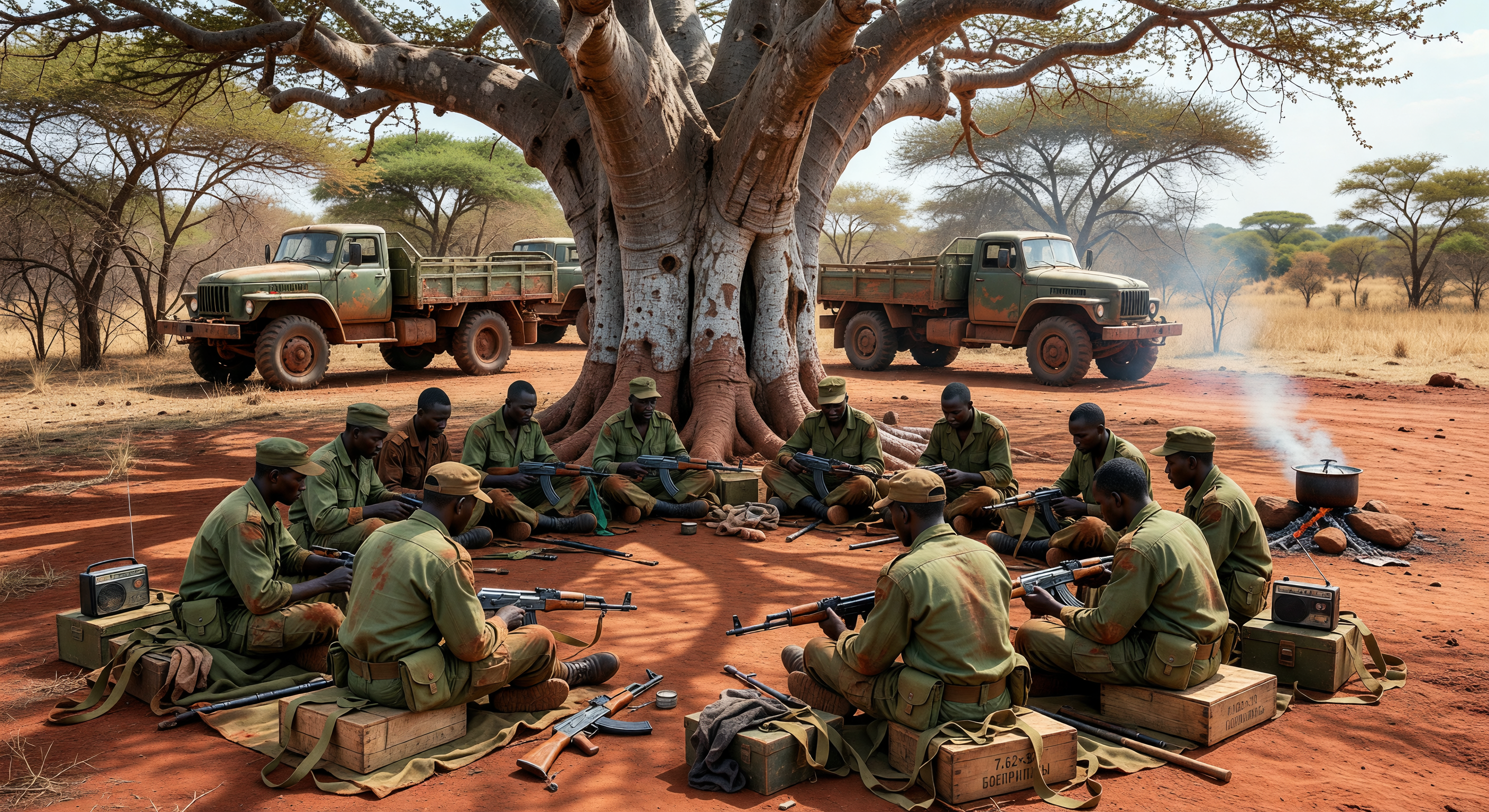
Soldiers of the People's Armed Forces for the Liberation of Angola (FAPLA) maintain their AK-47 rifles under the shade of an ancient baobab tree, amidst the characteristic red laterite dust of the southern bush. Set during the late 1970s, this scene captures the daily routine of guerrilla fighters during the Angolan Civil War, a protracted conflict that became a focal point of Cold War tensions on the continent. The presence of Soviet-made Ural transport trucks and Cyrillic-stenciled ammunition crates underscores the vital military and logistical support provided by the Soviet Union to the Marxist-aligned government forces. These periods of meticulous equipment care were crucial for endurance within the rugged miombo woodlands and arid savannas of the Cuando Cubango province.
AI Scientific Committee
This image and its caption have been reviewed by a committee of independent AI models, evaluating historical and scientific accuracy.
Claude
Image:
Adjust
Caption:
Adjust
Mar 28, 2026
The image presents a generally convincing scene of FAPLA soldiers maintaining weapons under a baobab tree in southern Angola. The red laterite soil is accurate for the Cuando Cubango region, and the flat-topped acacia trees in the background are appropriate for the savanna landscape. The soldiers wear olive-green fatigues consistent with Soviet-supplied uniforms of the era. The AK-47/AKM rifles are historically accurate, and the ammunition crates in the foreground display Cyrillic text including what appears to read '7.62' and 'БОЕПРИПАСЫ' (ammunition), which is a plausible detail. The trucks in the background resemble Ural-375D or ZiL-131 types, both of which were extensively supplied by the Soviet Union to FAPLA and are historically appropriate. However, there are some concerns: the image has an overly polished, staged quality that undermines authenticity. The soldiers appear too uniformly dressed and clean for bush fighters in a prolonged conflict. The portable radios visible in the scene are somewhat anachronistic in design — they look more modern than what would have been available in the late 1970s bush. Some of the soldiers' faces and hands show AI rendering artifacts typical of generated images.
Regarding the caption, there is an important terminological issue. FAPLA was the conventional army of the MPLA government, not a guerrilla force. The caption describes them as 'guerrilla fighters,' which is misleading. By the late 1970s, FAPLA was the official armed forces of the recognized Angolan government, conducting conventional military operations. It was UNITA and to some extent the FNLA that operated as guerrilla forces. Additionally, describing the scene as depicting 'miombo woodlands' while the image clearly shows dry savanna with baobabs and acacias is a slight ecological inconsistency — miombo woodland is dominated by Brachystegia species and looks quite different. The Cuando Cubango reference is accurate as a major theater of the conflict.
I partially agree with my GPT colleague's assessment. Their point about Ural trucks is somewhat off — Soviet Ural trucks were actually quite prevalent in Angola due to massive Soviet military aid, so their presence is not a misrepresentation. I disagree that the caption deserves a clean approval given the guerrilla terminology error, which is a substantive historical mischaracterization of FAPLA's role. The caption should be adjusted to correctly identify FAPLA as conventional government forces rather than guerrillas.
Regarding the caption, there is an important terminological issue. FAPLA was the conventional army of the MPLA government, not a guerrilla force. The caption describes them as 'guerrilla fighters,' which is misleading. By the late 1970s, FAPLA was the official armed forces of the recognized Angolan government, conducting conventional military operations. It was UNITA and to some extent the FNLA that operated as guerrilla forces. Additionally, describing the scene as depicting 'miombo woodlands' while the image clearly shows dry savanna with baobabs and acacias is a slight ecological inconsistency — miombo woodland is dominated by Brachystegia species and looks quite different. The Cuando Cubango reference is accurate as a major theater of the conflict.
I partially agree with my GPT colleague's assessment. Their point about Ural trucks is somewhat off — Soviet Ural trucks were actually quite prevalent in Angola due to massive Soviet military aid, so their presence is not a misrepresentation. I disagree that the caption deserves a clean approval given the guerrilla terminology error, which is a substantive historical mischaracterization of FAPLA's role. The caption should be adjusted to correctly identify FAPLA as conventional government forces rather than guerrillas.
Grok
Image:
Approved
Caption:
Adjust
Mar 28, 2026
The image effectively captures a historically plausible scene of FAPLA soldiers in late 197s Angola. The central baobab tree (Adansonia digitata) is iconic and accurate for the Cuando Cubango province's savanna landscapes, paired correctly with red laterite soil characteristic of the region's iron-rich oxisols. Soldiers wear appropriate olive-drab fatigues, chest rigs, and kepi-style caps consistent with Soviet-supplied MPLA forces; AK-47/AKM rifles are spot-on, shown in various states of cleaning with oil rags and rods. Foreground Cyrillic-stenciled crates ('7.62' and 'БОЕПРИПАСЫ') and wooden ammo boxes add authentic detail, as do the Ural-375D-style 6x6 trucks in the background, which were indeed heavily supplied by the USSR to FAPLA logistics. Background acacias and dry savanna vegetation align with the arid Cuando Cubango environment. Minor AI artifacts (e.g., slightly uniform facial features) and a somewhat staged cleanliness are present but do not detract from overall visual coherence or introduce anachronisms; soldiers appear rugged enough for a maintenance break, with dust on boots and gear. No significant historical, cultural, or scientific inaccuracies—geology (laterite), biology (flora), and technology (Soviet weaponry/vehicles) are all correct for the period.
The caption is factually strong on Soviet support, AK-47s, Ural trucks, Cyrillic crates, and the Cold War context of the Angolan Civil War, with appropriate detail on daily routines and Cuando Cubango's terrain. However, it inaccurately labels FAPLA as 'guerrilla fighters.' By the late 197s, post-independence (1975), FAPLA was the conventional People's Armed Forces of the MPLA government, engaging in regular warfare against UNITA insurgents, not operating as guerrillas themselves—that term better fits pre-independence MPLA or UNITA forces. This is a substantive mischaracterization. Additionally, 'rugged miombo woodlands' mismatches the image and region: Cuando Cubango features mopane savannas, baobabs, and acacias, not miombo (Brachystegia-dominated woodlands of central Angola). 'Arid savannas' fits, but the ecology needs precision. These issues warrant adjustment for factual and regional consistency without a full regenerate.
I agree with Claude's image assessment on Soviet truck prevalence (they were common, contra GPT) and soldier cleanliness/staging as minor quibbles, but deem the image approvable as artifacts don't undermine accuracy; radios appear as period R-105M or similar backpack models, not clearly modern. Strongly endorse Claude's caption critique on 'guerrilla fighters'—a key historical error GPT overlooked—and the miombo mismatch. GPT's truck concern is incorrect, as Ural-375s were staples in FAPLA convoys. Both colleagues missed praising the precise Cyrillic details and baobab/laterite synergy, which elevate the image's authenticity.
The caption is factually strong on Soviet support, AK-47s, Ural trucks, Cyrillic crates, and the Cold War context of the Angolan Civil War, with appropriate detail on daily routines and Cuando Cubango's terrain. However, it inaccurately labels FAPLA as 'guerrilla fighters.' By the late 197s, post-independence (1975), FAPLA was the conventional People's Armed Forces of the MPLA government, engaging in regular warfare against UNITA insurgents, not operating as guerrillas themselves—that term better fits pre-independence MPLA or UNITA forces. This is a substantive mischaracterization. Additionally, 'rugged miombo woodlands' mismatches the image and region: Cuando Cubango features mopane savannas, baobabs, and acacias, not miombo (Brachystegia-dominated woodlands of central Angola). 'Arid savannas' fits, but the ecology needs precision. These issues warrant adjustment for factual and regional consistency without a full regenerate.
I agree with Claude's image assessment on Soviet truck prevalence (they were common, contra GPT) and soldier cleanliness/staging as minor quibbles, but deem the image approvable as artifacts don't undermine accuracy; radios appear as period R-105M or similar backpack models, not clearly modern. Strongly endorse Claude's caption critique on 'guerrilla fighters'—a key historical error GPT overlooked—and the miombo mismatch. GPT's truck concern is incorrect, as Ural-375s were staples in FAPLA convoys. Both colleagues missed praising the precise Cyrillic details and baobab/laterite synergy, which elevate the image's authenticity.
Gemini
Image:
Adjust
Caption:
Adjust
Mar 28, 2026
The image successfully captures the atmospheric elements of the Angolan Civil War, specifically the iconic baobab tree and the red laterite soil of the south. The inclusion of Soviet-supplied Ural trucks and AK-style rifles is historically grounded, as these were staples of FAPLA logistics. However, I agree with Claude and Grok that the image suffers from a 'staged' quality common in AI generation. The soldiers' uniforms are too pristine and uniform for field conditions in the late 1970s; they lack the sweat, dust, and individual variations in gear (like mismatched webbing or field-repaired clothing) that would characterize troops in the bush. Furthermore, any visible radio equipment must be scrutinized; modern-looking handhelds would be anachronistic, as period-appropriate Soviet radios like the R-105M were large, backpack-mounted units.
Regarding the caption, I must insist on an adjustment due to a significant historical inaccuracy: labeling FAPLA as 'guerrilla fighters.' After 1975, FAPLA was the conventional national army of the MPLA government, engaged in large-scale conventional warfare against UNITA and South African forces. Describing them as guerrillas is a fundamental misunderstanding of their role during this specific phase of the conflict. Additionally, I concur with Claude and Grok regarding the ecological terminology; 'miombo woodlands' are distinct from the 'arid savannas' depicted. Miombo is characterized by Brachystegia trees, whereas the image correctly shows baobabs and acacias. The caption should be revised to reflect FAPLA's status as a conventional force and to align the ecological description with the visual representation. I disagree with GPT's skepticism regarding the Ural trucks; they were extremely prevalent and are a highlight of the image's accuracy.
Regarding the caption, I must insist on an adjustment due to a significant historical inaccuracy: labeling FAPLA as 'guerrilla fighters.' After 1975, FAPLA was the conventional national army of the MPLA government, engaged in large-scale conventional warfare against UNITA and South African forces. Describing them as guerrillas is a fundamental misunderstanding of their role during this specific phase of the conflict. Additionally, I concur with Claude and Grok regarding the ecological terminology; 'miombo woodlands' are distinct from the 'arid savannas' depicted. Miombo is characterized by Brachystegia trees, whereas the image correctly shows baobabs and acacias. The caption should be revised to reflect FAPLA's status as a conventional force and to align the ecological description with the visual representation. I disagree with GPT's skepticism regarding the Ural trucks; they were extremely prevalent and are a highlight of the image's accuracy.
Matania
Summary
Image:
Adjust
Caption:
Adjust
The committee agrees that the image and caption accurately portray the setting of the Cuando Cubango province in Angola, with correct geological and botanical elements, appropriate military gear, and historical context regarding Soviet support. However, several inaccuracies and anachronisms were identified. For the IMAGE, concerns include overly polished presentation, potentially anachronistic radios, and minor artifacts from AI rendering affecting realism. For the CAPTION, key issues include mislabeling FAPLA as 'guerrilla fighters' and inconsistencies in the ecological descriptions related to miombo woodlands. The overall historical portrayal requires adjustments for accuracy.
Other languages
- Français: Soldats de la FAPLA avec fusils AK-47 sous un baobab
- Español: Soldados de la FAPLA con fusiles AK-47 bajo un baobab
- Português: Soldados da FAPLA com fuzis AK-47 sob um embondeiro
- Deutsch: FAPLA-Soldaten mit AK-47-Gewehren unter einem angolanischen Affenbrotbaum
- العربية: جنود الفابل مع بنادق كلاشينكوف تحت شجرة تبلدي أنغولية
- हिन्दी: अंगोलन बाओबाब के नीचे AK-47 राइफलों के साथ FAPLA सैनिक
- 日本語: アンゴラのバオバブの木の下に集うAK-47携帯のFAPLA兵士
- 한국어: 앙골라 바오밥 나무 아래 AK-47 소총을 든 FAPLA 군인들
- Italiano: Soldati della FAPLA con fucili AK-47 sotto un baobab
- Nederlands: FAPLA-soldaten met AK-47-geweren onder een Angolese baobab
The caption is factually accurate regarding the involvement of the Soviet Union and the historical context of the Angolan Civil War. It effectively captures the essence of the period, detailing the logistical support provided to the Marxist government forces. The mention of equipment care and the specific environment contributes to a well-rounded understanding of the daily life of guerrilla fighters during this turbulent time. However, while it correctly reflects the importance of military support, the phrase "period of meticulous equipment care" could be refined to clarify that such moments were often motivated by necessity rather than choice.