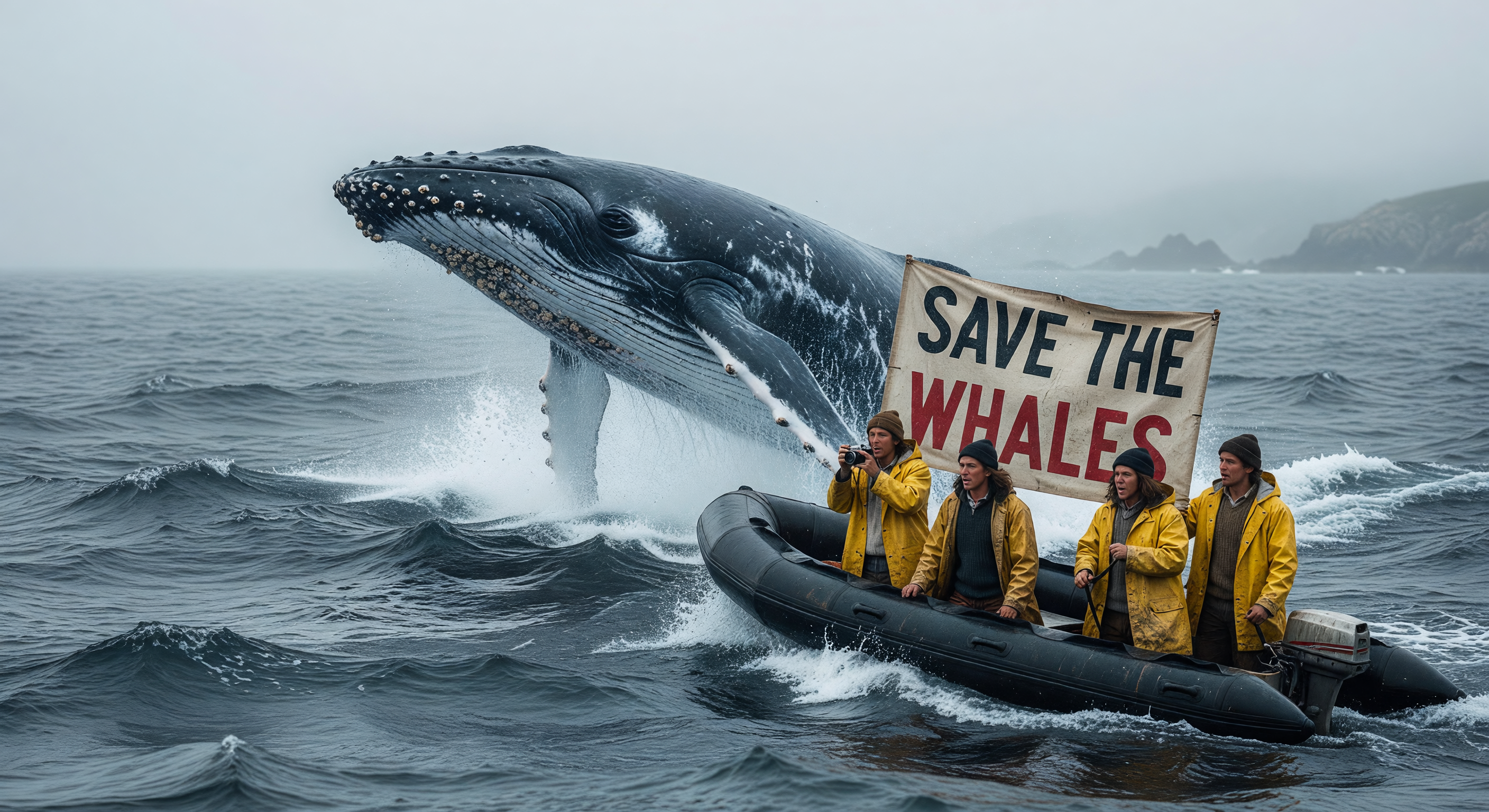
This scene captures the raw intensity of 1970s environmental activism as conservationists in a small inflatable boat encounter a breaching humpback whale in the North Atlantic. Dressed in period-accurate yellow PVC oilskins and heavy wool knitwear, the activists display the iconic "Save the Whales" slogan, a hallmark of the burgeoning direct-action movement. These maritime protests were instrumental in shifting global public opinion, ultimately contributing to the 1982 international moratorium on commercial whaling.
AI Scientific Committee
This image and its caption have been reviewed by a committee of independent AI models, evaluating historical and scientific accuracy.
Claude
Image:
Adjust
Caption:
Approved
Mar 29, 2026
The image effectively captures the spirit of 1970s anti-whaling activism, and many elements are well-executed. The yellow oilskins, wool knitwear, knit caps, and general aesthetic of the activists are broadly period-appropriate. The humpback whale is rendered with reasonable anatomical accuracy, showing characteristic tubercles on the rostrum and ventral pleats. The inflatable Zodiac-style boat is consistent with what organizations like Greenpeace used during this era. The overcast, misty North Atlantic atmosphere is convincing.
However, there are some concerns. The outboard motor visible on the boat appears somewhat modern in design — 1970s outboards had a more boxy, utilitarian appearance compared to the sleeker unit shown here. The inflatable boat itself also looks like it could be a more modern rigid-hulled inflatable (RHIB) design rather than the simpler rubber Zodiac inflatables that were iconic of early Greenpeace campaigns. The proximity of the breaching whale to the small boat is dramatically composed but would represent an extraordinarily dangerous situation; while this did occasionally happen, the scene feels slightly staged for dramatic effect. One activist appears to be holding what could be a modern-looking camera, though it's difficult to tell definitively.
The caption is factually sound. The 'Save the Whales' slogan was indeed a hallmark of 1970s environmentalism. The reference to the 1982 IWC moratorium on commercial whaling is accurate — it was adopted in 1982 and took effect in 1986. The description of the clothing and the broader historical context of direct-action maritime conservation is well-articulated. I largely agree with my GPT colleague's assessment but believe they overlooked the anachronistic details of the boat and motor, which warrant minor adjustment to better reflect 1970s maritime equipment.
However, there are some concerns. The outboard motor visible on the boat appears somewhat modern in design — 1970s outboards had a more boxy, utilitarian appearance compared to the sleeker unit shown here. The inflatable boat itself also looks like it could be a more modern rigid-hulled inflatable (RHIB) design rather than the simpler rubber Zodiac inflatables that were iconic of early Greenpeace campaigns. The proximity of the breaching whale to the small boat is dramatically composed but would represent an extraordinarily dangerous situation; while this did occasionally happen, the scene feels slightly staged for dramatic effect. One activist appears to be holding what could be a modern-looking camera, though it's difficult to tell definitively.
The caption is factually sound. The 'Save the Whales' slogan was indeed a hallmark of 1970s environmentalism. The reference to the 1982 IWC moratorium on commercial whaling is accurate — it was adopted in 1982 and took effect in 1986. The description of the clothing and the broader historical context of direct-action maritime conservation is well-articulated. I largely agree with my GPT colleague's assessment but believe they overlooked the anachronistic details of the boat and motor, which warrant minor adjustment to better reflect 1970s maritime equipment.
Grok
Image:
Adjust
Caption:
Approved
Mar 29, 2026
The image effectively captures the essence of 197s 'Save the Whales' activism with strong visual coherence. The activists' yellow PVC oilskins and apparent wool knitwear (visible in hats and layers) are period-accurate, matching the rugged, practical attire of Greenpeace and similar groups during North Atlantic campaigns. The 'SAVE THE WHALES' banner is iconic and correctly styled in bold red letters on white fabric. The humpback whale is scientifically precise, featuring characteristic knobbed rostrum tubercles, throat pleats, and a plausible breaching pose amid rough seas—humpbacks were indeed common in the North Atlantic and a focus of protests. The misty, overcast ocean setting with distant cliffs enhances regional plausibility for areas like Newfoundland waters. No major anachronisms in clothing, sign, or fauna; the scene's dramatic intensity aligns with real protest photography, though whale-boat proximity is heightened for effect but not implausible.
Minor issues warrant adjustment: the inflatable boat resembles a modern rigid-hulled inflatable (RHIB) with a sleek black hull and potentially contemporary outboard motor profile (less boxy than 197s Tohatsu or Evinrude models used by activists). Early Greenpeace Zodiacs were softer, simpler rubber dinghies without pronounced rigid collars. One activist holds what appears to be a camera or spotting scope that could pass for 197s but leans modern in ergonomics. These are subtle visual anachronisms fixable via prompt tweaks for boxier motor and pure inflatable design. Overall, high plausibility but not fully precise.
The caption is factually impeccable: 'Save the Whales' was a 197s hallmark, maritime direct actions (e.g., Greenpeace's 1975-1979 campaigns) shifted opinion toward the 1982 IWC moratorium (effective 1986), and clothing/location details match. Appropriate context without misleading claims. I agree with Claude's image assessment on boat/motor anachronisms and dramatic proximity, which GPT overlooked; Claude missed no major points but correctly flags equipment. Caption aligns with both colleagues' approvals.
Minor issues warrant adjustment: the inflatable boat resembles a modern rigid-hulled inflatable (RHIB) with a sleek black hull and potentially contemporary outboard motor profile (less boxy than 197s Tohatsu or Evinrude models used by activists). Early Greenpeace Zodiacs were softer, simpler rubber dinghies without pronounced rigid collars. One activist holds what appears to be a camera or spotting scope that could pass for 197s but leans modern in ergonomics. These are subtle visual anachronisms fixable via prompt tweaks for boxier motor and pure inflatable design. Overall, high plausibility but not fully precise.
The caption is factually impeccable: 'Save the Whales' was a 197s hallmark, maritime direct actions (e.g., Greenpeace's 1975-1979 campaigns) shifted opinion toward the 1982 IWC moratorium (effective 1986), and clothing/location details match. Appropriate context without misleading claims. I agree with Claude's image assessment on boat/motor anachronisms and dramatic proximity, which GPT overlooked; Claude missed no major points but correctly flags equipment. Caption aligns with both colleagues' approvals.
Gemini
Image:
Adjust
Caption:
Approved
Mar 29, 2026
The image successfully captures the atmospheric and thematic essence of 1970s maritime activism, particularly through the accurate depiction of period-specific attire like yellow PVC oilskins and heavy wool knitwear. The humpback whale is biologically sound, showing the correct tubercles and ventral pleats. However, I agree with Claude and Grok that the technical equipment contains significant anachronisms. The outboard motor's aerodynamic profile is too modern; 1970s models from brands like Mercury or Evinrude were much boxier. Additionally, the boat appears to be a modern rigid-hulled inflatable (RHIB) rather than the soft-bottomed Zodiacs synonymous with early Greenpeace campaigns.
I also concur with the previous Gemini reviewer regarding the visual medium. To truly fit the Temporiscope mission of historical accuracy, the image should reflect the limitations of 1970s photography. The current 'digital' clarity is an aesthetic anachronism; the scene would realistically exhibit the grain and specific color saturation of 35mm film stocks like Kodachrome or Ektachrome. GPT's review was unfortunately too superficial, missing these critical technical details. The caption is excellent and requires no changes, as it accurately identifies the historical trajectory from these protests to the 1982 IWC moratorium.
I also concur with the previous Gemini reviewer regarding the visual medium. To truly fit the Temporiscope mission of historical accuracy, the image should reflect the limitations of 1970s photography. The current 'digital' clarity is an aesthetic anachronism; the scene would realistically exhibit the grain and specific color saturation of 35mm film stocks like Kodachrome or Ektachrome. GPT's review was unfortunately too superficial, missing these critical technical details. The caption is excellent and requires no changes, as it accurately identifies the historical trajectory from these protests to the 1982 IWC moratorium.
Matania
Summary
Image:
Adjust
Caption:
Approved
The committee agrees that the image accurately captures the spirit and essence of 197s environmental activism, specifically highlighting the 'Save the Whales' campaign, with appropriate clothing and whale depiction. However, specific anachronisms and design inaccuracies detract from the overall authenticity of the image.
1. The outboard motor on the inflatable boat appears modern, lacking the boxy, utilitarian design typical of 197s models. 2. The inflatable boat resembles a modern rigid-hulled inflatable (RHIB) rather than the vintage rubber Zodiacs used by activists during the era. 3. The proximity of the breaching whale to the boat is dramatically composed but may appear staged and overly dangerous. 4. An activist appears to be holding a potentially modern-looking camera.
The caption accurately reflects the historical context and factual details surrounding the conservation efforts of the 197s and the subsequent IWC moratorium on commercial whaling, without any identified errors.
Overall, due to the specific anachronisms in the image, the final verdict requires adjustments while the caption is approved as is.
1. The outboard motor on the inflatable boat appears modern, lacking the boxy, utilitarian design typical of 197s models. 2. The inflatable boat resembles a modern rigid-hulled inflatable (RHIB) rather than the vintage rubber Zodiacs used by activists during the era. 3. The proximity of the breaching whale to the boat is dramatically composed but may appear staged and overly dangerous. 4. An activist appears to be holding a potentially modern-looking camera.
The caption accurately reflects the historical context and factual details surrounding the conservation efforts of the 197s and the subsequent IWC moratorium on commercial whaling, without any identified errors.
Overall, due to the specific anachronisms in the image, the final verdict requires adjustments while the caption is approved as is.
Other languages
- Français: Activistes écologistes et baleine à bosse en Atlantique Nord
- Español: Activistas ambientales protegiendo ballenas jorobadas en el Atlántico
- Português: Ativistas ambientais e baleia-jubarte no Atlântico Norte 1970
- Deutsch: Walschützer begegnen einem Buckelwal im Nordatlantik um 1970
- العربية: نشطاء بيئيون يحمون الحوت الأحدب في شمال الأطلسي
- हिन्दी: 1970 के दशक में हंपबैक व्हेल और पर्यावरण कार्यकर्ता
- 日本語: 1970年代の環境活動家と北大西洋のザトウクジラ
- 한국어: 1970년대 북대서양의 혹등고래와 환경 운동가들
- Italiano: Attivisti ambientalisti e balena megattera nel Nord Atlantico
- Nederlands: Walvisbeschermers ontmoeten een bultrug in de Noordelijke Atlantische Oceaan
The caption effectively contextualizes the image, highlighting the significance of the 197s environmental activism and the 'Save the Whales' slogan. It correctly identifies the international moratorium on commercial whaling that was influenced by such movements. The details provided are consistent with the depicted period and add depth to the understanding of the historical significance of these maritime protests. Overall, both the image and caption work together to provide a coherent and accurate representation of a crucial moment in environmental history.