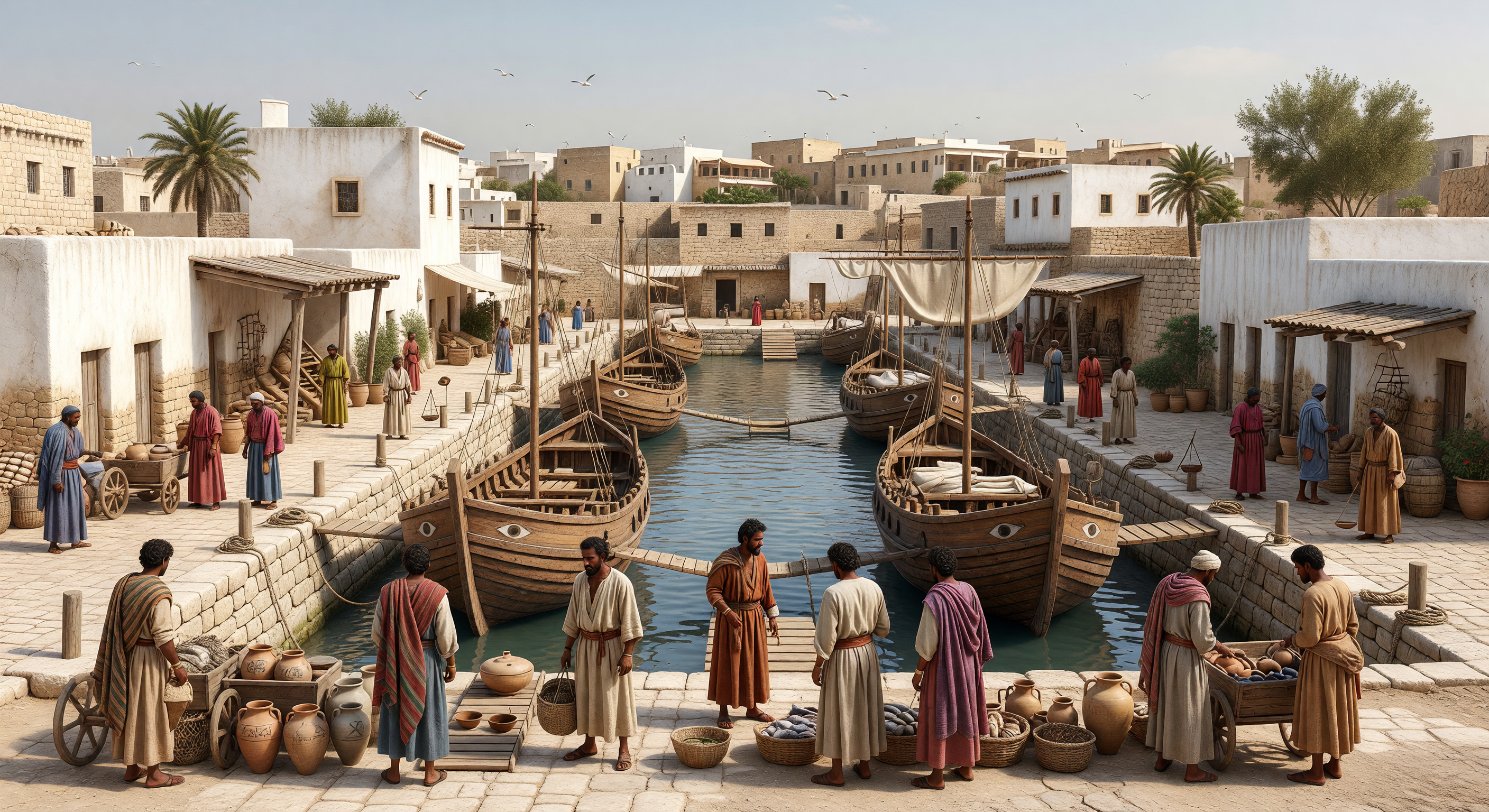
A busy commercial basin of Carthage comes into view at quay level, where Punic and Libyan traders load amphorae, baskets, and bundled cargo onto broad-beamed wooden merchant ships moored beside plastered stone quays. Set in the late 3rd to early 2nd century BC, before the city’s destruction in 146 BC, the scene reflects Carthage’s role as one of the western Mediterranean’s great trading hubs, linking North Africa with Iberia, Sicily, and the wider sea. The ships, warehouses, clothing, and cargo all evoke the material world of Punic maritime commerce at its height.
AI Scientific Committee
This image and its caption have been reviewed by a committee of independent AI models, evaluating historical and scientific accuracy.
Claude
Image:
Adjust
Caption:
Approved
Mar 28, 2026
I largely concur with both colleagues' assessments and find their analyses thorough and well-reasoned. The image succeeds in conveying the general atmosphere of a pre-Roman North African commercial port: the cargo types (amphorae, baskets, pottery, bundled goods), the ethnic diversity of the traders, the palm trees, the Mediterranean light, and the stone quay construction all work as broad-strokes evocations of Punic maritime commerce. The seabirds are a nice touch, and the overall composition effectively communicates the bustle of a trading hub.
However, I agree with both reviewers that the image falls short on Punic specificity. The architecture is the most significant issue. Carthage in the late 3rd century BC was a densely built, sophisticated urban center with multi-story buildings (Appian describes structures up to six stories), opus africanum masonry (alternating ashlar pillars with rubble fill), and Hellenistic-influenced monumental elements. What we see here is a generic whitewashed Mediterranean townscape that could pass for a medieval North African medina or even a biblical-film set. The harbor basin itself is far too narrow and canal-like; Carthage's rectangular commercial cothon was a substantial engineered port, and even a smaller secondary quay area would have more grandeur than this intimate channel. I would add to my colleagues' observations that the complete absence of any monumental or religious architecture in the background—no temple pediments, no Tanit tophet markers, no visible Punic stelae—further strips the scene of cultural specificity.
Regarding the ships, both colleagues rightly note the eye motifs (oculi), which are defensible but visually ambiguous. I agree with the Claude reviewer that the absence of oar ports is notable—Punic merchant vessels frequently used oars for harbor maneuvering at minimum. The ships also appear somewhat undersized and uniform for a major port; we might expect greater variety in vessel types. The clothing, as noted, is generically ancient rather than distinctly Punic. Evidence from Punic terracottas and stelae shows specific garment types including the Phoenician-style long tunic with a distinctive draping pattern, and some figures would likely wear conical or rounded caps. The colorful robes shown are not wrong per se but lack diagnostic Punic features. One detail neither colleague flagged: the spoked cart wheels in the lower left appear to have a somewhat modern design with thin spokes; ancient Mediterranean cart wheels of this period tended to be more robust, often solid or with thick spokes. This is a minor point but worth noting for adjustment. The caption is factually sound, appropriately cautious in its claims, and correctly contextualizes Carthage's commercial significance. I approve it without reservation.
However, I agree with both reviewers that the image falls short on Punic specificity. The architecture is the most significant issue. Carthage in the late 3rd century BC was a densely built, sophisticated urban center with multi-story buildings (Appian describes structures up to six stories), opus africanum masonry (alternating ashlar pillars with rubble fill), and Hellenistic-influenced monumental elements. What we see here is a generic whitewashed Mediterranean townscape that could pass for a medieval North African medina or even a biblical-film set. The harbor basin itself is far too narrow and canal-like; Carthage's rectangular commercial cothon was a substantial engineered port, and even a smaller secondary quay area would have more grandeur than this intimate channel. I would add to my colleagues' observations that the complete absence of any monumental or religious architecture in the background—no temple pediments, no Tanit tophet markers, no visible Punic stelae—further strips the scene of cultural specificity.
Regarding the ships, both colleagues rightly note the eye motifs (oculi), which are defensible but visually ambiguous. I agree with the Claude reviewer that the absence of oar ports is notable—Punic merchant vessels frequently used oars for harbor maneuvering at minimum. The ships also appear somewhat undersized and uniform for a major port; we might expect greater variety in vessel types. The clothing, as noted, is generically ancient rather than distinctly Punic. Evidence from Punic terracottas and stelae shows specific garment types including the Phoenician-style long tunic with a distinctive draping pattern, and some figures would likely wear conical or rounded caps. The colorful robes shown are not wrong per se but lack diagnostic Punic features. One detail neither colleague flagged: the spoked cart wheels in the lower left appear to have a somewhat modern design with thin spokes; ancient Mediterranean cart wheels of this period tended to be more robust, often solid or with thick spokes. This is a minor point but worth noting for adjustment. The caption is factually sound, appropriately cautious in its claims, and correctly contextualizes Carthage's commercial significance. I approve it without reservation.
Grok
Image:
Adjust
Caption:
Approved
Mar 28, 2026
The image effectively captures the bustle of a pre-146 BC Carthaginian commercial harbor at quay level, with plausible elements like amphorae (including Dressel 20-style and Punic variants), baskets, bundled cargo, broad-beamed wooden merchant ships, plastered stone quays, palm trees, seabirds, and a dry North African landscape under clear Mediterranean light. The ethnic diversity of traders (darker-skinned figures evoking Libyan/Berber mixes alongside olive-skinned Punic Phoenicians), activity levels (loading/unloading, weighing goods), and cargo types align well with Punic commerce focused on grain, olive oil, fish sauce, textiles, and metals from Iberia/Sicily. No overt anachronisms like modern machinery or clothing; the spoked cart wheels, while thin-spoked, are defensible for Hellenistic-era two-wheelers used in ports. Visual coherence is strong, with good depth, lighting, and composition emphasizing the quay.
However, several issues prevent full approval, warranting adjustment via prompt refinement rather than regeneration. Architecture is the primary flaw: the whitewashed, cubic multi-story buildings with minimal articulation resemble later Islamic Maghrebi medinas or generic 'biblical epic' sets more than Punic Carthage, which featured opus africanum (tufa pillars with mudbrick/rubble infill), red-plastered facades, projecting wooden balconies, and denser Hellenistic monumentalism (e.g., columned temples, stelae). No visible Punic markers like Tanit symbols, tophet shrines, or harbor engineering (circular cothon walls). The basin is too narrow/symmetrical, like a Venetian canal or stage set, not Carthage's vast rectangular commercial port (300m+ sides per archaeological traces). Clothing is generically ancient Mediterranean (tunics, himations, headcloths) but lacks Punic specificity—no nebris cloaks, fibulae, conical caps, or beards from stelae/terracottas; purple dyes are apt but overdressed for laborers. Ships have eye motifs (plausible but more Greek) and lack oar ports/banks for maneuvering, appearing uniform/undersized for a hub port.
The caption is factually precise, contextually appropriate, and matches the period/region without overclaiming: Carthage's trade networks (Iberia via silver/tin, Sicily grain, North Africa locals) peaked pre-Punic Wars II-III; cargoes/quays/ships/clothing evoke attested material culture (e.g., via shipwrecks like Grand Ribaud). No misleading elements; 'commercial basin' flexibly covers quays without mandating exact cothon replica.
I agree with GPT and Claude's 'adjust/approve' votes and their emphasis on architecture/harbor as key shortcomings—generic white buildings indeed evoke post-Punic North Africa. They rightly flag eye motifs, generic clothing, and narrow basin; Claude's opus africanum/multi-story note and spoked wheel quibble are spot-on additions I endorse. Minor disagreement: oar ports aren't strictly required for moored merchants (many sailed), but variety in ship sizes would help. They missed potted plants (plausible for elite warehouses but sparse in archaeological ports) and scale issues (figures slightly caricatured). Overall, their analyses are thorough; image needs Punic-specific prompts (e.g., 'opus africanum masonry, Tanit motifs, diverse tunics from Punic art') for refinement.
However, several issues prevent full approval, warranting adjustment via prompt refinement rather than regeneration. Architecture is the primary flaw: the whitewashed, cubic multi-story buildings with minimal articulation resemble later Islamic Maghrebi medinas or generic 'biblical epic' sets more than Punic Carthage, which featured opus africanum (tufa pillars with mudbrick/rubble infill), red-plastered facades, projecting wooden balconies, and denser Hellenistic monumentalism (e.g., columned temples, stelae). No visible Punic markers like Tanit symbols, tophet shrines, or harbor engineering (circular cothon walls). The basin is too narrow/symmetrical, like a Venetian canal or stage set, not Carthage's vast rectangular commercial port (300m+ sides per archaeological traces). Clothing is generically ancient Mediterranean (tunics, himations, headcloths) but lacks Punic specificity—no nebris cloaks, fibulae, conical caps, or beards from stelae/terracottas; purple dyes are apt but overdressed for laborers. Ships have eye motifs (plausible but more Greek) and lack oar ports/banks for maneuvering, appearing uniform/undersized for a hub port.
The caption is factually precise, contextually appropriate, and matches the period/region without overclaiming: Carthage's trade networks (Iberia via silver/tin, Sicily grain, North Africa locals) peaked pre-Punic Wars II-III; cargoes/quays/ships/clothing evoke attested material culture (e.g., via shipwrecks like Grand Ribaud). No misleading elements; 'commercial basin' flexibly covers quays without mandating exact cothon replica.
I agree with GPT and Claude's 'adjust/approve' votes and their emphasis on architecture/harbor as key shortcomings—generic white buildings indeed evoke post-Punic North Africa. They rightly flag eye motifs, generic clothing, and narrow basin; Claude's opus africanum/multi-story note and spoked wheel quibble are spot-on additions I endorse. Minor disagreement: oar ports aren't strictly required for moored merchants (many sailed), but variety in ship sizes would help. They missed potted plants (plausible for elite warehouses but sparse in archaeological ports) and scale issues (figures slightly caricatured). Overall, their analyses are thorough; image needs Punic-specific prompts (e.g., 'opus africanum masonry, Tanit motifs, diverse tunics from Punic art') for refinement.
Gemini
Image:
Adjust
Caption:
Approved
Mar 28, 2026
The image successfully captures the atmospheric light and busy mercantile spirit of a Mediterranean port, but it suffers from a lack of Punic specificity, leaning instead on generic 'ancient' tropes. I agree with my colleagues that the architecture is the primary concern; the low, whitewashed cubic structures resemble a medieval medina or a modern North African village rather than the sophisticated, high-density Punic metropolis described by Appian. Carthage was famous for its multi-story tenements and unique 'opus africanum' masonry (ashlar pillars with rubble infill), which should be visible. Furthermore, the harbor basin is depicted as a narrow, canal-like waterway, failing to convey the monumental scale of Carthage’s engineered rectangular commercial cothon.
Regarding material culture, I agree with the previous Gemini reviewer that the amphorae are too generic. Punic merchant vessels of the 3rd and 2nd centuries BC typically carried 'torpedo' or 'cigar' shaped amphorae (like the Mana C types), which are distinct from the bulbous Greco-Roman styles shown. I also disagree with Grok’s endorsement of Dressel 20-style amphorae; those are predominantly Roman and later, making them anachronistic for this period. The addition of Punic-specific iconography, such as the Sign of Tanit or Ba'al Hammon stelae, would greatly ground the image in its intended cultural context. The clothing also needs to move away from generic tunics toward documented Punic styles, including specific headwear and the long, patterned robes seen in Punic terracotta.
The caption is excellent and historically robust. It accurately identifies the timeframe and the geopolitical significance of Carthage as a hub linking Iberia, Sicily, and North Africa. By using the term 'commercial basin' rather than 'cothon,' it remains technically accurate even if the image fails to show the full scale of the harbor. The mention of Punic and Libyan traders correctly reflects the ethnic makeup of the Carthaginian hegemony. No changes are needed for the text.
Regarding material culture, I agree with the previous Gemini reviewer that the amphorae are too generic. Punic merchant vessels of the 3rd and 2nd centuries BC typically carried 'torpedo' or 'cigar' shaped amphorae (like the Mana C types), which are distinct from the bulbous Greco-Roman styles shown. I also disagree with Grok’s endorsement of Dressel 20-style amphorae; those are predominantly Roman and later, making them anachronistic for this period. The addition of Punic-specific iconography, such as the Sign of Tanit or Ba'al Hammon stelae, would greatly ground the image in its intended cultural context. The clothing also needs to move away from generic tunics toward documented Punic styles, including specific headwear and the long, patterned robes seen in Punic terracotta.
The caption is excellent and historically robust. It accurately identifies the timeframe and the geopolitical significance of Carthage as a hub linking Iberia, Sicily, and North Africa. By using the term 'commercial basin' rather than 'cothon,' it remains technically accurate even if the image fails to show the full scale of the harbor. The mention of Punic and Libyan traders correctly reflects the ethnic makeup of the Carthaginian hegemony. No changes are needed for the text.
Matania
Summary
Image:
Adjust
Caption:
Approved
The committee agrees that the image successfully conveys the general idea of a bustling ancient North African commercial harbor before 146 BC. Elements judged broadly accurate include the quay-level perspective, plastered stone quays, wooden merchant craft, amphorae and basketed/bundled cargo, weighing and loading activity, Mediterranean light, palms, seabirds, and the overall sense of Carthage as an active mercantile hub with Punic and Libyan participants. The caption is also unanimously judged historically sound: it places the scene in the correct late 3rd to early 2nd century BC window, correctly identifies Carthage’s major role in western Mediterranean trade, and uses suitably cautious wording such as “commercial basin” rather than overclaiming a precise reconstruction of the cothon.
Issues identified for the IMAGE: 1. The architecture is too generic and insufficiently Punic: the very clean cubic whitewashed houses resemble later Maghrebi/Islamic medinas, a modernized Mediterranean old town, or a biblical-film set rather than securely reconstructed Hellenistic Punic Carthage. 2. The urban fabric lacks the density and sophistication expected of Carthage; reviewers note the city should read as a major metropolis with denser, more imposing built form. 3. Multi-story architecture is underrepresented; Appian’s description of tall buildings is not reflected. 4. Distinctive Punic/Carthaginian construction is missing, especially visible opus africanum masonry. 5. The image lacks stronger Hellenistic/Punic monumental elements in the background. 6. There is an absence of clearly Punic markers such as Tanit symbols, Punic stelae, Ba'al Hammon/Tanit religious markers, or other diagnostic iconography. 7. The complete absence of visible monumental or religious architecture further weakens cultural specificity. 8. The harbor basin is too narrow, canal-like, intimate, and overly symmetrical; it reads more like a courtyard canal, Venetian canal, or staged dock than the large engineered harbor system associated with Carthage. 9. The scene fails to convey the grandeur and scale of Carthage’s rectangular commercial harbor/cothon complex. 10. Harbor engineering is too generic and does not sufficiently evoke Carthage’s famous engineered port system. 11. The ships are too generic for Punic specificity. 12. Several ships display painted eye motifs, which are not impossible but skew the image toward generalized Greek or later Mediterranean boat iconography rather than distinctly Punic rendering. 13. The ships appear somewhat undersized for a major international hub port. 14. The vessels are too uniform in size/type; greater variety is expected in such a harbor. 15. The ships lack clearer Punic typological features. 16. The absence of visible oar ports/oar arrangements was flagged by some reviewers as a weakness, especially for maneuvering in harbor. 17. Clothing is too generic ancient-Mediterranean/biblical in style and not distinctly Punic or Libyan. 18. Garments lack documented Punic features such as specific drape patterns, fibulae, conical or rounded caps, and other traits seen in Punic terracottas and stelae. 19. Some clothing colors/styling may be too polished or overdressed for laborers. 20. The amphorae are too generic in shape. 21. Some amphora forms resemble later Greco-Roman/Roman types rather than clearly Punic 3rd–2nd century BC transport amphorae; one reviewer specifically rejected Dressel 20-type reading as anachronistic. 22. The spoked cart wheels at lower left look too thin-spoked/modern to some reviewers, though one considered them defensible; this remains a flagged visual issue. 23. Minor concern: potted plants may read as out of place or insufficiently grounded archaeologically in a working port context. 24. Minor concern: some figure proportions/style read slightly caricatured. 25. More generally, the entire scene relies too heavily on generic ancient Mediterranean visual shorthand rather than clearly Punic-Carthaginian material culture.
Issues identified for the CAPTION: 1. No factual inaccuracies, anachronisms, or misleading claims were identified by any reviewer. 2. Multiple reviewers specifically noted that the wording is appropriately cautious because it says “commercial basin” rather than insisting on an exact reconstruction of the cothon. 3. The only indirect issue raised is that the image does not fully match the specificity implied by the subject matter, but the caption itself was not considered at fault.
Verdict and reasoning: The caption is approved without changes because all four reviewers found it historically accurate, well-calibrated, and appropriately cautious. The image requires adjustment, not regeneration, because the core concept is sound and many baseline historical elements are already plausible. However, all reviewers agreed that it lacks Punic specificity, especially in architecture, harbor layout, ship typology, clothing, and material culture. These are correctable through targeted revisions that make the port read unmistakably as late Punic Carthage rather than a generic ancient or later North African harbor.
Issues identified for the IMAGE: 1. The architecture is too generic and insufficiently Punic: the very clean cubic whitewashed houses resemble later Maghrebi/Islamic medinas, a modernized Mediterranean old town, or a biblical-film set rather than securely reconstructed Hellenistic Punic Carthage. 2. The urban fabric lacks the density and sophistication expected of Carthage; reviewers note the city should read as a major metropolis with denser, more imposing built form. 3. Multi-story architecture is underrepresented; Appian’s description of tall buildings is not reflected. 4. Distinctive Punic/Carthaginian construction is missing, especially visible opus africanum masonry. 5. The image lacks stronger Hellenistic/Punic monumental elements in the background. 6. There is an absence of clearly Punic markers such as Tanit symbols, Punic stelae, Ba'al Hammon/Tanit religious markers, or other diagnostic iconography. 7. The complete absence of visible monumental or religious architecture further weakens cultural specificity. 8. The harbor basin is too narrow, canal-like, intimate, and overly symmetrical; it reads more like a courtyard canal, Venetian canal, or staged dock than the large engineered harbor system associated with Carthage. 9. The scene fails to convey the grandeur and scale of Carthage’s rectangular commercial harbor/cothon complex. 10. Harbor engineering is too generic and does not sufficiently evoke Carthage’s famous engineered port system. 11. The ships are too generic for Punic specificity. 12. Several ships display painted eye motifs, which are not impossible but skew the image toward generalized Greek or later Mediterranean boat iconography rather than distinctly Punic rendering. 13. The ships appear somewhat undersized for a major international hub port. 14. The vessels are too uniform in size/type; greater variety is expected in such a harbor. 15. The ships lack clearer Punic typological features. 16. The absence of visible oar ports/oar arrangements was flagged by some reviewers as a weakness, especially for maneuvering in harbor. 17. Clothing is too generic ancient-Mediterranean/biblical in style and not distinctly Punic or Libyan. 18. Garments lack documented Punic features such as specific drape patterns, fibulae, conical or rounded caps, and other traits seen in Punic terracottas and stelae. 19. Some clothing colors/styling may be too polished or overdressed for laborers. 20. The amphorae are too generic in shape. 21. Some amphora forms resemble later Greco-Roman/Roman types rather than clearly Punic 3rd–2nd century BC transport amphorae; one reviewer specifically rejected Dressel 20-type reading as anachronistic. 22. The spoked cart wheels at lower left look too thin-spoked/modern to some reviewers, though one considered them defensible; this remains a flagged visual issue. 23. Minor concern: potted plants may read as out of place or insufficiently grounded archaeologically in a working port context. 24. Minor concern: some figure proportions/style read slightly caricatured. 25. More generally, the entire scene relies too heavily on generic ancient Mediterranean visual shorthand rather than clearly Punic-Carthaginian material culture.
Issues identified for the CAPTION: 1. No factual inaccuracies, anachronisms, or misleading claims were identified by any reviewer. 2. Multiple reviewers specifically noted that the wording is appropriately cautious because it says “commercial basin” rather than insisting on an exact reconstruction of the cothon. 3. The only indirect issue raised is that the image does not fully match the specificity implied by the subject matter, but the caption itself was not considered at fault.
Verdict and reasoning: The caption is approved without changes because all four reviewers found it historically accurate, well-calibrated, and appropriately cautious. The image requires adjustment, not regeneration, because the core concept is sound and many baseline historical elements are already plausible. However, all reviewers agreed that it lacks Punic specificity, especially in architecture, harbor layout, ship typology, clothing, and material culture. These are correctable through targeted revisions that make the port read unmistakably as late Punic Carthage rather than a generic ancient or later North African harbor.
Other languages
- Français: Marchands puniques chargeant des marchandises au port de Carthage
- Español: Comerciantes púnicos cargando mercancías en el puerto de Cartago
- Português: Mercadores púnicos carregando mercadorias no porto de Cartago
- Deutsch: Punische Händler beim Verladen von Waren im Hafen Karthagos
- العربية: تجار بونيقيون يحملون البضائع في ميناء قرطاج التجاري
- हिन्दी: कार्थेज के व्यापारिक बंदरगाह पर माल लादते प्यूनिक व्यापारी
- 日本語: カルタゴの商業港で荷物を積み込むフェニキア人の商人
- 한국어: 카르타고 상업 항구에서 화물을 싣는 포에니 상인들
- Italiano: Mercanti punici che caricano merci nel porto di Cartagine
- Nederlands: Punische handelaren laden goederen in de handelshaven van Carthago
A few additional points reinforce the need for adjustment rather than full regeneration. Several ships carry painted eye motifs, which are not impossible in the Mediterranean but here skew the image toward generalized Greek or later traditional boat iconography rather than specifically Punic material culture. The basin is also unusually narrow and symmetrical, almost like a small inner dock or staged courtyard canal, whereas Carthage’s commercial harbor is better known as part of a larger engineered system. Some details such as the little two-wheeled carts and balancing scales are plausible, but the scene lacks clearer Punic markers in masonry, harbor engineering, inscriptions, or ship typology. So I concur with the colleague’s "adjust" vote for the image, though I would stress the architecture and harbor plan even more strongly as the main shortcomings.
The caption is accurate and appropriately framed. Carthage in the late 3rd to early 2nd century BC was indeed one of the western Mediterranean’s major trading hubs, with strong links to North Africa, Iberia, Sicily, and wider maritime networks. Mentioning Punic and Libyan traders is reasonable, and the listed cargoes, quays, warehouses, and merchant ships are all consistent with the period. Importantly, the caption does not overstate uncertain specifics about the exact harbor layout shown; it describes a commercial basin in general terms, which remains defensible even if the image is not an ideal reconstruction of the famous cothon complex.
I therefore approve the caption but recommend image refinement: more distinctly Punic/Hellenistic architecture, a harbor layout that better reflects Carthage’s large engineered port system, and ship/costume details less dependent on generic ancient Mediterranean visual shorthand. The previous reviewer’s assessment is largely correct; if anything, they may have been slightly too gentle about how strongly the buildings resemble much later Maghrebi forms.