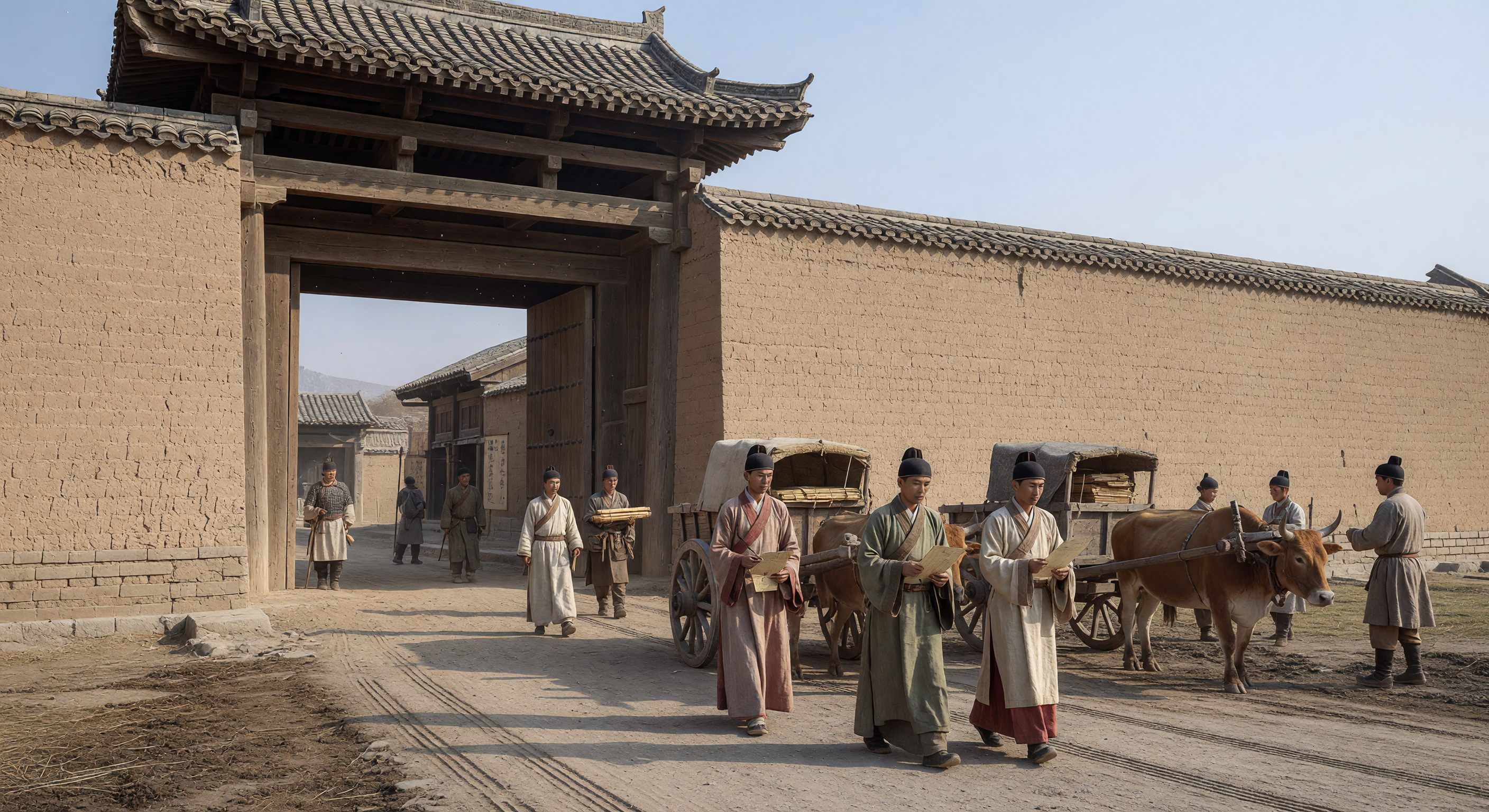
Beneath the imposing rammed-earth walls of a commandery city in northern China, officials and clerks of the late Qin or early Western Han period move through a deep timber gate, carrying bamboo-slip documents that symbolize the new empire’s bureaucratic reach. Ox carts rumble over the hard-packed road, while the austere gate tower—with its timber frame and gray ceramic tiles—reflects the practical monumental style of early imperial state architecture. The scene evokes the administrative order and standardized infrastructure that helped unify China in the 3rd and 2nd centuries BC.
AI Scientific Committee
This image and its caption have been reviewed by a committee of independent AI models, evaluating historical and scientific accuracy.
Claude
Image:
Adjust
Caption:
Adjust
Mar 28, 2026
The image effectively conveys the atmosphere of an early imperial Chinese commandery city, with several elements working well: the rammed-earth walls (though they show brick-like coursing in places that reads more like adobe block than true hangtu rammed earth), the ox carts, the dusty northern landscape, and figures carrying what appear to be bamboo-slip bundles. The overall mood of bureaucratic activity at a fortified administrative center is convincing. However, there are notable anachronistic issues. The black headgear worn by the officials is problematic — the rounded, tall black caps closely resemble the wushamao or futou styles associated with Tang dynasty and later periods, not the Qin/early Han period. Archaeological evidence from terracotta warriors and Han tomb figurines suggests that Qin/Han officials wore flat-topped jin or ze caps, or simple cloth wrappings, not the stiff black rounded caps shown here. The gate tower's roof exhibits relatively pronounced upturned eaves with well-formed gray tiles that, while not egregiously later in style, are somewhat more refined and curved than what we would expect from the austere, relatively straight-eaved architecture of the Qin/early Han period as reconstructed from archaeological evidence (e.g., the Qin palace foundations at Xianyang or Han models from mingqi). The robes themselves are broadly acceptable — cross-collar layered garments are attested for this period — though some of the tailoring and color combinations feel slightly generic.
The documents held by the foreground figures are another issue: several appear to be reading flat, sheet-like items that look more like paper documents than bamboo slips. While one figure in the background appears to carry bundled slips, the foreground figures' documents undercut the caption's emphasis on bamboo-slip administration. Paper was not widely used for documents until well into the Eastern Han or later.
The caption is largely accurate in its historical claims. The Qin and early Western Han did indeed rely on commandery-based administration, bamboo-slip documentation, and rammed-earth fortified cities, and the caption appropriately situates these developments in the 3rd–2nd centuries BC. However, it describes the scene with more architectural specificity than is warranted — calling the gate tower's style 'practical monumental' and specifically noting 'gray ceramic tiles' implies a secure reconstruction when in fact the image reflects later architectural conventions. The caption should acknowledge its reconstructive nature more explicitly, and the phrase about bamboo-slip documents is somewhat undermined by what appears to be flat documents in the image.
I largely agree with the GPT reviewer's assessment. Their observations about the later-style headgear, the overly refined roof curvature, and the paper-like documents are all valid and important. I concur that the image does not require full regeneration — the overall scene is coherent and evocative — but adjustments to headgear, roof form, and document depiction would significantly improve historical accuracy. The caption similarly needs softening of its claims about architectural specifics.
The documents held by the foreground figures are another issue: several appear to be reading flat, sheet-like items that look more like paper documents than bamboo slips. While one figure in the background appears to carry bundled slips, the foreground figures' documents undercut the caption's emphasis on bamboo-slip administration. Paper was not widely used for documents until well into the Eastern Han or later.
The caption is largely accurate in its historical claims. The Qin and early Western Han did indeed rely on commandery-based administration, bamboo-slip documentation, and rammed-earth fortified cities, and the caption appropriately situates these developments in the 3rd–2nd centuries BC. However, it describes the scene with more architectural specificity than is warranted — calling the gate tower's style 'practical monumental' and specifically noting 'gray ceramic tiles' implies a secure reconstruction when in fact the image reflects later architectural conventions. The caption should acknowledge its reconstructive nature more explicitly, and the phrase about bamboo-slip documents is somewhat undermined by what appears to be flat documents in the image.
I largely agree with the GPT reviewer's assessment. Their observations about the later-style headgear, the overly refined roof curvature, and the paper-like documents are all valid and important. I concur that the image does not require full regeneration — the overall scene is coherent and evocative — but adjustments to headgear, roof form, and document depiction would significantly improve historical accuracy. The caption similarly needs softening of its claims about architectural specifics.
Grok
Image:
Adjust
Caption:
Adjust
Mar 28, 2026
The image captures a coherent and visually plausible scene of bureaucratic activity at a northern Chinese commandery city gate during the late Qin/early Western Han period (3rd-2nd centuries BC). Strengths include the rammed-earth walls (hangtu construction), which have the correct thick, monolithic earthen texture and beige hue typical of northern fortifications like those at Handan or early Han sites; the deep timber gate with sturdy bracketing; ox carts on a hard-packed dirt road, accurately depicting transport technology; and a dry, arid landscape with sparse vegetation fitting northern China's loess plateau regions. Bundles carried by some figures convincingly resemble tied bamboo slips (e.g., the foreground clerk's load), and the overall administrative bustle evokes the period's commandery system. However, anachronisms mar accuracy: the gate tower's roof features pronounced upturned eaves and densely packed gray ceramic tiles with a polished, curved profile more akin to Tang or Song dynasty styles than the simpler, straighter-eaved, less ornate roofs evidenced in Qin palace foundations (e.g., E'fang) or early Han mingqi models. Headgear on officials—tall, rounded black hats—resembles later futou or wushamao (Tang+), not the flat jin/ze caps, lacquered mianguan, or simple kerchiefs from Qin Terracotta Army officers or Han tomb figurines. Some documents appear flat and scroll-like (e.g., the reading official), evoking silk or proto-paper rather than rigid bamboo slips. Robes are broadly correct (deep cross-collars, layered), but tailoring feels slightly modernized. These are fixable via prompt refinements for earlier roof forms, authentic headwear, and clearer slip bundles, avoiding regeneration.
The caption is factually strong on key historical elements: rammed-earth walls, bamboo-slip bureaucracy, ox carts, commandery administration, and unification infrastructure under Qin/Han, all aligning with textual sources like the Shiji and archaeological finds from sites like Loulan or Juyan. It appropriately dates to 3rd-2nd centuries BC and contextualizes the 'new empire's bureaucratic reach.' Issues are minor but tie too closely to the image's inaccuracies: specifying an 'austere gate tower—with its timber frame and gray ceramic tiles' overstates the depicted form's authenticity, as such refined tiling and framing are not securely Qin/Han but later conventions. This could mislead on architectural style. Adjusting to generalize (e.g., 'evoking early imperial gate towers') or note reconstructive intent would align it perfectly without losing educational value.
I fully agree with GPT and Claude's assessments—they correctly identify the later roof curvature/tiling (beyond Qin/Han restraint, per Xianyang excavations), problematic black rounded caps (vs. Terracotta Army evidence), and ambiguous documents (some paper-like). They didn't miss much, though the walls here read more convincingly as true rammed-earth than the 'adobe brick' they noted, and oxen breeds look period-appropriate (short-horned yellow types). No major disagreements; their 'adjust' votes are spot-on, emphasizing refinement over redo for this evocative base image.
The caption is factually strong on key historical elements: rammed-earth walls, bamboo-slip bureaucracy, ox carts, commandery administration, and unification infrastructure under Qin/Han, all aligning with textual sources like the Shiji and archaeological finds from sites like Loulan or Juyan. It appropriately dates to 3rd-2nd centuries BC and contextualizes the 'new empire's bureaucratic reach.' Issues are minor but tie too closely to the image's inaccuracies: specifying an 'austere gate tower—with its timber frame and gray ceramic tiles' overstates the depicted form's authenticity, as such refined tiling and framing are not securely Qin/Han but later conventions. This could mislead on architectural style. Adjusting to generalize (e.g., 'evoking early imperial gate towers') or note reconstructive intent would align it perfectly without losing educational value.
I fully agree with GPT and Claude's assessments—they correctly identify the later roof curvature/tiling (beyond Qin/Han restraint, per Xianyang excavations), problematic black rounded caps (vs. Terracotta Army evidence), and ambiguous documents (some paper-like). They didn't miss much, though the walls here read more convincingly as true rammed-earth than the 'adobe brick' they noted, and oxen breeds look period-appropriate (short-horned yellow types). No major disagreements; their 'adjust' votes are spot-on, emphasizing refinement over redo for this evocative base image.
Gemini
Image:
Adjust
Caption:
Adjust
Mar 28, 2026
The image successfully establishes the scale and atmosphere of a Qin or early Western Han commandery, particularly in its depiction of the arid northern landscape and the utilitarian bustle of the ox carts. However, as noted by my colleagues, the material culture is significantly anachronistic. The officials' headwear is the most prominent error; the tall, rounded black caps are clearly 'futou' or 'wushamao' styles that did not emerge until the Sui-Tang transition, roughly 800 years after the period described. Qin and Han officials wore flatter, more angular caps (jin or guan) or simple headcloths. Furthermore, the gate tower’s roof features the pronounced upturned eaves and decorative tiling typical of the late imperial period (Ming/Qing) or medieval reconstructions. Archaeological evidence from the Qin palace at Xianyang and Han 'mingqi' (tomb models) points to straighter rooflines and much simpler, more functional bracket sets (dougong). I agree with Claude and Grok that the documents in the foreground appear too thin and flexible, resembling paper or silk scrolls rather than the rigid, bundled bamboo slips mentioned in the caption.
The caption is historically excellent in its conceptual framework, accurately highlighting the importance of standardized administration and infrastructure in the 3rd and 2nd centuries BC. However, it requires adjustment because it treats the inaccurate visual elements—specifically the 'austere' gate tower and its tiling—as if they are authentic archaeological representations of the period. By describing the gate as 'practical monumental' while the image shows a later, more decorative style, the caption inadvertently validates anachronistic architecture. I agree with GPT that the caption should be softened to describe these elements as 'evocative' or 'inspired by' the period rather than definitive. I also agree with Grok that the 'yellow cattle' (oxen) are a strong point of regional accuracy. To bring this image to a 'scientific review' standard, the prompt needs to specify 'flat-topped guan headgear,' 'straight-pitched roofs without upturned eaves,' and 'horizontal striations' in the rammed-earth walls to distinguish them from later masonry or adobe brick.
The caption is historically excellent in its conceptual framework, accurately highlighting the importance of standardized administration and infrastructure in the 3rd and 2nd centuries BC. However, it requires adjustment because it treats the inaccurate visual elements—specifically the 'austere' gate tower and its tiling—as if they are authentic archaeological representations of the period. By describing the gate as 'practical monumental' while the image shows a later, more decorative style, the caption inadvertently validates anachronistic architecture. I agree with GPT that the caption should be softened to describe these elements as 'evocative' or 'inspired by' the period rather than definitive. I also agree with Grok that the 'yellow cattle' (oxen) are a strong point of regional accuracy. To bring this image to a 'scientific review' standard, the prompt needs to specify 'flat-topped guan headgear,' 'straight-pitched roofs without upturned eaves,' and 'horizontal striations' in the rammed-earth walls to distinguish them from later masonry or adobe brick.
Matania
Summary
Image:
Adjust
Caption:
Adjust
The committee agrees that the scene is broadly plausible and successfully conveys an early imperial northern Chinese commandery setting. Elements consistently judged accurate or effective include the overall administrative atmosphere, the northern dry/arid landscape, the rammed-earth fortification concept, the deep timber gate, ox carts on a hard-packed road, the general use of cross-collar layered robes, and the idea of clerks or officials carrying written records. Several reviewers also found the oxen and the overall bureaucratic bustle regionally and conceptually appropriate for the late Qin to early Western Han context.
For the IMAGE, the committee identified the following issues: 1. The gate tower roof is too strongly curved and features pronounced upturned eaves, reading as medieval or late imperial Chinese architecture rather than the straighter, more restrained rooflines expected for late Qin/early Western Han reconstructions. 2. The gray ceramic roof tiling is too dense, polished, standardized, and visually refined, again suggesting later Tang/Song/Ming-Qing conventions rather than securely attested Qin/Han gate architecture. 3. The overall gate-tower silhouette and finish are too polished and later-looking, including relatively refined roofline treatment and bracket expression. 4. The visible wall surface reads in places like adobe block or brick coursing rather than clearly monolithic rammed-earth; the wall should show more convincing hangtu character, including horizontal striations/compacted layers rather than masonry-like patterning. 5. The officials' headgear is anachronistic: the tall, rounded black caps resemble later futou/wushamao or related post-Han official styles, not Qin/early Han flat-topped jin/ze caps, angular guan, simple kerchiefs, or period-appropriate headcloths. 6. Some clothing details, while broadly acceptable in robe form, feel generic or slightly modernized/later in tailoring and color treatment rather than closely based on Qin/Han figurine and relief evidence. 7. Several foreground documents appear thin, flat, flexible, or sheet-like, resembling paper sheets, proto-paper, or silk documents rather than rigid bundled bamboo slips. 8. The visual emphasis on bamboo-slip administration is therefore undercut by the presence of paper-like items in some hands. 9. One reviewer noted the gate's bracketing/dougong treatment appears more developed than expected for the austere early imperial context. 10. More generally, the architecture and dress together lean later than the intended 3rd-2nd centuries BC even though the scene remains coherent.
For the CAPTION, the committee identified the following issues: 1. The caption is broadly historically sound in its discussion of commandery administration, bureaucratic standardization, ox carts, rammed-earth walls, and bamboo-slip recordkeeping, but it overstates certainty. 2. It describes specific visual architectural details as though they were securely characteristic of late Qin/early Western Han reconstruction, especially the 'austere gate tower' and its 'timber frame and gray ceramic tiles,' even though the depicted gate reflects later architectural conventions. 3. The phrase describing the gate as a 'practical monumental style of early imperial state architecture' is too definitive given the image's anachronistic roof form and tiling. 4. The caption should more explicitly signal that the scene is an evocation or reconstruction inspired by early imperial northern China, not a precise archaeological visualization of a known gate-tower type. 5. The mention of officials carrying bamboo-slip documents is conceptually correct, but the image itself includes some flat, paper-like documents, so the wording currently aligns imperfectly with what is shown. 6. One reviewer noted that 'new empire's bureaucratic reach' fits Qin especially well but is slightly less precise if read as equally specific to the already consolidating early Han; this is a minor nuance rather than a major error.
Final verdict: adjust for both image and caption. The committee found no fantasy elements or catastrophic historical failures, and the core setting is strong enough that regeneration is unnecessary. However, the image contains consistent, significant anachronisms in roof form, roof tiling, headgear, wall texture treatment, and document depiction, while the caption is too confident about architectural specifics that the image does not authentically support. Targeted revisions can bring both to a solid scientific-review standard.
For the IMAGE, the committee identified the following issues: 1. The gate tower roof is too strongly curved and features pronounced upturned eaves, reading as medieval or late imperial Chinese architecture rather than the straighter, more restrained rooflines expected for late Qin/early Western Han reconstructions. 2. The gray ceramic roof tiling is too dense, polished, standardized, and visually refined, again suggesting later Tang/Song/Ming-Qing conventions rather than securely attested Qin/Han gate architecture. 3. The overall gate-tower silhouette and finish are too polished and later-looking, including relatively refined roofline treatment and bracket expression. 4. The visible wall surface reads in places like adobe block or brick coursing rather than clearly monolithic rammed-earth; the wall should show more convincing hangtu character, including horizontal striations/compacted layers rather than masonry-like patterning. 5. The officials' headgear is anachronistic: the tall, rounded black caps resemble later futou/wushamao or related post-Han official styles, not Qin/early Han flat-topped jin/ze caps, angular guan, simple kerchiefs, or period-appropriate headcloths. 6. Some clothing details, while broadly acceptable in robe form, feel generic or slightly modernized/later in tailoring and color treatment rather than closely based on Qin/Han figurine and relief evidence. 7. Several foreground documents appear thin, flat, flexible, or sheet-like, resembling paper sheets, proto-paper, or silk documents rather than rigid bundled bamboo slips. 8. The visual emphasis on bamboo-slip administration is therefore undercut by the presence of paper-like items in some hands. 9. One reviewer noted the gate's bracketing/dougong treatment appears more developed than expected for the austere early imperial context. 10. More generally, the architecture and dress together lean later than the intended 3rd-2nd centuries BC even though the scene remains coherent.
For the CAPTION, the committee identified the following issues: 1. The caption is broadly historically sound in its discussion of commandery administration, bureaucratic standardization, ox carts, rammed-earth walls, and bamboo-slip recordkeeping, but it overstates certainty. 2. It describes specific visual architectural details as though they were securely characteristic of late Qin/early Western Han reconstruction, especially the 'austere gate tower' and its 'timber frame and gray ceramic tiles,' even though the depicted gate reflects later architectural conventions. 3. The phrase describing the gate as a 'practical monumental style of early imperial state architecture' is too definitive given the image's anachronistic roof form and tiling. 4. The caption should more explicitly signal that the scene is an evocation or reconstruction inspired by early imperial northern China, not a precise archaeological visualization of a known gate-tower type. 5. The mention of officials carrying bamboo-slip documents is conceptually correct, but the image itself includes some flat, paper-like documents, so the wording currently aligns imperfectly with what is shown. 6. One reviewer noted that 'new empire's bureaucratic reach' fits Qin especially well but is slightly less precise if read as equally specific to the already consolidating early Han; this is a minor nuance rather than a major error.
Final verdict: adjust for both image and caption. The committee found no fantasy elements or catastrophic historical failures, and the core setting is strong enough that regeneration is unnecessary. However, the image contains consistent, significant anachronisms in roof form, roof tiling, headgear, wall texture treatment, and document depiction, while the caption is too confident about architectural specifics that the image does not authentically support. Targeted revisions can bring both to a solid scientific-review standard.
Other languages
- Français: Bureaucrates Impériaux Qin à la Porte de Terre Battue
- Español: Burócratas Imperiales Qin en la Puerta de Tierra Pisonada
- Português: Burocratas Imperiais Qin no Portão de Terra Batida
- Deutsch: Beamte der Qin-Dynastie am Stadttor aus Stampflehm
- العربية: بيروقراطيو إمبراطورية تشين عند بوابة مدينة التراب المدكوك
- हिन्दी: ठोककर बनाई गई मिट्टी की दीवार पर किन नौकरशाह
- 日本語: 秦代の版築城門を通る簡牘を持った役人たち
- 한국어: 판축 성문 아래 죽간을 든 진나라 관료들
- Italiano: Funzionari Imperiali Qin alla Porta di Terra Battuta
- Nederlands: Qin-bureaucraten bij de stadspoort van aangestampte aarde
There are no glaring fantasy elements, and the carts, oxen, and bureaucratic props are coherent, so this does not require a full regeneration. But it should be adjusted toward earlier imperial Chinese material culture: simpler gate architecture, less exaggerated roof curvature, less standardized later-style tiling, and clothing/headgear based more closely on Qin/Han tomb figures and relief evidence. The documents should more clearly read as bamboo-slip bundles rather than flat paper-like sheets in some hands.
The caption is mostly sound in its broad claims. Qin and early Western Han governments did rely heavily on written administration, standardization, and commandery-level control, and bamboo slips are an appropriate documentary medium. Referring to rammed-earth walls and ox carts is also accurate. The main issue is that the caption overstates certainty by describing a specific visual form—an austere gate tower with timber frame and gray ceramic tiles—as though it were securely characteristic of the late Qin/early Han scene shown, when the image itself reflects later architectural conventions. In addition, 'new empire’s bureaucratic reach' fits Qin and early Han, though the phrase is a bit smoother for Qin unification than for the already consolidating Han.
I would keep the caption but soften its specificity: say the scene is an evocation inspired by early imperial northern Chinese commandery cities, rather than a precise reconstruction of a gate tower type. If revised to emphasize administrative order, bamboo-slip recordkeeping, rammed-earth fortifications, and transport infrastructure without tying itself too tightly to the depicted roof and clothing details, it would be strong.