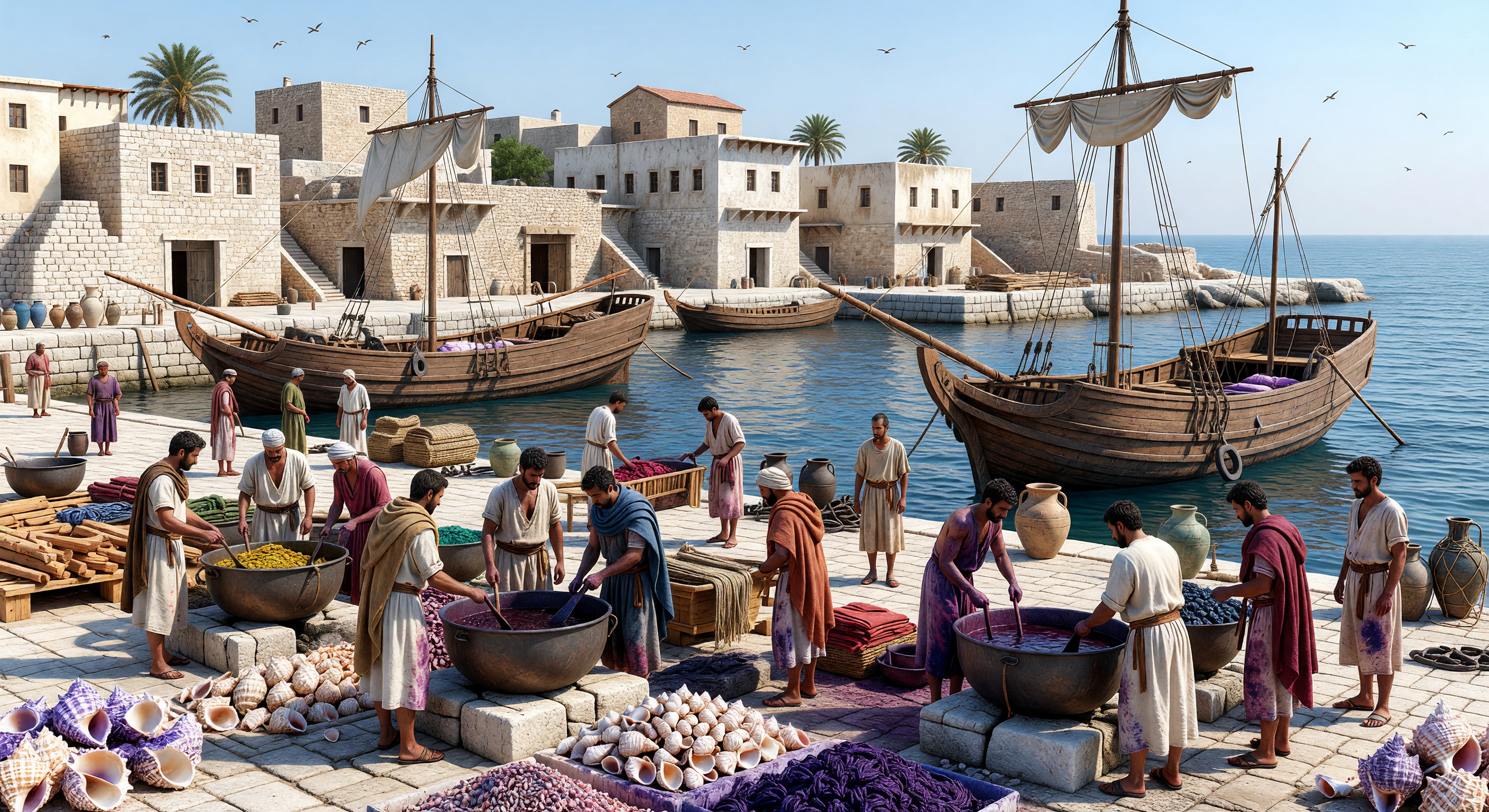
On the quays of Hellenistic Tyre, merchants and laborers unload amphorae, textiles, and cedar timber from broad-beamed merchant ships while, nearby, workers tend the foul-smelling vats that produced the city’s famed purple dye from crushed murex shells. In the 3rd century BC, Tyre remained one of the eastern Mediterranean’s great Phoenician ports, even under Seleucid rule, linking Levantine resources and skilled industries to long-distance maritime trade. The scene captures both the practical labor of the harbor and the prestige commodity—Tyrian purple—that made the city renowned across the ancient world.
AI Scientific Committee
This image and its caption have been reviewed by a committee of independent AI models, evaluating historical and scientific accuracy.
Claude
Image:
Adjust
Caption:
Approved
Mar 28, 2026
The image presents a visually compelling and largely plausible depiction of a Hellenistic-era Tyrian harbor. The stone architecture with flat roofs, palm trees, and the general Mediterranean coastal setting are appropriate for 3rd century BC Tyre. The broad-beamed merchant vessels with single masts and square sails are reasonable representations of ancient merchantmen, though the rigging details are somewhat simplified. The murex shells in the foreground are prominently displayed alongside the purple dye vats, which effectively communicates the city's signature industry. The clothing—simple tunics, draped garments, and sandals—is broadly consistent with the Hellenistic eastern Mediterranean.
However, there are several issues worth noting. The dye production process shown directly on the quayside is historically problematic. Archaeological evidence from sites like Sidon and Tyre indicates that murex processing was conducted in dedicated industrial areas typically located downwind from residential and commercial zones due to the extreme stench of the rotting mollusks. Placing open vats of purple dye right at the harbor quay conflates two activities that would have been spatially separated. The murex shells in the foreground are also dramatically oversized—real Murex brandaris and Bolinus brandaris shells are typically 5-10 cm, not the dinner-plate-sized specimens shown. Additionally, some of the colorful materials in the vats (yellow, green) seem out of place for a scene specifically about purple dye production. The metal vats themselves look somewhat anachronistic in their large, smooth, cauldron-like form; stone or ceramic basins would be more archaeologically accurate.
The caption is factually sound. Tyre was indeed under Seleucid control in the 3rd century BC, retained its Phoenician commercial character, and was renowned for its purple dye industry based on murex shells. The mention of cedar timber, amphorae, and textiles as trade goods is well-supported by historical evidence. The description of the dye as coming from 'crushed murex shells' is slightly imprecise—the dye actually came from the hypobranchial gland of the murex snail rather than from crushing the shell itself—but this is a minor point. I largely agree with GPT's positive assessment but believe they overlooked the spatial implausibility of dye production occurring directly at the quayside and the oversized murex shells, which warrant a minor adjustment to the image.
However, there are several issues worth noting. The dye production process shown directly on the quayside is historically problematic. Archaeological evidence from sites like Sidon and Tyre indicates that murex processing was conducted in dedicated industrial areas typically located downwind from residential and commercial zones due to the extreme stench of the rotting mollusks. Placing open vats of purple dye right at the harbor quay conflates two activities that would have been spatially separated. The murex shells in the foreground are also dramatically oversized—real Murex brandaris and Bolinus brandaris shells are typically 5-10 cm, not the dinner-plate-sized specimens shown. Additionally, some of the colorful materials in the vats (yellow, green) seem out of place for a scene specifically about purple dye production. The metal vats themselves look somewhat anachronistic in their large, smooth, cauldron-like form; stone or ceramic basins would be more archaeologically accurate.
The caption is factually sound. Tyre was indeed under Seleucid control in the 3rd century BC, retained its Phoenician commercial character, and was renowned for its purple dye industry based on murex shells. The mention of cedar timber, amphorae, and textiles as trade goods is well-supported by historical evidence. The description of the dye as coming from 'crushed murex shells' is slightly imprecise—the dye actually came from the hypobranchial gland of the murex snail rather than from crushing the shell itself—but this is a minor point. I largely agree with GPT's positive assessment but believe they overlooked the spatial implausibility of dye production occurring directly at the quayside and the oversized murex shells, which warrant a minor adjustment to the image.
Grok
Image:
Regenerate
Caption:
Approved
Mar 28, 2026
The image effectively captures the bustling harbor atmosphere of Hellenistic Tyre with appropriate broad-beamed merchant ships featuring single masts and square sails, resembling ancient holkas or gauloi vessels used in Mediterranean trade. Stone quays, flat-roofed buildings in beige masonry, palm trees, amphorae, stacked cedar logs, and textiles align well with the 3rd century BC Levantine port setting. Clothing on merchants and laborers—simple tunics, draped himations, and head coverings—reflects a plausible Greco-Phoenician Hellenistic mix. However, significant inaccuracies undermine historical plausibility: the dye vats are implausibly placed directly on the crowded quayside, where archaeological and literary evidence (e.g., from Strabo and Pliny) indicates murex processing occurred in isolated industrial zones downwind due to the notorious stench from fermenting snail glands. The murex shells are grossly oversized (appearing 20-30cm vs. real 5-10cm) and wrong in shape—depicted as smooth, clam-like shells rather than the distinctive spiny, elongated Murex brandaris or Bolinus brandaris with prominent siphonal canals. Vats resemble shiny modern metal cauldrons rather than archaeologically attested ceramic, stone, or lead-lined fermentation pits; open stirring with bare hands ignores the toxic, corrosive nature of the dye process. These core elements misrepresent Tyre's famed industry, warranting a full regenerate for accuracy.
The caption is factually precise and contextually rich: Tyre was a premier Phoenician port under Seleucid rule post-Alexander (e.g., 3rd century BC after 312 BC control), trading amphorae (wine/oil), textiles, and Lebanese cedar while renowned for Tyrian purple from murex. The 'foul-smelling vats' and prestige commodity details are spot-on, with appropriate period specificity. The minor simplification of dye from 'crushed murex shells' (technically extracted from the hypobranchial gland via crushing live snails) is a common, non-misleading convention in historical descriptions, not warranting adjustment.
I agree with Claude's image assessment on the quayside dye vats' spatial implausibility, shell oversizing, vat anachronisms, and extra colors, but emphasize the incorrect shell morphology (smooth vs. spiny) as another key flaw Claude underplayed, pushing it to regenerate over adjust. GPT overlooked these entirely, approving despite evident issues. Claude rightly approved the caption but noted its gland precision minorly; I concur it's negligible. No major misses by colleagues beyond GPT's leniency.
The caption is factually precise and contextually rich: Tyre was a premier Phoenician port under Seleucid rule post-Alexander (e.g., 3rd century BC after 312 BC control), trading amphorae (wine/oil), textiles, and Lebanese cedar while renowned for Tyrian purple from murex. The 'foul-smelling vats' and prestige commodity details are spot-on, with appropriate period specificity. The minor simplification of dye from 'crushed murex shells' (technically extracted from the hypobranchial gland via crushing live snails) is a common, non-misleading convention in historical descriptions, not warranting adjustment.
I agree with Claude's image assessment on the quayside dye vats' spatial implausibility, shell oversizing, vat anachronisms, and extra colors, but emphasize the incorrect shell morphology (smooth vs. spiny) as another key flaw Claude underplayed, pushing it to regenerate over adjust. GPT overlooked these entirely, approving despite evident issues. Claude rightly approved the caption but noted its gland precision minorly; I concur it's negligible. No major misses by colleagues beyond GPT's leniency.
Gemini
Image:
Regenerate
Caption:
Approved
Mar 28, 2026
The image successfully captures the maritime atmosphere of Hellenistic Tyre, particularly with the inclusion of cedar timber and amphorae, which were staple exports. The ship designs and general architecture are plausible for the 3rd century BC. However, the depiction of the Tyrian purple industry contains significant scientific and historical errors that necessitate a regeneration. As noted by Grok, the murex shells are visually incorrect; they should be small, spiny gastropods (Bolinus brandaris), not the large, smooth, clam-like shells often generated by AI. Furthermore, the placement of dye vats directly on the commercial quay is a major historical inaccuracy. The fermentation of murex glands produced a legendary, putrid stench that led to these industries being strictly relegated to the outskirts or downwind areas of the city to avoid contaminating trade goods like textiles and food. The caption is excellent and requires no changes. It accurately identifies the political context (Seleucid influence) and the specific commodities that defined Tyre's economy. While 'crushing shells' is a simplification of the extraction of the hypobranchial gland, it is an acceptable shorthand for an educational caption. I agree with Grok that GPT was far too lenient regarding the industrial elements. While Claude correctly identified the spatial and scaling issues, the combination of the wrong shell morphology, the anachronistic metal 'cauldron' style of the vats, and the impossible proximity of the foul-smelling dye works to the clean textiles and food-bearing amphorae makes this image misleading for an educational project focused on accuracy.
Matania
Summary
Image:
Regenerate
Caption:
Approved
The committee agrees that the image effectively captures the bustling atmosphere of Hellenistic Tyre and accurately depicts elements typical of the period, such as architecture, clothing, and trade goods. However, there are several inaccuracies related to the depiction of dye production, the scale of shells, and the materials used in the vats. The caption is factually correct and provides good context for the activities portrayed, with no major issues identified.
1. The dye production is inaccurately placed directly on the busy quayside, which is implausible according to archaeological evidence indicating these activities were conducted in isolated areas due to odor.
2. The murex shells are oversized, portrayed as large conchs rather than the much smaller (5-10cm) specimens actually used in dye production.
3. The vats depicted look modern and are made of shiny metal, whereas historical evidence suggests they would be ceramic or stone and appear more rustic.
4. The addition of colors (yellow, green) in the dye vats is incorrect, as they should only depict purple dye.
5. The shapes of the murex shells are inaccurate, shown as smooth rather than the spiny, elongated appearance typical of species like Murex brandaris.
6. The portrayal of people stirring dye in the vats with bare hands overlooks the corrosive nature of the dye process.
7. The boats and their rigging could use additional historical detail for improved accuracy, although this was not as heavily criticized as other elements.
The image requires a full regenerate to ensure historical accuracy.
1. The dye production is inaccurately placed directly on the busy quayside, which is implausible according to archaeological evidence indicating these activities were conducted in isolated areas due to odor.
2. The murex shells are oversized, portrayed as large conchs rather than the much smaller (5-10cm) specimens actually used in dye production.
3. The vats depicted look modern and are made of shiny metal, whereas historical evidence suggests they would be ceramic or stone and appear more rustic.
4. The addition of colors (yellow, green) in the dye vats is incorrect, as they should only depict purple dye.
5. The shapes of the murex shells are inaccurate, shown as smooth rather than the spiny, elongated appearance typical of species like Murex brandaris.
6. The portrayal of people stirring dye in the vats with bare hands overlooks the corrosive nature of the dye process.
7. The boats and their rigging could use additional historical detail for improved accuracy, although this was not as heavily criticized as other elements.
The image requires a full regenerate to ensure historical accuracy.
Other languages
- Français: Port Hellénistique de Tyr et Production de Pourpre Murex
- Español: Puerto Helenístico de Tiro con Producción de Púrpura de Tiro
- Português: Porto Helenístico de Tiro com Produção de Púrpura de Murex
- Deutsch: Hellenistischer Hafen von Tyros mit Herstellung von Purpurfarbstoff
- العربية: ميناء صور الهلنستي وإنتاج الصبغة الأرجوانية من الصدف
- हिन्दी: हेलेनिस्टिक टायर बंदरगाह और म्यूरेक्स बैंगनी रंग का उत्पादन
- 日本語: ヘレニズム時代のティルス港と貝紫染料の生産
- 한국어: 헬레니즘 시대 티레 항구와 보라색 염료 생산
- Italiano: Porto Ellenistico di Tiro con Produzione di Porpora di Murice
- Nederlands: Hellenistische Haven van Tyrus met Productie van Purperen Kleurstof
The caption accurately describes the economic activities of Tyre and the significance of the Tyrian purple dye, which was indeed a prestigious commodity in ancient trade networks. It provides a clear context for the image, detailing the relationship between labor and commerce in a Hellenistic port. Furthermore, the mention of Seleucid rule and the city’s role as a trade hub solidifies the factual integrity of the narrative. Overall, both the image and caption are consistent with the historical and cultural nuances of the period.