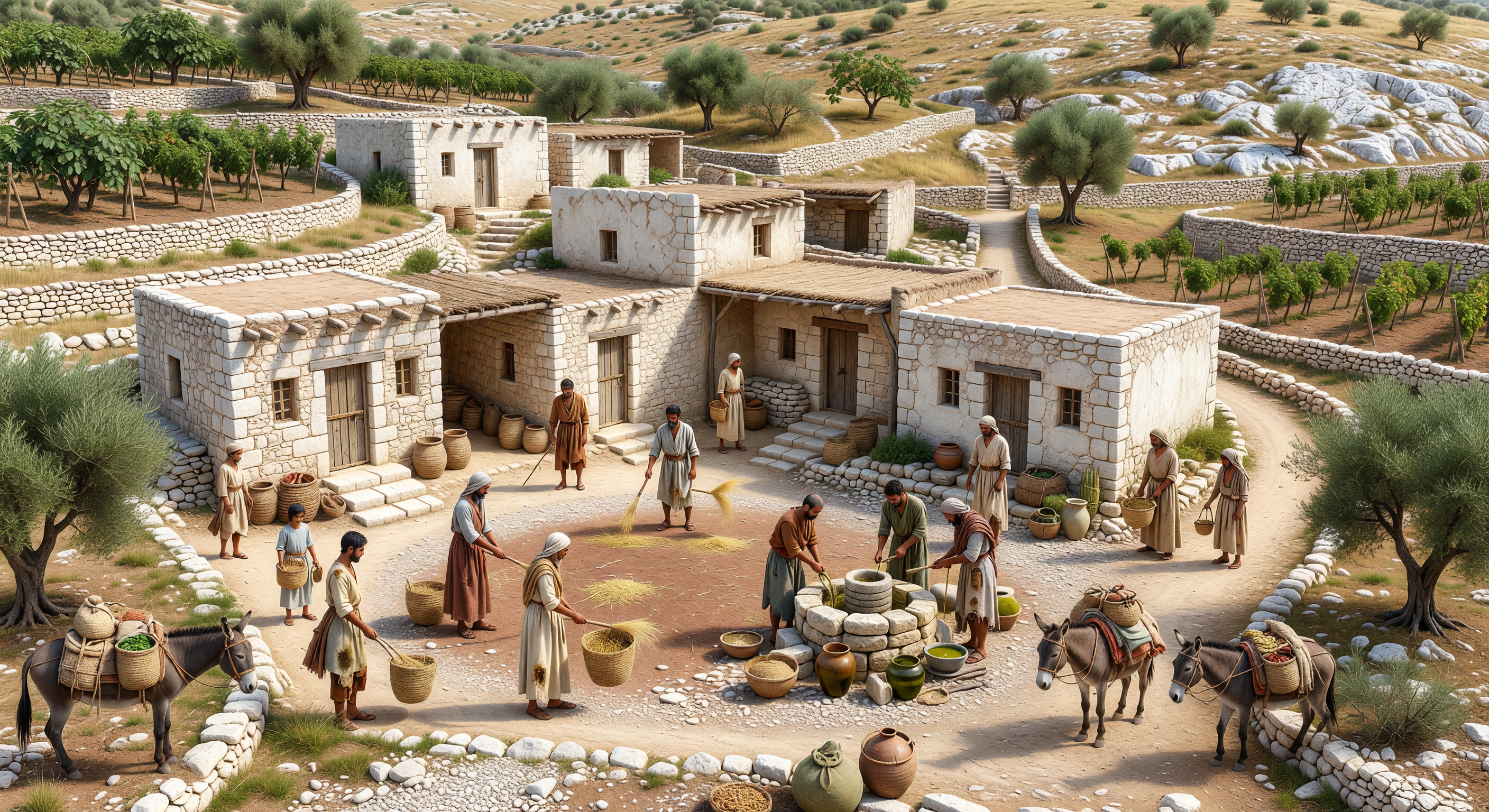
This scene evokes daily life in a Judean hill village during the Hasmonean period of the late 2nd century BC. Built of local limestone with flat earthen roofs and surrounded by terraced plots of vines, figs, and olives, such settlements depended on mixed agriculture and seasonal labor like threshing grain and pressing الزيت—olive oil—for household use and trade. The villagers’ simple wool and linen clothing, ceramic storage jars, stone installations, and donkey transport reflect the material culture of rural Judea in the southern Levant under an emerging independent Jewish state.
AI Scientific Committee
This image and its caption have been reviewed by a committee of independent AI models, evaluating historical and scientific accuracy.
Claude
Image:
Approved
Caption:
Adjust
Mar 28, 2026
The image is a well-executed depiction of a Hasmonean-period Judean hill village. The limestone architecture with flat roofs is accurate for the region and period, consistent with archaeological evidence from sites like Khirbet Qeiyafa and other rural Judean settlements. The terraced hillside agriculture with olive trees, grapevines, and what appear to be fig trees is historically appropriate for the Judean hill country. The central threshing and processing area, stone olive press installation, ceramic storage jars, woven baskets, and donkeys for transport all reflect the material culture documented in archaeological excavations of Second Temple period rural sites. The clothing—simple tunics in earth tones with head coverings—is plausible for the period, though the garments appear somewhat generic. The exposed limestone bedrock on the hillside is geologically accurate for the Judean highlands. One minor observation: some of the buildings appear quite neatly constructed and uniform, perhaps slightly too polished for a humble village, but this is within acceptable artistic license.
The caption is largely accurate and informative, but it contains an odd stylistic choice: the insertion of the Arabic word 'الزيت' (al-zayt, meaning 'oil') mid-sentence. While etymologically interesting, this is anachronistic and misleading in a description of a Jewish Hasmonean-period village. The relevant Semitic term would be Hebrew 'shemen' (שמן), not Arabic. The use of Arabic here is jarring and historically inappropriate for the context, even if intended as a multilingual flourish. Otherwise, the caption's description of mixed agriculture, seasonal labor, material culture, and the political context of the emerging Hasmonean state is accurate. The characterization of the late 2nd century BC as the period of the Hasmonean dynasty is correct—this follows the Maccabean revolt and the establishment of Jewish independence.
I partially agree with the GPT reviewer's assessment but believe they overlooked the problematic Arabic insertion in the caption, which is a notable editorial issue for an educational product focused on a Jewish Hasmonean-period setting. This warrants an adjustment to the caption to either remove the Arabic term or replace it with the Hebrew equivalent.
The caption is largely accurate and informative, but it contains an odd stylistic choice: the insertion of the Arabic word 'الزيت' (al-zayt, meaning 'oil') mid-sentence. While etymologically interesting, this is anachronistic and misleading in a description of a Jewish Hasmonean-period village. The relevant Semitic term would be Hebrew 'shemen' (שמן), not Arabic. The use of Arabic here is jarring and historically inappropriate for the context, even if intended as a multilingual flourish. Otherwise, the caption's description of mixed agriculture, seasonal labor, material culture, and the political context of the emerging Hasmonean state is accurate. The characterization of the late 2nd century BC as the period of the Hasmonean dynasty is correct—this follows the Maccabean revolt and the establishment of Jewish independence.
I partially agree with the GPT reviewer's assessment but believe they overlooked the problematic Arabic insertion in the caption, which is a notable editorial issue for an educational product focused on a Jewish Hasmonean-period setting. This warrants an adjustment to the caption to either remove the Arabic term or replace it with the Hebrew equivalent.
Grok
Image:
Approved
Caption:
Adjust
Mar 28, 2026
The image accurately captures a Judean hill village from the Hasmonean period (late 2nd century BC). The architecture features local limestone construction with flat earthen roofs, clustered in a courtyard layout typical of rural Judean settlements like those excavated at sites such as Hirbet el-Meshash or Gamla. Terraced hillsides with olive groves, grapevines, and possibly figs align with the agroecology of the Judean highlands, where limestone bedrock and karst topography are geologically correct. Villagers wear simple wool/linen tunics, robes, and headscarves in earth tones, consistent with Second Temple period attire from iconography and texts like the Dead Sea Scrolls descriptions. Activities include threshing grain on a circular floor, handling ceramic pithoi (storage jars), woven baskets, and donkeys for transport— all archaeologically attested. An olive press basin and levers are visible, reflecting beam-press technology of the era. No anachronisms; visual coherence is high, with plausible lighting and dust for a Mediterranean summer day. Scientifically, flora (Olea europaea, Vitis vinifera) and fauna (Equus asinus) are period-appropriate.
The caption is factually strong, correctly describing mixed agriculture (vines, figs, olives, grain), seasonal labor (threshing, oil pressing), material culture (wool/linen clothing, ceramics, stone installations, donkeys), and the Hasmonean context of Jewish independence post-Maccabean revolt. It matches the image well and provides educational depth without overstatement. However, the insertion of the Arabic term 'الزيت' (al-zayt, 'the oil') is anachronistic and culturally mismatched for a Hebrew/Aramaic-speaking Jewish village; the period term was Hebrew 'shemen zayit' (שמן זית) or Aramaic equivalents. This jarring element disrupts the historical immersion and could mislead viewers on linguistics. Minor adjustment to replace or remove it would perfect it.
I agree with GPT's approval of the image—its assessment of architecture, agriculture, and clothing is spot-on, though it underemphasized the precise material culture details like the olive press. I concur with Claude's image approval and caption adjustment, validating the Arabic issue they flagged (which GPT overlooked); Claude's archaeological references (e.g., Khirbet Qeiyafa, though slightly earlier Iron Age II, are analogous) are apt, and their note on building neatness is minor artistic license I deem acceptable. Neither missed major flaws, but Claude correctly prioritized the caption's linguistic inaccuracy for an educational project.
The caption is factually strong, correctly describing mixed agriculture (vines, figs, olives, grain), seasonal labor (threshing, oil pressing), material culture (wool/linen clothing, ceramics, stone installations, donkeys), and the Hasmonean context of Jewish independence post-Maccabean revolt. It matches the image well and provides educational depth without overstatement. However, the insertion of the Arabic term 'الزيت' (al-zayt, 'the oil') is anachronistic and culturally mismatched for a Hebrew/Aramaic-speaking Jewish village; the period term was Hebrew 'shemen zayit' (שמן זית) or Aramaic equivalents. This jarring element disrupts the historical immersion and could mislead viewers on linguistics. Minor adjustment to replace or remove it would perfect it.
I agree with GPT's approval of the image—its assessment of architecture, agriculture, and clothing is spot-on, though it underemphasized the precise material culture details like the olive press. I concur with Claude's image approval and caption adjustment, validating the Arabic issue they flagged (which GPT overlooked); Claude's archaeological references (e.g., Khirbet Qeiyafa, though slightly earlier Iron Age II, are analogous) are apt, and their note on building neatness is minor artistic license I deem acceptable. Neither missed major flaws, but Claude correctly prioritized the caption's linguistic inaccuracy for an educational project.
Gemini
Image:
Approved
Caption:
Adjust
Mar 28, 2026
The image is an excellent representation of a Hasmonean-period Judean village. The architectural use of local limestone and flat earthen roofs is supported by archaeological findings in the Judean highlands, such as at Khirbet Qeiyafa or later Second Temple rural sites. The agricultural setting is particularly well-conceived; the 'Mediterranean triad' of grain, grapes, and olives, grown on labor-intensive terraces, was the backbone of the Judean economy. The presence of donkeys and stone installations for processing crops provides a high level of material realism without any detectable anachronisms. I agree with my colleagues that the visual coherence and geological accuracy of the limestone bedrock are strong points.
Regarding the caption, I must align with Claude and Grok in flagging the inclusion of the Arabic word 'الزيت' (al-zayt). During the late 2nd century BC, the inhabitants of Judea spoke Hebrew and Aramaic. The Hebrew term for oil is 'shemen.' Using Arabic in this specific historical and cultural context is anachronistic, as Arabic did not become the primary language of the region until many centuries later. This is a significant detail for an educational project like Temporiscope, as it conflates two distinct cultural and linguistic eras. GPT’s review failed to catch this linguistic error. The rest of the caption is historically robust, accurately placing the Hasmonean state in its correct temporal and geopolitical context.
Regarding the caption, I must align with Claude and Grok in flagging the inclusion of the Arabic word 'الزيت' (al-zayt). During the late 2nd century BC, the inhabitants of Judea spoke Hebrew and Aramaic. The Hebrew term for oil is 'shemen.' Using Arabic in this specific historical and cultural context is anachronistic, as Arabic did not become the primary language of the region until many centuries later. This is a significant detail for an educational project like Temporiscope, as it conflates two distinct cultural and linguistic eras. GPT’s review failed to catch this linguistic error. The rest of the caption is historically robust, accurately placing the Hasmonean state in its correct temporal and geopolitical context.
Matania
Summary
Image:
Approved
Caption:
Adjust
The committee agrees that the image accurately represents a Judean hill village during the Hasmonean period, highlighting appropriate architectural and agricultural elements. The clothing, transportation methods, and general material culture depicted are appropriate for the era. However, the caption contains an anachronistic linguistic element that detracts from its historical accuracy, specifically regarding the use of modern Arabic terminology in a context that would have utilized Hebrew or Aramaic.
For the IMAGE: 1. Some committee members noted that the buildings appear too neatly constructed and uniform for a humble village environment, though this was seen as acceptable artistic license.
For the CAPTION: 1. The Arabic word 'الزيت' ('al-zayt,' meaning 'oil') is considered anachronistic for a 2nd-century BC Judean village and should be replaced either with the Hebrew term 'שמן' ('shemen') or simplified to 'oil.' 2. The overall description should maintain cultural and linguistic consistency with the period, as the use of Arabic could mislead viewers about the historical context.
The final verdict is to approve the image as it meets historical accuracy, while suggesting an adjustment to the caption to eliminate the anachronistic language.
For the IMAGE: 1. Some committee members noted that the buildings appear too neatly constructed and uniform for a humble village environment, though this was seen as acceptable artistic license.
For the CAPTION: 1. The Arabic word 'الزيت' ('al-zayt,' meaning 'oil') is considered anachronistic for a 2nd-century BC Judean village and should be replaced either with the Hebrew term 'שמן' ('shemen') or simplified to 'oil.' 2. The overall description should maintain cultural and linguistic consistency with the period, as the use of Arabic could mislead viewers about the historical context.
The final verdict is to approve the image as it meets historical accuracy, while suggesting an adjustment to the caption to eliminate the anachronistic language.
Other languages
- Français: Village Judéen de l’Époque Hasmonéenne avec Terrasses d'Oliviers
- Español: Aldea de Judea del Periodo Asmoneo con Terrazas Agrícolas
- Português: Aldeia da Judeia do Período Hasmoneu com Terraços Agrícolas
- Deutsch: Hasmonäisches Dorf im Judäischen Bergland mit Terrassenfeldern
- العربية: قرية يهودية من العصر الحشموني مع مدرجات زراعية
- हिन्दी: हश्मोनी काल का यहूदी पहाड़ी गाँव और जैतून के बाग
- 日本語: ハスモン朝時代のユダヤの丘陵集落と段々畑
- 한국어: 하스몬 왕조 시대 유대 언덕 마을과 계단식 밭
- Italiano: Villaggio Giudeo dell'Epoca Asmonea con Terrazzamenti Agricoli
- Nederlands: Joods Heuveldorp uit de Hasmoneese Tijd met Terrasbouw
The caption accurately describes the scene and aligns well with historical facts about daily life in rural Judea during the Hasmonean period. It provides context on the architecture, agricultural practices, and material culture mentioned in the image. The details on labor activities like threshing grain and pressing olive oil resonate with documented practices of that era. No misleading statements or inaccuracies appear in the caption; it offers a suitable level of detail that enhances the understanding of the depicted scene, making it both informative and historically relevant.