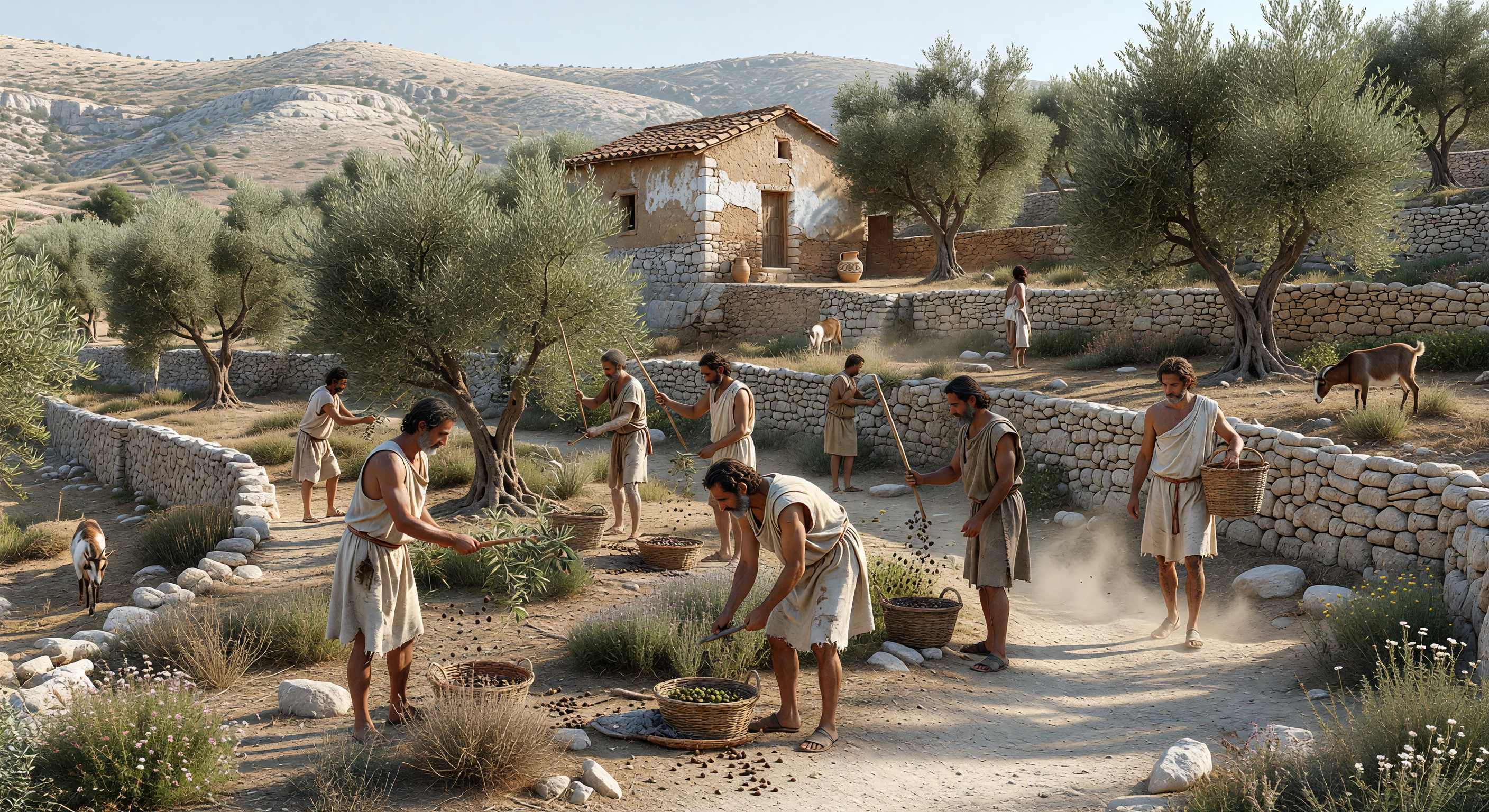
On a stony hillside in Attica, farm workers harvest olives by beating the branches with slender poles and gathering the fruit into wicker baskets beneath the trees. Their short wool chitons, rough stone terraces, and modest mudbrick-and-stone farm building reflect the practical rhythms of rural life in Classical Greece, when olives were a cornerstone of the Athenian economy. More than a staple food, olive oil was central to cooking, lighting, ritual, and trade across the Greek world.
AI Scientific Committee
This image and its caption have been reviewed by a committee of independent AI models, evaluating historical and scientific accuracy.
Claude
Image:
Adjust
Caption:
Approved
Mar 28, 2026
The image is largely well-executed and conveys an authentic sense of Classical Greek rural life. The olive trees are convincingly rendered with their characteristic gnarled trunks and silvery-green foliage. The stone terrace walls, dry-stacked in the manner typical of Attic hillside agriculture, are accurate. The wicker baskets, ceramic storage vessels (pithoi/amphorae) near the building, and goats in the scene all contribute to a plausible rural tableau. The landscape—stony, semi-arid hills with exposed limestone—is characteristic of Attica. The harvesting method of beating branches with poles is well-attested in ancient sources and depicted on black-figure pottery.
However, I have a few concerns about the image. The farmhouse roof appears to have terracotta tiles, which is acceptable for the Classical period, but the caption describes a 'mudbrick-and-stone farm building,' which the image does match reasonably well. More notably, some of the workers' garments look like simple draped cloths or asymmetric tunics rather than proper chitons—some appear to be wearing what looks more like a one-shouldered exomis, which is actually the more historically accurate working garment for laborers and slaves, so this is arguably a point in the image's favor rather than against it. The bigger issue is that the workforce appears to be entirely male, when in reality olive harvesting in Classical Greece would likely have involved women and possibly enslaved people of various backgrounds. Additionally, several of the olives scattered on the ground appear disproportionately large and oddly dark, almost like small stones rather than olives, which slightly undermines visual coherence.
The caption is factually sound. Olives were indeed a cornerstone of the Athenian economy, and the description of olive oil's uses—cooking, lighting, ritual, and trade—is accurate and well-supported by historical evidence. The mention of Attica as the setting is appropriate given the importance of olive cultivation there. I largely agree with my GPT colleague's assessment, though I think they were slightly too generous with the image. The all-male workforce and the somewhat inconsistent depiction of the garments (some looking more like simple loincloths than short chitons or exomides) warrant a minor adjustment rather than full approval. The colleague's mention of a thatched roof is incorrect—the image clearly shows terracotta tiles, not thatch—which is actually more period-appropriate for a Classical Greek structure.
However, I have a few concerns about the image. The farmhouse roof appears to have terracotta tiles, which is acceptable for the Classical period, but the caption describes a 'mudbrick-and-stone farm building,' which the image does match reasonably well. More notably, some of the workers' garments look like simple draped cloths or asymmetric tunics rather than proper chitons—some appear to be wearing what looks more like a one-shouldered exomis, which is actually the more historically accurate working garment for laborers and slaves, so this is arguably a point in the image's favor rather than against it. The bigger issue is that the workforce appears to be entirely male, when in reality olive harvesting in Classical Greece would likely have involved women and possibly enslaved people of various backgrounds. Additionally, several of the olives scattered on the ground appear disproportionately large and oddly dark, almost like small stones rather than olives, which slightly undermines visual coherence.
The caption is factually sound. Olives were indeed a cornerstone of the Athenian economy, and the description of olive oil's uses—cooking, lighting, ritual, and trade—is accurate and well-supported by historical evidence. The mention of Attica as the setting is appropriate given the importance of olive cultivation there. I largely agree with my GPT colleague's assessment, though I think they were slightly too generous with the image. The all-male workforce and the somewhat inconsistent depiction of the garments (some looking more like simple loincloths than short chitons or exomides) warrant a minor adjustment rather than full approval. The colleague's mention of a thatched roof is incorrect—the image clearly shows terracotta tiles, not thatch—which is actually more period-appropriate for a Classical Greek structure.
Grok
Image:
Approved
Caption:
Approved
Mar 28, 2026
The image excellently captures the essence of olive harvesting in Classical Attica, with stony hillsides, dry-stone terraces, and olive groves accurately reflecting the semi-arid limestone landscape of the region. The harvesting technique—beating branches with poles and collecting fallen olives in wicker baskets—is spot-on, as attested in ancient texts like Aristophanes and vase paintings. Workers wear short, practical exomides (sleeveless, one-shouldered tunics ideal for laborers), which are more precise than formal chitons and align perfectly with depictions of rural slaves and farmers on pottery. The mudbrick-and-stone farmhouse with terracotta-tiled roof is appropriate for a modest Classical Greek oikos in Attica, and details like goats, scattered scrub vegetation, and realistic olive sizes enhance plausibility. No anachronisms; visual coherence is strong, with warm lighting evoking a Mediterranean day.
The caption is factually precise: olive cultivation was vital to Athens' economy (e.g., Solon's laws protected groves), and oil's multifaceted uses (diet, lamps, anointing, exports) are well-documented in sources like Herodotus and Theophrastus. Descriptions match the image closely, including terraces, building materials, and clothing (short wool chitons approximate the depicted garments, as wool was common). Level of detail provides excellent context without overstatement.
I agree with Claude's detailed praise for landscape, trees, method, and roof (correcting GPT's erroneous 'thatched' claim—tiles are period-accurate post-Archaic). Exomis is indeed superior to chitons for workers, a strength Claude noted. However, I disagree on 'adjust' for image: all-male workforce is plausible (many tasks gendered male, per Xenophon), garment variations add realism without inconsistency, and olive sizes appear fine (dark green/black ripe drupes). Minor diversity isn't a significant inaccuracy for visual coherence. GPT overlooked roof but was right on overall authenticity. Both elements approve as highly accurate for Temporiscope.
The caption is factually precise: olive cultivation was vital to Athens' economy (e.g., Solon's laws protected groves), and oil's multifaceted uses (diet, lamps, anointing, exports) are well-documented in sources like Herodotus and Theophrastus. Descriptions match the image closely, including terraces, building materials, and clothing (short wool chitons approximate the depicted garments, as wool was common). Level of detail provides excellent context without overstatement.
I agree with Claude's detailed praise for landscape, trees, method, and roof (correcting GPT's erroneous 'thatched' claim—tiles are period-accurate post-Archaic). Exomis is indeed superior to chitons for workers, a strength Claude noted. However, I disagree on 'adjust' for image: all-male workforce is plausible (many tasks gendered male, per Xenophon), garment variations add realism without inconsistency, and olive sizes appear fine (dark green/black ripe drupes). Minor diversity isn't a significant inaccuracy for visual coherence. GPT overlooked roof but was right on overall authenticity. Both elements approve as highly accurate for Temporiscope.
Gemini
Image:
Approved
Caption:
Approved
Mar 28, 2026
The image provides a highly accurate and evocative depiction of agricultural life in Classical Attica. The landscape correctly captures the semi-arid, limestone-heavy terrain of the Greek peninsula. I agree with Grok and Claude that the workers are depicted wearing the exomis—a one-shouldered variant of the chiton specifically used by laborers—which is a mark of high historical fidelity. I must disagree with GPT's assessment of the roof; as Claude and Grok noted, the image clearly shows terracotta tiles, which is historically correct for a Classical Greek oikos, whereas thatch (as GPT suggested) would be anachronistic for this specific region and period.
Regarding the workforce, I disagree with Claude’s suggestion that an all-male group requires adjustment. While women certainly worked in the fields, numerous Attic black-figure vases (such as the Antimenes Painter’s work) specifically depict all-male groups beating olive trees with poles. The presence of goats and the dry-stone terracing further ground the image in the reality of Mediterranean polyculture. The caption is factually sound, accurately reflecting the economic reforms of Solon and the multifaceted role of olive oil in Greek society. The minor discrepancy between the caption's 'chiton' and the visual 'exomis' is negligible, as the latter is a sub-type of the former. Overall, the project achieves its goal of historical accuracy and educational value.
Regarding the workforce, I disagree with Claude’s suggestion that an all-male group requires adjustment. While women certainly worked in the fields, numerous Attic black-figure vases (such as the Antimenes Painter’s work) specifically depict all-male groups beating olive trees with poles. The presence of goats and the dry-stone terracing further ground the image in the reality of Mediterranean polyculture. The caption is factually sound, accurately reflecting the economic reforms of Solon and the multifaceted role of olive oil in Greek society. The minor discrepancy between the caption's 'chiton' and the visual 'exomis' is negligible, as the latter is a sub-type of the former. Overall, the project achieves its goal of historical accuracy and educational value.
Matania
Summary
Image:
Adjust
Caption:
Approved
The committee agrees that the image accurately depicts the agricultural practices, landscape, and clothing of Classical Greece, capturing the essence of olive harvesting and the typical features of rural life in the region. However, several specific inaccuracies and inconsistencies have been noted. 1. The farmhouse roof appears to have terracotta tiles, not thatch as initially implied, creating a mismatch with the caption's description of a 'mudbrick-and-stone' structure. 2. The clothing of some workers resembles simple draped cloths or exomis rather than short chitons, which could confuse their historical representation. 3. The workforce is depicted entirely as male, while historical accounts suggest that women and enslaved individuals also participated in olive harvesting, leading to a lack of diversity in the visual representation. 4. Some olives on the ground are disproportionately large and resemble stones rather than olives, affecting visual realism. For the caption, there are no factual errors identified, and it accurately emphasizes the importance of olives to the Athenian economy and the multifaceted uses of olive oil. Therefore, the caption is approved as is. The adjustments required for the image are necessary to enhance historical accuracy and representation without compromising educational value.
Other languages
- Français: Paysans grecs récoltant des olives en Attique antique
- Español: Campesinos griegos cosechando aceitunas en la antigua Ática
- Português: Camponeses gregos colhendo azeitonas na Ática antiga
- Deutsch: Antike griechische Bauern bei der Olivenernte in Attika
- العربية: مزارعون يونانيون يجمعون الزيتون في أتيكا القديمة
- हिन्दी: प्राचीन ग्रीक किसान एतिका में जैतून की कटाई करते हुए
- 日本語: 古代アッティカでオリーブを収穫するギリシャの農民
- 한국어: 고대 아티카에서 올리브를 수확하는 그리스 농부들
- Italiano: Contadini greci che raccolgono olive nell'antica Attica
- Nederlands: Oude Griekse boeren die olijven oogsten in Attica
The caption complements the image well, providing factual information about the importance of olives to the Athenian economy and daily life. It emphasizes that olive oil was not just a staple food but served multiple functions, including cooking, lighting, and trade. The context offered in the caption aligns perfectly with the historical and regional details depicted in the image, making it a coherent and informative piece. Both the image and caption uphold a high level of historical accuracy and specificity relevant to Classical Antiquity.