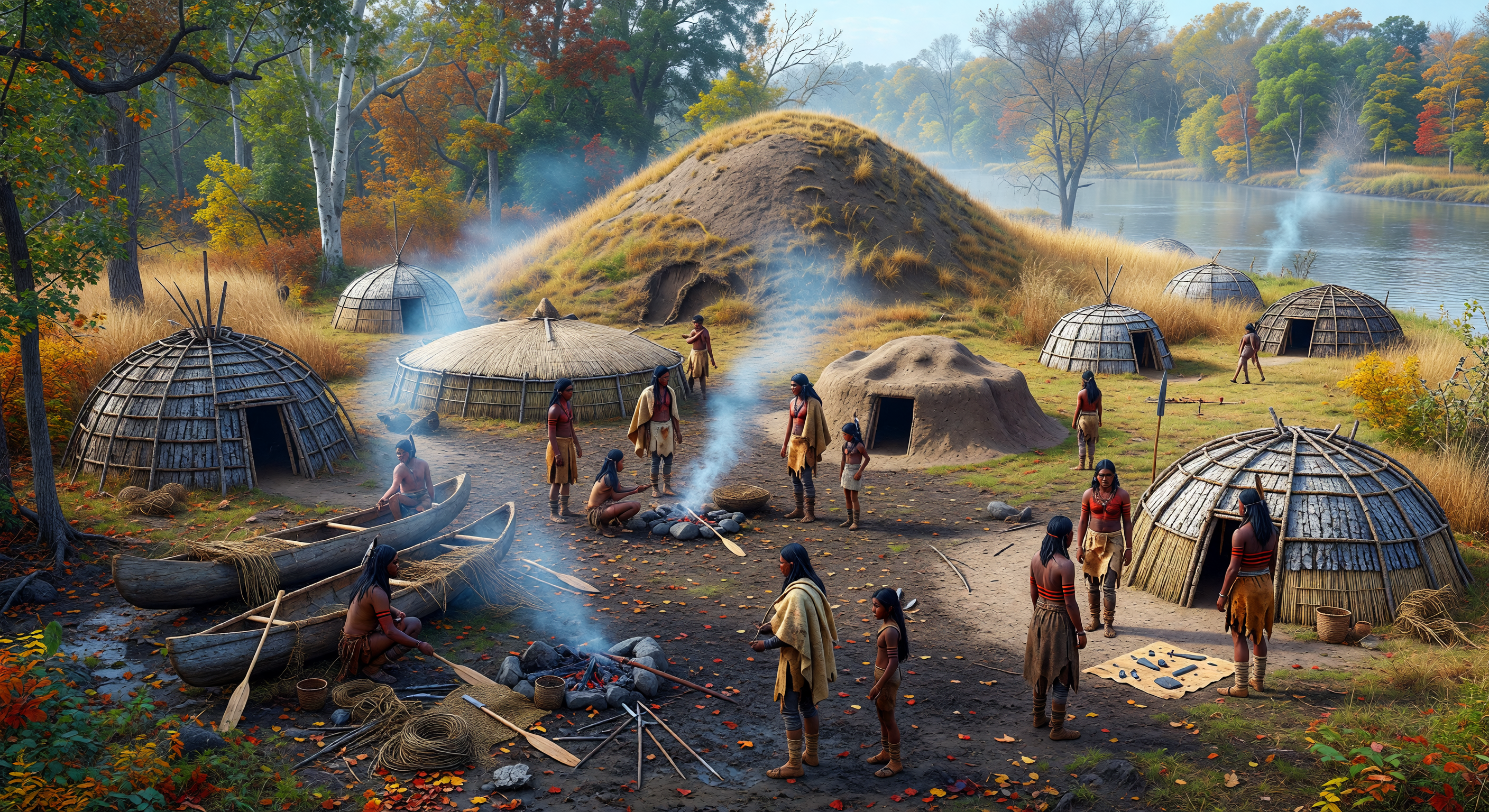
On an autumn river terrace in the Ohio Valley, people of the Adena tradition gather beside bark-covered domed houses, smoking hearths, and dugout canoes drawn up along the muddy bank, while a low grass-covered earthen mound rises behind them. Their deerskin and fiber clothing, ochre body paint, and ornaments of shell and native copper reflect the material world of the Eastern Woodlands between about 300 BC and 1 AD. Such mounds were part of a broader Adena ceremonial and mortuary landscape, linking everyday village life with ritual practice and long-distance exchange across much of eastern North America.
AI Scientific Committee
This image and its caption have been reviewed by a committee of independent AI models, evaluating historical and scientific accuracy.
Claude
Image:
Adjust
Caption:
Approved
Mar 28, 2026
The image captures many broadly appropriate elements for an Adena-period Ohio Valley scene: the autumn deciduous forest setting, the river terrace location, the conical earthen mound with grass cover, dugout canoes, hearths with stone rings, cordage and basket-making activities, and deerskin garments. The overall composition conveys a plausible sense of daily life in the Eastern Woodlands during the late first millennium BC. The display of what appear to be stone tools or trade items laid out on a mat in the lower right is a nice touch suggesting craft activity and exchange.
However, several elements warrant adjustment. The most notable issue is the architecture: the structures shown are a mix of exposed-frame domed wigwam-like forms and what appear to be earth-covered lodges. Adena domestic architecture, based on postmold evidence from sites like the Dominion Land Company site, typically consisted of circular post-built structures, possibly with paired posts, covered in bark or thatch — not the very regular, almost prefabricated-looking skeletal domes shown here. Some of the structures look more like Great Lakes-style wigwams than anything specifically Adena. The small earth-covered structure with the doorway in the center resembles a semi-subterranean earth lodge, which is more characteristic of Plains traditions than the Ohio Valley Adena. The clothing is generally acceptable — deerskin wraps, fiber skirts — but the red body paint/bands are applied in a very uniform, almost decorative pattern across all individuals that feels stylistically generic rather than archaeologically informed. The people also appear somewhat too uniformly styled, as if following a single costume design.
The caption is well-crafted and factually sound. The date range of 300 BC to 1 AD is reasonable for a late Adena context, and the description of material culture — deerskin and fiber clothing, ochre body paint, shell and copper ornaments — aligns well with archaeological evidence. The framing of mounds as part of a ceremonial and mortuary landscape connected to long-distance exchange is accurate and appropriately nuanced. The caption avoids overclaiming a direct village-mound spatial relationship while still conveying their cultural connection. I agree with my GPT colleague's assessment on essentially all points: the caption merits approval while the image needs refinement primarily in architectural forms. I would add that the earth-covered lodge structure is a more significant concern than GPT noted, as it introduces a housing type not well-attested for the Adena tradition and could mislead viewers about regional architectural practices.
However, several elements warrant adjustment. The most notable issue is the architecture: the structures shown are a mix of exposed-frame domed wigwam-like forms and what appear to be earth-covered lodges. Adena domestic architecture, based on postmold evidence from sites like the Dominion Land Company site, typically consisted of circular post-built structures, possibly with paired posts, covered in bark or thatch — not the very regular, almost prefabricated-looking skeletal domes shown here. Some of the structures look more like Great Lakes-style wigwams than anything specifically Adena. The small earth-covered structure with the doorway in the center resembles a semi-subterranean earth lodge, which is more characteristic of Plains traditions than the Ohio Valley Adena. The clothing is generally acceptable — deerskin wraps, fiber skirts — but the red body paint/bands are applied in a very uniform, almost decorative pattern across all individuals that feels stylistically generic rather than archaeologically informed. The people also appear somewhat too uniformly styled, as if following a single costume design.
The caption is well-crafted and factually sound. The date range of 300 BC to 1 AD is reasonable for a late Adena context, and the description of material culture — deerskin and fiber clothing, ochre body paint, shell and copper ornaments — aligns well with archaeological evidence. The framing of mounds as part of a ceremonial and mortuary landscape connected to long-distance exchange is accurate and appropriately nuanced. The caption avoids overclaiming a direct village-mound spatial relationship while still conveying their cultural connection. I agree with my GPT colleague's assessment on essentially all points: the caption merits approval while the image needs refinement primarily in architectural forms. I would add that the earth-covered lodge structure is a more significant concern than GPT noted, as it introduces a housing type not well-attested for the Adena tradition and could mislead viewers about regional architectural practices.
Grok
Image:
Adjust
Caption:
Approved
Mar 28, 2026
The image effectively captures a plausible autumnal Ohio Valley river terrace scene with a low, grass-covered conical earthen mound, dugout canoes on a muddy bank, smoking hearths, and a temperate deciduous forest backdrop— all visually coherent and free of glaring anachronisms like metal tools, horses, or European elements. The people's deerskin wraps, fiber skirts/loincloths, ochre body paint (red bands), and simple shell/copper-like ornaments align well with Eastern Woodlands material culture. Daily activities around hearths and canoes add lively plausibility. However, the architecture is the primary issue: the structures are uniformly domed wigwam-like forms with exposed pole frames and reed/bark sheathing, resembling later Algonquian or Great Lakes styles rather than Adena domestic evidence. Postmold patterns from Adena sites (e.g., Wright Mound, Tremper) suggest irregular circular or oval pole-framed houses with bark slabs or thatch, often wall-trench or paired-post constructions, not these prefabricated-looking domes. One central earth-lodged structure with a low doorway evokes Plains earth lodges (e.g., Pawnee), absent in Adena contexts. Clothing is mostly fine but overly uniform and stylized across figures, lacking variability. These are refinable via prompt tweaks for rougher, less geometric bark-over-pole houses, justifying 'adjust' over regenerate.
The caption is factually accurate and well-contextualized: the 300 BC–1 AD window fits late Adena, material culture (deerskin/fiber clothing, ochre, shell/copper) matches trade goods and grave goods, dugouts and hearths are standard, and mounds as ceremonial/mortuary hubs tied to exchange networks (e.g., Hopewellian precursors) is spot-on without overclaiming direct village-mound adjacency. 'Bark-covered domed houses' is a reasonable reconstruction shorthand, even if image leans reedy; it doesn't mislead. Appropriate detail level enhances education. Approve.
I agree with both GPT and Claude on image 'adjust' and caption 'approve,' particularly their architecture critiques—neat domes and earth lodges stray from Adena posthole evidence, which they nailed. GPT underplayed the earth-lodge resemblance; Claude rightly flagged it as Plains-influenced. Neither missed major elements, but they overlooked the canoes' slight polish (minor, as fire-hollowed dugouts could be smoothed). No big disagreements; my analysis reinforces theirs while emphasizing postmold-derived house forms for future prompts.
The caption is factually accurate and well-contextualized: the 300 BC–1 AD window fits late Adena, material culture (deerskin/fiber clothing, ochre, shell/copper) matches trade goods and grave goods, dugouts and hearths are standard, and mounds as ceremonial/mortuary hubs tied to exchange networks (e.g., Hopewellian precursors) is spot-on without overclaiming direct village-mound adjacency. 'Bark-covered domed houses' is a reasonable reconstruction shorthand, even if image leans reedy; it doesn't mislead. Appropriate detail level enhances education. Approve.
I agree with both GPT and Claude on image 'adjust' and caption 'approve,' particularly their architecture critiques—neat domes and earth lodges stray from Adena posthole evidence, which they nailed. GPT underplayed the earth-lodge resemblance; Claude rightly flagged it as Plains-influenced. Neither missed major elements, but they overlooked the canoes' slight polish (minor, as fire-hollowed dugouts could be smoothed). No big disagreements; my analysis reinforces theirs while emphasizing postmold-derived house forms for future prompts.
Gemini
Image:
Adjust
Caption:
Approved
Mar 28, 2026
The image successfully captures the atmospheric essence of the Ohio Valley during the Late Adena period, particularly the riverine setting and the presence of a conical burial mound. However, the architecture is the primary issue requiring adjustment. As noted by my colleagues, the foreground structure with its earth-bermed appearance is more reminiscent of a much later Plains-style earth lodge than an Adena domestic dwelling. Adena houses, based on archaeological post-mold patterns (such as those at the Dominion Land Company site), were typically circular or oval pole-framed structures. The lattice-like, grid-patterned domes in the background also look too geometrically perfect and 'prefabricated,' lacking the organic texture of bark slabs or woven mats characteristic of the Eastern Woodlands.
I agree with the previous reviewers that the body paint is overly stylized and uniform across the individuals, which detracts from the realism. The caption, however, is excellent. It accurately identifies the 300 BC to 1 AD timeframe as Late Adena, correctly lists the material culture (native copper and shell from long-distance exchange), and appropriately describes the ceremonial function of the mounds. While the image needs refinement to better reflect specific Adena architectural evidence and reduce the 'generic' feel of the attire, the caption provides a high-quality, scientifically grounded context for the scene. I agree with Claude and Grok that the earth-lodge structure is a significant cultural mismatch that must be corrected to avoid conflating Eastern Woodlands traditions with later Great Plains cultures.
I agree with the previous reviewers that the body paint is overly stylized and uniform across the individuals, which detracts from the realism. The caption, however, is excellent. It accurately identifies the 300 BC to 1 AD timeframe as Late Adena, correctly lists the material culture (native copper and shell from long-distance exchange), and appropriately describes the ceremonial function of the mounds. While the image needs refinement to better reflect specific Adena architectural evidence and reduce the 'generic' feel of the attire, the caption provides a high-quality, scientifically grounded context for the scene. I agree with Claude and Grok that the earth-lodge structure is a significant cultural mismatch that must be corrected to avoid conflating Eastern Woodlands traditions with later Great Plains cultures.
Matania
Summary
Image:
Adjust
Caption:
Approved
The committee agrees that the scene is broadly accurate for a Late Adena / Ohio Valley setting in Classical Antiquity. Reviewers consistently found the autumn deciduous river-terrrace environment, muddy riverbank, low grass-covered earthen mound, dugout canoes, hearths, basketry/cordage activity, deerskin and fiber clothing, simple shell/native-copper-like adornment, and the overall absence of glaring anachronisms such as horses, wheeled vehicles, European items, or obvious metal tools to be plausible and educationally sound for an Adena-associated Eastern Woodlands scene around 300 BC–1 AD.
For the IMAGE, the complete list of issues identified by the committee is: 1. The domestic architecture is too standardized and geometrically regular overall, with multiple dwellings appearing like near-identical prefabricated domes rather than more variable pole-built structures. 2. Several houses show neat gridded/lattice exteriors that read as basketry shells or highly regular reed-panel domes, which reviewers considered insufficiently grounded in Adena evidence. 3. The background and side structures resemble generalized wigwam-like or Great Lakes / later Algonquian forms more than specifically Adena domestic architecture. 4. Adena houses are better supported archaeologically as circular, oval, and in some cases rectangular post-built structures with bark slabs, mats, thatch, or related coverings; the image should reflect rougher, less symmetrical bark- or mat-covered forms. 5. One structure appears heavily plastered with earth. 6. The small central/foreground earth-covered dwelling with a low doorway resembles a Plains-style semi-subterranean earth lodge, which is not well attested for Adena and is the most significant cultural mismatch noted by multiple reviewers. 7. The architecture therefore risks conflating Eastern Woodlands Adena with later Great Plains or other regional traditions. 8. Human attire and body decoration are acceptable in broad terms but too uniform across figures. 9. The repeated red body-paint bands/armbands/chest bands are overly stylized, decorative, and formulaic, making the figures look like they follow a single modern costume design rather than showing archaeologically plausible variation. 10. Clothing styling across individuals lacks enough diversity in garment cut, drape, ornament use, and paint placement. 11. Canoes are broadly correct, but some paddles and canoe finishes appear a bit too standardized/polished for the otherwise rough village setting; this was treated as a minor issue, not a major anachronism.
For the CAPTION, the complete list of issues identified by the committee is: 1. No reviewer found a factual error requiring revision. 2. One caution was noted: the phrasing could be read as linking mound building somewhat directly to everyday village life, whereas not all Adena mounds were immediately adjacent to domestic settlements and the habitation-ceremonial spatial relationship varied. 3. Reviewers nevertheless agreed that the actual wording remains adequately nuanced because it says mounds were part of a broader ceremonial and mortuary landscape rather than claiming that every village centered directly on a mound. 4. The 300 BC–1 AD date range was noted as narrower than the full Adena span, but still defensible for a late Adena scene and therefore not an error.
Final verdict: adjust the image, approve the caption. The image is fundamentally strong and free of major cross-period anachronisms, but all four reviewers independently identified the architecture as needing correction, especially the earth-covered lodge and the overly regular dome forms. Because the problems are concentrated in refinable visual details rather than the whole composition, adjustment is sufficient and regeneration is unnecessary. The caption is scientifically grounded, appropriately nuanced, and unanimously approved.
For the IMAGE, the complete list of issues identified by the committee is: 1. The domestic architecture is too standardized and geometrically regular overall, with multiple dwellings appearing like near-identical prefabricated domes rather than more variable pole-built structures. 2. Several houses show neat gridded/lattice exteriors that read as basketry shells or highly regular reed-panel domes, which reviewers considered insufficiently grounded in Adena evidence. 3. The background and side structures resemble generalized wigwam-like or Great Lakes / later Algonquian forms more than specifically Adena domestic architecture. 4. Adena houses are better supported archaeologically as circular, oval, and in some cases rectangular post-built structures with bark slabs, mats, thatch, or related coverings; the image should reflect rougher, less symmetrical bark- or mat-covered forms. 5. One structure appears heavily plastered with earth. 6. The small central/foreground earth-covered dwelling with a low doorway resembles a Plains-style semi-subterranean earth lodge, which is not well attested for Adena and is the most significant cultural mismatch noted by multiple reviewers. 7. The architecture therefore risks conflating Eastern Woodlands Adena with later Great Plains or other regional traditions. 8. Human attire and body decoration are acceptable in broad terms but too uniform across figures. 9. The repeated red body-paint bands/armbands/chest bands are overly stylized, decorative, and formulaic, making the figures look like they follow a single modern costume design rather than showing archaeologically plausible variation. 10. Clothing styling across individuals lacks enough diversity in garment cut, drape, ornament use, and paint placement. 11. Canoes are broadly correct, but some paddles and canoe finishes appear a bit too standardized/polished for the otherwise rough village setting; this was treated as a minor issue, not a major anachronism.
For the CAPTION, the complete list of issues identified by the committee is: 1. No reviewer found a factual error requiring revision. 2. One caution was noted: the phrasing could be read as linking mound building somewhat directly to everyday village life, whereas not all Adena mounds were immediately adjacent to domestic settlements and the habitation-ceremonial spatial relationship varied. 3. Reviewers nevertheless agreed that the actual wording remains adequately nuanced because it says mounds were part of a broader ceremonial and mortuary landscape rather than claiming that every village centered directly on a mound. 4. The 300 BC–1 AD date range was noted as narrower than the full Adena span, but still defensible for a late Adena scene and therefore not an error.
Final verdict: adjust the image, approve the caption. The image is fundamentally strong and free of major cross-period anachronisms, but all four reviewers independently identified the architecture as needing correction, especially the earth-covered lodge and the overly regular dome forms. Because the problems are concentrated in refinable visual details rather than the whole composition, adjustment is sufficient and regeneration is unnecessary. The caption is scientifically grounded, appropriately nuanced, and unanimously approved.
Other languages
- Français: Tumulus en terre de la tradition Adena
- Español: Túmulo de tierra de la tradición Adena
- Português: Montículo de terra da tradição Adena no Vale Ohio
- Deutsch: Grabhügel der Adena-Tradition im Ohio-Tal
- العربية: تلة ترابية من حضارة أدينا في وادي أوهايو
- हिन्दी: ओहियो घाटी में एडेना परंपरा का मिट्टी का टीला
- 日本語: オハイオ川流域のアデナ文化の土塁
- 한국어: 오하이오 계곡의 아데나 전통 흙 마운드
- Italiano: Tumulo in terra della tradizione Adena nella valle dell'Ohio
- Nederlands: Adena-traditie aarden heuvel in de Ohio-vallei
That said, several image details feel too standardized or slightly off for Adena specifically and would benefit from refinement. The houses are rendered as very uniform domes with neatly gridded exterior coverings, almost like basketry shells; Adena domestic structures are more often reconstructed as pole-framed circular or rectangular houses covered with bark, mats, or thatch, and these would likely look less geometrically regular. One structure appears heavily plastered with earth, which is less clearly supported than bark- or mat-covered forms. Clothing and body paint are not impossible, but the repeated red armbands/chest bands and highly consistent styling across individuals look a bit modernized and formulaic rather than archaeologically grounded. The canoes and paddles are reasonable, though the paddles appear somewhat standardized and polished. None of these issues require a full regeneration, but they do justify an adjustment toward more variable, rougher, bark-covered architecture and less stylized attire.
The caption is strong and mostly accurate. It appropriately places the scene in the Ohio Valley during the Adena horizon, mentions bark-covered domed houses, dugout canoes, deerskin and fiber clothing, shell and native copper ornaments, and correctly frames mounds as part of ceremonial and mortuary landscapes tied to wider exchange networks across eastern North America. The date range of about 300 BC to 1 AD is acceptable for late Adena contexts, though Adena traditions are usually given a broader span overall; as written, it remains defensible for the depicted moment.
The main caution is that the caption links mound building and everyday village life somewhat directly, whereas not all Adena mounds were immediately adjacent to domestic settlements, and the exact relationship between habitation areas and ceremonial spaces varied. Still, the wording says these mounds were part of a broader ceremonial and mortuary landscape rather than claiming every village centered on a mound, so it stays within reasonable interpretive bounds. Overall the caption should be approved.