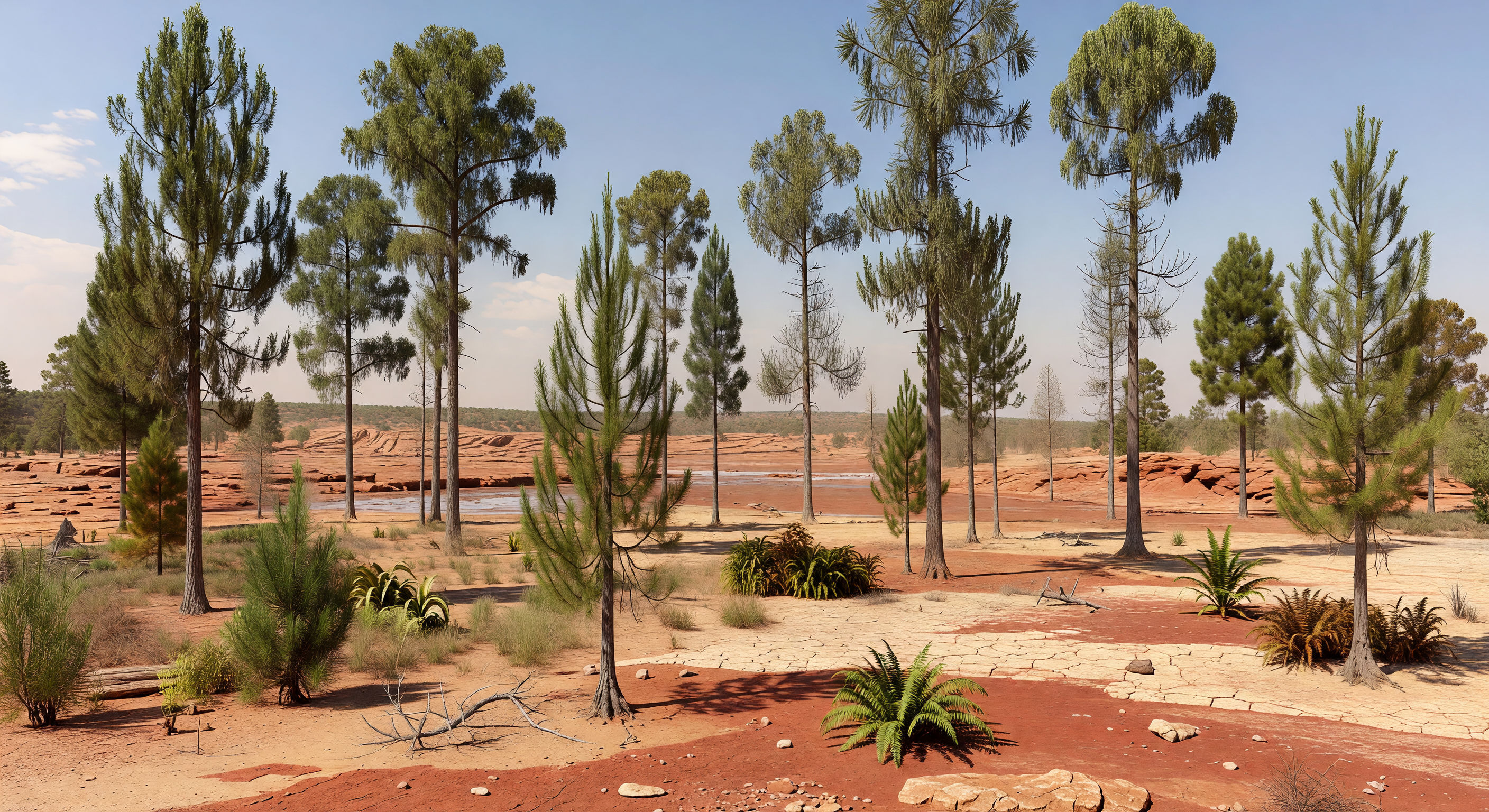
In this reconstruction of a late Carboniferous dry woodland, tall Cordaites trees rise above rust-red sandy soils and pale calcrete crusts, their sparse crowns shading an open understory of seed ferns such as Medullosa and Alethopteris, with scattered Walchia conifers adapted to seasonal drought. Set in the interior lowlands of assembling Pangaea about 310–300 million years ago, this landscape contrasts sharply with the better-known coal swamps of the same period. Red beds, ephemeral braided channels, and distant playa-like flats reflect a hot, semi-arid climate in which seed plants became increasingly important across better-drained uplands and basin margins.
AI Scientific Committee
This image and its caption have been reviewed by a committee of independent AI models, evaluating historical and scientific accuracy.
Claude
Image:
Regenerate
Caption:
Adjust
Mar 27, 2026
The image presents a scene that reads overwhelmingly as a modern semi-arid pine woodland rather than a late Carboniferous dryland ecosystem. The tall trees are unmistakably rendered as modern pines — their branching architecture, bark texture, needle clusters, and overall crown morphology are all characteristic of extant Pinus species. Cordaites trees should have strap-shaped leaves (often 50 cm or more long) arranged in terminal clusters on relatively simple branching systems, giving them a distinctive appearance quite unlike any modern conifer. The smaller conifer-like shrubs in the understory similarly look like modern pine saplings rather than Walchia, which had a distinctive, densely branched habit with small scale-like to needle-like leaves in a more symmetrical arrangement. The understory ferns, while a reasonable nod toward seed ferns, look like modern Boston ferns or sword ferns rather than the compound-fronded Medullosa or Alethopteris. The sedimentary landscape — red beds, cracked pale calcrete surfaces, distant playa-like flats, and layered red sandstone outcrops — is actually quite well done and scientifically plausible for a Carboniferous interior basin setting. The grass-like ground cover scattered throughout is a significant anachronism; grasses did not evolve until the Cretaceous at the earliest. Overall, the botanical inaccuracies are too fundamental for adjustment; the image needs regeneration with properly reconstructed Paleozoic plant morphologies.
The caption is scientifically well-informed and captures a genuinely important but underrepresented aspect of Carboniferous terrestrial ecology. The contrast with coal swamps, the mention of red beds and calcrete, the emphasis on seed plants in better-drained settings — all of this reflects current paleobotanical understanding. However, several points warrant adjustment. Walchia is primarily known from the latest Carboniferous (Gzhelian) into the early Permian, so featuring it prominently at 310 Ma pushes its known range; the text should either narrow the timeframe to ~305–300 Ma or soften the claim. Alethopteris, while a genuine pteridosperm, is more typically associated with seasonally wet or mesic environments rather than strongly arid open woodland, so its inclusion in this context is somewhat misleading. The characterization as 'hot' should be tempered given that this interval falls within the Late Paleozoic Ice Age, when even low-latitude continental interiors may have experienced cooler seasons; 'warm, seasonally dry to semi-arid' would be more defensible.
I largely agree with GPT's assessment. Their identification of the modern pine-like tree morphology as the primary problem is spot-on, as is their concern about Walchia's temporal range and Alethopteris's ecological associations. One element GPT did not specifically flag is the grass-like ground cover visible throughout the scene, which is a clear anachronism — grasses would not appear for another ~200 million years. This alone would warrant regeneration. I also think GPT's point about the Late Paleozoic Ice Age is important and well-taken; calling conditions simply 'hot' oversimplifies a complex climatic picture during a major glacial interval.
The caption is scientifically well-informed and captures a genuinely important but underrepresented aspect of Carboniferous terrestrial ecology. The contrast with coal swamps, the mention of red beds and calcrete, the emphasis on seed plants in better-drained settings — all of this reflects current paleobotanical understanding. However, several points warrant adjustment. Walchia is primarily known from the latest Carboniferous (Gzhelian) into the early Permian, so featuring it prominently at 310 Ma pushes its known range; the text should either narrow the timeframe to ~305–300 Ma or soften the claim. Alethopteris, while a genuine pteridosperm, is more typically associated with seasonally wet or mesic environments rather than strongly arid open woodland, so its inclusion in this context is somewhat misleading. The characterization as 'hot' should be tempered given that this interval falls within the Late Paleozoic Ice Age, when even low-latitude continental interiors may have experienced cooler seasons; 'warm, seasonally dry to semi-arid' would be more defensible.
I largely agree with GPT's assessment. Their identification of the modern pine-like tree morphology as the primary problem is spot-on, as is their concern about Walchia's temporal range and Alethopteris's ecological associations. One element GPT did not specifically flag is the grass-like ground cover visible throughout the scene, which is a clear anachronism — grasses would not appear for another ~200 million years. This alone would warrant regeneration. I also think GPT's point about the Late Paleozoic Ice Age is important and well-taken; calling conditions simply 'hot' oversimplifies a complex climatic picture during a major glacial interval.
Grok
Image:
Regenerate
Caption:
Adjust
Mar 27, 2026
The image depicts a semi-arid landscape with rust-red sandy soils, pale cracked surfaces suggestive of calcrete, distant layered red sandstone outcrops, and ephemeral channel-like features, which are geologically plausible for late Carboniferous intra-Pangaean basin margins during a seasonally dry climate. However, the flora is fundamentally anachronistic and visually incoherent with the period. The dominant tall trees are rendered as modern Pinus species, with needle clusters, symmetrical branching, and pine-like bark—entirely unlike Cordaites, which featured tall trunks with sparse, upright branches bearing long (up to 1m), strap-shaped leaves in terminal tufts, giving a more alien, palm-like or sparse-crowned appearance. Scattered smaller conifers resemble modern pines or junipers rather than Walchia's dense, whorled, scale-leaved shrubby habit. Understory elements include grass-like tufts (grasses evolved ~140 Ma in Cretaceous), generic sword-ferns (not matching Medullosa's massive bipinnate fronds with seed pods), and prominently anachronistic succulent rosettes resembling Agave or Aloe (angiosperm monocots, post-Jurassic). No fauna or other period-specific details are present, but the botanical mismatches dominate, making the scene look like a modern Australian pine savanna. These core inaccuracies require full regeneration with authentic Paleozoic plant reconstructions.
The caption is factually strong overall, accurately highlighting underrepresented dryland ecosystems contrasting coal swamps, with appropriate mentions of red beds, calcretes, play as, and the rise of seed plants (Cordaites, pteridosperms) in better-drained settings around 310-300 Ma. The assembling Pangaea context and semi-arid emphasis align with paleogeographic and sedimentologic evidence from basins like those in Euramerica. Minor issues include: Walchia, while present in latest Carboniferous (Gzhelian), is more emblematic of early Permian drylands, so prominence at 310 Ma slightly precedes peak abundance—soften to 'early conifers like Walchia' or narrow to 305-300 Ma. Alethopteris is a pteridosperm but typically from mesic-wet lowlands, less common in arid open woodlands (better choices: Callipteris or other dry-adapted forms). 'Hot' climate oversimplifies the Late Paleozoic Ice Age context, where equatorial interiors had seasonal aridity but cooler/drier winters; 'warm to hot, semi-arid' or 'seasonally dry' is preferable. These are tweakable for precision.
I fully agree with GPT and Claude's assessments: both correctly identify modern pine morphology as the primary image flaw, grass anachronism (Claude), Walchia timing, Alethopteris ecology, and ice age climate nuance. They didn't explicitly note the agave-like succulents, a glaring post-Mesozoic intrusion amplifying the regenerate need. No major disagreements; their analyses are thorough and align with current paleobotany (e.g., DiMichele et al. on Carboniferous dry floras).
The caption is factually strong overall, accurately highlighting underrepresented dryland ecosystems contrasting coal swamps, with appropriate mentions of red beds, calcretes, play as, and the rise of seed plants (Cordaites, pteridosperms) in better-drained settings around 310-300 Ma. The assembling Pangaea context and semi-arid emphasis align with paleogeographic and sedimentologic evidence from basins like those in Euramerica. Minor issues include: Walchia, while present in latest Carboniferous (Gzhelian), is more emblematic of early Permian drylands, so prominence at 310 Ma slightly precedes peak abundance—soften to 'early conifers like Walchia' or narrow to 305-300 Ma. Alethopteris is a pteridosperm but typically from mesic-wet lowlands, less common in arid open woodlands (better choices: Callipteris or other dry-adapted forms). 'Hot' climate oversimplifies the Late Paleozoic Ice Age context, where equatorial interiors had seasonal aridity but cooler/drier winters; 'warm to hot, semi-arid' or 'seasonally dry' is preferable. These are tweakable for precision.
I fully agree with GPT and Claude's assessments: both correctly identify modern pine morphology as the primary image flaw, grass anachronism (Claude), Walchia timing, Alethopteris ecology, and ice age climate nuance. They didn't explicitly note the agave-like succulents, a glaring post-Mesozoic intrusion amplifying the regenerate need. No major disagreements; their analyses are thorough and align with current paleobotany (e.g., DiMichele et al. on Carboniferous dry floras).
Gemini
Image:
Regenerate
Caption:
Adjust
Mar 27, 2026
The image requires a complete regeneration as it fails the primary requirement of historical accuracy by substituting modern flora for Paleozoic equivalents. The trees described by previous reviewers are clearly extant Pinus species; Carboniferous Cordaites had distinct strap-shaped leaves and sparse, terminal branching, while Walchia possessed a specific whorled architecture. The presence of grass and agave-like succulents are massive anachronisms, predating their evolution by over 150 million years. While the geological depiction of red beds and calcrete crusts is excellent and captures the 'arid Pangaea' aesthetic perfectly, it cannot save a scene where the biological components are fundamentally modern.
The caption is strong in its conceptualization of Carboniferous drylands—a necessary contrast to the over-represented coal swamps—but requires adjustments for scientific precision. Labeling the climate as 'hot' ignores the complexities of the Late Paleozoic Ice Age; 'warm and seasonally dry' is more accurate. Furthermore, Alethopteris is an odd choice for an arid zone, as it is typically a mesic/wetland pteridosperm. I concur with my colleagues that Walchia’s appearance should be qualified or the date shifted slightly later (towards 300 Ma) to better reflect its peak distribution. I particularly agree with Grok’s catch regarding the agave-like succulents, which represents a much later angiosperm morphology that must be excluded from the next iteration.
The caption is strong in its conceptualization of Carboniferous drylands—a necessary contrast to the over-represented coal swamps—but requires adjustments for scientific precision. Labeling the climate as 'hot' ignores the complexities of the Late Paleozoic Ice Age; 'warm and seasonally dry' is more accurate. Furthermore, Alethopteris is an odd choice for an arid zone, as it is typically a mesic/wetland pteridosperm. I concur with my colleagues that Walchia’s appearance should be qualified or the date shifted slightly later (towards 300 Ma) to better reflect its peak distribution. I particularly agree with Grok’s catch regarding the agave-like succulents, which represents a much later angiosperm morphology that must be excluded from the next iteration.
Matania
Summary
Image:
Regenerate
Caption:
Adjust
Committee consensus is that the scene gets several broad environmental elements right: the rust-red sandy to muddy substrate, pale cracked surfaces suggestive of calcrete or playa crusts, red-bed basin-margin/outcrop scenery, sparse vegetation, and the general idea of a seasonally dry late Carboniferous interior-Pangaean landscape distinct from coal swamps are all scientifically plausible. The caption likewise succeeds in emphasizing an important but underrepresented Carboniferous dryland setting, including red beds, ephemeral channels/playa-like flats, and the increasing importance of seed plants in better-drained habitats.
For the IMAGE, the committee identified the following complete set of issues: 1. The dominant tall trees are rendered as unmistakably modern pines/Pinus rather than Carboniferous plants. 2. Their overall crown architecture is modern-coniferous and not appropriate for Cordaites. 3. Their branching patterns are modern pine-like rather than the simpler branching expected for Cordaites. 4. Their needle clusters are anachronistic for Cordaites. 5. Their bark/trunk appearance is modern pine-like rather than plausibly Paleozoic. 6. The scene therefore reads as a modern semi-arid pine woodland rather than a late Carboniferous ecosystem. 7. The smaller conifer-like trees/shrubs also resemble modern pine saplings or junipers rather than Walchia. 8. These smaller conifers lack Walchia's distinctive dense, symmetrical/whorled architecture. 9. The understory ferns look like modern Boston ferns/sword ferns rather than plausible Medullosa or Alethopteris-type pteridosperms. 10. The understory vegetation in general is too modern in habit and composition. 11. Grass-like ground cover is present, but grasses had not evolved in the Carboniferous, making these tufts a major anachronism. 12. Agave- or Aloe-like succulent rosettes are present, which are post-Paleozoic angiosperm/monocot morphologies and highly anachronistic. 13. The flora as a whole is taxonomically incoherent for the period and insufficiently alien/Paleozoic in physiognomy. 14. No amount of minor editing would fix the core problem because the primary diagnostic features of the scene, the plants, are fundamentally incorrect.
For the CAPTION, the committee identified the following complete set of issues: 1. Walchia is more characteristic of the latest Carboniferous into the early Permian and especially emblematic of early Permian drylands, so featuring it prominently across the full stated 310-300 Ma range overstates its appropriateness unless the time is pushed later or the wording is softened. 2. If Walchia is retained, the timeframe should be narrowed toward the latest Carboniferous, especially roughly 305-300 Ma. 3. Alethopteris is more typically associated with wetter, mesic, or seasonally wet lowland floras and is not an ideal representative of strongly arid open woodland. 4. Its inclusion in an arid dry-woodland scene is therefore potentially misleading and should be qualified or replaced with a more dryland-appropriate pteridosperm. 5. Describing the climate simply as 'hot' is too confident and oversimplified for the late Carboniferous because this interval falls within the Late Paleozoic Ice Age. 6. The climatic wording should be tempered to something like warm, seasonally dry, semi-arid, or warm-to-hot seasonally dry rather than implying uniformly hot desert conditions.
Final verdict: regenerate the image and adjust the caption. The environmental sedimentary backdrop is acceptable, but the image fails on its most important diagnostic criterion: the vegetation is overwhelmingly modern and includes multiple severe anachronisms, especially pine-like trees, grasses, and agave-like succulents. The caption is conceptually strong and largely accurate, but several taxonomic and climatic details need tightening for late Carboniferous precision.
For the IMAGE, the committee identified the following complete set of issues: 1. The dominant tall trees are rendered as unmistakably modern pines/Pinus rather than Carboniferous plants. 2. Their overall crown architecture is modern-coniferous and not appropriate for Cordaites. 3. Their branching patterns are modern pine-like rather than the simpler branching expected for Cordaites. 4. Their needle clusters are anachronistic for Cordaites. 5. Their bark/trunk appearance is modern pine-like rather than plausibly Paleozoic. 6. The scene therefore reads as a modern semi-arid pine woodland rather than a late Carboniferous ecosystem. 7. The smaller conifer-like trees/shrubs also resemble modern pine saplings or junipers rather than Walchia. 8. These smaller conifers lack Walchia's distinctive dense, symmetrical/whorled architecture. 9. The understory ferns look like modern Boston ferns/sword ferns rather than plausible Medullosa or Alethopteris-type pteridosperms. 10. The understory vegetation in general is too modern in habit and composition. 11. Grass-like ground cover is present, but grasses had not evolved in the Carboniferous, making these tufts a major anachronism. 12. Agave- or Aloe-like succulent rosettes are present, which are post-Paleozoic angiosperm/monocot morphologies and highly anachronistic. 13. The flora as a whole is taxonomically incoherent for the period and insufficiently alien/Paleozoic in physiognomy. 14. No amount of minor editing would fix the core problem because the primary diagnostic features of the scene, the plants, are fundamentally incorrect.
For the CAPTION, the committee identified the following complete set of issues: 1. Walchia is more characteristic of the latest Carboniferous into the early Permian and especially emblematic of early Permian drylands, so featuring it prominently across the full stated 310-300 Ma range overstates its appropriateness unless the time is pushed later or the wording is softened. 2. If Walchia is retained, the timeframe should be narrowed toward the latest Carboniferous, especially roughly 305-300 Ma. 3. Alethopteris is more typically associated with wetter, mesic, or seasonally wet lowland floras and is not an ideal representative of strongly arid open woodland. 4. Its inclusion in an arid dry-woodland scene is therefore potentially misleading and should be qualified or replaced with a more dryland-appropriate pteridosperm. 5. Describing the climate simply as 'hot' is too confident and oversimplified for the late Carboniferous because this interval falls within the Late Paleozoic Ice Age. 6. The climatic wording should be tempered to something like warm, seasonally dry, semi-arid, or warm-to-hot seasonally dry rather than implying uniformly hot desert conditions.
Final verdict: regenerate the image and adjust the caption. The environmental sedimentary backdrop is acceptable, but the image fails on its most important diagnostic criterion: the vegetation is overwhelmingly modern and includes multiple severe anachronisms, especially pine-like trees, grasses, and agave-like succulents. The caption is conceptually strong and largely accurate, but several taxonomic and climatic details need tightening for late Carboniferous precision.
Other languages
- Français: Forêt sèche du Carbonifère avec Cordaites et Walchia
- Español: Bosque seco del Carbonífero con Cordaites y Walchia
- Português: Floresta seca do Carbonífero com Cordaites e Walchia
- Deutsch: Karbonischer Trockenwald mit Cordaites- und Walchia-Bäumen
- العربية: غابة جافة من العصر الفحمي مع أشجار الكوردايتس
- हिन्दी: कार्बोनिफेरस काल के शुष्क वन में कॉर्डाइट्स और वाल्चिया
- 日本語: 石炭紀後期のコルダイテスとワルキアの乾燥林
- 한국어: 석탄기 후기 코르다이테스와 왈키아가 있는 건조림
- Italiano: Foresta secca del Carbonifero con Cordaites e Walchia
- Nederlands: Laat-Carbonisch droog bos met Cordaites en Walchia
The image itself is much less accurate. The trees are rendered essentially as modern pines or other modern conifers, with familiar crown architecture, trunks, and needle-bearing branch patterns that do not convincingly represent Carboniferous Cordaites or early coniferous forms. The whole scene reads like a modern semi-arid pine woodland with a few generic cycads/ferns inserted, rather than a late Carboniferous flora. Carboniferous dryland vegetation would likely look more alien and taxonomically mixed, with cordaitaleans, pteridosperms, and early conifers differing substantially from extant pine forest physiognomy. The understory plants also appear too modern in habit and composition.
The sedimentary setting is plausible in a general sense: red sandy substrate, cracked pale surfaces suggestive of calcrete/playa conditions, and sparse vegetation are all reasonable for an arid basin-margin reconstruction. But because the flora is the primary diagnostic element for this period and region, the modernized botanical appearance is a major anachronism. I would recommend a full regeneration of the image to replace modern-looking pines with more plausible Carboniferous cordaitalean and early conifer morphologies, and a smaller caption adjustment to better qualify Walchia, Alethopteris, and the climatic phrasing.