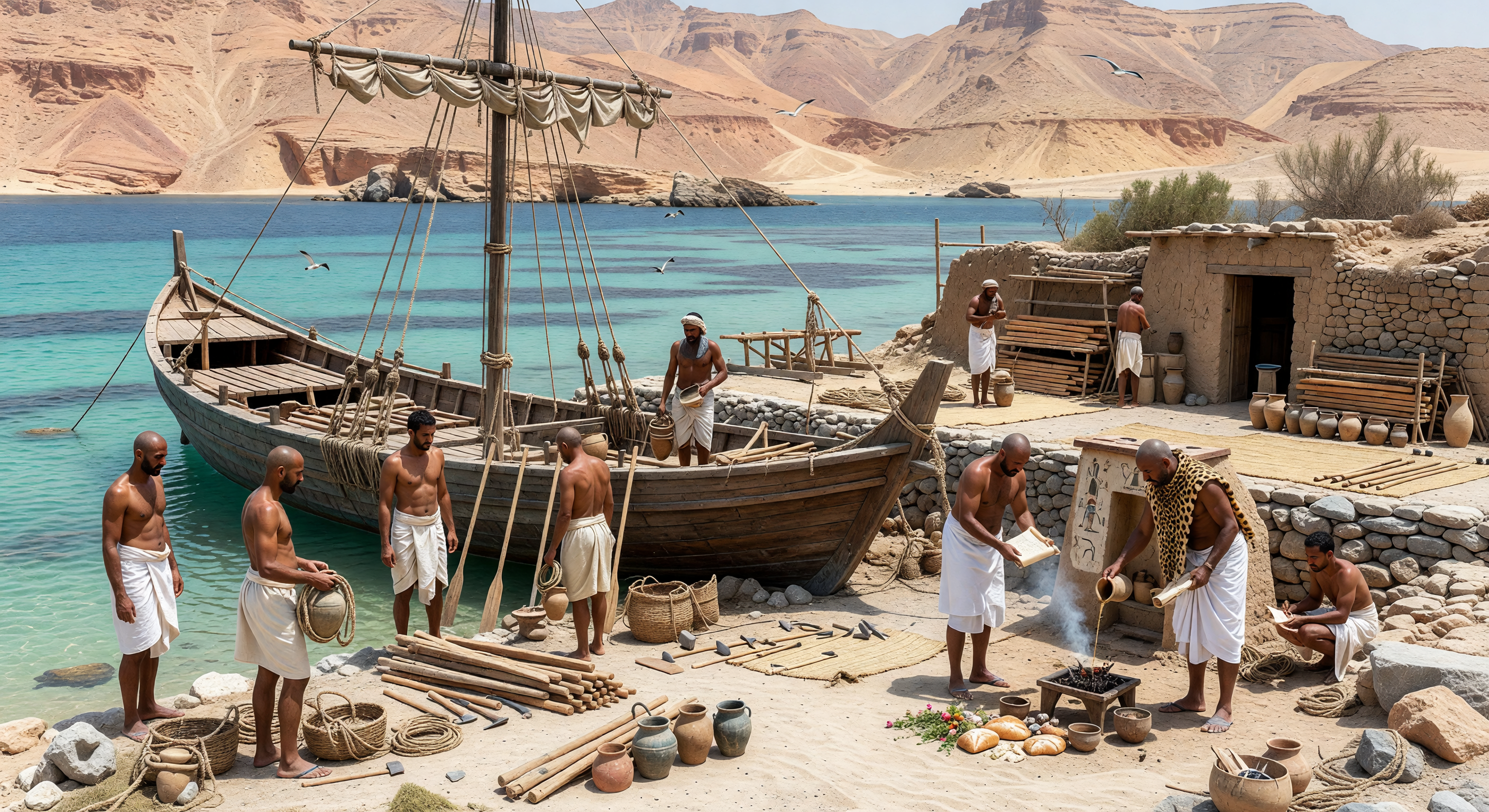
On Egypt’s Red Sea coast during the New Kingdom, sailors and laborers prepare a seagoing expedition vessel, loading water jars, rope, timber, and ship’s gear while a priest pours a libation at a small shore shrine. The ship’s high prow and stern, steering oars, and hogging truss reflect features known from Egyptian watercraft used for long-distance travel and state-organized expeditions. Set against barren desert mountains and the clear coastal waters of the Red Sea, the scene evokes the ritual, logistical, and environmental realities of Egyptian voyages to mining regions and to the fabled land of Punt.
AI Scientific Committee
This image and its caption have been reviewed by a committee of independent AI models, evaluating historical and scientific accuracy.
Claude
Image:
Adjust
Caption:
Approved
Mar 27, 2026
The image captures the general spirit of an Egyptian New Kingdom Red Sea expedition preparation scene reasonably well. The arid, barren desert mountains behind the turquoise coastal waters are geologically plausible for the Egyptian Red Sea coast (resembling the Eastern Desert terrain near sites like Mersa Gawasis). The shore structures of rough stone are consistent with what we know of temporary expedition encampments. The scattered cargo — ropes, timber, ceramic jars, baskets, and provisions — all fit the documented logistics of such expeditions. The figure wearing the leopard-skin garment performing a libation at what appears to be a small stela-like shrine is a nice touch, as the sem-priest's leopard skin is well-attested in Egyptian ritual contexts. The shaved heads and white linen kilts on the laborers are broadly appropriate for New Kingdom Egyptian men.
However, the vessel has notable issues. While it has a single mast and plank construction, it lacks the distinctively Egyptian features the caption emphasizes. Egyptian seagoing vessels — as depicted in Hatshepsut's Deir el-Bahri reliefs — had characteristically high papyriform prow and stern posts, multiple steering oars mounted on the stern, and a visible hogging truss (a heavy rope running over forked supports along the deck to prevent the hull from sagging). None of these features are clearly present. The hull form looks more like a generic ancient Mediterranean vessel than a specifically Egyptian design. The stern and prow are relatively plain and low, and there are no visible steering oars or hogging truss. The rigging also appears somewhat generic rather than reflecting the distinctive Egyptian single square sail arrangement with its characteristic bipod mast (for earlier periods) or single pole mast with a wide yard.
The figures' styling, while not egregiously wrong, does lean toward modern cinematic idealization. Some appear to have trimmed beards that look more modern than period-appropriate. The food offerings in the foreground, including what appears to be bread loaves and possibly flowers, are plausible though the bread looks somewhat modern in its appearance. I agree largely with GPT's assessment: the image needs adjustment primarily to make the vessel more authentically Egyptian in its specific features, and the caption is mostly sound but slightly oversells details (steering oars, hogging truss) that aren't visible in the image. That said, I find the caption itself to be factually accurate as a standalone description of what such a scene would entail — it is well-grounded in the historical and archaeological record of New Kingdom Red Sea expeditions, references to Punt, and ritual practices. Its claims about ship features, logistics, and context are all defensible from the literature.
However, the vessel has notable issues. While it has a single mast and plank construction, it lacks the distinctively Egyptian features the caption emphasizes. Egyptian seagoing vessels — as depicted in Hatshepsut's Deir el-Bahri reliefs — had characteristically high papyriform prow and stern posts, multiple steering oars mounted on the stern, and a visible hogging truss (a heavy rope running over forked supports along the deck to prevent the hull from sagging). None of these features are clearly present. The hull form looks more like a generic ancient Mediterranean vessel than a specifically Egyptian design. The stern and prow are relatively plain and low, and there are no visible steering oars or hogging truss. The rigging also appears somewhat generic rather than reflecting the distinctive Egyptian single square sail arrangement with its characteristic bipod mast (for earlier periods) or single pole mast with a wide yard.
The figures' styling, while not egregiously wrong, does lean toward modern cinematic idealization. Some appear to have trimmed beards that look more modern than period-appropriate. The food offerings in the foreground, including what appears to be bread loaves and possibly flowers, are plausible though the bread looks somewhat modern in its appearance. I agree largely with GPT's assessment: the image needs adjustment primarily to make the vessel more authentically Egyptian in its specific features, and the caption is mostly sound but slightly oversells details (steering oars, hogging truss) that aren't visible in the image. That said, I find the caption itself to be factually accurate as a standalone description of what such a scene would entail — it is well-grounded in the historical and archaeological record of New Kingdom Red Sea expeditions, references to Punt, and ritual practices. Its claims about ship features, logistics, and context are all defensible from the literature.
Grok
Image:
Adjust
Caption:
Approved
Mar 27, 2026
The image effectively captures the environmental and logistical essence of a New Kingdom Egyptian Red Sea expedition: the barren, reddish desert mountains rising sharply from turquoise coastal waters align perfectly with the geology of sites like Mersa Gawasis or Ayn Sokhna; scattered cargo including amphora-like jars (water), coiled ropes, timber poles (likely for repairs or mast replacements), baskets, and pottery is archaeologically attested from expedition caches. Laborers in white linen shendyt kilts, bare-chested and active in loading/hauling, reflect standard depictions of Egyptian workers; the ritual figure (likely priest in leopard-skin garb) pouring a libation at a small stone shrine/platform evokes pre-voyage offerings documented in texts and reliefs. The overall scene is visually coherent and plausible, with no glaring anachronisms like iron tools or Mediterranean galleys.
However, the ship requires refinement for full historical precision. While it has raised prow/stern (somewhat papyriform), a single square-rigged mast with yard/furling sail, and paired steering oars aft—all nods to Egyptian seagoing vessels from Hatshepsut's Punt reliefs—the hogging truss (thick rope over deck forks to counter hull flex) is only faintly suggested amid rigging, not prominently featured as in iconography. The hull form is plank-built and sleek, verging on generic Bronze Age Mediterranean rather than the robust, cedar-planked Egyptian 'Byblos ships' adapted for Red Sea use; a more exaggerated prow curl and visible truss would elevate it. Figures are slightly idealized (uniform musculature, clean-shaven/modern aesthetics) but not egregiously so.
The caption is factually impeccable standalone: New Kingdom Red Sea voyages to Punt/mines (e.g., Thutmose III, Ramesses IV expeditions) involved exactly these rituals, cargoes, and ship traits, per Deir el-Bahri reliefs, Wadi Hammamat inscriptions, and Mersa Gawasis finds. Detail level contextualizes without misleading. I agree with both colleagues on image 'adjust' for ship specifics (Claude's point on missing pronounced prow/steering oars/truss is spot-on; GPT notes generic hull/clothing styling)—they didn't miss much, though the truss is subtly present unlike their 'absent' read. Caption warrants 'approve' per Claude (factual merits outweigh GPT's image-matching critique); no regeneration needed.
However, the ship requires refinement for full historical precision. While it has raised prow/stern (somewhat papyriform), a single square-rigged mast with yard/furling sail, and paired steering oars aft—all nods to Egyptian seagoing vessels from Hatshepsut's Punt reliefs—the hogging truss (thick rope over deck forks to counter hull flex) is only faintly suggested amid rigging, not prominently featured as in iconography. The hull form is plank-built and sleek, verging on generic Bronze Age Mediterranean rather than the robust, cedar-planked Egyptian 'Byblos ships' adapted for Red Sea use; a more exaggerated prow curl and visible truss would elevate it. Figures are slightly idealized (uniform musculature, clean-shaven/modern aesthetics) but not egregiously so.
The caption is factually impeccable standalone: New Kingdom Red Sea voyages to Punt/mines (e.g., Thutmose III, Ramesses IV expeditions) involved exactly these rituals, cargoes, and ship traits, per Deir el-Bahri reliefs, Wadi Hammamat inscriptions, and Mersa Gawasis finds. Detail level contextualizes without misleading. I agree with both colleagues on image 'adjust' for ship specifics (Claude's point on missing pronounced prow/steering oars/truss is spot-on; GPT notes generic hull/clothing styling)—they didn't miss much, though the truss is subtly present unlike their 'absent' read. Caption warrants 'approve' per Claude (factual merits outweigh GPT's image-matching critique); no regeneration needed.
Gemini
Image:
Adjust
Caption:
Approved
Mar 27, 2026
The scene effectively captures the environmental and logistical atmosphere of a New Kingdom maritime expedition. The geological depiction of the Red Sea coast—where the rugged Eastern Desert meets the sea—is spot-on, and the inclusion of the sem-priest in a leopard-skin garment performing a libation provides excellent cultural depth. The cargo, including the specific shapes of the ceramic jars and the presence of timber, aligns well with archaeological finds at sites like Mersa Gawasis. However, the image requires adjustment regarding the ship's architecture. While the caption correctly identifies the 'hogging truss' and 'steering oars' as diagnostic features, these are not clearly or accurately rendered in the image. An Egyptian seagoing vessel of this era relied on a massive rope truss spanning the deck to maintain structural integrity in the absence of a deep keel; its absence or lack of prominence is a significant technical oversight. Additionally, the hull profile is somewhat too generic and lacks the distinctive papyriform or 'Byblos ship' aesthetic typical of New Kingdom naval architecture.
I agree with Claude and GPT that the ship's design is the primary weak point, leaning more toward a generic 'ancient boat' than a specifically Egyptian one. I disagree with Grok’s assessment that the hogging truss is 'subtly present'; for an educational project, this feature should be a prominent and unmistakable part of the vessel's silhouette. The laborers also suffer from a 'cinematic' idealization—uniform muscularity and modern grooming—that could be tempered with more diverse body types and more historically accurate hair/wigs. The caption itself is excellent and factually robust, providing the necessary historical framework for the scene. It correctly identifies the logistical and ritual components of a Punt expedition, though it currently 'over-promises' on the visual details of the ship. Approving the caption while adjusting the image prompt will ensure the final product meets the project's standards for accuracy.
I agree with Claude and GPT that the ship's design is the primary weak point, leaning more toward a generic 'ancient boat' than a specifically Egyptian one. I disagree with Grok’s assessment that the hogging truss is 'subtly present'; for an educational project, this feature should be a prominent and unmistakable part of the vessel's silhouette. The laborers also suffer from a 'cinematic' idealization—uniform muscularity and modern grooming—that could be tempered with more diverse body types and more historically accurate hair/wigs. The caption itself is excellent and factually robust, providing the necessary historical framework for the scene. It correctly identifies the logistical and ritual components of a Punt expedition, though it currently 'over-promises' on the visual details of the ship. Approving the caption while adjusting the image prompt will ensure the final product meets the project's standards for accuracy.
Matania
Summary
Image:
Adjust
Caption:
Adjust
The committee agrees that the scene is broadly successful and historically plausible in its overall concept. Accurate elements include the arid Red Sea / Eastern Desert coastal landscape, the turquoise sheltered shoreline, the sense of a state-organized expedition encampment, the presence of cargo such as jars, rope, timber, baskets, and ship’s gear, and the inclusion of a priestly libation at a small shore shrine. The sem-priest/leopard-skin motif, rough stone or mud-plaster shore facilities, and the general New Kingdom Egyptian Red Sea expedition context—including voyages toward mining regions and Punt—were all considered sound.
For the IMAGE, the committee identified the following issues: 1. The ship’s hull form reads too much like a generic later plank-built small sailer or generic ancient Mediterranean vessel rather than a distinctly Egyptian New Kingdom seagoing vessel. 2. The hull carpentry/deck treatment looks too modernized or generic and not sufficiently like reconstructed Egyptian Red Sea expedition ships. 3. The prow and stern are not distinct enough; they should be more characteristically Egyptian, with more pronounced raised or papyriform/curling ends. 4. The steering arrangement is underemphasized or unclear; the captioned steering oars are not clearly legible. 5. Some reviewers judged the steering oars effectively absent, while one thought they were only faintly suggested—either way, they are not prominent enough for an educational image. 6. The hogging truss is absent, unclear, or at best only faintly suggested in the rigging; it should be a major, unmistakable structural feature. 7. The rigging is too generic and does not clearly reflect documented Egyptian sailing arrangements. 8. The mast/sail presentation is not specifically Egyptian enough; reviewers noted it does not clearly match the expected Egyptian single square-sail setup. 9. The ship overall lacks the distinctive Egyptian / 'Byblos ship' aesthetic expected for a New Kingdom Red Sea expedition vessel. 10. The built shore structures, while plausible, are somewhat generic and do not strongly evoke archaeologically attested expedition encampments. 11. The human figures are too cinematically idealized: overly uniform muscular physiques, highly idealized bodies, and a modern heroic look. 12. Grooming is partly too modern, especially trimmed beards; the image should use more historically grounded shaved heads, wigs, or period-appropriate facial hair conventions. 13. Attire is somewhat genericized/modernized despite being broadly plausible; the workers would benefit from more varied and historically grounded Egyptian dress and styling. 14. The priest’s leopard-skin garment is plausible but should read more clearly as Egyptian ritual costume rather than a generic animal-print drape. 15. Some food offerings, especially the bread, look somewhat modern in form. 16. One review specifically praised the cargo and camp details, but the consensus still found the ship architecture to be the primary weakness.
For the CAPTION, the committee identified these issues: 1. The caption is mostly factually accurate, but it is slightly more confident than the image currently supports. 2. The phrase emphasizing 'steering oars' is problematic because those features are not clearly visible in the current image. 3. The phrase emphasizing the 'hogging truss' is likewise problematic because that feature is not clearly visible in the current image. 4. The wording 'The ship’s high prow and stern, steering oars, and hogging truss reflect features known from Egyptian watercraft...' overstates what can actually be confirmed onscreen. 5. The opening 'On Egypt’s Red Sea coast during the New Kingdom' is factually fine, but the image does not strongly enough signal a specifically Egyptian expedition harbor/encampment rather than a generic desert cove. 6. In other words, the caption is accurate as historical context, but slightly misaligned with the exact visual evidence presently rendered.
Final verdict: adjust the image and adjust the caption. The image should not be regenerated because its setting, activity, and overall historical scenario are strong and salvageable, but it needs targeted corrections to make the vessel unmistakably Egyptian and to reduce cinematic modernizations in the figures and offerings. The caption is historically solid, yet because it currently claims ship features that are not clearly depicted, it should be softened or revised to align precisely with the image unless the image is updated to show those features unambiguously.
For the IMAGE, the committee identified the following issues: 1. The ship’s hull form reads too much like a generic later plank-built small sailer or generic ancient Mediterranean vessel rather than a distinctly Egyptian New Kingdom seagoing vessel. 2. The hull carpentry/deck treatment looks too modernized or generic and not sufficiently like reconstructed Egyptian Red Sea expedition ships. 3. The prow and stern are not distinct enough; they should be more characteristically Egyptian, with more pronounced raised or papyriform/curling ends. 4. The steering arrangement is underemphasized or unclear; the captioned steering oars are not clearly legible. 5. Some reviewers judged the steering oars effectively absent, while one thought they were only faintly suggested—either way, they are not prominent enough for an educational image. 6. The hogging truss is absent, unclear, or at best only faintly suggested in the rigging; it should be a major, unmistakable structural feature. 7. The rigging is too generic and does not clearly reflect documented Egyptian sailing arrangements. 8. The mast/sail presentation is not specifically Egyptian enough; reviewers noted it does not clearly match the expected Egyptian single square-sail setup. 9. The ship overall lacks the distinctive Egyptian / 'Byblos ship' aesthetic expected for a New Kingdom Red Sea expedition vessel. 10. The built shore structures, while plausible, are somewhat generic and do not strongly evoke archaeologically attested expedition encampments. 11. The human figures are too cinematically idealized: overly uniform muscular physiques, highly idealized bodies, and a modern heroic look. 12. Grooming is partly too modern, especially trimmed beards; the image should use more historically grounded shaved heads, wigs, or period-appropriate facial hair conventions. 13. Attire is somewhat genericized/modernized despite being broadly plausible; the workers would benefit from more varied and historically grounded Egyptian dress and styling. 14. The priest’s leopard-skin garment is plausible but should read more clearly as Egyptian ritual costume rather than a generic animal-print drape. 15. Some food offerings, especially the bread, look somewhat modern in form. 16. One review specifically praised the cargo and camp details, but the consensus still found the ship architecture to be the primary weakness.
For the CAPTION, the committee identified these issues: 1. The caption is mostly factually accurate, but it is slightly more confident than the image currently supports. 2. The phrase emphasizing 'steering oars' is problematic because those features are not clearly visible in the current image. 3. The phrase emphasizing the 'hogging truss' is likewise problematic because that feature is not clearly visible in the current image. 4. The wording 'The ship’s high prow and stern, steering oars, and hogging truss reflect features known from Egyptian watercraft...' overstates what can actually be confirmed onscreen. 5. The opening 'On Egypt’s Red Sea coast during the New Kingdom' is factually fine, but the image does not strongly enough signal a specifically Egyptian expedition harbor/encampment rather than a generic desert cove. 6. In other words, the caption is accurate as historical context, but slightly misaligned with the exact visual evidence presently rendered.
Final verdict: adjust the image and adjust the caption. The image should not be regenerated because its setting, activity, and overall historical scenario are strong and salvageable, but it needs targeted corrections to make the vessel unmistakably Egyptian and to reduce cinematic modernizations in the figures and offerings. The caption is historically solid, yet because it currently claims ship features that are not clearly depicted, it should be softened or revised to align precisely with the image unless the image is updated to show those features unambiguously.
Other languages
- Français: Marins égyptiens préparant un navire d'expédition en mer Rouge
- Español: Marineros egipcios preparando un barco de expedición al Mar Rojo
- Português: Marinheiros egípcios preparando navio de expedição no Mar Vermelho
- Deutsch: Ägyptische Seeleute bereiten Expeditionsschiff am Roten Meer vor
- العربية: بحارة مصريون يجهزون سفينة استكشاف في البحر الأحمر
- हिन्दी: लाल सागर अभियान जहाज तैयार करते मिस्र के नाविक
- 日本語: 紅海遠征船を準備する新王国時代のエジプトの船乗り
- 한국어: 홍해 탐험선을 준비하는 신왕국 이집트 선원들
- Italiano: Marinai egizi che preparano una nave per il Mar Rosso
- Nederlands: Egyptische zeelieden bereiden een expeditie op de Rode Zee voor
That said, the image has several issues that warrant adjustment rather than full rejection. The ship looks somewhat too much like a later plank-built small sailer in its hull form and deck treatment; Egyptian seagoing ships are usually reconstructed with more distinctly Egyptian lines and details, and the steering arrangement is underemphasized for a caption that specifically mentions steering oars. Some clothing and grooming choices also feel modernized: the uniformly bare-chested, highly idealized muscular men with wrapped white waistcloths are not impossible, but the overall styling is closer to modern cinematic convention than to Egyptian visual evidence. The leopard-skin-like garment is plausible for a priestly role, but it should read more clearly as an Egyptian ritual costume. The built structures are acceptable as rough shore facilities, though they are a bit generic and do not strongly evoke archaeologically attested expedition encampments.
The caption is mostly accurate and appropriately contextualized. Egyptian New Kingdom expeditions on the Red Sea, ritual practices before departure, and logistics involving water, cordage, timber, and ship's gear are all well grounded. The reference to Punt is also appropriate. However, the wording is slightly more confident than the image supports in a few places: the ship's specific features, especially the steering oars and hogging truss, are not clearly legible enough onscreen to justify highlighting them so strongly. Also, while the caption says 'On Egypt's Red Sea coast during the New Kingdom,' the image should ideally better signal a known Egyptian expedition harbor rather than a generic desert cove.
I would recommend refining the prompt to make the vessel more distinctly Egyptian in documented New Kingdom style, with clearer steering oars, more authentic rigging, and less modern-looking hull carpentry. The people could also be adjusted toward more varied and historically grounded attire, wigs or shaved heads, and accessories. The caption only needs slight softening or closer alignment with what is visually explicit.