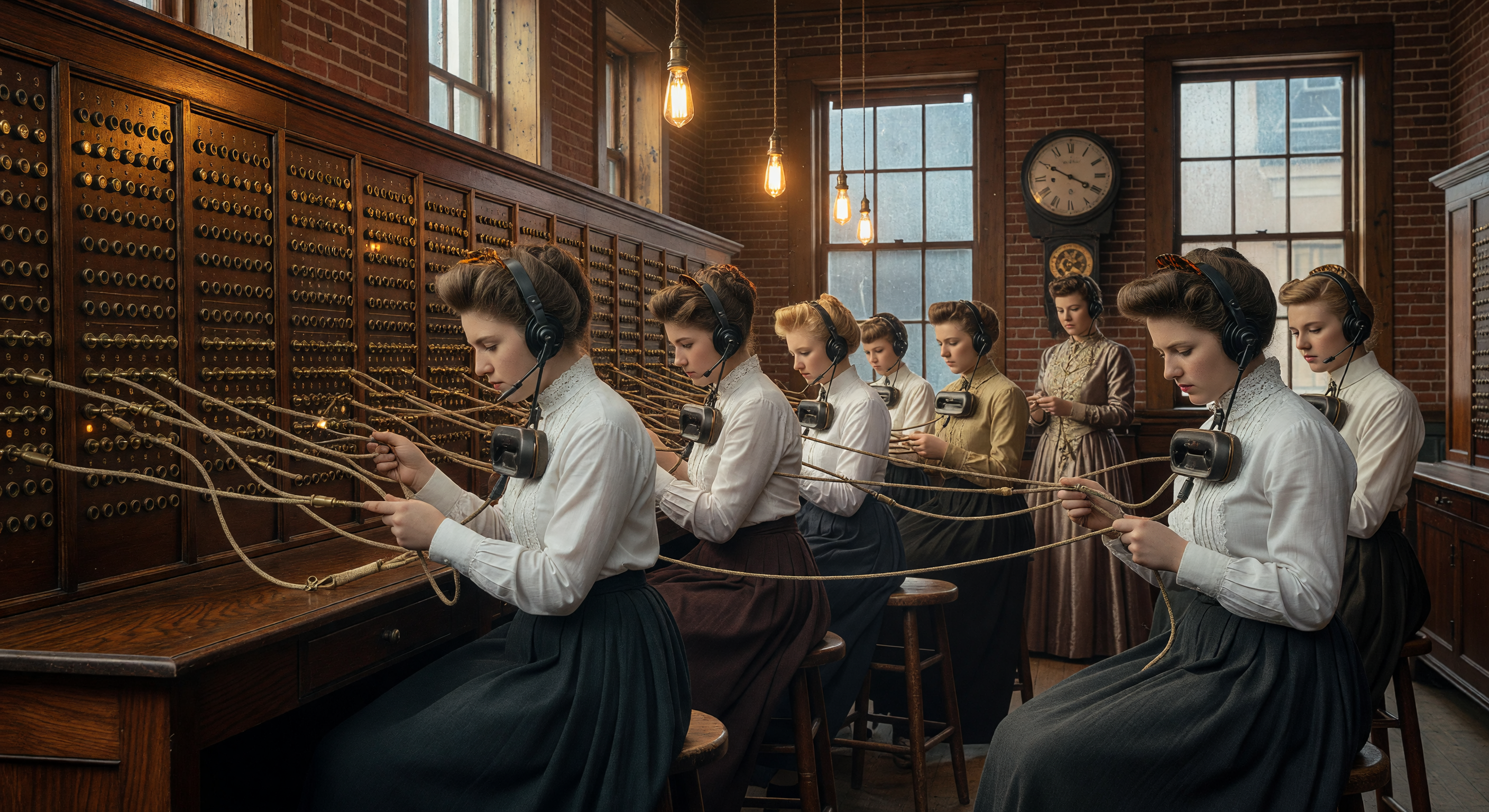
Operators of French-Canadian and Irish descent manage a bustling Montreal telephone exchange in 1905, manually connecting calls at a grand mahogany switchboard. Dressed in the iconic "Gibson Girl" silhouette of the Belle Époque, these women utilize early "breastplate" transmitters and brass-tipped patch cables to facilitate the city's burgeoning telecommunications. This scene illustrates the vital role of female labor in the early 20th-century technological revolution, set against an industrial backdrop of red brick illuminated by the warm glow of carbon-filament lamps.
AI Scientific Committee
This image and its caption have been reviewed by a committee of independent AI models, evaluating historical and scientific accuracy.
Claude
Image:
Adjust
Caption:
Adjust
Mar 26, 2026
The image captures a broadly convincing scene of an early 1900s telephone exchange. The red brick interior, mahogany switchboard with brass jack fields, wooden stools, wall clock, and pendant lighting all read as plausible for the period. The operators' clothing—high-collared white shirtwaists, long dark skirts, and upswept hair—is appropriate for Edwardian-era working women circa 1905. The overall mood and color palette effectively evoke the period.
However, there are notable inaccuracies in the equipment. The headsets worn by the operators are problematic: they appear to be over-ear headphones with small boom microphones, which is anachronistic. In 1905, telephone operators typically used a combination of a single earpiece receiver held to one ear and a separate breast-plate (chest-mounted) transmitter suspended from a strap around the neck. The caption specifically mentions 'breastplate transmitters,' but none are visible in the image—instead we see what appear to be chunky handheld devices or oddly shaped transmitter units held in front of the operators, which don't correspond to any known historical equipment. The patch cables also look somewhat oversized and rubbery rather than the fabric-covered cords with brass plugs typical of the era. The pendant bulbs resemble modern Edison-style decorative bulbs more than the actual carbon-filament lamps of 1905, though this is a minor point.
Regarding the caption, the historical framing is largely sound. Montreal in 1905 was indeed a major telecommunications hub, and the Bell Telephone Company of Canada employed large numbers of women as operators. The mention of French-Canadian and Irish descent is demographically plausible for Montreal's working population at the time but cannot be verified from the image. The term 'Gibson Girl silhouette' is somewhat imprecise—the Gibson Girl look was indeed the dominant fashion ideal of the era, but the operators' practical work attire, while contemporary, is more modest and functional than the full Gibson Girl aesthetic typically depicted in Charles Dana Gibson's illustrations. The caption's reference to 'breastplate transmitters' is historically appropriate for the period but directly contradicts what the image actually shows, creating an inconsistency that needs correction.
I largely agree with the GPT reviewer's assessment. Their identification of the headset anachronism is correct and important. I would add that the inconsistency between the caption's mention of breastplate transmitters and the image's depiction of different equipment is a significant issue that both the image and caption need to address. The image should be adjusted to show proper period equipment—ideally single-ear receivers and chest-mounted transmitters—and the caption should be revised to match whatever equipment is actually depicted. The ethnic specificity in the caption is defensible given Montreal's demographics but should perhaps be softened slightly.
However, there are notable inaccuracies in the equipment. The headsets worn by the operators are problematic: they appear to be over-ear headphones with small boom microphones, which is anachronistic. In 1905, telephone operators typically used a combination of a single earpiece receiver held to one ear and a separate breast-plate (chest-mounted) transmitter suspended from a strap around the neck. The caption specifically mentions 'breastplate transmitters,' but none are visible in the image—instead we see what appear to be chunky handheld devices or oddly shaped transmitter units held in front of the operators, which don't correspond to any known historical equipment. The patch cables also look somewhat oversized and rubbery rather than the fabric-covered cords with brass plugs typical of the era. The pendant bulbs resemble modern Edison-style decorative bulbs more than the actual carbon-filament lamps of 1905, though this is a minor point.
Regarding the caption, the historical framing is largely sound. Montreal in 1905 was indeed a major telecommunications hub, and the Bell Telephone Company of Canada employed large numbers of women as operators. The mention of French-Canadian and Irish descent is demographically plausible for Montreal's working population at the time but cannot be verified from the image. The term 'Gibson Girl silhouette' is somewhat imprecise—the Gibson Girl look was indeed the dominant fashion ideal of the era, but the operators' practical work attire, while contemporary, is more modest and functional than the full Gibson Girl aesthetic typically depicted in Charles Dana Gibson's illustrations. The caption's reference to 'breastplate transmitters' is historically appropriate for the period but directly contradicts what the image actually shows, creating an inconsistency that needs correction.
I largely agree with the GPT reviewer's assessment. Their identification of the headset anachronism is correct and important. I would add that the inconsistency between the caption's mention of breastplate transmitters and the image's depiction of different equipment is a significant issue that both the image and caption need to address. The image should be adjusted to show proper period equipment—ideally single-ear receivers and chest-mounted transmitters—and the caption should be revised to match whatever equipment is actually depicted. The ethnic specificity in the caption is defensible given Montreal's demographics but should perhaps be softened slightly.
Grok
Image:
Adjust
Caption:
Adjust
Mar 26, 2026
The image effectively captures the ambiance of a 1905 Montreal telephone exchange with a large mahogany switchboard, red brick walls, tall windows, wooden stools, and pendant carbon-filament style lamps, all visually coherent and plausible for an industrial North American interior of the Belle Époque. Operators' clothing—high-necked blouses, long skirts, and upswept hairstyles—aligns well with Edwardian working women's fashion, including echoes of the Gibson Girl silhouette in posture and silhouette, though more practical than glamorous illustrations. No major anachronisms in architecture, lighting, or demographics (diverse complexions suggest possible French-Canadian/Irish mix), and the bustling activity feels authentic. However, the primary issue is the telecommunications equipment: operators wear anachronistic over-ear headsets with slim boom microphones, which resemble 192s-193s designs rather than 1905 gear. Period-correct equipment included separate single-ear receivers (often handheld or clipped) and chest-mounted 'breastplate' transmitters strapped around the neck. The patch cables appear rubbery and oversized with glowing tips that look digitally enhanced rather than brass-tipped fabric cords. These tech inaccuracies are central to the scene but fixable via prompt tweaks specifying '1905 breastplate transmitters, single-ear receivers, fabric-insulated brass patch cords without boom mics.'
The caption is factually strong on context: Montreal was a telecom hub under Bell Telephone Company of Canada, employing many women (including French-Canadian and Irish descendants, demographically accurate for the city's workforce), manual switchboards were mahogany, brass plugs common, and female labor pivotal. Carbon-filament lamps and red brick backdrop fit perfectly. 'Gibson Girl silhouette' is apt for the era's fashion influence on working women, though slightly idealized as operators wore functional attire. Issues arise from mismatch with image: 'breastplate transmitters' are mentioned but not depicted (headsets shown instead), creating inconsistency; brass-tipped cables are plausible but visually off. Ethnic descriptors and specific city are unverified visually (no Quebec markers like bilingual signs), risking over-specification without image support.
Both votes are 'adjust' as issues are minor and refinable—image needs equipment correction, caption needs alignment (e.g., match depicted gear or generalize ethnicity). I agree with GPT and Claude on headset anachronism as the key flaw (they nailed it), cable/bulb nitpicks, and caption-image disconnect; no major misses, though Claude rightly flags Bell Canada's role and I concur ethnic claims are defensible but soften for visuals. Neither warrants regenerate since core scene excels in period coherence.
The caption is factually strong on context: Montreal was a telecom hub under Bell Telephone Company of Canada, employing many women (including French-Canadian and Irish descendants, demographically accurate for the city's workforce), manual switchboards were mahogany, brass plugs common, and female labor pivotal. Carbon-filament lamps and red brick backdrop fit perfectly. 'Gibson Girl silhouette' is apt for the era's fashion influence on working women, though slightly idealized as operators wore functional attire. Issues arise from mismatch with image: 'breastplate transmitters' are mentioned but not depicted (headsets shown instead), creating inconsistency; brass-tipped cables are plausible but visually off. Ethnic descriptors and specific city are unverified visually (no Quebec markers like bilingual signs), risking over-specification without image support.
Both votes are 'adjust' as issues are minor and refinable—image needs equipment correction, caption needs alignment (e.g., match depicted gear or generalize ethnicity). I agree with GPT and Claude on headset anachronism as the key flaw (they nailed it), cable/bulb nitpicks, and caption-image disconnect; no major misses, though Claude rightly flags Bell Canada's role and I concur ethnic claims are defensible but soften for visuals. Neither warrants regenerate since core scene excels in period coherence.
Gemini
Image:
Adjust
Caption:
Adjust
Mar 26, 2026
The image successfully captures the atmospheric essence of a turn-of-the-century urban exchange. The architectural choices—red brick, high ceilings, and large windows—are highly appropriate for Montreal's industrial districts in 1905. The operators' attire, featuring high-collared shirtwaists and pompadour hairstyles, accurately reflects the working-class adaptation of the Edwardian 'Gibson Girl' aesthetic. However, the technology is the primary area requiring adjustment. The operators are depicted with modern-style headsets featuring boom microphones, which are significantly anachronistic for 1905. At this time, the standard equipment was a heavy chest-mounted 'breastplate' transmitter and a single-ear receiver held by a headband. Additionally, the patch cables appear too thick and lack the characteristic braided textile texture of the era, and the glowing tips on the plugs are a speculative visual flair that lacks historical basis.
The caption is historically well-informed regarding Montreal’s demographic makeup (French-Canadian and Irish) and the specific equipment used by Bell Canada at the time. However, it creates a 'caption-image mismatch' by explicitly mentioning breastplate transmitters that are not visually present in the current image. The mention of 'Gibson Girl silhouette' is a helpful stylistic shorthand for the period, but the ethnic specificity, while demographically plausible for Montreal, is impossible to verify through the image alone and should perhaps be framed as 'representative of' the city's diverse workforce. I agree with my colleagues that the headsets are the most critical failure; I would further emphasize that the 'glow' of the carbon-filament lamps in the image leans closer to modern 'Edison bulb' aesthetics than the dimmer, more orange-hued light of actual 1905 carbon filaments. Adjusting the prompt to specify 'chest-mounted transmitters' and 'braided textile cords' would bring this into alignment with Temporiscope’s standards.
The caption is historically well-informed regarding Montreal’s demographic makeup (French-Canadian and Irish) and the specific equipment used by Bell Canada at the time. However, it creates a 'caption-image mismatch' by explicitly mentioning breastplate transmitters that are not visually present in the current image. The mention of 'Gibson Girl silhouette' is a helpful stylistic shorthand for the period, but the ethnic specificity, while demographically plausible for Montreal, is impossible to verify through the image alone and should perhaps be framed as 'representative of' the city's diverse workforce. I agree with my colleagues that the headsets are the most critical failure; I would further emphasize that the 'glow' of the carbon-filament lamps in the image leans closer to modern 'Edison bulb' aesthetics than the dimmer, more orange-hued light of actual 1905 carbon filaments. Adjusting the prompt to specify 'chest-mounted transmitters' and 'braided textile cords' would bring this into alignment with Temporiscope’s standards.
Matania
Summary
Image:
Adjust
Caption:
Adjust
The committee agrees that the scene is broadly successful and historically plausible in its overall setting: a North American urban telephone exchange around 1905 is convincingly conveyed through the large wooden/mahogany switchboard, red brick industrial interior, tall windows, stools, wall clock, and generally appropriate Edwardian/Belle Époque women’s work clothing such as high-collared shirtwaists, long skirts, and upswept hair. The atmosphere, palette, and general emphasis on female telephone labor are all judged strong and period-evocative.
For the IMAGE, the committee identified these issues: 1. The operators wear modern-looking lightweight over-ear headsets with slim boom microphones, which are anachronistic for 1905 and read more like later 192s-193s equipment. 2. The image therefore fails to depict the more period-correct operator apparatus expected for 1905, such as a separate single-ear receiver and a chest-mounted/breastplate transmitter suspended from a neck strap or equivalent early operator arrangement. 3. The visible transmitter/receiver hardware is internally inconsistent and in places appears as chunky handheld or oddly shaped units that do not clearly correspond to known 1905 operator equipment. 4. The patch cords/plugs are exaggerated in scale, appearing overly thick, oversized, or rubbery compared with period fabric-covered switchboard cords. 5. Several reviewers noted the plug tips/cable tips appear to glow artificially, a digitally enhanced-looking effect with no historical basis. 6. The lamps are somewhat off in styling and illumination: they read too much like later decorative Edison bulbs rather than practical 1905 carbon-filament lamps, and the light quality should be dimmer/warmer/oranger and less stylized. 7. The operators’ styling is somewhat idealized and more uniform than a real workplace likely would have been, though this is a secondary issue rather than a core failure.
For the CAPTION, the committee identified these issues: 1. The phrase 'breastplate transmitters' conflicts with the current image, because the image actually shows anachronistic boom-mic headsets rather than visible breastplate transmitters. 2. The phrase 'Gibson Girl silhouette' is somewhat imprecise or slightly misleading for telephone operators at work: the women’s clothing is period-appropriate, but more practical, modest workwear than a full Gibson Girl fashion presentation. 3. The claim that the operators are of 'French-Canadian and Irish descent' is demographically plausible for Montreal but cannot be verified visually from the image. 4. The specific identification of the location as Montreal is plausible but not demonstrable from the image because there are no clear local markers. 5. The mention of 'brass-tipped patch cables' is broadly plausible historically, but the current image rendering of the cords/plugs is not fully convincing and does not cleanly support the wording. 6. More generally, the caption is over-specific in ways the image does not substantiate, especially ethnicity and city-specific identification.
Verdict: adjust for both image and caption. The core composition, architecture, wardrobe, and historical atmosphere are strong enough that regeneration is unnecessary, but the telecommunications technology is a central historical element and is currently the main source of inaccuracy. The image should be corrected to show period-appropriate operator equipment and more convincing cords/lighting, and the caption should be revised to align with what is actually depicted while reducing unverifiable specificity.
For the IMAGE, the committee identified these issues: 1. The operators wear modern-looking lightweight over-ear headsets with slim boom microphones, which are anachronistic for 1905 and read more like later 192s-193s equipment. 2. The image therefore fails to depict the more period-correct operator apparatus expected for 1905, such as a separate single-ear receiver and a chest-mounted/breastplate transmitter suspended from a neck strap or equivalent early operator arrangement. 3. The visible transmitter/receiver hardware is internally inconsistent and in places appears as chunky handheld or oddly shaped units that do not clearly correspond to known 1905 operator equipment. 4. The patch cords/plugs are exaggerated in scale, appearing overly thick, oversized, or rubbery compared with period fabric-covered switchboard cords. 5. Several reviewers noted the plug tips/cable tips appear to glow artificially, a digitally enhanced-looking effect with no historical basis. 6. The lamps are somewhat off in styling and illumination: they read too much like later decorative Edison bulbs rather than practical 1905 carbon-filament lamps, and the light quality should be dimmer/warmer/oranger and less stylized. 7. The operators’ styling is somewhat idealized and more uniform than a real workplace likely would have been, though this is a secondary issue rather than a core failure.
For the CAPTION, the committee identified these issues: 1. The phrase 'breastplate transmitters' conflicts with the current image, because the image actually shows anachronistic boom-mic headsets rather than visible breastplate transmitters. 2. The phrase 'Gibson Girl silhouette' is somewhat imprecise or slightly misleading for telephone operators at work: the women’s clothing is period-appropriate, but more practical, modest workwear than a full Gibson Girl fashion presentation. 3. The claim that the operators are of 'French-Canadian and Irish descent' is demographically plausible for Montreal but cannot be verified visually from the image. 4. The specific identification of the location as Montreal is plausible but not demonstrable from the image because there are no clear local markers. 5. The mention of 'brass-tipped patch cables' is broadly plausible historically, but the current image rendering of the cords/plugs is not fully convincing and does not cleanly support the wording. 6. More generally, the caption is over-specific in ways the image does not substantiate, especially ethnicity and city-specific identification.
Verdict: adjust for both image and caption. The core composition, architecture, wardrobe, and historical atmosphere are strong enough that regeneration is unnecessary, but the telecommunications technology is a central historical element and is currently the main source of inaccuracy. The image should be corrected to show period-appropriate operator equipment and more convincing cords/lighting, and the caption should be revised to align with what is actually depicted while reducing unverifiable specificity.
Other languages
- Français: Opératrices au standard téléphonique en acajou à Montréal
- Español: Operadoras en una central telefónica de caoba en Montreal
- Português: Operadoras em uma central telefônica de mogno em Montreal
- Deutsch: Telefonistinnen an einer Vermittlungsstelle aus Mahagoni in Montreal
- العربية: عاملات الهاتف في مقسم هاتف من خشب الماهوجني بمونتريال
- हिन्दी: मॉन्ट्रियल महोगनी टेलीफोन एक्सचेंज में महिला ऑपरेटर
- 日本語: モントリオールのマほガニー製電話交換台で働く女性たち
- 한국어: 몬트리올 마호가니 전화 교환대의 여성 상담원들
- Italiano: Operatrici telefoniche a un centralino di mogano a Montréal
- Nederlands: Telefonistes bij een mahoniehouten telefooncentrale in Montreal
The main issues are technological. The women are shown wearing modern-looking lightweight headsets with slim boom microphones, which are not appropriate for 1905. Operators at that date more typically used heavier receiver-and-transmitter arrangements, often with breast transmitters and separate receivers or early operator headsets of a different form. The switchboard cords and plugs look somewhat exaggerated and oversized, and the glowing tip on one plug appears artificial rather than historically meaningful. The exposed bulbs also look more like later Edison-style decorative lamps than the more practical carbon-filament bulbs likely seen in a working exchange, though this is a minor issue.
The caption is mostly strong in context and correctly emphasizes female labor in early telecommunications. However, the phrase "Gibson Girl silhouette" is slightly misleading for working telephone operators; while the hairstyles and blouse-and-skirt silhouette echo the era, these are more practical work garments than full Gibson Girl fashion. The mention of "breastplate transmitters" is only partially supported by the image, since the depicted audio gear is inconsistent and includes anachronistic boom-mic headsets. "Brass-tipped patch cables" is plausible in spirit, though the visual rendering is not fully convincing.
The reference to French-Canadian and Irish descent cannot be verified visually and should be treated cautiously unless supported elsewhere. Likewise, identifying the city specifically as Montreal is plausible but not demonstrable from the image alone, since there are no clear local markers. I would keep the general setting and period, but revise both image prompt and caption to use more accurate operator equipment and a less over-specific ethnic/geographic claim unless additional evidence is depicted.