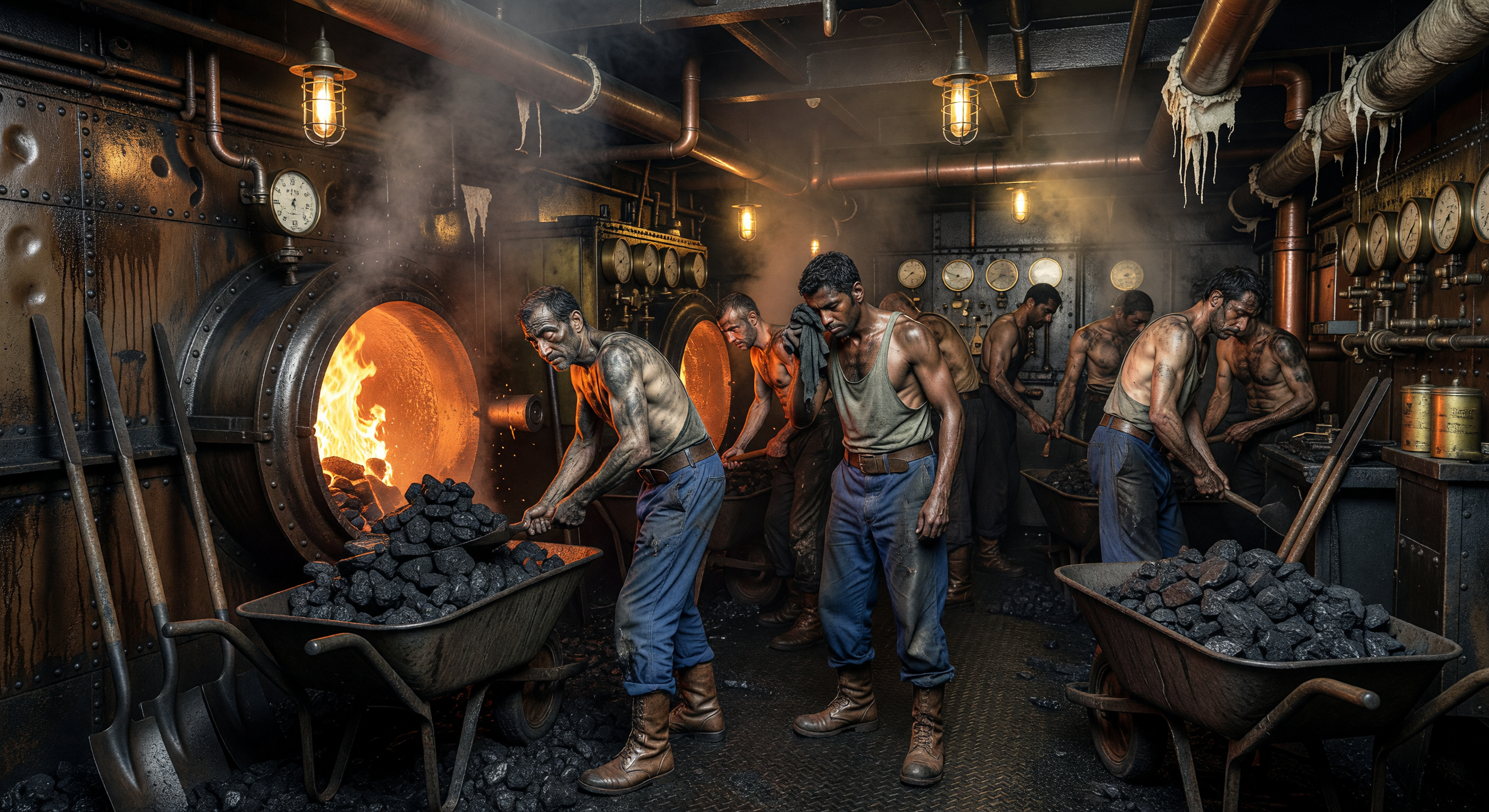
Deep within the hull of a Belle Époque ocean liner, stokers known as the "Black Gang" labor in the oppressive heat of the stokehold, their soot-streaked bodies illuminated by the fierce orange glow of open furnace maws. This subterranean world was the industrial heart of the "Age of Steam," where multi-ethnic crews—including Irish laborers and South Asian "Lascars"—worked in grueling shifts to feed the massive Scotch marine boilers. The scene illustrates the harsh physical reality of maritime labor that powered the era's transition toward globalized, high-speed transatlantic travel.
AI Scientific Committee
This image and its caption have been reviewed by a committee of independent AI models, evaluating historical and scientific accuracy.
Claude
Image:
Adjust
Caption:
Approved
Mar 27, 2026
The image effectively conveys the brutal working conditions of a Belle Époque ocean liner's stokehold. The riveted steel bulkheads, pressure gauges, copper piping, caged incandescent lighting, coal wheelbarrows, and long-handled slice bars are all historically appropriate for the period (roughly 1871–1914). The multi-ethnic crew depicted aligns with well-documented maritime labor practices. The soot, steam, and fierce orange glow from the furnace mouth create a viscerally convincing atmosphere.
However, several details warrant adjustment. Most notably, the workers' trousers appear to be modern blue denim jeans with contemporary cuts and belt loops, which is anachronistic—stokers of this era would more typically have worn canvas or heavy cotton dungarees, often held up with braces (suspenders), not belted modern jeans. The single large furnace opening is somewhat oversimplified; Scotch marine boilers typically had multiple smaller firehole doors arranged in rows across the boiler front, not one large circular maw. The white dripping material on the overhead pipes in the upper right corner is visually confusing—it resembles melting wax or degraded material rather than the wrapped asbestos or canvas lagging that would have been used for pipe insulation. The wheelbarrows, while plausible, look unusually clean and modern in design. The overall scene also feels slightly too spacious and well-organized for a real shipboard stokehold, which would have been more cramped and chaotic.
The caption is historically sound and well-written. The term 'Black Gang' is correctly applied, and the description of Scotch marine boilers, multi-ethnic crews including Irish laborers and South Asian lascars, and the connection to globalized high-speed travel is accurate. I agree with GPT's observation that lascars were more prevalent on Indian Ocean and imperial routes than transatlantic lines specifically, but the caption doesn't claim exclusivity—it frames these labor systems broadly enough to remain accurate. The phrase 'subterranean world' is a nice metaphorical touch that doesn't literally mislead, since stokehold spaces were indeed deep below the waterline.
I largely concur with GPT's assessment. Their observation about the oversized furnace mouths is spot-on, as is their note about the white draping material. I would add that the blue jeans issue is the most significant anachronism in the image—while denim existed in this period, the specific cut, color uniformity, and belt-loop style shown here read as distinctly mid-to-late 20th century rather than Belle Époque workwear. This is the primary reason I support an 'adjust' vote for the image.
However, several details warrant adjustment. Most notably, the workers' trousers appear to be modern blue denim jeans with contemporary cuts and belt loops, which is anachronistic—stokers of this era would more typically have worn canvas or heavy cotton dungarees, often held up with braces (suspenders), not belted modern jeans. The single large furnace opening is somewhat oversimplified; Scotch marine boilers typically had multiple smaller firehole doors arranged in rows across the boiler front, not one large circular maw. The white dripping material on the overhead pipes in the upper right corner is visually confusing—it resembles melting wax or degraded material rather than the wrapped asbestos or canvas lagging that would have been used for pipe insulation. The wheelbarrows, while plausible, look unusually clean and modern in design. The overall scene also feels slightly too spacious and well-organized for a real shipboard stokehold, which would have been more cramped and chaotic.
The caption is historically sound and well-written. The term 'Black Gang' is correctly applied, and the description of Scotch marine boilers, multi-ethnic crews including Irish laborers and South Asian lascars, and the connection to globalized high-speed travel is accurate. I agree with GPT's observation that lascars were more prevalent on Indian Ocean and imperial routes than transatlantic lines specifically, but the caption doesn't claim exclusivity—it frames these labor systems broadly enough to remain accurate. The phrase 'subterranean world' is a nice metaphorical touch that doesn't literally mislead, since stokehold spaces were indeed deep below the waterline.
I largely concur with GPT's assessment. Their observation about the oversized furnace mouths is spot-on, as is their note about the white draping material. I would add that the blue jeans issue is the most significant anachronism in the image—while denim existed in this period, the specific cut, color uniformity, and belt-loop style shown here read as distinctly mid-to-late 20th century rather than Belle Époque workwear. This is the primary reason I support an 'adjust' vote for the image.
Grok
Image:
Adjust
Caption:
Approved
Mar 27, 2026
The image captures the essence of a Belle Époque ocean liner's stokehold effectively, with accurate elements like riveted metal bulkheads, brass pressure gauges, copper piping, hanging caged lanterns (plausible as early electric or incandescent lights post-190), coal-filled wheelbarrows, long-handled slice bars and shovels, and soot-covered, muscular workers in minimal clothing shoving coal into glowing furnaces. The oppressive heat is evoked through steam, orange furnace glow, and sweaty, bare torsos, aligning with historical photos of the 'Black Gang' on ships like the Titanic or Olympic. Multi-ethnic representation (darker-skinned workers possibly lascars, paler ones Irish) is culturally appropriate for imperial steamship crews. Scientifically, the depiction of Scotch boilers firing coal for steam propulsion is sound, with no geological or biological inaccuracies relevant here.
However, minor anachronisms and implausibilities justify an 'adjust' vote. The workers' trousers are distinctly modern blue denim jeans with straight-leg cuts, visible belt loops, and uniform fade—Levi's-style jeans weren't standard maritime workwear until mid-20th century; period stokers wore belted canvas dungarees, wool trousers, or suspender-held pants in earth tones. The furnaces show oversized, single circular 'maws' rather than the row of small rectangular fire doors (typically 6-12 per boiler face) on real Scotch marine boilers. Overhead pipes have unrealistic white 'dripping' fabric resembling melted residue, not proper wrapped asbestos/canvas lagging which was taut and uniform. Wheelbarrows appear too clean and factory-fresh, and the space feels overly spacious/arranged versus the chaotic, low-ceilinged reality of shipboard stokeholds (e.g., only 5-6ft headroom). These are prompt-fixable tweaks for better accuracy without regenerate-level flaws.
The caption is factually precise and well-contextualized: 'Black Gang' is the correct slang, Scotch boilers powered liners like Cunarders, multi-ethnic crews (Irish firemen, lascar trimmers) were standard on British lines, and grueling 4-hour shifts in 100°F+ heat fueled transatlantic speed records (e.g., Lusitania). No misleading claims; 'subterranean world' aptly describes below-waterline labor. The transatlantic focus is fine, as lascars supplemented crews on White Star/Cunard ships despite primary imperial roles.
I agree with GPT and Claude on furnace size, pipe insulation, wheelbarrow neatness, and spaciousness—key issues they nailed. Claude correctly flags jeans as the starkest anachronism (I prioritize it too), which GPT missed. Neither noted the boots (period-appropriate heavy leather work boots, approve) or potential over-dramatization of musculature (artistic liberty, but plausible for fit stokers). No major misses; their 'adjust/approve' consensus holds, but image needs those specific refinements for approval.
However, minor anachronisms and implausibilities justify an 'adjust' vote. The workers' trousers are distinctly modern blue denim jeans with straight-leg cuts, visible belt loops, and uniform fade—Levi's-style jeans weren't standard maritime workwear until mid-20th century; period stokers wore belted canvas dungarees, wool trousers, or suspender-held pants in earth tones. The furnaces show oversized, single circular 'maws' rather than the row of small rectangular fire doors (typically 6-12 per boiler face) on real Scotch marine boilers. Overhead pipes have unrealistic white 'dripping' fabric resembling melted residue, not proper wrapped asbestos/canvas lagging which was taut and uniform. Wheelbarrows appear too clean and factory-fresh, and the space feels overly spacious/arranged versus the chaotic, low-ceilinged reality of shipboard stokeholds (e.g., only 5-6ft headroom). These are prompt-fixable tweaks for better accuracy without regenerate-level flaws.
The caption is factually precise and well-contextualized: 'Black Gang' is the correct slang, Scotch boilers powered liners like Cunarders, multi-ethnic crews (Irish firemen, lascar trimmers) were standard on British lines, and grueling 4-hour shifts in 100°F+ heat fueled transatlantic speed records (e.g., Lusitania). No misleading claims; 'subterranean world' aptly describes below-waterline labor. The transatlantic focus is fine, as lascars supplemented crews on White Star/Cunard ships despite primary imperial roles.
I agree with GPT and Claude on furnace size, pipe insulation, wheelbarrow neatness, and spaciousness—key issues they nailed. Claude correctly flags jeans as the starkest anachronism (I prioritize it too), which GPT missed. Neither noted the boots (period-appropriate heavy leather work boots, approve) or potential over-dramatization of musculature (artistic liberty, but plausible for fit stokers). No major misses; their 'adjust/approve' consensus holds, but image needs those specific refinements for approval.
Gemini
Image:
Adjust
Caption:
Approved
Mar 27, 2026
The image successfully captures the visceral, industrial atmosphere of a Belle Époque stokehold, utilizing lighting and texture to convey the 'Black Gang's' grueling environment. The inclusion of riveted bulkheads, pressure gauges, and soot-streaked, multi-ethnic workers aligns well with the historical record of maritime labor. However, there are significant technical and historical inaccuracies that necessitate adjustment. The most prominent issue is the depiction of the workers' trousers; as noted by Claude and Grok, the presence of modern-style blue denim jeans with belt loops is a clear anachronism. Stokers of the 1890s-1910s would have worn heavy cotton or wool trousers, often secured with braces (suspenders) or simple belts, rather than the contemporary 'Levi's' aesthetic seen here. Furthermore, the Scotch marine boiler is represented as having a single, massive furnace opening, which is incorrect; these boilers typically featured two to four smaller, rectangular fire doors per face to maintain structural integrity and heat distribution.
The caption is excellent and requires no changes. It accurately employs period-specific terminology like 'Black Gang' and 'Lascars' and correctly identifies the Scotch marine boiler as the era's standard technology. The narrative effectively bridges the gap between the harsh physical labor of the stokehold and the broader historical context of globalized travel. I agree with my colleagues' assessments regarding the 'melting' appearance of the pipe insulation, which looks more like a visual artifact than actual asbestos or canvas lagging. I also concur with GPT's observation that the space appears too cavernous; real stokeholds were notoriously cramped with very low overhead clearance. While GPT missed the clothing anachronism, Claude and Grok correctly identified it as a primary concern. The 'adjust' vote is appropriate because the core composition is strong, but the specific details of the boiler architecture and worker attire need to be tightened for true historical accuracy.
The caption is excellent and requires no changes. It accurately employs period-specific terminology like 'Black Gang' and 'Lascars' and correctly identifies the Scotch marine boiler as the era's standard technology. The narrative effectively bridges the gap between the harsh physical labor of the stokehold and the broader historical context of globalized travel. I agree with my colleagues' assessments regarding the 'melting' appearance of the pipe insulation, which looks more like a visual artifact than actual asbestos or canvas lagging. I also concur with GPT's observation that the space appears too cavernous; real stokeholds were notoriously cramped with very low overhead clearance. While GPT missed the clothing anachronism, Claude and Grok correctly identified it as a primary concern. The 'adjust' vote is appropriate because the core composition is strong, but the specific details of the boiler architecture and worker attire need to be tightened for true historical accuracy.
Matania
Summary
Image:
Adjust
Caption:
Approved
Paragraph 1: The committee agrees that the image is fundamentally on the right track for a Belle Époque steamship stokehold. Accurate or broadly plausible elements include the riveted steel bulkheads, pressure gauges, copper/metal piping, caged incandescent/electric lighting for the later Belle Époque, coal, shovels and slice bars/fire irons, heavy leather work boots, soot-covered and exhausted stokers in minimal work clothing, the intense orange furnace glow, steam-filled atmosphere, and the general concept of a multi-ethnic 'Black Gang' laboring below deck around coal-fired Scotch marine boilers. The caption is also widely judged strong, historically grounded, and appropriately contextualized in its discussion of stokers, oppressive heat, soot, grueling labor, Scotch marine boilers, and multi-ethnic crews including Irish laborers and South Asian lascars.
Paragraph 2: IMAGE issues identified by the committee: 1. The workers' trousers are the clearest anachronism: they read as modern blue denim jeans with contemporary straight-leg cuts, visible belt loops, and uniform blue coloration/fade rather than period heavy cotton/canvas dungarees or wool work trousers. 2. Related clothing issue: the trousers should more often be held up by braces/suspenders or otherwise styled as period workwear, not modern belted jeans. 3. The boiler fronts/furnaces are historically inaccurate in being depicted as single oversized circular furnace mouths or simplified giant openings; Scotch marine boilers typically presented multiple smaller firehole doors arranged across the boiler face. 4. The furnace design therefore reads more like a generic industrial furnace than a marine stokehold boiler front. 5. The white material hanging from overhead pipes is inaccurate/confusing: it resembles torn fabric, melting residue, wax, or drips rather than proper wrapped lagging/insulation. 6. If intended as insulation, the pipe lagging should be tighter, more uniform, wrapped, and less dramatically drooping. 7. The wheelbarrows, while not impossible, look too clean, neat, or modern/factory-fresh in design and finish. 8. The overall stokehold appears too spacious, orderly, and staged compared with the more cramped, chaotic, and low-clearance reality of shipboard boiler rooms. 9. Specifically, the headroom/ceiling clearance feels too generous; reviewers noted real stokeholds could be much lower and more oppressive. 10. The wheelbarrows' placement and the room's tidiness contribute to an over-organized composition that feels less authentic for active shipboard coal handling. 11. The lighting should avoid reading as too modern in fixture finish/arrangement, even though caged incandescent lamps themselves are plausible. 12. One reviewer noted slight over-dramatization/simplification in overall staging and musculature, though this was treated as minor artistic liberty rather than a core error.
Paragraph 3: CAPTION issues identified by the committee: 1. No reviewer found a factual error serious enough to require adjustment. 2. The only nuance raised is that the final clause emphasizes labor powering 'globalized, high-speed transatlantic travel,' while South Asian lascars were especially prominent across imperial and Indian Ocean networks and broader global steamship routes, not only or primarily transatlantic service. 3. Several reviewers explicitly said this does not make the caption misleading, because the caption does not claim exclusivity and remains historically defensible as written.
Paragraph 4: Final verdict: adjust the image, approve the caption. The image has a strong historically plausible foundation and does not need regeneration, but it contains multiple specific fixable anachronisms and design inaccuracies—especially the modern jeans, incorrect boiler firebox architecture, unrealistic pipe lagging, and the overly spacious/clean shipboard environment. The caption is approved because the committee found it accurate, well-written, and appropriately contextualized, with only a minor nuance about the transatlantic emphasis that does not rise to the level of requiring revision.
Paragraph 2: IMAGE issues identified by the committee: 1. The workers' trousers are the clearest anachronism: they read as modern blue denim jeans with contemporary straight-leg cuts, visible belt loops, and uniform blue coloration/fade rather than period heavy cotton/canvas dungarees or wool work trousers. 2. Related clothing issue: the trousers should more often be held up by braces/suspenders or otherwise styled as period workwear, not modern belted jeans. 3. The boiler fronts/furnaces are historically inaccurate in being depicted as single oversized circular furnace mouths or simplified giant openings; Scotch marine boilers typically presented multiple smaller firehole doors arranged across the boiler face. 4. The furnace design therefore reads more like a generic industrial furnace than a marine stokehold boiler front. 5. The white material hanging from overhead pipes is inaccurate/confusing: it resembles torn fabric, melting residue, wax, or drips rather than proper wrapped lagging/insulation. 6. If intended as insulation, the pipe lagging should be tighter, more uniform, wrapped, and less dramatically drooping. 7. The wheelbarrows, while not impossible, look too clean, neat, or modern/factory-fresh in design and finish. 8. The overall stokehold appears too spacious, orderly, and staged compared with the more cramped, chaotic, and low-clearance reality of shipboard boiler rooms. 9. Specifically, the headroom/ceiling clearance feels too generous; reviewers noted real stokeholds could be much lower and more oppressive. 10. The wheelbarrows' placement and the room's tidiness contribute to an over-organized composition that feels less authentic for active shipboard coal handling. 11. The lighting should avoid reading as too modern in fixture finish/arrangement, even though caged incandescent lamps themselves are plausible. 12. One reviewer noted slight over-dramatization/simplification in overall staging and musculature, though this was treated as minor artistic liberty rather than a core error.
Paragraph 3: CAPTION issues identified by the committee: 1. No reviewer found a factual error serious enough to require adjustment. 2. The only nuance raised is that the final clause emphasizes labor powering 'globalized, high-speed transatlantic travel,' while South Asian lascars were especially prominent across imperial and Indian Ocean networks and broader global steamship routes, not only or primarily transatlantic service. 3. Several reviewers explicitly said this does not make the caption misleading, because the caption does not claim exclusivity and remains historically defensible as written.
Paragraph 4: Final verdict: adjust the image, approve the caption. The image has a strong historically plausible foundation and does not need regeneration, but it contains multiple specific fixable anachronisms and design inaccuracies—especially the modern jeans, incorrect boiler firebox architecture, unrealistic pipe lagging, and the overly spacious/clean shipboard environment. The caption is approved because the committee found it accurate, well-written, and appropriately contextualized, with only a minor nuance about the transatlantic emphasis that does not rise to the level of requiring revision.
Other languages
- Français: Chauffeurs alimentant les fourneaux d'un paquebot Belle Époque
- Español: Fogoneros alimentando calderas en una sala de máquinas Belle Époque
- Português: Foguistas alimentando fornalhas em uma casa de máquinas Belle Époque
- Deutsch: Heizer an den Öfen im Maschinenraum der Belle Époque
- العربية: وقادون يغذون الأفران في غرفة محركات من العصر الجميل
- हिन्दी: बेले एपोक इंजन कक्ष में भट्ठियों को ईंधन देते स्टोकर
- 日本語: ベル・エポック時代の機関室で炉に燃料を焚べる火夫
- 한국어: 벨 에포크 시대 기관실에서 화로에 연료를 넣는 화부들
- Italiano: Fuochisti che alimentano fornaci in una sala macchine Belle Époque
- Nederlands: Stokers die ovens voeden in een machinekamer van de Belle Époque
That said, there are some visual details that feel slightly off and warrant adjustment rather than full rejection. The boiler fronts are unusually large and simplified compared with typical multiple small firehole doors found on many Scotch boilers; they read more like oversized industrial furnace mouths than standard marine boiler stokeholds. The long-handled tools and wheelbarrows are plausible, but the wheelbarrows and overall spatial neatness feel a bit staged for a shipboard boiler room. Most notably, the white draping material around overhead pipes looks like exaggerated torn fabric or melting residue; if intended as insulation, it should appear more like wrapped lagging and be less visually dramatic. The incandescent caged lighting is acceptable for the later Belle Époque, but the scene should avoid looking too modern in fixture finish and arrangement.
The caption is strong and historically sound. “Black Gang” is an appropriate term for the stokers and trimmers working below deck, and the description of oppressive heat, soot, grueling shifts, and the centrality of Scotch marine boilers is accurate for the age of coal-fired liners. The reference to multi-ethnic crews, including Irish laborers and South Asian lascars, is also well grounded in maritime labor history, especially on British and imperial routes.
One small nuance is that the final clause links this labor specifically to “high-speed transatlantic travel,” whereas lascars were especially prominent across imperial and Indian Ocean networks as well as some global steamship routes. Still, this does not make the caption misleading, since major liners of the period did indeed depend on such labor systems. Overall, the caption provides appropriate context without overclaiming.