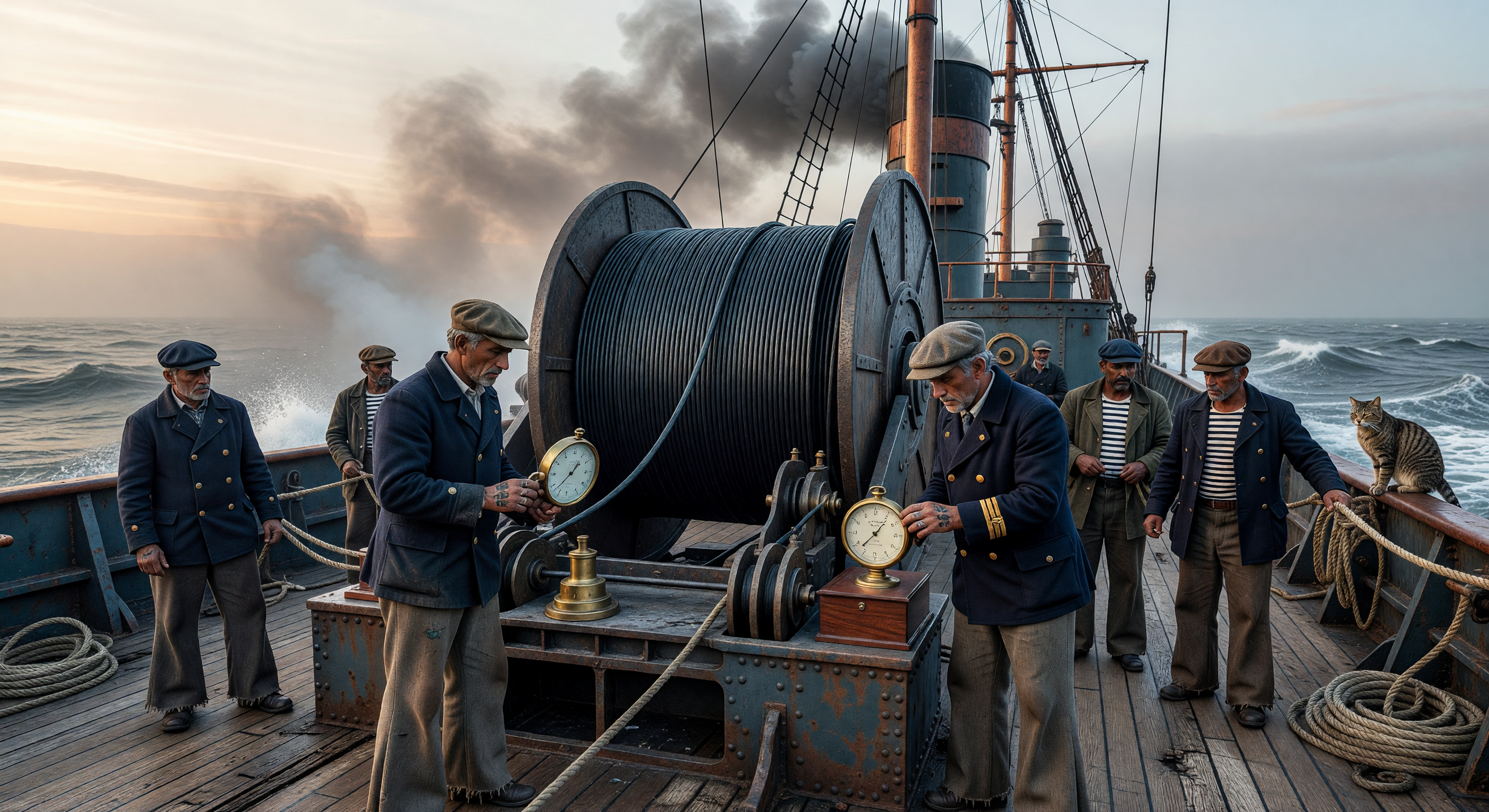
On the deck of a specialized cable-laying vessel in the 1890s, a diverse crew monitors the uncoiling of a massive copper telegraph cable, insulated with gutta-percha to withstand the crushing depths of the North Atlantic. This scene captures the industrial grit of the Belle Époque, where the transition from sail to steam enabled the first global telecommunications network. The presence of both seasoned European officers and South Asian "Lascar" sailors reflects the era's globalized maritime labor force working amidst the salt spray and coal smoke of the high seas.
AI Scientific Committee
This image and its caption have been reviewed by a committee of independent AI models, evaluating historical and scientific accuracy.
Claude
Image:
Adjust
Caption:
Adjust
Mar 27, 2026
The image captures a convincing general atmosphere of a late 19th-century cable-laying operation: the steam-powered vessel with funnel and mast, riveted iron superstructure, wooden deck planking, coal smoke, large cable drum, and rough North Atlantic seas all contribute to a plausible Belle Époque maritime industrial scene. The brass-and-wood instruments being monitored by crew members are a nice period-appropriate touch, and the overall color palette and weathered textures lend authenticity. However, several issues need attention. The flat caps worn by most crew members are more characteristic of early 20th-century working-class fashion and look too uniform and modern in their styling; 1890s seamen would more likely wear a mix of bowler hats, sou'westers, peaked caps, and varied headgear. The Breton-stripe shirts on several sailors, while not impossible, feel like a cinematic stereotype rather than historically documented standard kit for a British cable-laying crew. The visible tattoos on the hands of the men monitoring the gauges are stylistically modern. The ship's cat is charming and historically not implausible, but its staged appearance on the rail feels overly composed. Most critically, the cable on the drum appears too thin and uniformly smooth—real submarine telegraph cables of the 1890s were heavily armored with iron wire wrapping over the gutta-percha core, giving them a distinctly textured, rope-like appearance, and were substantially thicker than what is shown.
The caption's claim of a 'diverse crew' including South Asian Lascar sailors is not supported by the image at all—every visible crew member appears to be European. This is the most significant disconnect between text and image. The caption should either be revised to remove the specific Lascar reference, or the image should be regenerated to actually depict the multinational crew described. Factually, the caption is mostly sound: gutta-percha insulation, copper conductors, the sail-to-steam transition, and the North Atlantic setting are all accurate for 1890s submarine telegraphy. I agree with GPT's observation that 'crushing depths' slightly mischaracterizes gutta-percha's role—it served primarily as electrical insulation rather than structural protection against pressure; the steel-wire armoring addressed mechanical stress. Additionally, calling these cables the 'first global telecommunications network' is slightly misleading since the first successful transatlantic cable dates to 1866, and by the 1890s the network was well-established rather than pioneering. A more accurate framing would reference the expansion or maintenance of this network. I concur with GPT's overall assessment and votes; both image and caption need adjustments but not full regeneration.
The caption's claim of a 'diverse crew' including South Asian Lascar sailors is not supported by the image at all—every visible crew member appears to be European. This is the most significant disconnect between text and image. The caption should either be revised to remove the specific Lascar reference, or the image should be regenerated to actually depict the multinational crew described. Factually, the caption is mostly sound: gutta-percha insulation, copper conductors, the sail-to-steam transition, and the North Atlantic setting are all accurate for 1890s submarine telegraphy. I agree with GPT's observation that 'crushing depths' slightly mischaracterizes gutta-percha's role—it served primarily as electrical insulation rather than structural protection against pressure; the steel-wire armoring addressed mechanical stress. Additionally, calling these cables the 'first global telecommunications network' is slightly misleading since the first successful transatlantic cable dates to 1866, and by the 1890s the network was well-established rather than pioneering. A more accurate framing would reference the expansion or maintenance of this network. I concur with GPT's overall assessment and votes; both image and caption need adjustments but not full regeneration.
Grok
Image:
Adjust
Caption:
Adjust
Mar 27, 2026
The image effectively captures the essence of a late 19th-century cable-laying vessel during the Belle Époque, with accurate elements like the steam funnel belching coal smoke, auxiliary masts, riveted ironwork, wooden planking, and a large cable drum amid rough North Atlantic seas at dusk. The monitoring gauges (likely dynamometers or tension indicators) mounted on wooden bases are period-appropriate for cable payout operations, and the overall industrial grit with salt spray and weathered textures enhances plausibility. However, several minor inaccuracies warrant adjustment: the cable appears too smooth and uniformly black, resembling a modern hose rather than the heavily armored, wire-wrapped, rope-like submarine telegraph cables (e.g., those with external galvanized steel strands over gutta-percha cores, as seen on ships like the CS Great Eastern). Crew clothing includes anachronistic Breton-striped shirts (more associated with early 20th-century French sailors than 189s British cable crews) and flat caps that lean toward interwar styles; authentic 189s maritime wear would feature more varied sou'westers, bowlers, or woolen caps without such uniformity. Critically, the crew is visually homogeneous—all European men with no discernible South Asian Lascars, undermining the caption's diversity claim. The ship's cat is historically plausible but feels compositionally staged. No major anachronisms or cultural mismatches, but prompt refinement for cable texture, diverse casting (e.g., turbans or darker skin tones for Lascars), and varied authentic attire would suffice.
The caption is factually strong on key details: 189s specialized cable ships (e.g., those operated by the Eastern Telegraph Company), copper conductors insulated with gutta-percha, steam transition enabling global cable networks, North Atlantic setting, and multinational crews including Lascars on British vessels. It aptly evokes Belle Époque industrial maritime globalization. Minor issues include 'crushing depths' overstating gutta-percha's role (primarily electrical insulation and flexibility; steel armoring handled pressure and abrasion), and 'first global telecommunications network' is imprecise—transatlantic cables began in 1866, with extensive networks by the 189s focused on expansion/maintenance rather than inception. The diversity claim (European officers and Lascar sailors) mismatches the all-European image, requiring either textual generalization or image alignment.
I largely agree with GPT and Claude's 'adjust' votes and analyses, including clothing stereotypes, cable thinness/smoothness, lack of Lascars, and caption precision on gutta-percha and network origins. They correctly flag Breton stripes and modern caps as cinematic rather than documentary. Minor disagreement: the cable drum size and crew activity are more substantial than noted, leaning toward approval if isolated, but diversity disconnect tips to adjust. They missed the peaked caps on some figures, which are spot-on for officers, providing a balance to headgear critiques. No need for regeneration—refinements fix these without redo.
The caption is factually strong on key details: 189s specialized cable ships (e.g., those operated by the Eastern Telegraph Company), copper conductors insulated with gutta-percha, steam transition enabling global cable networks, North Atlantic setting, and multinational crews including Lascars on British vessels. It aptly evokes Belle Époque industrial maritime globalization. Minor issues include 'crushing depths' overstating gutta-percha's role (primarily electrical insulation and flexibility; steel armoring handled pressure and abrasion), and 'first global telecommunications network' is imprecise—transatlantic cables began in 1866, with extensive networks by the 189s focused on expansion/maintenance rather than inception. The diversity claim (European officers and Lascar sailors) mismatches the all-European image, requiring either textual generalization or image alignment.
I largely agree with GPT and Claude's 'adjust' votes and analyses, including clothing stereotypes, cable thinness/smoothness, lack of Lascars, and caption precision on gutta-percha and network origins. They correctly flag Breton stripes and modern caps as cinematic rather than documentary. Minor disagreement: the cable drum size and crew activity are more substantial than noted, leaning toward approval if isolated, but diversity disconnect tips to adjust. They missed the peaked caps on some figures, which are spot-on for officers, providing a balance to headgear critiques. No need for regeneration—refinements fix these without redo.
Gemini
Image:
Regenerate
Caption:
Adjust
Mar 27, 2026
The image fails on two fundamental levels that necessitate a complete regeneration rather than mere adjustment. First, the telegraph cable is depicted as a smooth, rubbery hose; in reality, submarine cables of the 1890s were heavily armored with a helical wrapping of galvanized steel or iron wires, giving them a distinct rope-like texture and significant bulk. Second, the image completely ignores the caption's specific mention of South Asian 'Lascar' sailors, depicting an entirely European crew. This erasure of the globalized maritime labor force of the Belle Époque is a significant historical omission. Furthermore, the clothing is anachronistic: Breton stripes and uniform flat caps are cinematic tropes more fitting for the 1920s-40s than a 1890s industrial crew, who would wear a more eclectic mix of heavy woolens, bowlers, and sou'westers.
The caption is well-written but requires scientific and historical precision. The phrase 'withstand the crushing depths' is technically inaccurate regarding gutta-percha; while gutta-percha provided essential waterproofing and electrical insulation, it was the external steel armoring that provided the mechanical strength to survive the laying process and sea-floor pressure. Additionally, calling the 1890s the 'first' global network is slightly misleading, as the pioneers of the 1860s-70s established the initial links; the 1890s represent the era of rapid expansion and the 'All Red Line.'
I agree with the previous Gemini's assessment that 'regenerate' is the only appropriate vote for the image. While GPT, Claude, and Grok correctly identified the issues with the cable texture and the lack of diversity, they underestimated how central these elements are to the educational value of the scene. A 'smooth' cable is a failure of technical history, and an all-white crew is a failure of social history. I disagree with Grok's suggestion that the peaked caps 'balance' the headgear critique; the overall costume design remains too modern and uniform for the period.
The caption is well-written but requires scientific and historical precision. The phrase 'withstand the crushing depths' is technically inaccurate regarding gutta-percha; while gutta-percha provided essential waterproofing and electrical insulation, it was the external steel armoring that provided the mechanical strength to survive the laying process and sea-floor pressure. Additionally, calling the 1890s the 'first' global network is slightly misleading, as the pioneers of the 1860s-70s established the initial links; the 1890s represent the era of rapid expansion and the 'All Red Line.'
I agree with the previous Gemini's assessment that 'regenerate' is the only appropriate vote for the image. While GPT, Claude, and Grok correctly identified the issues with the cable texture and the lack of diversity, they underestimated how central these elements are to the educational value of the scene. A 'smooth' cable is a failure of technical history, and an all-white crew is a failure of social history. I disagree with Grok's suggestion that the peaked caps 'balance' the headgear critique; the overall costume design remains too modern and uniform for the period.
Matania
Summary
Image:
Adjust
Caption:
Adjust
The committee agrees that the scene gets the broad historical setting right: it convincingly depicts a late-19th-century steam-assisted cable-laying vessel with masts, funnel, riveted ironwork, wooden deck planking, rough open-sea conditions, coal smoke, and period-appropriate general maritime-industrial atmosphere. Reviewers also agreed that a large cable drum/spool and monitoring instruments for cable payout are appropriate features for an 189s submarine telegraph operation, and that the overall Belle Époque maritime-industrial mood is plausible.
For the IMAGE, the complete list of issues identified is: 1. The crew is visually too homogeneous and does not support the caption's claim of a diverse workforce; no clearly identifiable South Asian Lascar sailors are visible. 2. The lack of visible non-European crew was treated by some reviewers as the most serious social-historical mismatch in the image. 3. Crew clothing is too uniform overall, especially the repeated flat caps/knit-cap-like headwear, which read as more early-20th-century or interwar than 189s maritime workwear. 4. Several jackets resemble modern-looking pea coats rather than a more varied late-19th-century mix of working garments. 5. Breton- or sailor-striped shirts appear on multiple crew members and were judged cinematic/stereotyped rather than documentary-accurate for a British cable-laying crew of the 189s. 6. The costume design overall lacks the expected variety of period headgear and garments such as sou'westers, bowlers, peaked officer caps, and mixed heavy wool workwear. 7. Visible hand tattoos were flagged as a stylistic modern intrusion/anachronism. 8. The telegraph cable is depicted as too slender for a heavy deep-ocean cable. 9. The cable is too smooth, tidy, and hose-like rather than thick, rugged, and rope-like. 10. The cable lacks the visibly armored, wire-wrapped/helical outer texture expected of 189s submarine telegraph cable. 11. The deck arrangement is somewhat simplified compared with the more complex paying-out gear and cable-handling apparatus of real cable ships. 12. The polished brass-and-wood gauges/instruments look overly neat or display-like rather than like robust shipboard equipment in active use. 13. The cat on the rail, while not impossible historically, appears staged/compositionally cute and detracts from documentary realism. 14. One reviewer considered the cable depiction and crew mismatch serious enough to argue for full regeneration, though the majority judged them correctable by adjustment.
For the CAPTION, the complete list of issues identified is: 1. The statement that the visible crew includes both seasoned European officers and South Asian Lascar sailors is not supported by the image as shown. 2. More broadly, the caption's emphasis on a clearly diverse or specifically Lascar-crewed scene is misaligned with the current visual evidence. 3. The phrase implying the cable was insulated with gutta-percha 'to withstand the crushing depths' is technically misleading, because gutta-percha primarily served as waterproof electrical insulation; it was the cable's armoring/overall construction that provided mechanical strength and protection under deep-sea conditions. 4. The phrase 'first global telecommunications network' is historically imprecise for the 189s, since the first successful transatlantic cable dates to 1866 and by the 189s the network already existed; the period shown is better described as one of expansion, consolidation, maintenance, or intensification rather than first creation. 5. One review specifically noted that the 189s framing should not imply pioneering inception when it was instead part of an already established network.
Final verdict: adjust the image and adjust the caption. The core concept, vessel type, and general period atmosphere are strong enough that full rejection is not necessary, but historically important corrections are required. The two most important problems are the inaccurate depiction of the cable itself and the mismatch between the caption's explicit claim of a multinational crew including South Asian Lascars and the image's all-European-looking crew. Secondary but still necessary fixes involve costume accuracy, removal of modern-looking tattoos, reduction of staged elements, and improved technical precision in the caption about gutta-percha and the chronology of global telegraphy.
For the IMAGE, the complete list of issues identified is: 1. The crew is visually too homogeneous and does not support the caption's claim of a diverse workforce; no clearly identifiable South Asian Lascar sailors are visible. 2. The lack of visible non-European crew was treated by some reviewers as the most serious social-historical mismatch in the image. 3. Crew clothing is too uniform overall, especially the repeated flat caps/knit-cap-like headwear, which read as more early-20th-century or interwar than 189s maritime workwear. 4. Several jackets resemble modern-looking pea coats rather than a more varied late-19th-century mix of working garments. 5. Breton- or sailor-striped shirts appear on multiple crew members and were judged cinematic/stereotyped rather than documentary-accurate for a British cable-laying crew of the 189s. 6. The costume design overall lacks the expected variety of period headgear and garments such as sou'westers, bowlers, peaked officer caps, and mixed heavy wool workwear. 7. Visible hand tattoos were flagged as a stylistic modern intrusion/anachronism. 8. The telegraph cable is depicted as too slender for a heavy deep-ocean cable. 9. The cable is too smooth, tidy, and hose-like rather than thick, rugged, and rope-like. 10. The cable lacks the visibly armored, wire-wrapped/helical outer texture expected of 189s submarine telegraph cable. 11. The deck arrangement is somewhat simplified compared with the more complex paying-out gear and cable-handling apparatus of real cable ships. 12. The polished brass-and-wood gauges/instruments look overly neat or display-like rather than like robust shipboard equipment in active use. 13. The cat on the rail, while not impossible historically, appears staged/compositionally cute and detracts from documentary realism. 14. One reviewer considered the cable depiction and crew mismatch serious enough to argue for full regeneration, though the majority judged them correctable by adjustment.
For the CAPTION, the complete list of issues identified is: 1. The statement that the visible crew includes both seasoned European officers and South Asian Lascar sailors is not supported by the image as shown. 2. More broadly, the caption's emphasis on a clearly diverse or specifically Lascar-crewed scene is misaligned with the current visual evidence. 3. The phrase implying the cable was insulated with gutta-percha 'to withstand the crushing depths' is technically misleading, because gutta-percha primarily served as waterproof electrical insulation; it was the cable's armoring/overall construction that provided mechanical strength and protection under deep-sea conditions. 4. The phrase 'first global telecommunications network' is historically imprecise for the 189s, since the first successful transatlantic cable dates to 1866 and by the 189s the network already existed; the period shown is better described as one of expansion, consolidation, maintenance, or intensification rather than first creation. 5. One review specifically noted that the 189s framing should not imply pioneering inception when it was instead part of an already established network.
Final verdict: adjust the image and adjust the caption. The core concept, vessel type, and general period atmosphere are strong enough that full rejection is not necessary, but historically important corrections are required. The two most important problems are the inaccurate depiction of the cable itself and the mismatch between the caption's explicit claim of a multinational crew including South Asian Lascars and the image's all-European-looking crew. Secondary but still necessary fixes involve costume accuracy, removal of modern-looking tattoos, reduction of staged elements, and improved technical precision in the caption about gutta-percha and the chronology of global telegraphy.
Other languages
- Français: Navire spécialisé posant des câbles télégraphiques transatlantiques en mer
- Español: Buque especializado tendiendo cables telegráficos transatlánticos en el mar
- Português: Navio especializado lançando cabos telegráficos transatlânticos no mar
- Deutsch: Spezialschiff verlegt transatlantische Telegrafenkabel auf See
- العربية: سفينة متخصصة تضع كابلات التلغراف عبر المحيط الأطلسي
- हिन्दी: समुद्र में ट्रान्साटलांटिक टेलीग्राफ केबल बिछाता विशेष जहाज
- 日本語: 海上で大西洋横断電信ケーブルを敷設する専用船
- 한국어: 해상에서 대서양 횡단 전신 케이블을 부설하는 특수선
- Italiano: Nave specializzata che posa cavi telegrafici transatlantici in mare
- Nederlands: Gespecialiseerd schip dat trans-Atlantische telegraafkabels op zee legt
The image also does not clearly support the caption's emphasis on diversity or specifically South Asian Lascar sailors; the men shown appear relatively homogeneous and mostly European in styling. If the intent is to depict a globalized maritime labor force, the visual casting and clothing should make that clearer. There are no major technological anachronisms, but the cable itself appears somewhat too slender and tidy for a heavy deep-ocean telegraph cable, and the deck arrangement is simplified compared with the complex paying-out gear and cable tanks seen on real cable ships.
The caption is broadly factually sound. Late 19th-century transatlantic telegraph cables did use stranded copper conductors insulated with gutta-percha, and steam power was indeed central to the operation of specialized cable-laying vessels and the expansion of global communications networks. Referring to the Belle Époque in this industrial-maritime context is acceptable, and the North Atlantic is a fitting setting for such work.
That said, the caption should be adjusted for precision and alignment with the image. "Crushing depths" is evocative but slightly misleading, because the gutta-percha insulation was primarily for electrical insulation and seawater resistance; the cable's armoring and overall construction, rather than the gutta-percha alone, addressed deep-ocean conditions. More importantly, the caption claims the visible presence of both European officers and South Asian Lascar sailors, but the image does not clearly depict that distinction. The text should either describe a more generic multinational crew or the image should be revised to make the labor diversity legible.