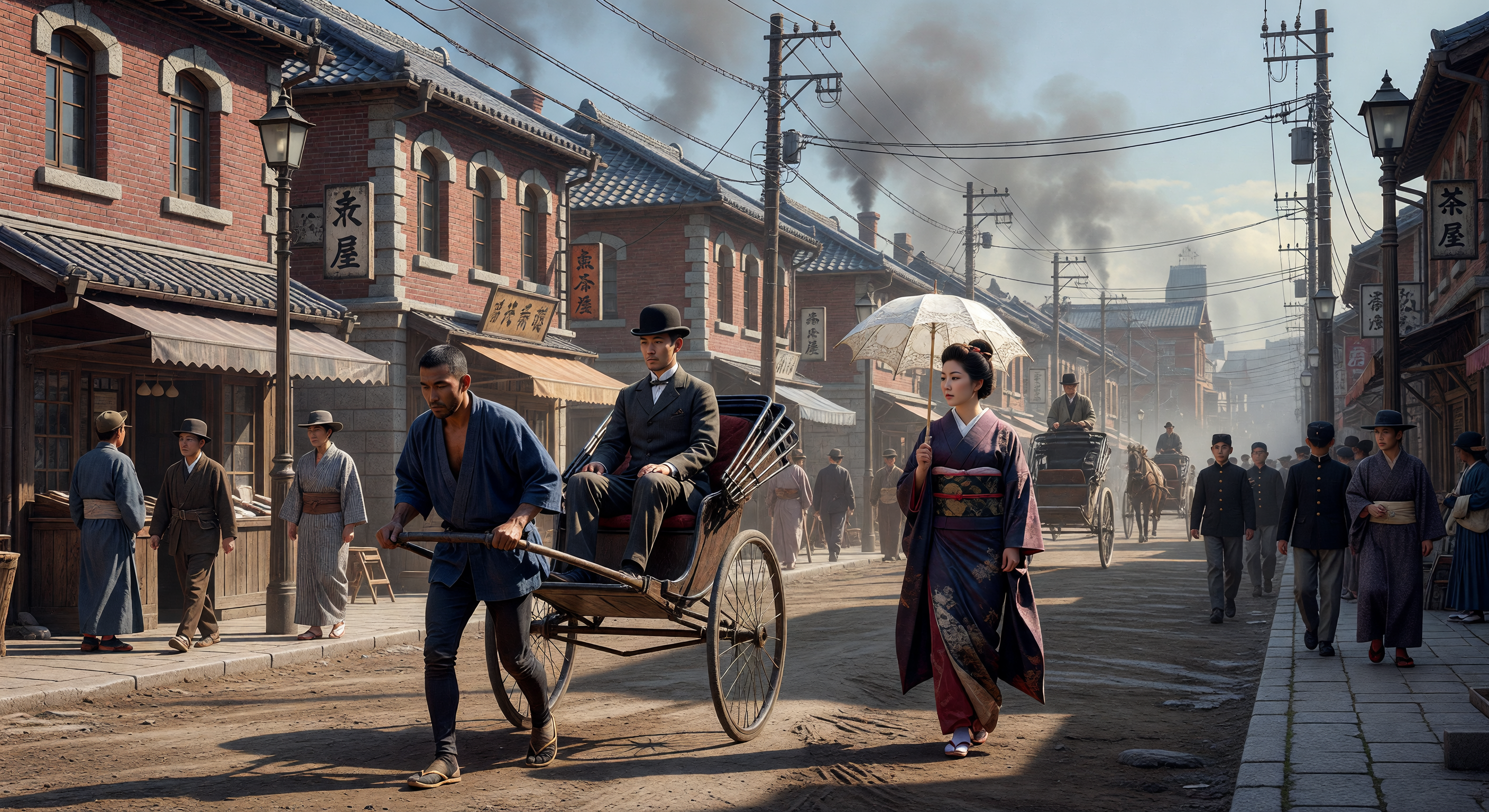
This scene captures the bustling Ginza district of Tokyo circa 1895, showcasing the distinctive "Bricktown" architecture and the rapid Westernization that defined Japan’s Meiji period. An elite passenger in a wool frock coat and bowler hat travels by rickshaw past a woman pairing a traditional silk kimono with a European lace parasol, illustrating the cultural synthesis of the era. The presence of telegraph wires and gas lamps against the backdrop of red-brick Giyofu-style buildings highlights the transformative friction between centuries of tradition and the industrial modernity of the Belle Époque.
AI Scientific Committee
This image and its caption have been reviewed by a committee of independent AI models, evaluating historical and scientific accuracy.
Claude
Image:
Adjust
Caption:
Adjust
Mar 26, 2026
The image effectively conveys the general atmosphere of Meiji-era Japan with its mix of Western and traditional elements. The rickshaw, the man in Western suit and bowler hat, the woman in kimono with a lace parasol, red-brick buildings with Japanese-style tiled roofs, gas lamps, telegraph poles, and the mix of traditional and Western-dressed pedestrians all work together to create a plausible late 19th-century Japanese urban scene. The rickshaw puller's attire — indigo work clothing with tabi and waraji-style sandals — is reasonably accurate. The kanji signage on shops (茶屋 for teahouse, etc.) adds authentic detail. The background smoke from what appears to be industrial activity is a nice period touch suggesting modernization.
However, there are notable issues. The street surface appears to be unpaved dirt, which is problematic if this is specifically meant to represent Ginza circa 1895. The Ginza Bricktown (Ginza Renga-gai) was rebuilt after the 1872 fire with paved streets, sidewalks with trees, and gas lighting — it was meant to be a showcase of Western urban planning. The buildings shown here, while brick, retain heavily Japanese rooflines that don't match the more thoroughly Western aesthetic of the original Ginza Bricktown designed by Thomas Waters, which featured colonnaded arcades and more European proportions. The wiring density on the utility poles looks more characteristic of the early 1900s or later than 1895. The rickshaw puller also appears somewhat too muscular and modern in his physique and grooming, looking slightly cinematic rather than historically documentary.
Regarding the caption, most claims are directionally correct but contain imprecisions. The term 'Giyofu-style' (擬洋風) is technically a specific architectural category referring to Japanese carpenters' interpretations of Western architecture, often seen in government buildings and schools in the 1870s-80s. The Ginza Bricktown was actually designed by a British architect (Thomas Waters) and built with genuine Western construction methods, so calling it giyōfū is somewhat misleading — these were Western-designed buildings, not Japanese approximations. The caption's description of the man's 'wool frock coat' is reasonable though the garment in the image looks more like a sack suit than a frock coat. The mention of gas lamps is appropriate for this period, though Ginza actually received electric lighting relatively early (around 1882 for some streets).
I largely agree with GPT's assessment. Their observation about the road surface and the architecture not matching the well-known Ginza Bricktown aesthetic is spot-on. I would add that the giyōfū terminology issue is more than just imprecision — it's a categorical misidentification that should be corrected. GPT's suggestion to use 'Western-influenced Meiji brick architecture' is reasonable, though for Ginza specifically, simply referencing the 'Ginza Bricktown' (Ginza Renga-gai) designed by Thomas Waters would be most accurate. Both image and caption need adjustments rather than full regeneration, as the overall spirit and composition are sound.
However, there are notable issues. The street surface appears to be unpaved dirt, which is problematic if this is specifically meant to represent Ginza circa 1895. The Ginza Bricktown (Ginza Renga-gai) was rebuilt after the 1872 fire with paved streets, sidewalks with trees, and gas lighting — it was meant to be a showcase of Western urban planning. The buildings shown here, while brick, retain heavily Japanese rooflines that don't match the more thoroughly Western aesthetic of the original Ginza Bricktown designed by Thomas Waters, which featured colonnaded arcades and more European proportions. The wiring density on the utility poles looks more characteristic of the early 1900s or later than 1895. The rickshaw puller also appears somewhat too muscular and modern in his physique and grooming, looking slightly cinematic rather than historically documentary.
Regarding the caption, most claims are directionally correct but contain imprecisions. The term 'Giyofu-style' (擬洋風) is technically a specific architectural category referring to Japanese carpenters' interpretations of Western architecture, often seen in government buildings and schools in the 1870s-80s. The Ginza Bricktown was actually designed by a British architect (Thomas Waters) and built with genuine Western construction methods, so calling it giyōfū is somewhat misleading — these were Western-designed buildings, not Japanese approximations. The caption's description of the man's 'wool frock coat' is reasonable though the garment in the image looks more like a sack suit than a frock coat. The mention of gas lamps is appropriate for this period, though Ginza actually received electric lighting relatively early (around 1882 for some streets).
I largely agree with GPT's assessment. Their observation about the road surface and the architecture not matching the well-known Ginza Bricktown aesthetic is spot-on. I would add that the giyōfū terminology issue is more than just imprecision — it's a categorical misidentification that should be corrected. GPT's suggestion to use 'Western-influenced Meiji brick architecture' is reasonable, though for Ginza specifically, simply referencing the 'Ginza Bricktown' (Ginza Renga-gai) designed by Thomas Waters would be most accurate. Both image and caption need adjustments rather than full regeneration, as the overall spirit and composition are sound.
Grok
Image:
Adjust
Caption:
Adjust
Mar 26, 2026
The image effectively captures the hybrid cultural and architectural essence of Meiji-era Tokyo, with red-brick buildings evoking Ginza's post-1872 'Bricktown' redevelopment, a rickshaw pulled by a figure in traditional indigo workwear and sandals, a Western-dressed elite in a dark suit and bowler hat, a kimono-clad woman with a lace parasol, mixed pedestrians including schoolboys in uniforms, telegraph poles with wires, gas lamps, and period signage like 茶屋 (teahouse). These elements are historically plausible for 1895 urban Japan: rickshaws were ubiquitous, Western attire symbolized elite modernization, kimonos persisted alongside parasols (both Japanese and European styles were fashionable), and utility infrastructure began appearing in the 187s-90s. The backdrop of industrial smoke adds a nice touch of rapid industrialization. No major anachronisms like automobiles or modern vehicles; visual coherence is strong, with a bustling street scene that feels lively and culturally accurate for East Asia.
However, key inaccuracies prevent full approval. The street is depicted as unpaved and dusty, which mismatches Ginza's reality: after the 1872 fire, Thomas Waters' redesign included paved roads, stone sidewalks, tree plantings, and gas lighting to showcase Western urbanism—central Ginza by 1895 was a formalized boulevard, not a rural dirt track. Brick buildings feature prominent traditional Japanese tiled roofs, diluting the Western-inspired flat or mansard roofs of the original Renga-dōri (Brick Street); while hybrid architecture existed, Ginza's iconic stretch was more uniformly European in proportion with arcades. Overhead wires appear overly dense and grid-like, resembling Taishō-era (191s+) setups rather than sparse 189s telegraph lines. These are fixable with prompt tweaks for paved surfaces, refined architecture, and sparser wiring, making 'adjust' appropriate over regeneration.
The caption is factually strong on cultural synthesis, rickshaws, clothing juxtapositions, telegraph wires, and gas lamps—all accurate for Meiji Ginza. The Meiji-Belle Époque parallel works as a broad stylistic frame for global fin-de-siècle modernization. However, 'Giyofu-style' (擬洋風) is misleading: this term denotes Japanese carpenters' approximations of Western designs (e.g., in schools or stations), whereas Ginza Bricktown used authentic British engineering by Waters with imported bricks and methods, not 'pseudo-Western.' The 'wool frock coat' slightly mismatches the image's sack suit appearance. These are minor wording fixes. I agree with GPT and Claude on 'adjust' for both; they nailed the street paving, architecture, and giyōfū issues. GPT rightly flagged interpretive overreach in 'friction,' Claude correctly emphasized Waters' design—nothing major missed, though neither noted parasols' accuracy (Western lace ones were trendy among modern Japanese women by 189s, per photos). Adjustments suffice as the core scene is salvageable and evocative.
However, key inaccuracies prevent full approval. The street is depicted as unpaved and dusty, which mismatches Ginza's reality: after the 1872 fire, Thomas Waters' redesign included paved roads, stone sidewalks, tree plantings, and gas lighting to showcase Western urbanism—central Ginza by 1895 was a formalized boulevard, not a rural dirt track. Brick buildings feature prominent traditional Japanese tiled roofs, diluting the Western-inspired flat or mansard roofs of the original Renga-dōri (Brick Street); while hybrid architecture existed, Ginza's iconic stretch was more uniformly European in proportion with arcades. Overhead wires appear overly dense and grid-like, resembling Taishō-era (191s+) setups rather than sparse 189s telegraph lines. These are fixable with prompt tweaks for paved surfaces, refined architecture, and sparser wiring, making 'adjust' appropriate over regeneration.
The caption is factually strong on cultural synthesis, rickshaws, clothing juxtapositions, telegraph wires, and gas lamps—all accurate for Meiji Ginza. The Meiji-Belle Époque parallel works as a broad stylistic frame for global fin-de-siècle modernization. However, 'Giyofu-style' (擬洋風) is misleading: this term denotes Japanese carpenters' approximations of Western designs (e.g., in schools or stations), whereas Ginza Bricktown used authentic British engineering by Waters with imported bricks and methods, not 'pseudo-Western.' The 'wool frock coat' slightly mismatches the image's sack suit appearance. These are minor wording fixes. I agree with GPT and Claude on 'adjust' for both; they nailed the street paving, architecture, and giyōfū issues. GPT rightly flagged interpretive overreach in 'friction,' Claude correctly emphasized Waters' design—nothing major missed, though neither noted parasols' accuracy (Western lace ones were trendy among modern Japanese women by 189s, per photos). Adjustments suffice as the core scene is salvageable and evocative.
Gemini
Image:
Adjust
Caption:
Adjust
Mar 26, 2026
The image successfully captures the 'wakon-yōsai' (Japanese spirit, Western techniques) atmosphere of the mid-Meiji period, but it fails the specific 'Ginza 1895' test on two major counts: the road surface and the architectural style. By 1895, central Ginza was a showcase of modernization with paved streets and stone sidewalks; the dusty dirt track shown here is more appropriate for a peripheral district or an earlier decade. Furthermore, the buildings in Ginza's 'Bricktown' (Renga-gai) were designed by Thomas Waters in a Georgian/Victorian style with colonnades and Western rooflines. The image depicts a hybrid style—brick walls with traditional Japanese irimoya-style tiled roofs—which, while common in other parts of Meiji Japan, does not accurately represent the iconic Ginza streetscape of the era. The overhead wiring is also significantly over-dense for 1895, looking more like the 1920s.
Regarding the caption, I concur with my colleagues that 'Giyofu-style' is a categorical error. Giyōfū refers to 'pseudo-Western' architecture built by Japanese carpenters (like the Kaichi School), whereas Ginza was a direct Western import in design. The mention of 'gas lamps' is acceptable, but Ginza was actually the site of Japan's first electric arc lamp in 1882; mentioning electricity would better highlight the 'industrial modernity' the caption aims to describe. I agree with Claude and Grok that the 'frock coat' description likely mismatches the visual of a sack suit. The term 'Belle Époque' is a useful European temporal anchor but feels slightly superimposed on a period more accurately defined by the internal dynamics of the Meiji Restoration. Adjustments to the prompt should specify paved boulevards, Waters-style Georgian brickwork, and sparser telegraph lines.
Regarding the caption, I concur with my colleagues that 'Giyofu-style' is a categorical error. Giyōfū refers to 'pseudo-Western' architecture built by Japanese carpenters (like the Kaichi School), whereas Ginza was a direct Western import in design. The mention of 'gas lamps' is acceptable, but Ginza was actually the site of Japan's first electric arc lamp in 1882; mentioning electricity would better highlight the 'industrial modernity' the caption aims to describe. I agree with Claude and Grok that the 'frock coat' description likely mismatches the visual of a sack suit. The term 'Belle Époque' is a useful European temporal anchor but feels slightly superimposed on a period more accurately defined by the internal dynamics of the Meiji Restoration. Adjustments to the prompt should specify paved boulevards, Waters-style Georgian brickwork, and sparser telegraph lines.
Matania
Summary
Image:
Adjust
Caption:
Adjust
The committee agrees that the scene is broadly successful as a late-19th-century Meiji Tokyo image and accurately conveys the hybrid atmosphere of Westernization in Japan. Elements widely judged plausible include the rickshaw, the elite male passenger in Western dress with bowler hat, kimono-clad pedestrians, the woman with a lace parasol, schoolboys in dark uniforms, red-brick urban buildings, gas-lamp-style street lighting, telegraph/utility infrastructure in principle, period shop signage, and the overall coexistence of traditional Japanese and imported Western visual culture. The image has no major catastrophic anachronism such as automobiles, and its overall composition and mood were considered salvageable rather than requiring regeneration. Paragraph 2: IMAGE issues identified by the committee: 1. The street surface is depicted as unpaved, dusty dirt, which is inaccurate for central Ginza circa 1895; Ginza's Bricktown was intended as a modern showcase with paved streets. 2. The sidewalks/streetscape are not formal enough for Ginza: reviewers expected more clearly urbanized paving, stone sidewalks, and a more boulevard-like treatment rather than a rough road. 3. The architecture does not sufficiently match the well-known Ginza Bricktown/Renga-gai designed after the 1872 fire; the buildings read as generic Meiji hybrid brick structures rather than the specific Thomas Waters Ginza streetscape. 4. The buildings have overly traditional Japanese tiled/irimoya-style rooflines; while hybrid roofs existed elsewhere, this weakens the claim that the scene is specifically Ginza Bricktown, which was more uniformly Western in roofline and proportion. 5. The buildings lack the more distinctly Western/Georgian-Victorian proportions and arcaded/colonnaded character associated with Ginza's Bricktown. 6. The overhead utility poles and wires are too dense, too grid-like, and too modern in configuration for 1895, reading more like early 20th century or even later infrastructure rather than sparse 189s telegraph lines. 7. The rickshaw puller appears somewhat too muscular and too cinematically groomed/modern in appearance for a documentary-feeling 1895 street scene. Paragraph 3: CAPTION issues identified by the committee: 1. The term 'Giyofu-style' is incorrect or misleading for Ginza Bricktown; giyofu refers to Japanese carpenters' pseudo-Western approximations, whereas Ginza's brick district was associated with direct Western design and engineering under Thomas Waters. 2. Because of that, the caption misidentifies the architectural category of the buildings shown. 3. 'Wool frock coat' likely mismatches the garment actually depicted, which looks more like a sack suit than a frock coat. 4. The caption's specific architectural claim about 'Bricktown' is stronger than what the current image actually shows, since the pictured buildings do not closely match the iconic Ginza Bricktown aesthetic. 5. The phrase 'transformative friction between centuries of tradition and the industrial modernity of the Belle Époque' was judged overly literary/generalized rather than strictly documentary. 6. The use of 'Belle Époque' is acceptable as a broad global frame but slightly superimposed on Japan, where the more historically precise framing is the Meiji period and its own internal modernization dynamics. 7. The mention of gas lamps is not strictly wrong, but it is incomplete or somewhat less precise for Ginza, which also had notably early electric lighting; some reviewers felt electricity would better capture the district's modernity. Paragraph 4: Final verdict: adjust for both image and caption. All reviewers agreed the core concept is historically plausible and compositionally strong, but the scene fails the specific claim of 'Ginza circa 1895' because the roadway, streetscape, wiring density, and architectural detailing do not closely enough reflect the documented character of Ginza Bricktown. The caption likewise needs correction because it repeats and sharpens those architectural inaccuracies and uses at least one incorrect technical term ('Giyofu-style'). These are targeted, fixable issues, so adjustment is sufficient and regeneration is unnecessary.
Other languages
- Français: Pousse-pousse dans le quartier Ginza de Tokyo, ère Meiji
- Español: Rickshaws en el distrito Ginza de Tokio, era Meiji
- Português: Riquixás no distrito de Ginza em Tóquio, era Meiji
- Deutsch: Rikschas im Ginza-Viertel von Tokio während der Meiji-Zeit
- العربية: عربات الريكشا في حي جينزا بطوكيو خلال عصر ميجي
- हिन्दी: मीजी काल के दौरान टोक्यो के गिन्ज़ा में रिक्शा
- 日本語: 明治時代の東京銀座煉瓦街を行く人力車
- 한국어: 메이지 시대 도쿄 긴자 벽돌 거리의 인력거
- Italiano: Risciò nel quartiere Ginza di Tokyo, epoca Meiji
- Nederlands: Rikja's in de wijk Ginza in Tokio, Meiji-tijdperk
However, several details make the image better suited to adjustment than full approval. The utility poles and wiring look somewhat too dense and modern in configuration, more like an early 20th-century or even later streetscape than 1895 telegraph infrastructure. Some of the brick buildings are topped with strongly traditional tiled Japanese roofs, which is not impossible in Meiji hybrid architecture, but the caption's specific claim of Ginza's "Bricktown" would more typically suggest the well-known Western-style brick streetscape designed after the fire, not this quite so uniformly Japanese-roofed version. The street also appears unpaved and dusty; by the 189s central Ginza was more formally urbanized, so this rough road surface feels less precise for that district. The lace parasol is plausible, though it reads slightly romanticized.
The caption is mostly directionally accurate: Ginza was indeed associated with red-brick Westernizing architecture in the Meiji period, rickshaws were common, and the juxtaposition of Western dress and kimono is appropriate. Telegraph wires and gas lamps are also reasonable period markers. But there are some wording issues. Calling the buildings "Giyofu-style" is imprecise here: giyōfū usually refers to pseudo-Western architecture rather than simply red-brick Meiji urban buildings, and the image shows a hybridized brick streetscape rather than a textbook giyōfū example. Also, the phrase "transformative friction between centuries of tradition and the industrial modernity of the Belle Époque" is evocative but somewhat overgeneralized and literary rather than strictly documentary.
I would recommend refining both image and caption rather than regenerating from scratch. For the image, reduce the density/modern look of the overhead wires, make the roadway and sidewalks feel more formally urban for central Ginza, and consider architecture closer to the better-known brick Ginza aesthetic. For the caption, replace "Giyofu-style" with a more accurate term such as "Western-influenced Meiji brick architecture" and slightly temper the interpretive phrasing.