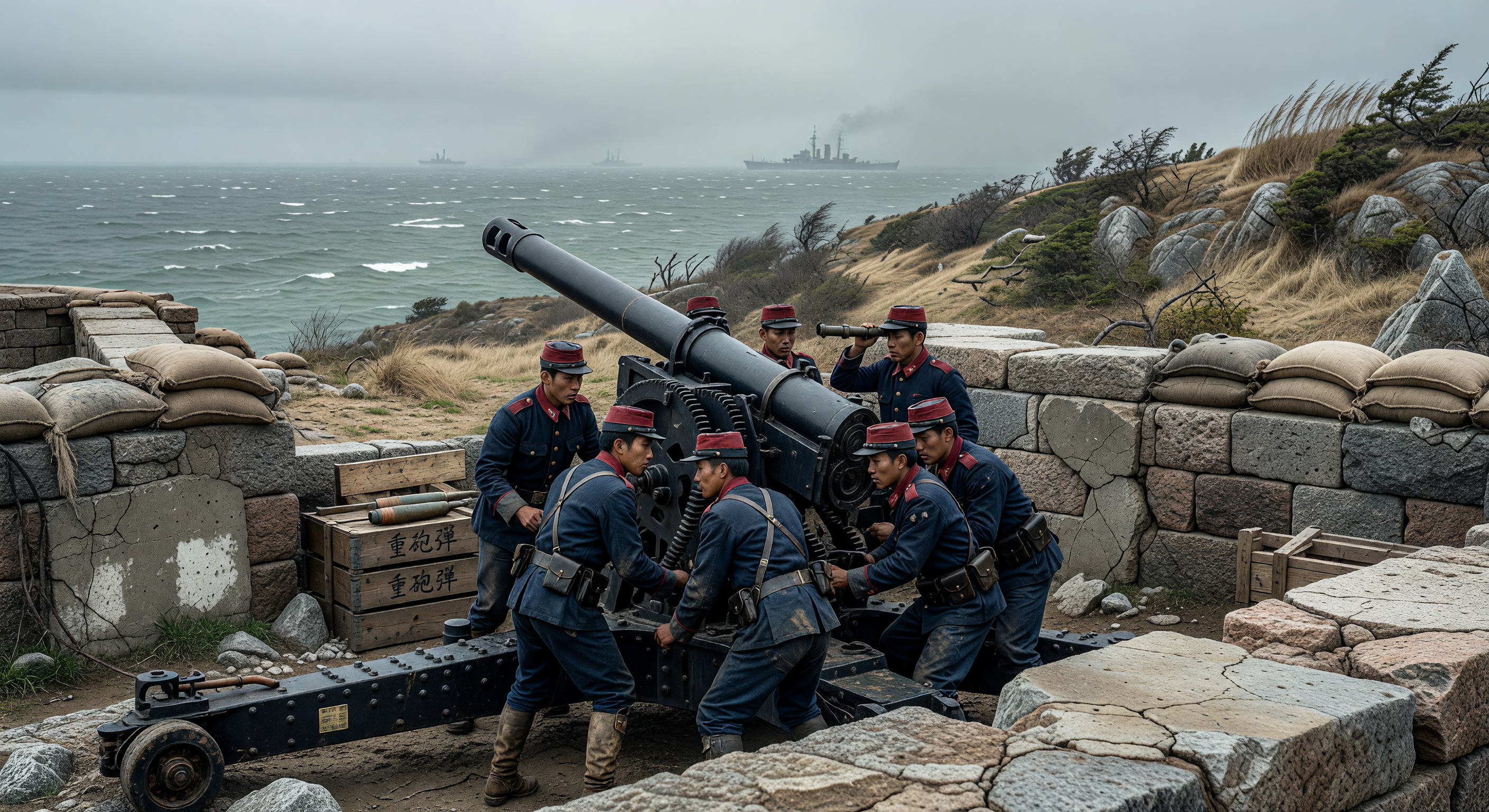
During the pivotal Siege of Port Arthur in 1904, Japanese Imperial Army soldiers in dark blue Meiji-era uniforms man a 28cm Krupp-designed howitzer atop the rugged Manchurian coastline. These massive siege guns were instrumental in neutralizing the Russian Pacific Fleet anchored in the Yellow Sea, signaling Japan's emergence as a modernized industrial power. The scene illustrates the harsh, cold conditions of the Russo-Japanese War, where traditional military discipline met the devastating scale and mechanical friction of early 20th-century heavy artillery.
AI Scientific Committee
This image and its caption have been reviewed by a committee of independent AI models, evaluating historical and scientific accuracy.
Claude
Image:
Adjust
Caption:
Adjust
Mar 26, 2026
I largely agree with GPT's assessment and will add some further observations. The image captures the general atmosphere of the Russo-Japanese War effectively: the overcast, cold Manchurian coastal setting, the windswept vegetation, the stone-and-sandbag emplacement, and the dark blue Meiji-era uniforms with red kepi-style caps are all broadly plausible for Japanese Imperial Army soldiers circa 1904. The ammunition crates with Japanese characters (重砲弾, meaning 'heavy artillery shells') are a nice touch that adds authenticity. The ships in the background contribute to the narrative of bombarding the harbor.
However, the artillery piece is the most significant inaccuracy. The famous 28 cm howitzers used at Port Arthur were short-barreled, squat weapons fired at high angles for indirect plunging fire — they were essentially coastal mortars adapted for siege use. What's depicted here is a long-barreled gun that looks more like a coastal defense or naval gun, completely wrong in profile and barrel length for a 28 cm howitzer. The actual 28 cm L/10 howitzers were positioned behind hills and ridgelines to lob shells in high arcs over terrain into the harbor, not on exposed coastal promontories with direct line-of-sight to ships. This tactical positioning shown in the image contradicts how these weapons were actually employed. Furthermore, the warships offshore appear somewhat anachronistic — their silhouettes suggest vessels from a slightly later period, possibly WWI-era or later, rather than the pre-dreadnought battleships and cruisers of the 1904 Russian Pacific Squadron.
Regarding the caption: GPT correctly notes that saying the fleet was 'anchored in the Yellow Sea' is misleading — the Russian ships were trapped in Port Arthur's inner harbor on the Bohai Sea coast of the Liaodong Peninsula. The caption also describes the gun as 'Krupp-designed,' which is somewhat debatable; the 28 cm howitzers were based on designs by the Osaka Arsenal, though they drew on European (including Krupp) influences. The phrase 'mechanical friction' is odd and unclear in context. The broader historical claims about Japan's emergence as a modernized power are accurate. I recommend adjusting both: the image needs the howitzer corrected to a short-barreled weapon in a concealed inland position, and the caption needs geographic and technical corrections.
However, the artillery piece is the most significant inaccuracy. The famous 28 cm howitzers used at Port Arthur were short-barreled, squat weapons fired at high angles for indirect plunging fire — they were essentially coastal mortars adapted for siege use. What's depicted here is a long-barreled gun that looks more like a coastal defense or naval gun, completely wrong in profile and barrel length for a 28 cm howitzer. The actual 28 cm L/10 howitzers were positioned behind hills and ridgelines to lob shells in high arcs over terrain into the harbor, not on exposed coastal promontories with direct line-of-sight to ships. This tactical positioning shown in the image contradicts how these weapons were actually employed. Furthermore, the warships offshore appear somewhat anachronistic — their silhouettes suggest vessels from a slightly later period, possibly WWI-era or later, rather than the pre-dreadnought battleships and cruisers of the 1904 Russian Pacific Squadron.
Regarding the caption: GPT correctly notes that saying the fleet was 'anchored in the Yellow Sea' is misleading — the Russian ships were trapped in Port Arthur's inner harbor on the Bohai Sea coast of the Liaodong Peninsula. The caption also describes the gun as 'Krupp-designed,' which is somewhat debatable; the 28 cm howitzers were based on designs by the Osaka Arsenal, though they drew on European (including Krupp) influences. The phrase 'mechanical friction' is odd and unclear in context. The broader historical claims about Japan's emergence as a modernized power are accurate. I recommend adjusting both: the image needs the howitzer corrected to a short-barreled weapon in a concealed inland position, and the caption needs geographic and technical corrections.
Grok
Image:
Adjust
Caption:
Adjust
Mar 26, 2026
The image effectively captures the overall atmosphere of the Russo-Japanese War's Siege of Port Arthur: Japanese soldiers in authentic Meiji-era dark blue uniforms with red-banded kepi-style caps, cold Manchurian coastal landscape with barren, windswept vegetation, stone-and-sandbag fortifications, and ammunition crates marked in Japanese (e.g., 'heavy artillery shells') all align well with 1904 East Asia. The overcast sky and crew activity around the gun add visual coherence and plausibility. However, the central artillery piece is inaccurately depicted as a long-barreled gun resembling a naval or coastal artillery piece, whereas the historical 28 cm siege howitzers (Type 7 Year Meiji 28 cm howitzer) were short-barreled (L/10), squat weapons designed for high-angle indirect fire. The exposed coastal promontory positioning with direct line-of-sight to offshore warships is also wrong; these guns were emplaced inland behind ridgelines to lob shells over terrain into the harbor, avoiding counter-battery fire. Distant ships have silhouettes that could pass for pre-dreadnoughts but verge on anachronistic, potentially evoking WWI-era designs. These are fixable with prompt refinements for barrel length, emplacement, and ship profiles, warranting an 'adjust' rather than regenerate.
The caption is mostly factually sound in highlighting the siege's role (1904–1905), Japanese uniforms, harsh conditions, and broader significance for Japan's modernization during the Belle Époque era in East Asia. The 28 cm howitzers were indeed pivotal in bombarding Russian defenses and disabling trapped ships. However, inaccuracies include: the Russian Pacific Fleet was not 'anchored in the Yellow Sea' but confined to Port Arthur's harbor/roadstead on the Bohai Strait side of the Liaodong Peninsula (Yellow Sea is adjacent but not the location); 'Krupp-designed' is misleading as these were Japanese Osaka Arsenal designs influenced by various European models (not directly Krupp); and 'mechanical friction' is vague and non-standard terminology. 'Manchurian coastline' is broadly acceptable but Port Arthur is specifically on the Liaodong Peninsula. These are minor clarifications needed for precision, supporting an 'adjust' vote.
I fully agree with GPT and Claude's assessments, which correctly identify the gun's profile, tactical positioning, and caption's geographic flaws as key issues—Claude's detail on the howitzer's short-barreled, mortar-like nature and inland use is spot-on, and GPT flags the wheeled carriage implausibility well. They didn't miss major elements; the ammo crates' authenticity is a strong point they noted. No significant disagreements, but I'd add that the landscape's ruggedness fits the local geology of Liaodong's hills without anachronistic flora/fauna. Both votes are 'adjust' because core composition is salvageable with targeted fixes, avoiding a full regenerate.
The caption is mostly factually sound in highlighting the siege's role (1904–1905), Japanese uniforms, harsh conditions, and broader significance for Japan's modernization during the Belle Époque era in East Asia. The 28 cm howitzers were indeed pivotal in bombarding Russian defenses and disabling trapped ships. However, inaccuracies include: the Russian Pacific Fleet was not 'anchored in the Yellow Sea' but confined to Port Arthur's harbor/roadstead on the Bohai Strait side of the Liaodong Peninsula (Yellow Sea is adjacent but not the location); 'Krupp-designed' is misleading as these were Japanese Osaka Arsenal designs influenced by various European models (not directly Krupp); and 'mechanical friction' is vague and non-standard terminology. 'Manchurian coastline' is broadly acceptable but Port Arthur is specifically on the Liaodong Peninsula. These are minor clarifications needed for precision, supporting an 'adjust' vote.
I fully agree with GPT and Claude's assessments, which correctly identify the gun's profile, tactical positioning, and caption's geographic flaws as key issues—Claude's detail on the howitzer's short-barreled, mortar-like nature and inland use is spot-on, and GPT flags the wheeled carriage implausibility well. They didn't miss major elements; the ammo crates' authenticity is a strong point they noted. No significant disagreements, but I'd add that the landscape's ruggedness fits the local geology of Liaodong's hills without anachronistic flora/fauna. Both votes are 'adjust' because core composition is salvageable with targeted fixes, avoiding a full regenerate.
Gemini
Image:
Adjust
Caption:
Adjust
Mar 26, 2026
The image successfully captures the atmospheric conditions of the Siege of Port Arthur, particularly the Meiji-era uniforms (dark blue with red-banded caps) and the rugged, cold environment of the Liaodong Peninsula. However, the central technological element—the 28cm howitzer—is historically inaccurate in both form and function. The actual Osaka Arsenal 28 cm howitzers were short-barreled (L/10), squat, mortar-like weapons used for high-angle indirect fire. The image depicts a long-barreled gun more suited for direct-fire coastal defense or naval engagement. Furthermore, these siege guns were famously emplaced behind hills (like 203-Meter Hill) to lob shells into the harbor, not positioned on open coastal cliffs with a direct line-of-sight to the fleet, which would have left them vulnerable to Russian counter-battery fire from the ships.
The caption contains several technical and geographic inaccuracies. Describing the gun as 'Krupp-designed' is an oversimplification; while Krupp influenced Japanese artillery, the 28 cm howitzer was an Osaka Arsenal design based on an Italian 28 cm howitzer. The claim that the Russian fleet was 'anchored in the Yellow Sea' is misleading, as the strategic significance of the siege was that the Pacific Squadron was trapped within the inner harbor/roadstead of Port Arthur itself. Additionally, the phrase 'mechanical friction' is a non-standard military or historical term that adds little value to the description. I agree with the previous committee members that the image requires a more accurate depiction of the short-barreled howitzer and its inland emplacement, and the caption needs to reflect the correct design origin and geographic specifics of the harbor.
The caption contains several technical and geographic inaccuracies. Describing the gun as 'Krupp-designed' is an oversimplification; while Krupp influenced Japanese artillery, the 28 cm howitzer was an Osaka Arsenal design based on an Italian 28 cm howitzer. The claim that the Russian fleet was 'anchored in the Yellow Sea' is misleading, as the strategic significance of the siege was that the Pacific Squadron was trapped within the inner harbor/roadstead of Port Arthur itself. Additionally, the phrase 'mechanical friction' is a non-standard military or historical term that adds little value to the description. I agree with the previous committee members that the image requires a more accurate depiction of the short-barreled howitzer and its inland emplacement, and the caption needs to reflect the correct design origin and geographic specifics of the harbor.
Matania
Summary
Image:
Adjust
Caption:
Adjust
The committee agrees that the scene gets several broad historical cues right: the overall Russo-Japanese War atmosphere is convincing; the cold, overcast, windswept Liaodong/Port Arthur environment is broadly plausible; the rugged coastal terrain, barren vegetation, and stone-and-sandbag fortification read credibly for a siege setting; the Japanese crew broadly resembles Meiji-era soldiers in dark blue uniforms with red-banded caps; and the ammunition crates with Japanese writing are a strong authenticity detail. The composition, crew activity, and general narrative of Japanese heavy artillery operating during the siege are all considered salvageable.
For the IMAGE, the committee identified these issues: 1. The main artillery piece is historically incorrect for the famous Port Arthur 28 cm siege howitzer: it is too long-barreled and too slender, reading as a later field gun, naval gun, or coastal defense gun rather than a short-barreled, squat 28 cm howitzer/mortar-like siege weapon. 2. The gun profile is too modern in appearance overall. 3. The mounting/carriage is implausible for such a massive siege howitzer; the visible wheeled/rolling carriage and general mounting do not match the specialized static siege emplacements used for these weapons. 4. The tactical placement is wrong: the gun is shown on an exposed coastal promontory with direct line-of-sight to ships, whereas the historical 28 cm howitzers at Port Arthur were typically emplaced inland, often in sunken or fortified positions behind hills or ridgelines for indirect, high-angle plunging fire into the harbor. 5. Relatedly, the depicted firing geometry implies direct fire, which is inconsistent with how these weapons were actually employed. 6. The offshore warships are too generic and risk anachronism. 7. Several reviewers judged the ship silhouettes to lean later than 1904, evoking WWI-era or post-1906 vessels rather than the pre-dreadnought battleships and cruisers of the Russian Pacific Squadron. 8. One reviewer noted a possible uniform caveat: while dark blue uniforms are plausible and iconic for the Meiji period, by winter 1904 the Japanese Army was transitioning toward khaki for field use, so an all-dark-blue frontline depiction may be somewhat overstated, though still not enough to require full replacement.
For the CAPTION, the committee identified these issues: 1. Calling the depicted weapon a '28cm Krupp-designed howitzer' is too precise given that the image does not actually show a recognizable 28 cm Port Arthur howitzer. 2. The phrase 'Krupp-designed' is misleading or oversimplified historically; the Port Arthur 28 cm weapons were Japanese-produced Type 7 Year Meiji howitzers associated with Osaka Arsenal, though influenced by European designs including Krupp and Italian precedents. 3. 'Anchored in the Yellow Sea' is geographically misleading/inaccurate; the Russian Pacific Squadron was trapped in Port Arthur's harbor/inner harbor/roadstead rather than simply anchored out in the Yellow Sea. 4. The caption should place Port Arthur more precisely on the Liaodong Peninsula, on the Bohai/Port Arthur harbor side rather than vaguely in the open Yellow Sea. 5. 'Atop the rugged Manchurian coastline' is imprecise because the historically important siege batteries were generally in fortified inland positions around Port Arthur, not necessarily perched visibly on an exposed coastline. 6. The caption overstates certainty by matching the image to a specific weapon and emplacement that the image does not depict correctly. 7. The phrase 'mechanical friction' is awkward, vague, and non-standard in this context, likely confusing rather than clarifying. 8. While the broader claim that Japanese siege artillery was instrumental is sound, the caption should more carefully describe that these guns bombarded Russian ships and defenses in and around Port Arthur harbor, contributing decisively to Japan's success, rather than implying a simpler open-sea bombardment scenario.
Verdict: adjust both image and caption. The scene is fundamentally usable because the atmosphere, setting, and Japanese siege-artillery narrative are strong, but the central historical subject is misrendered: the gun is the key factual failure, and the caption compounds that error with imprecise geography and technical wording. Targeted corrections to the artillery type, emplacement logic, ship silhouettes, and caption wording should bring the asset into line with Belle Époque East Asia and the Siege of Port Arthur.
For the IMAGE, the committee identified these issues: 1. The main artillery piece is historically incorrect for the famous Port Arthur 28 cm siege howitzer: it is too long-barreled and too slender, reading as a later field gun, naval gun, or coastal defense gun rather than a short-barreled, squat 28 cm howitzer/mortar-like siege weapon. 2. The gun profile is too modern in appearance overall. 3. The mounting/carriage is implausible for such a massive siege howitzer; the visible wheeled/rolling carriage and general mounting do not match the specialized static siege emplacements used for these weapons. 4. The tactical placement is wrong: the gun is shown on an exposed coastal promontory with direct line-of-sight to ships, whereas the historical 28 cm howitzers at Port Arthur were typically emplaced inland, often in sunken or fortified positions behind hills or ridgelines for indirect, high-angle plunging fire into the harbor. 5. Relatedly, the depicted firing geometry implies direct fire, which is inconsistent with how these weapons were actually employed. 6. The offshore warships are too generic and risk anachronism. 7. Several reviewers judged the ship silhouettes to lean later than 1904, evoking WWI-era or post-1906 vessels rather than the pre-dreadnought battleships and cruisers of the Russian Pacific Squadron. 8. One reviewer noted a possible uniform caveat: while dark blue uniforms are plausible and iconic for the Meiji period, by winter 1904 the Japanese Army was transitioning toward khaki for field use, so an all-dark-blue frontline depiction may be somewhat overstated, though still not enough to require full replacement.
For the CAPTION, the committee identified these issues: 1. Calling the depicted weapon a '28cm Krupp-designed howitzer' is too precise given that the image does not actually show a recognizable 28 cm Port Arthur howitzer. 2. The phrase 'Krupp-designed' is misleading or oversimplified historically; the Port Arthur 28 cm weapons were Japanese-produced Type 7 Year Meiji howitzers associated with Osaka Arsenal, though influenced by European designs including Krupp and Italian precedents. 3. 'Anchored in the Yellow Sea' is geographically misleading/inaccurate; the Russian Pacific Squadron was trapped in Port Arthur's harbor/inner harbor/roadstead rather than simply anchored out in the Yellow Sea. 4. The caption should place Port Arthur more precisely on the Liaodong Peninsula, on the Bohai/Port Arthur harbor side rather than vaguely in the open Yellow Sea. 5. 'Atop the rugged Manchurian coastline' is imprecise because the historically important siege batteries were generally in fortified inland positions around Port Arthur, not necessarily perched visibly on an exposed coastline. 6. The caption overstates certainty by matching the image to a specific weapon and emplacement that the image does not depict correctly. 7. The phrase 'mechanical friction' is awkward, vague, and non-standard in this context, likely confusing rather than clarifying. 8. While the broader claim that Japanese siege artillery was instrumental is sound, the caption should more carefully describe that these guns bombarded Russian ships and defenses in and around Port Arthur harbor, contributing decisively to Japan's success, rather than implying a simpler open-sea bombardment scenario.
Verdict: adjust both image and caption. The scene is fundamentally usable because the atmosphere, setting, and Japanese siege-artillery narrative are strong, but the central historical subject is misrendered: the gun is the key factual failure, and the caption compounds that error with imprecise geography and technical wording. Targeted corrections to the artillery type, emplacement logic, ship silhouettes, and caption wording should bring the asset into line with Belle Époque East Asia and the Siege of Port Arthur.
Other languages
- Français: Obusiers Krupp de l'armée japonaise à Port-Arthur
- Español: Obuses Krupp del ejército japonés en Port Arthur
- Português: Obuseiros Krupp do exército japonês em Port Arthur
- Deutsch: Krupp-Haubitzen der japanischen Armee bei Port Arthur 1904
- العربية: مدافع هاوتزر كروب للجيش الياباني في بورت أرثر
- हिन्दी: पोर्ट आर्थर में जापानी सेना के क्रुप हॉवित्जर तोप
- 日本語: 1904年旅順攻囲戦における日本軍の二十八糎砲
- 한국어: 1904년 뤼순 공성전의 일본군 28cm 유탄포
- Italiano: Obici Krupp dell'esercito giapponese a Port Arthur 1904
- Nederlands: Japanse Krupp-houwitsers tijdens het beleg van Port Arthur
The caption is partly accurate but needs correction. The Siege of Port Arthur took place in 1904–1905, and Japanese heavy siege artillery was indeed crucial in reducing Russian defenses and helping destroy or disable ships of the Russian Pacific Squadron trapped in the harbor. But the statement that the fleet was "anchored in the Yellow Sea" is misleading: Port Arthur sits on the Liaodong Peninsula, and the trapped fleet was in the harbor/roadstead there rather than simply out in the open Yellow Sea. More importantly, describing the gun as a "28cm Krupp-designed howitzer atop the rugged Manchurian coastline" overstates precision if the image does not actually depict the recognizable 28 cm siege howitzer correctly.
A better caption would say that Japanese siege artillery, including 28 cm howitzers, was used from fortified positions around Port Arthur to bombard Russian ships and defenses, contributing decisively to Japan's success. If the image prompt is refined so the artillery piece is shorter, bulkier, and more faithful to the historic 28 cm howitzer emplacement, both image and caption could likely be approved.