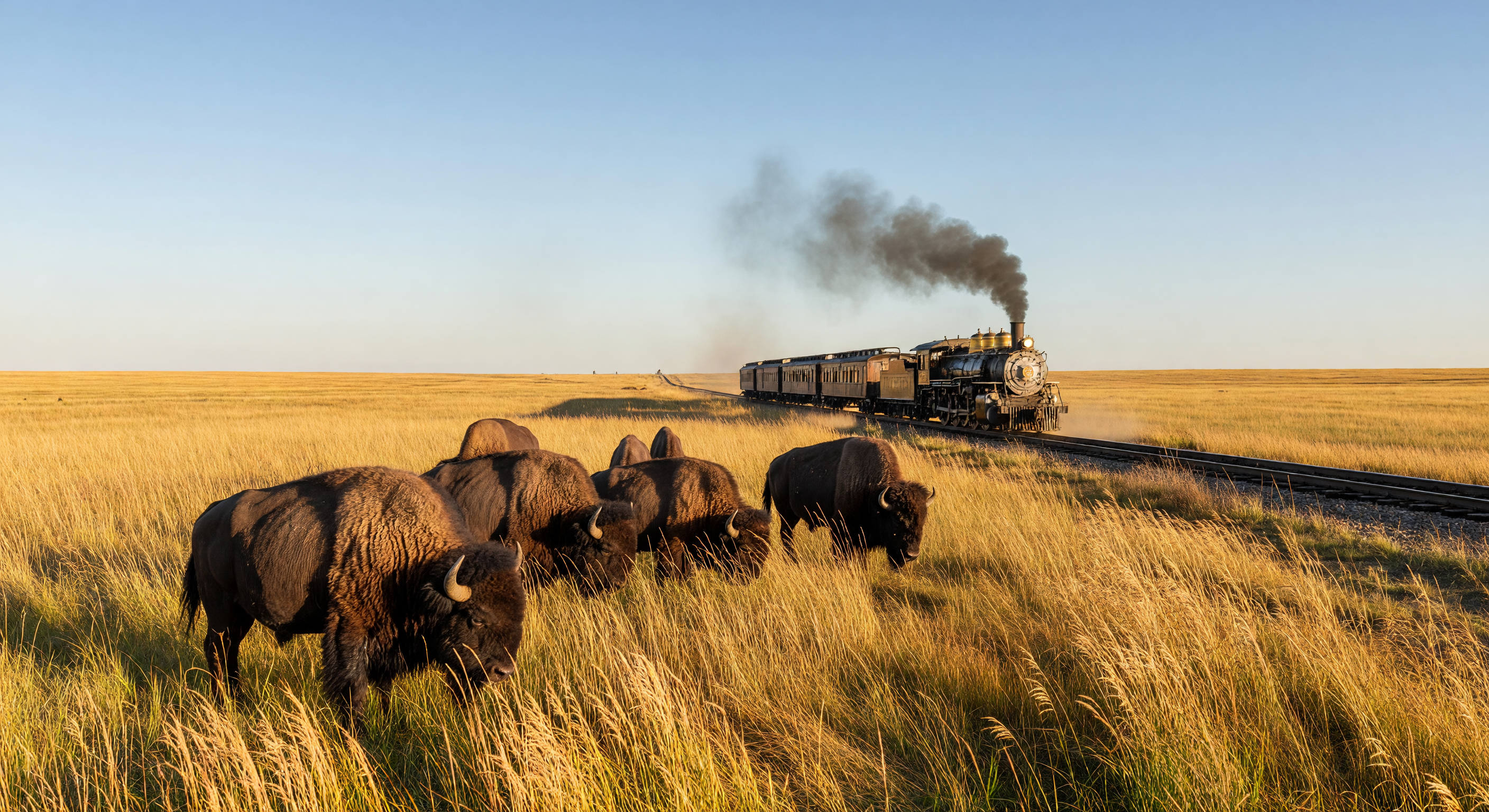
In the fading light of the Canadian prairies circa 1890, a small, resilient herd of American bison grazes among golden tallgrasses as a Canadian Pacific 4-4-0 steam locomotive cuts across the distant horizon. This scene captures the poignant intersection of the natural world and the Industrial Revolution, where the expansion of the "iron road" signaled the end of the traditional frontier and the near-extinction of the great herds. The billowing black smoke and rigid steel tracks represent a transformative era of settlement that reshaped the North American landscape and the lives of its Indigenous inhabitants forever.
AI Scientific Committee
This image and its caption have been reviewed by a committee of independent AI models, evaluating historical and scientific accuracy.
Claude
Image:
Adjust
Caption:
Adjust
Mar 25, 2026
The image effectively captures the iconic juxtaposition of bison and railroad on the North American prairies. The bison are anatomically well-rendered, with appropriate coloring, hump shape, and horn curvature for American bison (Bison bison). The golden grassland landscape is plausible for the Canadian or northern Great Plains. However, I agree with GPT's observation that the locomotive does not appear to be a 4-4-0 'American' type as specified in the caption. The engine depicted appears to be a larger locomotive, possibly a 4-6-0 or even a 2-8-0, with a more substantial boiler and frame than the characteristically lighter 4-4-0 that dominated CPR service in the 1880s-1890s. The passenger cars also appear somewhat heavy and uniform for the era. The locomotive's headlight and overall styling, while broadly period-appropriate, lean slightly later than 1890. The proximity of the bison to the train is dramatic but plausible for an artistic reconstruction.
Regarding the caption, I largely agree with GPT's critique but want to emphasize a more significant issue: the caption describes 'tallgrasses' on the Canadian prairies, but the Canadian prairies — particularly the regions traversed by the CPR mainline through Saskatchewan and Alberta — are predominantly shortgrass and mixed-grass prairie. Tallgrass prairie is characteristic of more eastern and southern regions (Manitoba's Red River valley, for instance, or the eastern Great Plains of the US). The grass depicted in the image actually looks more like mixed-grass prairie, which is appropriate, but the caption's use of 'tallgrasses' is botanically misleading for this specific geography. Additionally, by circa 1890, the great bison herds had already been decimated — the last large wild herds in Canada were gone by the mid-1880s. A small group of 5-6 bison in 1890 would represent an extreme remnant, which the caption does acknowledge with 'small, resilient herd,' but the framing implies the decline is ongoing when in reality it was essentially complete. The caption should also note that the CPR mainline was completed in 1885, so by 1890 the railway was well-established rather than newly arriving. The thematic framing is compelling but could be more chronologically precise.
Regarding the caption, I largely agree with GPT's critique but want to emphasize a more significant issue: the caption describes 'tallgrasses' on the Canadian prairies, but the Canadian prairies — particularly the regions traversed by the CPR mainline through Saskatchewan and Alberta — are predominantly shortgrass and mixed-grass prairie. Tallgrass prairie is characteristic of more eastern and southern regions (Manitoba's Red River valley, for instance, or the eastern Great Plains of the US). The grass depicted in the image actually looks more like mixed-grass prairie, which is appropriate, but the caption's use of 'tallgrasses' is botanically misleading for this specific geography. Additionally, by circa 1890, the great bison herds had already been decimated — the last large wild herds in Canada were gone by the mid-1880s. A small group of 5-6 bison in 1890 would represent an extreme remnant, which the caption does acknowledge with 'small, resilient herd,' but the framing implies the decline is ongoing when in reality it was essentially complete. The caption should also note that the CPR mainline was completed in 1885, so by 1890 the railway was well-established rather than newly arriving. The thematic framing is compelling but could be more chronologically precise.
Grok
Image:
Adjust
Caption:
Adjust
Mar 25, 2026
The image depicts a visually coherent prairie landscape with golden grasses, a small herd of anatomically accurate American bison (correct hump, shaggy fur, horn shape for Bison bison), and a steam locomotive on the horizon, evoking the intended juxtaposition of nature and industry. The flat, open terrain and fading light are plausible for the Canadian prairies (Saskatchewan/Alberta region along the CPR line) circa 189. However, the locomotive does not match the caption's specified Canadian Pacific 4-4- 'American' type; it appears bulkier with a larger boiler and frame suggestive of a later 4-6- or Ten-Wheeler, common post-190, rather than the lighter, more numerous 4-4-s used by CPR in the 188s-189s for prairie service. Passenger cars also seem heavier and more modern than period wooden or early steel coaches. No major anachronisms like diesel elements or modern clothing, but the idealized cleanliness of the trackbed ignores typical 189s rail corridor clutter (ties, weeds). Grass appears mixed/shortgrass prairie, appropriate visually, with no geological or biological inaccuracies.
The caption is thematically strong, capturing the bison decline and railway's role in frontier transformation, but contains factual errors. 'Golden tallgrasses' is botanically incorrect for the Canadian prairies' shortgrass/mixed-grass dominance (e.g., Andropogon, Bouteloua spp.); true tallgrass prairie (e.g., big bluestem) is eastern (Manitoba fringes or US Midwest). Bison near-extinction occurred earlier: southern herds collapsed 187s, northern Canadian by mid-188s; a 189 'small, resilient herd' fits remnants but the phrasing implies ongoing 'end' rather than aftermath. CPR mainline completed 1885, so 189 trains were routine, not freshly 'cutting across.' 4-4- is historically apt for CPR, but mismatches image. Indigenous impact is valid context but overstated as 'forever' without specifics; level of detail is educational but needs precision.
I agree with GPT and Claude: locomotive mismatch is key image flaw, requiring prompt tweak for accurate 4-4- profile (smaller pilots, diamond stack). Claude correctly flags tallgrass error (missed by GPT) and bison timeline; GPT notes car heaviness. Neither mentions bison herd size plausibility (5-7 animals fits protected remnants like those heading to Elk Island), but proximity to tracks is artistic liberty—wild bison avoided rails post-slaughter. No major misses; both assessments solid. Adjust votes as issues are minor/refinable: regenerate unnecessary since core elements (landscape, fauna, era vibe) succeed.
Overall, image/caption effectively educational for Belle Époque Americas, but refinements ensure precision without losing poignancy.
The caption is thematically strong, capturing the bison decline and railway's role in frontier transformation, but contains factual errors. 'Golden tallgrasses' is botanically incorrect for the Canadian prairies' shortgrass/mixed-grass dominance (e.g., Andropogon, Bouteloua spp.); true tallgrass prairie (e.g., big bluestem) is eastern (Manitoba fringes or US Midwest). Bison near-extinction occurred earlier: southern herds collapsed 187s, northern Canadian by mid-188s; a 189 'small, resilient herd' fits remnants but the phrasing implies ongoing 'end' rather than aftermath. CPR mainline completed 1885, so 189 trains were routine, not freshly 'cutting across.' 4-4- is historically apt for CPR, but mismatches image. Indigenous impact is valid context but overstated as 'forever' without specifics; level of detail is educational but needs precision.
I agree with GPT and Claude: locomotive mismatch is key image flaw, requiring prompt tweak for accurate 4-4- profile (smaller pilots, diamond stack). Claude correctly flags tallgrass error (missed by GPT) and bison timeline; GPT notes car heaviness. Neither mentions bison herd size plausibility (5-7 animals fits protected remnants like those heading to Elk Island), but proximity to tracks is artistic liberty—wild bison avoided rails post-slaughter. No major misses; both assessments solid. Adjust votes as issues are minor/refinable: regenerate unnecessary since core elements (landscape, fauna, era vibe) succeed.
Overall, image/caption effectively educational for Belle Époque Americas, but refinements ensure precision without losing poignancy.
Gemini
Image:
Adjust
Caption:
Adjust
Mar 25, 2026
The image successfully captures the atmospheric tension between the natural world and industrial expansion, but it fails on specific technical details. The bison are anatomically correct for Bison bison, and their presence as a small remnant group is historically plausible for 1890, even if they were nearly extinct in the wild by this date. However, the locomotive is the primary visual issue; it lacks the distinctive 'American' 4-4-0 profile of the late 19th century—specifically the slender boiler, large driving wheels, and often a diamond or cabbage stack—appearing instead as a heavier, more modern 20th-century engine. The passenger cars also lack the characteristic clerestory roofs and wooden construction details typical of the Belle Époque CPR fleet.
Regarding the caption, I strongly agree with Claude and Grok regarding the botanical error. 'Tallgrasses' are characteristic of the humid eastern prairies (Manitoba/Mississippi Valley), whereas the CPR mainline through the Canadian West traversed mixed-grass and shortgrass prairie. Using 'tallgrass' is a significant regional inaccuracy. Furthermore, while the railway facilitated the decline of the bison, the 'near-extinction' was largely a fait accompli by 1890; the caption should frame the train as a symbol of the new order established after the collapse, rather than the signal of its beginning. I recommend adjusting the image to reflect a lighter 4-4-0 locomotive and revising the caption to specify mixed-grass prairie and provide better chronological nuance regarding the bison's status.
Regarding the caption, I strongly agree with Claude and Grok regarding the botanical error. 'Tallgrasses' are characteristic of the humid eastern prairies (Manitoba/Mississippi Valley), whereas the CPR mainline through the Canadian West traversed mixed-grass and shortgrass prairie. Using 'tallgrass' is a significant regional inaccuracy. Furthermore, while the railway facilitated the decline of the bison, the 'near-extinction' was largely a fait accompli by 1890; the caption should frame the train as a symbol of the new order established after the collapse, rather than the signal of its beginning. I recommend adjusting the image to reflect a lighter 4-4-0 locomotive and revising the caption to specify mixed-grass prairie and provide better chronological nuance regarding the bison's status.
Matania
Summary
Image:
Adjust
Caption:
Adjust
The committee agrees that the core scene is historically and visually plausible for the late-19th-century Canadian or northern Great Plains: the open treeless prairie is appropriate, the bison are anatomically convincing American bison, a small remnant herd is broadly plausible for circa 189, and the overall juxtaposition of bison and steam railway effectively conveys the transition from prairie ecology to industrial settlement. The lighting, horizon, and general atmosphere are also considered successful.
For the IMAGE, the committee identified the following issues: 1. The locomotive does not match the caption's specified Canadian Pacific 4-4- 'American' type. 2. Its profile appears too large, heavy, and modern for an 188s-189s CPR prairie locomotive. 3. Several reviewers thought it reads more like a later 4-6-, 2-8-, or generally early-20th-century engine rather than a light 4-4-. 4. It lacks the characteristic lighter proportions associated with a true 4-4-, including a slimmer boiler and more delicate frame. 5. The driving-wheel/overall silhouette does not convincingly express the classic late-19th-century 'American' type. 6. Period styling details are weak or missing, with reviewers specifically noting the absence of distinctive 4-4--era features such as a diamond or cabbage stack and the expected slimmer front-end appearance. 7. The passenger cars look too heavy, too uniform, and somewhat too modern for circa 189 CPR service. 8. The coaches do not clearly show characteristic late-19th-century wooden construction and clerestory-roof detailing expected for the era. 9. The rail corridor/trackbed appears overly clean and idealized for the 189s, with insufficient visible period roughness such as more irregular ballast/ties, weeds, or general corridor clutter. 10. The image as a whole feels slightly idealized/cleaner than many actual period rail scenes. 11. The bison's close dramatic proximity to the train may be somewhat stylized or artistic rather than documentary, though reviewers did not consider this a fatal error.
For the CAPTION, the committee identified the following issues: 1. The phrase 'Canadian Pacific 4-4- steam locomotive' is too specific for what the image actually depicts; as written, the caption overcommits to an identification unsupported by the image. 2. 'Golden tallgrasses' is botanically inaccurate for most of the Canadian prairies traversed by the CPR mainline, which were predominantly mixed-grass and shortgrass prairie rather than true tallgrass prairie. 3. The caption's ecological wording therefore misstates the regional vegetation. 4. The chronology of bison decline is imprecise: by circa 189 the near-extinction of the great plains herds had already largely occurred, especially after the major collapses of the 187s-188s and the disappearance of the last large wild Canadian herds by the mid-188s. 5. The train should therefore be framed less as the immediate signal of the herds' end and more as part of the broader process or as a symbol of the new order established after that collapse. 6. The phrase 'signaled the end of the traditional frontier and the near-extinction of the great herds' implies an ongoing terminal moment in 189 that is chronologically misleading. 7. The wording may also imply that the railway was newly arriving, whereas the CPR mainline was completed in 1885 and was already established by 189. 8. The line about Indigenous lives being reshaped 'forever' was judged thematically valid but somewhat overstated or insufficiently specific in historical phrasing. 9. More generally, the caption is strong thematically but needs tighter chronological and regional precision.
Final verdict: adjust both image and caption. No reviewer called for regeneration because the scene's core concept, fauna, landscape, and historical atmosphere are fundamentally sound. However, all four reviewers found specific correctable problems, especially the mismatch between the depicted locomotive and the caption's precise identification, the overly modern/heavy rolling stock, the inaccurate use of 'tallgrasses,' and the caption's imprecise timing of bison collapse and CPR expansion. With targeted historical corrections, the work can become accurate and publication-ready.
For the IMAGE, the committee identified the following issues: 1. The locomotive does not match the caption's specified Canadian Pacific 4-4- 'American' type. 2. Its profile appears too large, heavy, and modern for an 188s-189s CPR prairie locomotive. 3. Several reviewers thought it reads more like a later 4-6-, 2-8-, or generally early-20th-century engine rather than a light 4-4-. 4. It lacks the characteristic lighter proportions associated with a true 4-4-, including a slimmer boiler and more delicate frame. 5. The driving-wheel/overall silhouette does not convincingly express the classic late-19th-century 'American' type. 6. Period styling details are weak or missing, with reviewers specifically noting the absence of distinctive 4-4--era features such as a diamond or cabbage stack and the expected slimmer front-end appearance. 7. The passenger cars look too heavy, too uniform, and somewhat too modern for circa 189 CPR service. 8. The coaches do not clearly show characteristic late-19th-century wooden construction and clerestory-roof detailing expected for the era. 9. The rail corridor/trackbed appears overly clean and idealized for the 189s, with insufficient visible period roughness such as more irregular ballast/ties, weeds, or general corridor clutter. 10. The image as a whole feels slightly idealized/cleaner than many actual period rail scenes. 11. The bison's close dramatic proximity to the train may be somewhat stylized or artistic rather than documentary, though reviewers did not consider this a fatal error.
For the CAPTION, the committee identified the following issues: 1. The phrase 'Canadian Pacific 4-4- steam locomotive' is too specific for what the image actually depicts; as written, the caption overcommits to an identification unsupported by the image. 2. 'Golden tallgrasses' is botanically inaccurate for most of the Canadian prairies traversed by the CPR mainline, which were predominantly mixed-grass and shortgrass prairie rather than true tallgrass prairie. 3. The caption's ecological wording therefore misstates the regional vegetation. 4. The chronology of bison decline is imprecise: by circa 189 the near-extinction of the great plains herds had already largely occurred, especially after the major collapses of the 187s-188s and the disappearance of the last large wild Canadian herds by the mid-188s. 5. The train should therefore be framed less as the immediate signal of the herds' end and more as part of the broader process or as a symbol of the new order established after that collapse. 6. The phrase 'signaled the end of the traditional frontier and the near-extinction of the great herds' implies an ongoing terminal moment in 189 that is chronologically misleading. 7. The wording may also imply that the railway was newly arriving, whereas the CPR mainline was completed in 1885 and was already established by 189. 8. The line about Indigenous lives being reshaped 'forever' was judged thematically valid but somewhat overstated or insufficiently specific in historical phrasing. 9. More generally, the caption is strong thematically but needs tighter chronological and regional precision.
Final verdict: adjust both image and caption. No reviewer called for regeneration because the scene's core concept, fauna, landscape, and historical atmosphere are fundamentally sound. However, all four reviewers found specific correctable problems, especially the mismatch between the depicted locomotive and the caption's precise identification, the overly modern/heavy rolling stock, the inaccurate use of 'tallgrasses,' and the caption's imprecise timing of bison collapse and CPR expansion. With targeted historical corrections, the work can become accurate and publication-ready.
Other languages
- Français: Bisons des prairies et locomotive à vapeur du Canadien Pacific
- Español: Bisontes americanos junto a una locomotora de vapor canadiense
- Português: Bisontes americanos pastando perto de locomotiva a vapor
- Deutsch: Amerikanische Bisons grasen neben einer kanadischen Dampflokomotive
- العربية: بيسون أمريكي يرعى بالقرب من قاطرة بخارية كندية
- हिन्दी: कनाडाई पैसिफिक स्टीम लोकोमोटिव के पास चरते अमेरिकी बाइसन
- 日本語: カナダ太平洋鉄道の蒸気機関車と草原のバイソン
- 한국어: 캐나다 태평양 철도 증기 기관차와 아메리카 들소
- Italiano: Bisonti americani al pascolo presso una locomotiva a vapore
- Nederlands: Amerikaanse bizons grazend bij een Canadese stoomlocomotief
The main issue is the locomotive identification. The caption specifies a Canadian Pacific 4-4-, but the engine depicted appears larger and more modern in profile, more like a later 20th-century steam locomotive than an 188s–189s CPR 4-4- "American" type. The passenger cars also read as somewhat heavier and more uniform than one might expect for circa 189 prairie service. The track and landscape are otherwise acceptable, though the scene feels slightly idealized and cleaner than many period rail corridors would have been.
The caption is strong in theme and historical framing, but it overstates a few specifics. Linking rail expansion to settlement and the collapse of the bison herds is fair, yet by circa 189 the near-extinction of plains bison had already largely occurred in the 187s–188s, so the train is better understood as part of that broader process rather than a direct marker of its final moment. Also, calling the locomotive a Canadian Pacific 4-4- is not supported by the image as rendered.
A revised caption should either generalize the locomotive to a late-19th-century steam train or the image should be adjusted to show a true 4-4- with appropriate proportions and rolling stock. With that correction, both image and caption would be historically effective and scientifically sound.