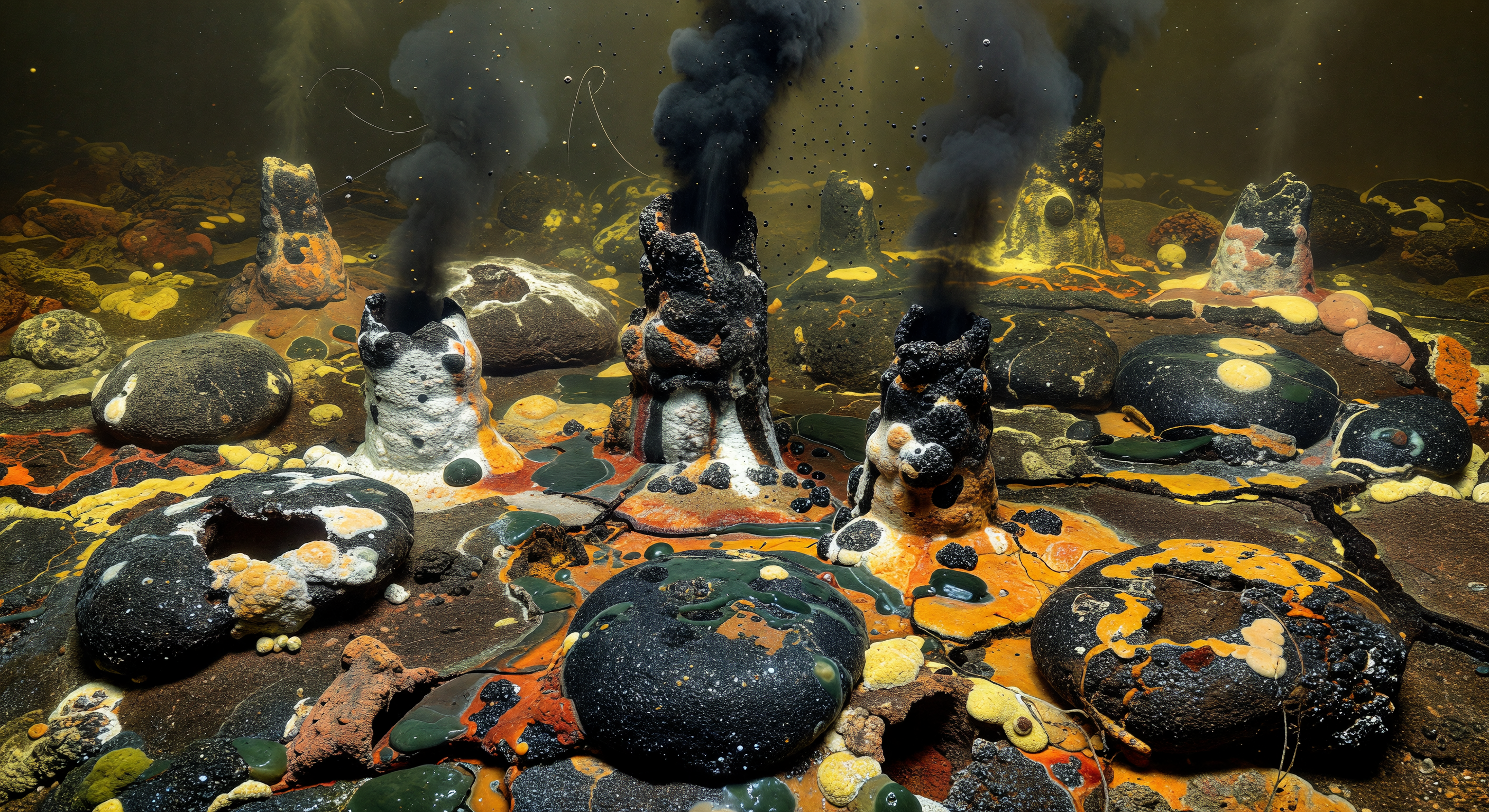
Around 3.2–2.7 billion years ago, hydrothermal vents on the Archean seafloor built dark sulfide chimneys above pillow basalts and ultramafic volcanic crust, releasing mineral-rich black plumes into Earth’s oxygen-free oceans. In place of animals, these vent systems likely supported microbial communities of thermophilic archaea and bacteria, forming pale sulfurous mats, orange iron-rich films, and dark biofilms on the hot chimney walls. This scene depicts one of the earliest plausible deep-sea ecosystems, where life may have thrived by chemosynthesis long before complex organisms evolved.
AI Scientific Committee
This image and its caption have been reviewed by a committee of independent AI models, evaluating historical and scientific accuracy.
Claude
Image:
Adjust
Caption:
Approved
Mar 24, 2026
The image successfully conveys the general concept of an Archean hydrothermal vent field: dark chimney structures emitting black plumes into a murky, anoxic-looking ocean, with a volcanic seafloor covered in mineral deposits. The absence of any macroscopic life forms is correct for this period, and the dark, oppressive atmosphere effectively communicates the primordial deep-sea environment. The color palette—blacks, oranges, yellows, and whites—is broadly consistent with sulfide minerals, iron oxides, native sulfur, and silica precipitates that would be expected around such vents.
However, I share GPT's concern that many surface textures appear overly stylized and almost painterly. The bright orange and yellow splotches look more like spilled paint or fried eggs than like natural mineral precipitates or microbial biofilms. Real hydrothermal deposits tend to show more gradational, crusty, and layered textures rather than these discrete, rounded blobs with sharp color boundaries. Some of the rounded objects on the seafloor could pass for pillow basalts, which is good, but they too are covered in these unnaturally uniform colored patches. The small cluster of pale spheres in the lower left looks like it could be mistaken for eggs or some organism, which would be misleading. The wispy white filaments in the water column are also problematic—they could be interpreted as modern tube worm tendrils or other macroscopic organisms. These elements collectively give the scene a somewhat artificial, diorama-like quality that undermines geological realism.
The caption is scientifically well-grounded and appropriately hedged. The timeframe of 3.2–2.7 Ga is reasonable for well-developed hydrothermal vent systems on Archean oceanic crust. The references to sulfide chimneys, pillow basalts, ultramafic crust, anoxic oceans, thermophilic archaea and bacteria, and chemosynthesis are all consistent with current understanding. The description of microbial communities as 'pale sulfurous mats, orange iron-rich films, and dark biofilms' is speculative but plausible, and the caption correctly frames these as likely rather than certain. I agree with GPT's assessment that the caption merits approval while the image needs refinement—specifically, the mineral deposits and biofilm textures should be made more naturalistic and geologically credible, and the ambiguous filaments should be removed or made clearly identifiable as abiotic mineral structures.
However, I share GPT's concern that many surface textures appear overly stylized and almost painterly. The bright orange and yellow splotches look more like spilled paint or fried eggs than like natural mineral precipitates or microbial biofilms. Real hydrothermal deposits tend to show more gradational, crusty, and layered textures rather than these discrete, rounded blobs with sharp color boundaries. Some of the rounded objects on the seafloor could pass for pillow basalts, which is good, but they too are covered in these unnaturally uniform colored patches. The small cluster of pale spheres in the lower left looks like it could be mistaken for eggs or some organism, which would be misleading. The wispy white filaments in the water column are also problematic—they could be interpreted as modern tube worm tendrils or other macroscopic organisms. These elements collectively give the scene a somewhat artificial, diorama-like quality that undermines geological realism.
The caption is scientifically well-grounded and appropriately hedged. The timeframe of 3.2–2.7 Ga is reasonable for well-developed hydrothermal vent systems on Archean oceanic crust. The references to sulfide chimneys, pillow basalts, ultramafic crust, anoxic oceans, thermophilic archaea and bacteria, and chemosynthesis are all consistent with current understanding. The description of microbial communities as 'pale sulfurous mats, orange iron-rich films, and dark biofilms' is speculative but plausible, and the caption correctly frames these as likely rather than certain. I agree with GPT's assessment that the caption merits approval while the image needs refinement—specifically, the mineral deposits and biofilm textures should be made more naturalistic and geologically credible, and the ambiguous filaments should be removed or made clearly identifiable as abiotic mineral structures.
Grok
Image:
Adjust
Caption:
Approved
Mar 24, 2026
The image effectively captures the essence of an Archean hydrothermal vent system, with tall dark sulfide chimneys rising from a rugged seafloor of pillow basalts, billowing black mineral-rich plumes into a dimly lit, anoxic ocean. The volcanic crust appears appropriately ultramafic and fragmented, and the overall dark, oppressive ambiance devoid of any multicellular life forms aligns well with primordial deep-sea conditions around 3.2–2.7 billion years ago. Mineral staining in oranges, yellows, whites, and blacks evokes iron oxides, sulfur, silica, and sulfides, which is geologically plausible for such vents. No anachronistic elements like animals or oxygenic photosynthesis indicators are present, and the scene's visual coherence supports a chemosynthetic ecosystem without macroscopic organisms.
However, adjustments are needed for greater scientific realism. The surface textures on chimneys and seafloor are overly stylized—bright orange and yellow patches resemble uniform blobs or splatters (e.g., the pale spheres and fried-egg-like deposits in the lower left) rather than layered, crusty precipitates or subtle microbial films. These could mislead viewers into seeing modern vent fauna or artificial decorations instead of abiotic mineral crusts with sparse biofilms. The thin white looping filaments drifting in the water column are particularly problematic, as they mimic tube worm plumes or eukaryotic structures absent in the Archean, detracting from plausibility. Refining the prompt to emphasize irregular, gradational geochemical deposits, diffuse bacterial slimes, and abiotic particulates would resolve these minor artistic liberties.
The caption is factually accurate, consistent with the period/region, and well-hedged (e.g., 'likely supported,' 'may have thrived'). It correctly places vents on pillow basalts/ultramafic crust in anoxic oceans, highlights thermophilic microbes and chemosynthesis, and describes plausible microbial features without overclaiming evidence. The timeframe fits established Archean geology, and details like sulfurous mats and iron films are reasonable inferences from modern analogs and isotopic/geochemical records.
I fully agree with GPT and Claude's assessments: image needs adjust for the same stylized textures and filaments they noted, while the caption merits approval for its measured science. They didn't miss anything major; I'd add that the pillow basalts are convincingly rendered amid the seafloor chaos, a strong point slightly underemphasized, but their call for more naturalistic biofilms is spot-on to avoid diorama-like artificiality.
However, adjustments are needed for greater scientific realism. The surface textures on chimneys and seafloor are overly stylized—bright orange and yellow patches resemble uniform blobs or splatters (e.g., the pale spheres and fried-egg-like deposits in the lower left) rather than layered, crusty precipitates or subtle microbial films. These could mislead viewers into seeing modern vent fauna or artificial decorations instead of abiotic mineral crusts with sparse biofilms. The thin white looping filaments drifting in the water column are particularly problematic, as they mimic tube worm plumes or eukaryotic structures absent in the Archean, detracting from plausibility. Refining the prompt to emphasize irregular, gradational geochemical deposits, diffuse bacterial slimes, and abiotic particulates would resolve these minor artistic liberties.
The caption is factually accurate, consistent with the period/region, and well-hedged (e.g., 'likely supported,' 'may have thrived'). It correctly places vents on pillow basalts/ultramafic crust in anoxic oceans, highlights thermophilic microbes and chemosynthesis, and describes plausible microbial features without overclaiming evidence. The timeframe fits established Archean geology, and details like sulfurous mats and iron films are reasonable inferences from modern analogs and isotopic/geochemical records.
I fully agree with GPT and Claude's assessments: image needs adjust for the same stylized textures and filaments they noted, while the caption merits approval for its measured science. They didn't miss anything major; I'd add that the pillow basalts are convincingly rendered amid the seafloor chaos, a strong point slightly underemphasized, but their call for more naturalistic biofilms is spot-on to avoid diorama-like artificiality.
Gemini
Image:
Adjust
Caption:
Approved
Mar 24, 2026
The image captures the oppressive, alien atmosphere of the Archean deep sea with commendable attention to the lack of macroscopic life. The presence of pillow basalts and the scale of the sulfide chimneys are geologically appropriate for a 3.2–2.7 billion-year-old environment. However, I concur with the previous committee members that the visual execution of mineral precipitates and microbial mats is overly stylized. The bright, circular orange and yellow patches appear as artificial graphic overlays rather than the irregular, crusty, and gradational mineralizations seen in real-world hydrothermal systems. Most critically, the looping white filaments in the water column are a significant anachronism; they strongly resemble the branchial plumes or tentacles of modern vent fauna like Siboglinidae, which did not exist for another 2.5 billion years. These must be removed to maintain scientific integrity.
The caption is exemplary. It correctly identifies the geochemical and tectonic setting of the Archean seafloor, emphasizing the ultramafic nature of the crust and the anoxic state of the oceans. The use of speculative but scientifically grounded descriptors for microbial communities—such as sulfurous mats and iron-rich films—appropriately reflects our current understanding of early chemosynthetic life without overstating the fossil record. The timeframe provided is consistent with the geological evidence for the onset of such hydrothermal systems.
To improve the scene, the prompt should be refined to emphasize 'irregular mineral encrustations,' 'diffuse bacterial slimes,' and 'abiotic particulate matter' while explicitly forbidding 'filamentous biological structures' or 'symmetrical color splotches.' This will shift the aesthetic from a stylized diorama to a more credible scientific reconstruction of Earth's earliest ecosystem.
The caption is exemplary. It correctly identifies the geochemical and tectonic setting of the Archean seafloor, emphasizing the ultramafic nature of the crust and the anoxic state of the oceans. The use of speculative but scientifically grounded descriptors for microbial communities—such as sulfurous mats and iron-rich films—appropriately reflects our current understanding of early chemosynthetic life without overstating the fossil record. The timeframe provided is consistent with the geological evidence for the onset of such hydrothermal systems.
To improve the scene, the prompt should be refined to emphasize 'irregular mineral encrustations,' 'diffuse bacterial slimes,' and 'abiotic particulate matter' while explicitly forbidding 'filamentous biological structures' or 'symmetrical color splotches.' This will shift the aesthetic from a stylized diorama to a more credible scientific reconstruction of Earth's earliest ecosystem.
Matania
Summary
Image:
Adjust
Caption:
Approved
The committee was unanimous that the image is broadly successful as an Archean hydrothermal vent reconstruction but needs refinement before approval. Reviewers agreed that the core setting is scientifically plausible: dark sulfide chimneys, black smoker plumes, pillow-basalt-rich volcanic seafloor, an anoxic deep-ocean atmosphere, and the absence of any obvious macroscopic fauna all align well with a 3.2–2.7 Ga chemosynthetic vent ecosystem. Several members specifically noted that the pillow basalts and general vent architecture are convincing strengths, and no reviewer found the overall concept anachronistic.
The shared concern is execution rather than premise. Across all four reviews, the mineral coatings and putative microbial films were judged too stylized, with bright orange, yellow, and white patches appearing like paint splatters, fried-egg shapes, or decorative blobs rather than irregular, crusty, layered precipitates and subtle biofilms. The most serious issue is the thin looping white filaments in the water column, which multiple reviewers said could be mistaken for modern vent-fauna structures such as tube-worm plumes or other biological appendages, making them misleading for the Archean. Because these are localized realism problems rather than a failure of subject matter, the image should be adjusted rather than regenerated. The caption, by contrast, received unanimous approval: it is scientifically grounded, appropriately hedged, and consistent with current understanding of Archean hydrothermal systems and early chemosynthetic microbial life.
The shared concern is execution rather than premise. Across all four reviews, the mineral coatings and putative microbial films were judged too stylized, with bright orange, yellow, and white patches appearing like paint splatters, fried-egg shapes, or decorative blobs rather than irregular, crusty, layered precipitates and subtle biofilms. The most serious issue is the thin looping white filaments in the water column, which multiple reviewers said could be mistaken for modern vent-fauna structures such as tube-worm plumes or other biological appendages, making them misleading for the Archean. Because these are localized realism problems rather than a failure of subject matter, the image should be adjusted rather than regenerated. The caption, by contrast, received unanimous approval: it is scientifically grounded, appropriately hedged, and consistent with current understanding of Archean hydrothermal systems and early chemosynthetic microbial life.
Other languages
- Français: Cheminées hydrothermales de sulfure sur plancher océanique archéen
- Español: Chimeneas de sulfuro hidrotermal en fondo marino Arcaico
- Português: Chaminés hidrotermais de sulfureto no fundo marinho Arcaico
- Deutsch: Hydrothermale Sulfidschlote auf archaischem vulkanischem Meeresboden
- العربية: مداخن الكبريتيد الحرارية المائية في قاع البحر البركاني
- हिन्दी: आर्कियन ज्वालामुखी समुद्री तल पर हाइड्रोथرمल सल्फाइड चिमनियाँ
- 日本語: 太古代の火山性海底における熱水硫化物チムニー
- 한국어: 시생누대 화산 해저의 열수 황화물 굴뚝
- Italiano: Camini di solfuro idrotermale su fondale vulcanico archeano
- Nederlands: Hydrothermale sulfide-schoorstenen op Archeïsche vulkanische zeebodem
That said, the image should be adjusted because several surface textures and deposits look overly stylized or biologically suggestive in a way that may mislead viewers. The bright orange, white, and green coatings appear somewhat paint-like and too evenly spread, and some rounded blobs and patterned patches resemble modern microbial mats, corals, or even artificial splatter rather than mineral precipitates and plausible microbial films. A more geologically grounded treatment would emphasize pillow basalts, sulfide crusts, iron and sulfur staining, and subtler biofilm-like coatings rather than thick, decorative-looking surface patterns. The thin looping white filaments in the water column also look artificial or anachronistic and should be removed.
The caption is solid overall. It is careful with uncertainty by using phrases like “likely supported” and “may have thrived,” which is appropriate for Archean ecosystems. Hydrothermal vents, sulfide chimneys, oxygen-free oceans, thermophilic archaea and bacteria, and chemosynthetic communities are all scientifically plausible for roughly 3.2–2.7 billion years ago. The mention of pillow basalts and ultramafic volcanic crust is also consistent with Archean oceanic crustal settings.
One nuance is that specific colors and textures of microbial communities in the Archean are not directly known in detail, so “pale sulfurous mats, orange iron-rich films, and dark biofilms” should be understood as plausible reconstructions rather than firmly established observations. Still, the caption presents this in a measured enough way that it does not require revision. Overall, the caption is accurate and appropriately framed, while the image would benefit from refinement toward less stylized and more geochemically realistic vent deposits.