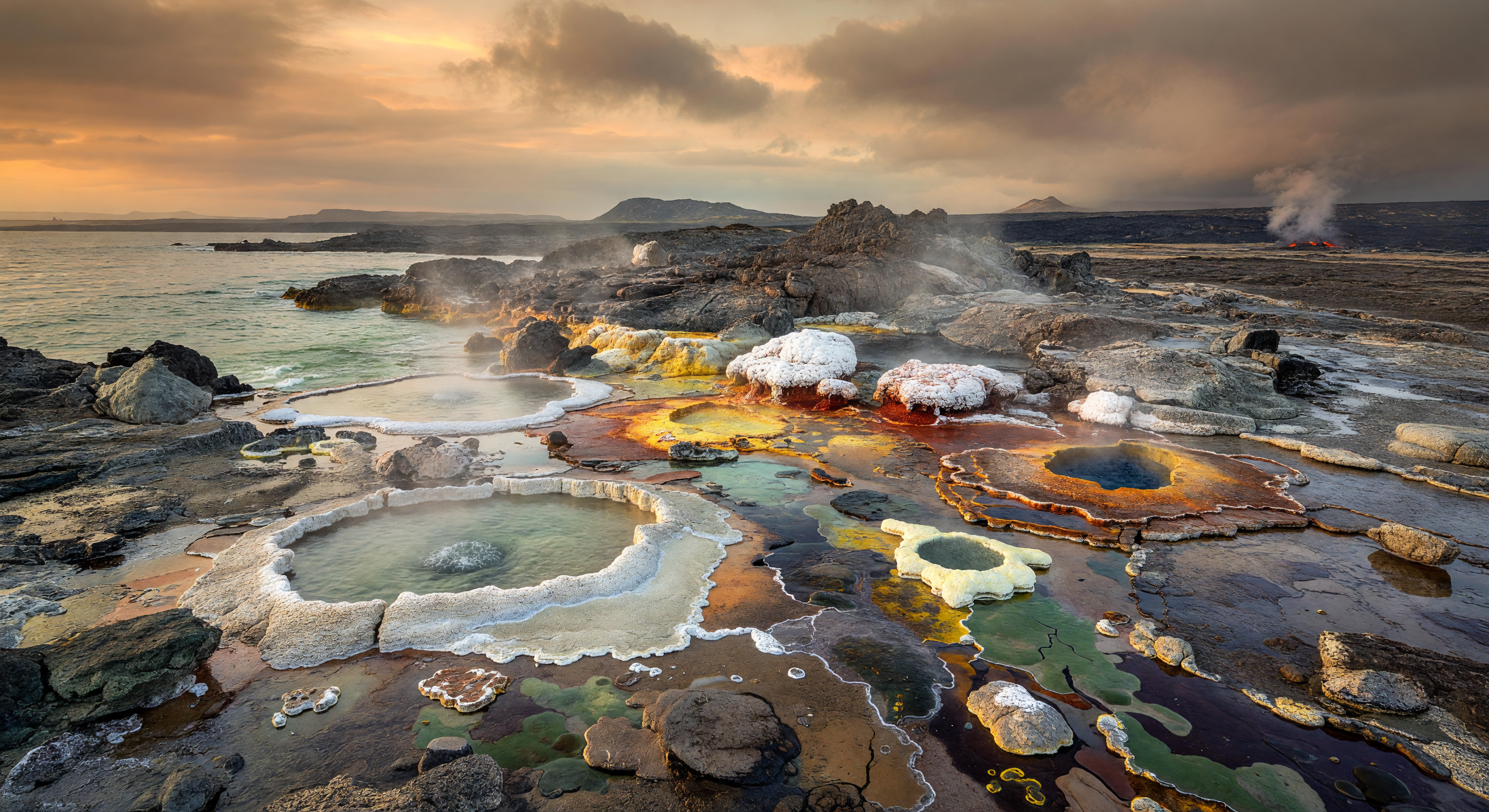
Around 3.2–2.8 billion years ago, an Archean craton margin may have looked like this: bare TTG granitoids and dark greenstone–komatiite rocks cut by steaming silica-rich hot springs, fumaroles, and shallow runoff channels. White siliceous sinter, red iron oxides, and yellow sulfur crust the hydrothermal ground, while life is represented only by thin microbial films clinging to persistently wet surfaces around the pools. Under a hazy, oxygen-poor sky, these emerging continental landscapes record some of Earth’s earliest stable land and the intimate link between volcanism, hydrothermal activity, and microbial ecosystems.
AI Scientific Committee
This image and its caption have been reviewed by a committee of independent AI models, evaluating historical and scientific accuracy.
Claude
Image:
Adjust
Caption:
Approved
Mar 24, 2026
The image does an impressive job conveying the essential character of an Archean craton margin: barren rocky terrain, active hydrothermal pools with mineral precipitates, steam and fumaroles, volcanic activity in the background (what appears to be lava glow at the right horizon), and a complete absence of macroscopic life. The mineral coloration palette — white siliceous sinter rims, red-orange iron oxide staining, yellow sulfurous deposits, and blue-green pool waters — is broadly consistent with what we'd expect from silica-rich hot springs in a reducing to mildly oxidizing hydrothermal environment. The dark mafic rocks could plausibly represent greenstone-komatiite lithologies, and lighter-toned rocks could stand in for TTG granitoids. The distant volcanic peaks and active lava flow effectively communicate the more volcanically active Archean Earth.
However, I share the GPT reviewer's concern that the scene reads too much like a modern Icelandic or Dallol-style geothermal field. Several specific issues warrant adjustment. First, the sky, while hazy and overcast, still shows too much blue-tinged clarity near the horizon and familiar cloud structures. The Archean atmosphere, dominated by N₂, CO₂, and CH₄ with negligible free oxygen, would likely produce a more persistently orange-to-greenish haze, with possible hydrocarbon aerosol effects reducing visibility. Second, the ocean water appears too blue-green and clear; Archean seawater was likely iron-rich and would have had a distinctly greenish or even murky character, with no modern-looking wave transparency. Third, the vivid banding colors around the pools — particularly the brilliant turquoise and deep blue — are in modern settings often strongly influenced by thermophilic microbial mats and modern water chemistry; for the Archean, the color palette might be somewhat more muted or dominated more by iron and sulfur tones. The neatly terraced pool morphology also looks very Yellowstone-like, which is shaped partly by specific modern microbial and chemical conditions.
The caption is scientifically sound and well-crafted. The geological terminology is accurate: TTG granitoids and greenstone-komatiite associations are indeed the hallmark lithologies of Archean cratons, and silica-rich hot springs with sinter deposits, iron oxides, and native sulfur are all geologically reasonable features for such a setting. The reference to microbial films on wet surfaces is appropriately restrained — we have evidence for microbial life in Archean hydrothermal settings from stromatolites and isotopic signatures, but not for anything more complex. The hedging language ('may have looked like this') is responsible. The connection drawn between volcanism, hydrothermal activity, and early microbial ecosystems reflects current scientific thinking about potential cradles of early life. I agree with the GPT reviewer that the caption merits approval while the image needs modest atmospheric and color-palette adjustments to better distinguish this scene from a modern analog.
However, I share the GPT reviewer's concern that the scene reads too much like a modern Icelandic or Dallol-style geothermal field. Several specific issues warrant adjustment. First, the sky, while hazy and overcast, still shows too much blue-tinged clarity near the horizon and familiar cloud structures. The Archean atmosphere, dominated by N₂, CO₂, and CH₄ with negligible free oxygen, would likely produce a more persistently orange-to-greenish haze, with possible hydrocarbon aerosol effects reducing visibility. Second, the ocean water appears too blue-green and clear; Archean seawater was likely iron-rich and would have had a distinctly greenish or even murky character, with no modern-looking wave transparency. Third, the vivid banding colors around the pools — particularly the brilliant turquoise and deep blue — are in modern settings often strongly influenced by thermophilic microbial mats and modern water chemistry; for the Archean, the color palette might be somewhat more muted or dominated more by iron and sulfur tones. The neatly terraced pool morphology also looks very Yellowstone-like, which is shaped partly by specific modern microbial and chemical conditions.
The caption is scientifically sound and well-crafted. The geological terminology is accurate: TTG granitoids and greenstone-komatiite associations are indeed the hallmark lithologies of Archean cratons, and silica-rich hot springs with sinter deposits, iron oxides, and native sulfur are all geologically reasonable features for such a setting. The reference to microbial films on wet surfaces is appropriately restrained — we have evidence for microbial life in Archean hydrothermal settings from stromatolites and isotopic signatures, but not for anything more complex. The hedging language ('may have looked like this') is responsible. The connection drawn between volcanism, hydrothermal activity, and early microbial ecosystems reflects current scientific thinking about potential cradles of early life. I agree with the GPT reviewer that the caption merits approval while the image needs modest atmospheric and color-palette adjustments to better distinguish this scene from a modern analog.
Grok
Image:
Adjust
Caption:
Approved
Mar 24, 2026
The image effectively captures the essence of an Archean craton margin with barren rocky terrain, hydrothermal pools steaming with vents, colorful mineral precipitates (white siliceous sinter, red iron oxides, yellow sulfur crusts), dark mafic/volcanic rocks suggestive of greenstone-komatiite associations, and a complete absence of macroscopic life or vegetation, which is highly appropriate for 3.2–2.8 Ga. Subtle thin films on wet surfaces plausibly represent early microbial mats, and background volcanism adds geological realism. The overall composition is visually coherent and evokes a primordial, hostile landscape tied to plate tectonic emergence and hydrothermal systems.
However, adjustments are needed for full accuracy. The hydrothermal pools are overly terraced and vividly stratified like modern Icelandic or Yellowstone sinter flats, which are influenced by contemporary atmospheric O2 levels and denser microbial communities; Archean versions would likely be less organized, more chaotic from intense volcanism. The sky, while hazy, retains too much blue hue and clarity— an anoxic Archean atmosphere (high CO2, CH4, N2, volcanic aerosols) should appear thicker, more orange-red from Rayleigh scattering absence and haze. Ocean/shallow water is unrealistically turquoise; early seas were likely iron-rich and greenish-murky. Rock exposures blend generically dark volcanics without distinct pale TTG granitoids (tonalitic gneisses, lighter gray-pink), missing a key caption element.
The caption is exemplary: factually precise on TTG-greenstone geology, hydrothermal minerals, timeframe (e.g., Pilbara/Kaapvaal cratons), microbial scale, and oxygen-poor haze. Cautious phrasing ('may have looked like') avoids overconfidence amid sparse direct evidence, while contextualizing volcanism-microbe links supported by Archean cherts/stromatolites. No misleading claims; detail level is educational and period-appropriate.
I fully agree with GPT and Claude on image 'adjust' (modern geothermal aesthetic, sky/water issues) and caption 'approve'. They aptly flagged Icelandic vibes and rock indistinction; I concur on green tones potentially overreading as algae (though subtle here) but note they underemphasized TTG visibility—crucial for 'emerging continents.' No major misses; their nuance on anoxic haze is spot-on, warranting prompt refinements like 'hazer orange-red sky, murky iron-green waters, chaotic pools, pale granitoid outcrops amid dark komatiites.'
However, adjustments are needed for full accuracy. The hydrothermal pools are overly terraced and vividly stratified like modern Icelandic or Yellowstone sinter flats, which are influenced by contemporary atmospheric O2 levels and denser microbial communities; Archean versions would likely be less organized, more chaotic from intense volcanism. The sky, while hazy, retains too much blue hue and clarity— an anoxic Archean atmosphere (high CO2, CH4, N2, volcanic aerosols) should appear thicker, more orange-red from Rayleigh scattering absence and haze. Ocean/shallow water is unrealistically turquoise; early seas were likely iron-rich and greenish-murky. Rock exposures blend generically dark volcanics without distinct pale TTG granitoids (tonalitic gneisses, lighter gray-pink), missing a key caption element.
The caption is exemplary: factually precise on TTG-greenstone geology, hydrothermal minerals, timeframe (e.g., Pilbara/Kaapvaal cratons), microbial scale, and oxygen-poor haze. Cautious phrasing ('may have looked like') avoids overconfidence amid sparse direct evidence, while contextualizing volcanism-microbe links supported by Archean cherts/stromatolites. No misleading claims; detail level is educational and period-appropriate.
I fully agree with GPT and Claude on image 'adjust' (modern geothermal aesthetic, sky/water issues) and caption 'approve'. They aptly flagged Icelandic vibes and rock indistinction; I concur on green tones potentially overreading as algae (though subtle here) but note they underemphasized TTG visibility—crucial for 'emerging continents.' No major misses; their nuance on anoxic haze is spot-on, warranting prompt refinements like 'hazer orange-red sky, murky iron-green waters, chaotic pools, pale granitoid outcrops amid dark komatiites.'
Gemini
Image:
Adjust
Caption:
Approved
Mar 24, 2026
The image captures the essential elements of an Archean hydrothermal landscape—barren rock, mineral-rich pools, and volcanic activity—but it suffers from a 'modern Earth' aesthetic that compromises its scientific accuracy. I concur with the previous reviewers that the sky and water are too blue and clear; an Archean atmosphere, rich in methane and carbon dioxide but lacking oxygen, would likely produce a thick orange or greenish haze. The turquoise water is characteristic of modern oxygenated shallow seas, whereas Archean oceans were likely iron-rich and greenish. Furthermore, the rock lithologies are too uniform; the image fails to clearly distinguish between the pale, silica-rich TTG granitoids and the dark greenstone-komatiite rocks mentioned in the caption. The caption itself is excellent, using precise geological terminology and appropriately cautious language to describe one of Earth's earliest stable land environments and its associated microbial ecosystems.
Matania
Summary
Image:
Adjust
Caption:
Approved
The committee is unanimous that the image is broadly on target in subject matter but needs refinement for period authenticity. Reviewers agree it successfully depicts an Archean hydrothermal craton-margin setting through barren rocky terrain, steaming vents, silica- and sulfur-rich hot spring deposits, iron-stained surfaces, volcanic activity, and the complete absence of plants and animals. These are all appropriate visual cues for an emergent Archean continental landscape tied to volcanism and hydrothermal systems. The caption also received unanimous approval: it is scientifically careful, uses accurate geological terminology, and appropriately limits life to thin microbial films while framing the scene as a plausible reconstruction rather than a certainty.
The main issue is that the image reads too strongly as a modern geothermal landscape, especially an Icelandic, Yellowstone, or Dallol analog. Across all four reviews, the strongest points of consensus were that the pools are too neatly terraced and vividly banded, the water is too blue-turquoise and clear, and the sky remains too visually familiar and oxygen-rich in tone. Reviewers also agreed that the bedrock should more clearly distinguish lighter TTG granitoids from darker greenstone-komatiite rocks, since that contrast is important to the caption's stated setting. The final verdict is therefore to adjust the image, not regenerate it, because the scene's core composition and geological logic are sound and only need targeted corrections to look less modern and more Archean.
The main issue is that the image reads too strongly as a modern geothermal landscape, especially an Icelandic, Yellowstone, or Dallol analog. Across all four reviews, the strongest points of consensus were that the pools are too neatly terraced and vividly banded, the water is too blue-turquoise and clear, and the sky remains too visually familiar and oxygen-rich in tone. Reviewers also agreed that the bedrock should more clearly distinguish lighter TTG granitoids from darker greenstone-komatiite rocks, since that contrast is important to the caption's stated setting. The final verdict is therefore to adjust the image, not regenerate it, because the scene's core composition and geological logic are sound and only need targeted corrections to look less modern and more Archean.
Other languages
- Français: Sources hydrothermales archéennes avec frittage blanc et soufre
- Español: Fuentes hidrotermales arcaicas con sílice blanca y azufre
- Português: Fontes hidrotermais arqueanas com sílica branca e enxofre
- Deutsch: Archaische Hydrothermalquellen mit weißem Sinter und Schwefel
- العربية: ينابيع حرارية أركية مع ترويسبات سيليكا وكبريت
- हिन्दी: सफेद सिंटर और सल्फर के साथ आर्कियन हाइड्रोथर्मल झरने
- 日本語: 白い焼結鉱と硫黄がある始生代の熱水泉
- 한국어: 흰색 신터와 황이 있는 시생누대 열수구
- Italiano: Sorgenti idrotermali archeane con sinterizzazione bianca e zolfo
- Nederlands: Archeïsche hydrothermale bronnen met wit sinter en zwavel
That said, the image should be adjusted rather than fully approved because it looks somewhat too modern and Icelandic in character. The pools are very neatly terraced and vividly colored in a way reminiscent of present-day silica-sinter hot spring fields shaped by modern atmospheric chemistry and often by abundant microbial mats; for the Archean, some of those colors and textures may be overstated or too aesthetically modern. The open blue-green water and relatively familiar cloud-lit sky also feel a bit too Earth-modern for an oxygen-poor Archean atmosphere, which would likely be hazier and less visually crisp. In addition, while coastlines and shallow seas certainly existed, the scene could better emphasize TTG granitoid exposures and komatiitic/greenstone associations if that is the intended craton-margin setting.
The caption is strong and scientifically responsible. Its use of cautious wording such as 'may have looked like this' is appropriate, and the geological references to TTG granitoids, greenstone-komatiite rocks, silica-rich hot springs, fumaroles, sinter, iron oxides, sulfur, and microbial films are all broadly consistent with what is plausible for Archean emerging continental environments. It also correctly avoids introducing land plants, animals, or more complex terrestrial biota that would be grossly anachronistic.
The caption’s framing of these landscapes as some of Earth’s earliest stable land and as recording the connection between volcanism, hydrothermal activity, and microbial ecosystems is appropriate. If anything, one could refine it slightly by noting that direct evidence for extensive subaerial Archean landscapes remains patchy and debated in some cases, but this is a minor nuance rather than a factual problem. Overall, the caption is accurate and well calibrated, while the image would benefit from prompt refinement toward a less overtly modern geothermal aesthetic and a more Archean-looking atmosphere and bedrock context.